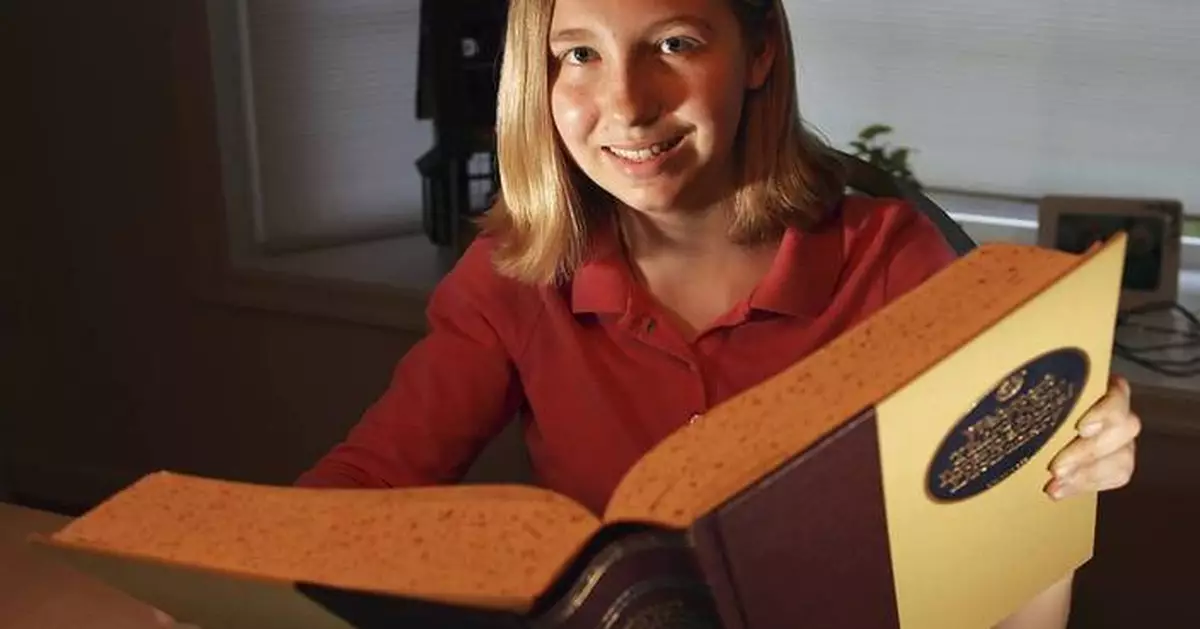
Joanne Lagatta arrived at the University of Wisconsin in 1995 with a flawless academic record and an achievement on her resumé that she didn't like to talk about — but that no other undergrad on the sprawling Madison campus could claim: Scripps National Spelling Bee champion.
The bee winner in 1991 at age 13, Lagatta nonetheless struggled adjusting to life outside her rural hometown of Clintonville, Wisconsin — until she got a push from a professor who was a devoted spelling-bee fan.
Click to Gallery
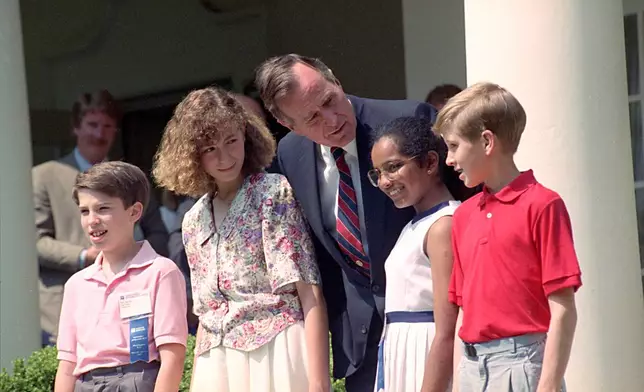
FILE - President George Bush meets with winners of the National Spelling Bee at the White House, May 31, 1991, including 13-year-old winner Joanne Lagatta, left, of Clintonville, Wisc., Maria Mathew, 11, of Sterling, Ill., and Todd Wallace, 13, of Blackfoot, Idaho. Boy at left is unidentified. (AP Photo/Barry Thumma, File)
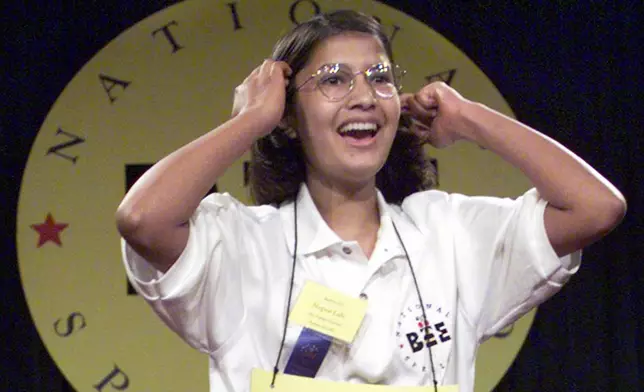
FILE – In this June 3, 1999 file photo Nupur Lala, 14, from Tampa, Fla. reacts upon winning the 72nd annual National Spelling Bee in Washington after correctly spelling "logorrhea." (AP Photo/Ron Edmonds, File)
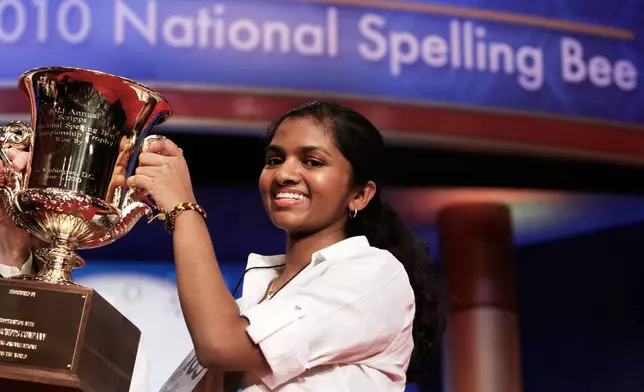
FILE - Anamika Veeramani, 14, of North Royalton, Ohio, holds her trophy after winning the 2010 National Spelling Bee in Washington, June 4, 2010. (AP Photo/Jacquelyn Martin, File)
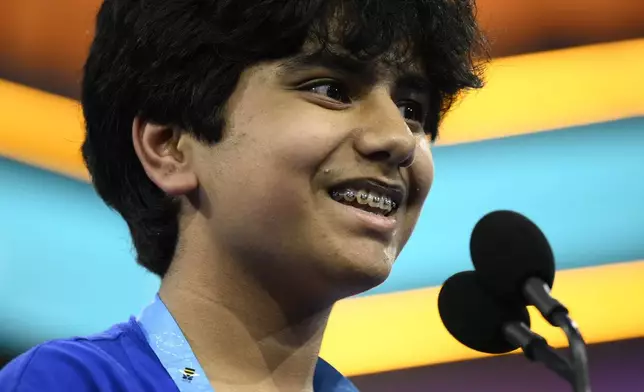
FILE - Dev Shah, 14, from Largo, Fla., competes during the Scripps National Spelling Bee finals, June 1, 2023, in Oxon Hill, Md. (AP Photo/Nick Wass, File)
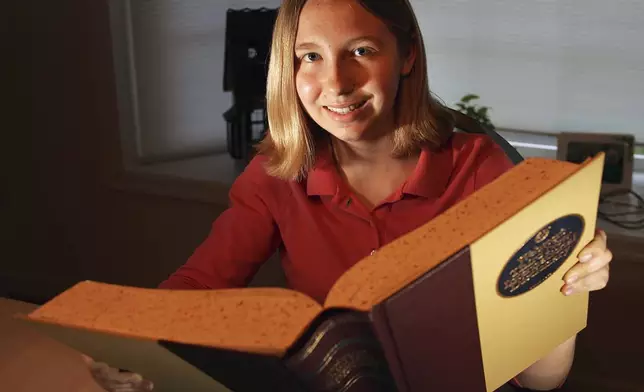
FILE - Katharine "Kerry" Close, 13, poses at home in Spring Lake, N.J., May 24, 2006. (AP Photo/Tim Larsen, File)
“I went in thinking I was a smart kid who had won a National Spelling Bee, and I must be able to compete with the highest-level academic kids. I signed up for a bunch of advanced classes I clearly had no place being in. I thought I was going to fail my chemistry class,” Lagatta says. “I went to my professor. He stared me down and said, ‘I know who you are. I know what you’re capable of. You are not failing my class.' He pushed me through that class. I certainly didn't get an A, but I didn't fail.”
Lagatta, now 47, turned out fine. She's a neonatologist at Children's Wisconsin, a hospital in Milwaukee. And like many former champions of the National Spelling Bee — which celebrates its 100th anniversary when it starts Tuesday at a convention center outside Washington — she says the competition changed her life for the better because it taught her she could do hard things.
Winners of the spelling bee aren't celebrities, exactly. Those who competed before it was televised by ESPN — it now airs on Scripps-owned ION — aren't often recognized by strangers. But they have to accept being known forever for something they accomplished in middle school. Google any past bee champion, and it's one of the first things that pops up.
Many past champions have remained involved with the bee. Jacques Bailly, the 1980 champion, is the bee's longtime pronouncer. Paige Kimble, who won a year later, ran the bee as executive director from 1996-2020. Vanya Shivashankar, the 2015 co-champ, returns each spring as master of ceremonies, and her older sister, Kavya, is one of several former champs on the panel that selects words for the competition.
Even for those former champs who've moved on entirely, the competition has remained a cornerstone of their lives. The Associated Press spoke to seven champs about their membership in this exclusive club.
Anamika Veeramani, the 2010 champion, graduated from Yale in three years and got her medical degree at Harvard. A resident in plastic and reconstructive surgery at Johns Hopkins Hospital in Baltimore, she is training to become a craniofacial surgeon, and the focused and disciplined approach that led her to the spelling bee title has been a throughline in her life since.
“You attain a level of mastery over a subject that you wouldn't have otherwise, and that feeling of mastery is very similar across fields,” the 29-year-old Veeramani says. “Once you know a subject well enough, you're able to really just play with that subject and and come up with things, and there's just a joy and delight in what you're doing. ... I'm going to spend the rest of my career in surgery chasing that.”
Molly Baker was never uncomfortable about her past as the 1982 spelling-bee champion, and in the right context, she's happy to bring it up — as an icebreaker or a standout line on her resumé.
“Oh, I was never cool,” Baker says. “I knew people who were state tennis champs, and they were, you know, in their own way equally as nerdy. I would always joke about it, that I was queen of the dorks.”
Baker, 55, worked as a staff writer at the Wall Street Journal and wrote a book, “High Flying Adventures in the Stock Market.” She's now a freelance journalist, and she says there's no question her spelling bee title helped her career.
“One summer in college I was an intern at, it was called ‘Real Life with Jane Pauley.’ It was an evening magazine TV news show,” Baker says. “And that, I'm sure, was partly a result of having been interviewed on the ‘Today’ show by Jane Pauley in 1982. I was not shy about saying that when I applied.”
Jon Pennington knew he was socially awkward when he won the bee in 1986. He even wore his mother's bulky sunglasses on the bee stage because the bright lights bothered him.
When he was 40, he was diagnosed with autism, a condition he proudly embraces.
“I did not win the National Spelling Bee in spite of my autism. I did not win the National Spelling Bee by triumphing over my autism. I won the National Spelling Bee because of my autism,” the 53-year-old Pennington says. “For me, it almost felt like if you hear a chord played on a piano but there's a dissonant note in that chord, that's what it felt like when you came across a misspelling.”
Pennington, who lives in Minneapolis with his wife and dog, worked for years in corporate human resources and is now working as a writer, collaborating on an as-yet unpublished biography of songwriter Eden Ahbez. He still loves academic competitions and word games, and he has had crossword puzzles published by the Atlantic, The Wall Street Journal and the Los Angeles Times.
Even among spelling champions, Nupur Lala's name inspires reverence and awe. Her victory in 1999 was later chronicled in a documentary, “Spellbound,” and she kicked off a quarter-century of Indian Americans dominating the bee. That doesn't mean it was easy to be known for her linguistic brilliance.
“One thing that really stood out about John (Masko), my very soon-to-be husband: Every man I had dated before never wanted to play any sort of word game with me. They would avoid doing the crossword puzzle, refused to play Scrabble,” the 40-year-old Lala says. “I realized this man was special among so many reasons because he was the first man who was willing to play Scrabble with me consistently, and now I would say we're pretty even in Scrabble ability.”
At this point, Masko chimes in via speakerphone: “She's still much better at crossword puzzles!”
Lala works as a neuro-oncologist at Dartmouth Health in Lebanon, New Hampshire. She prescribes chemotherapy and coordinates management of brain and spine tumors. And she has a theory about why spelling champions pursue medicine or neuroscience — because they're already intrigued by how the brain works.
“One thing I was really fascinated by after participating in spelling bees is eidetic memory. Things you've seen in the past flash as pictures in your head, and that occurred for me during the spelling bee,” Lala says. “When I went to medical school, I didn't expect this at all, I picked neurology because I was so interested in preserving faculties like language that really make people who they are.”
Kerry Close Guaragno won the 2006 bee in her fifth appearance at nationals and learned plenty about perseverance along the way.
“Looking at these kids who seemed so smart and so experienced, it seemed almost incomprehensible that I could win the competition one day,” said the 32-year-old Guaragno, who works for Group Gordon, a New York City-based public relations firm.
“I'm an endurance runner now. I do half marathons and marathons, and I qualified for the Boston Marathon earlier this year," she says. "Starting out running marathons and not being able to break four hours, and now qualifying for Boston, I learned the mindset and process of how to do that from the spelling bee.”
Of the many perks that came with winning the bee, 16-year-old Dev Shah, the victor two years ago, is most proud that he got an op-ed published in The Washington Post about how the bee taught him to take risks and accept the results.
During the 2023 bee, Shah spelled “rommack,” a word with an unknown language of origin that he had never seen before.
“The 40 seconds I spent spelling ‘rommack’ exhibited the traits of a champion rather than a good speller,” Shah says. “That’s what makes the spelling bee very special. It tests way more than just spelling. It tests critical thinking, risk-taking and poise.”
Because he passed those tests, Shah says he’s at peace with being forever recognized as a spelling champion, but adds: “I really hope that it’s not the only thing I’m known as for the rest of my life.”
Ben Nuckols has covered the Scripps National Spelling Bee since 2012. Follow his work here.
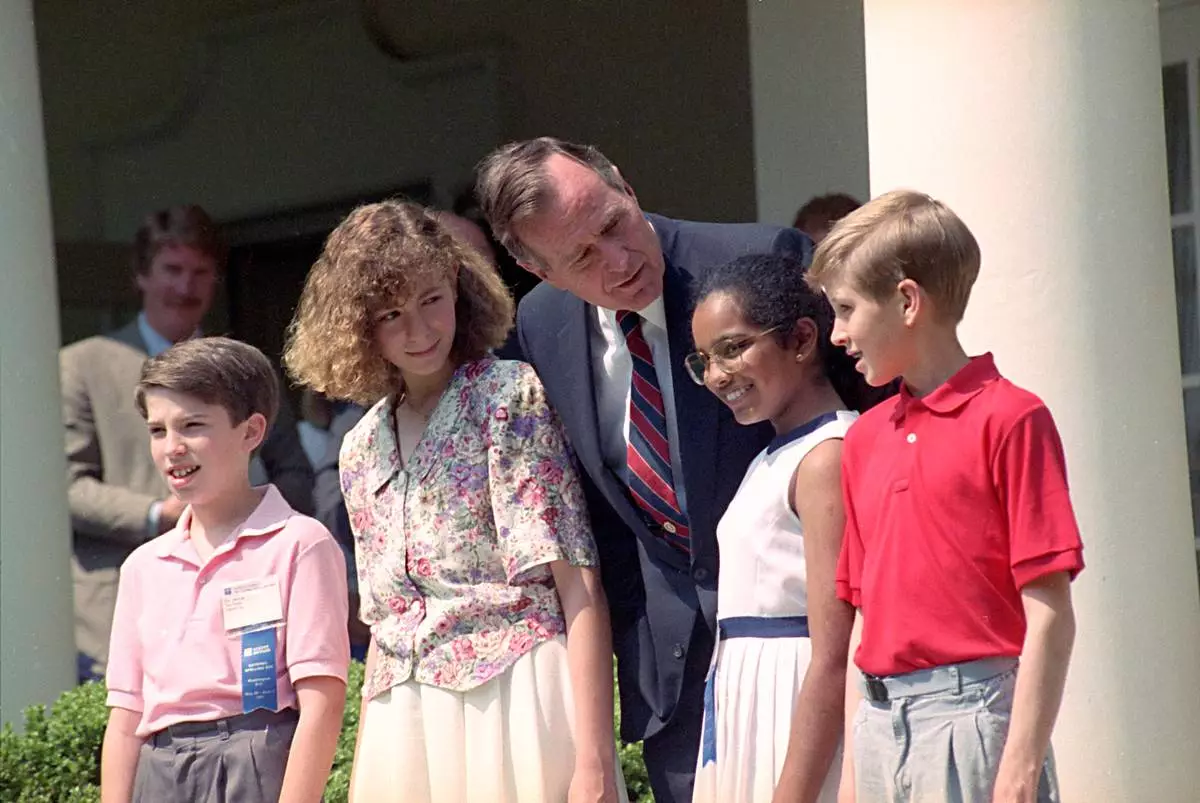
FILE - President George Bush meets with winners of the National Spelling Bee at the White House, May 31, 1991, including 13-year-old winner Joanne Lagatta, left, of Clintonville, Wisc., Maria Mathew, 11, of Sterling, Ill., and Todd Wallace, 13, of Blackfoot, Idaho. Boy at left is unidentified. (AP Photo/Barry Thumma, File)

FILE – In this June 3, 1999 file photo Nupur Lala, 14, from Tampa, Fla. reacts upon winning the 72nd annual National Spelling Bee in Washington after correctly spelling "logorrhea." (AP Photo/Ron Edmonds, File)
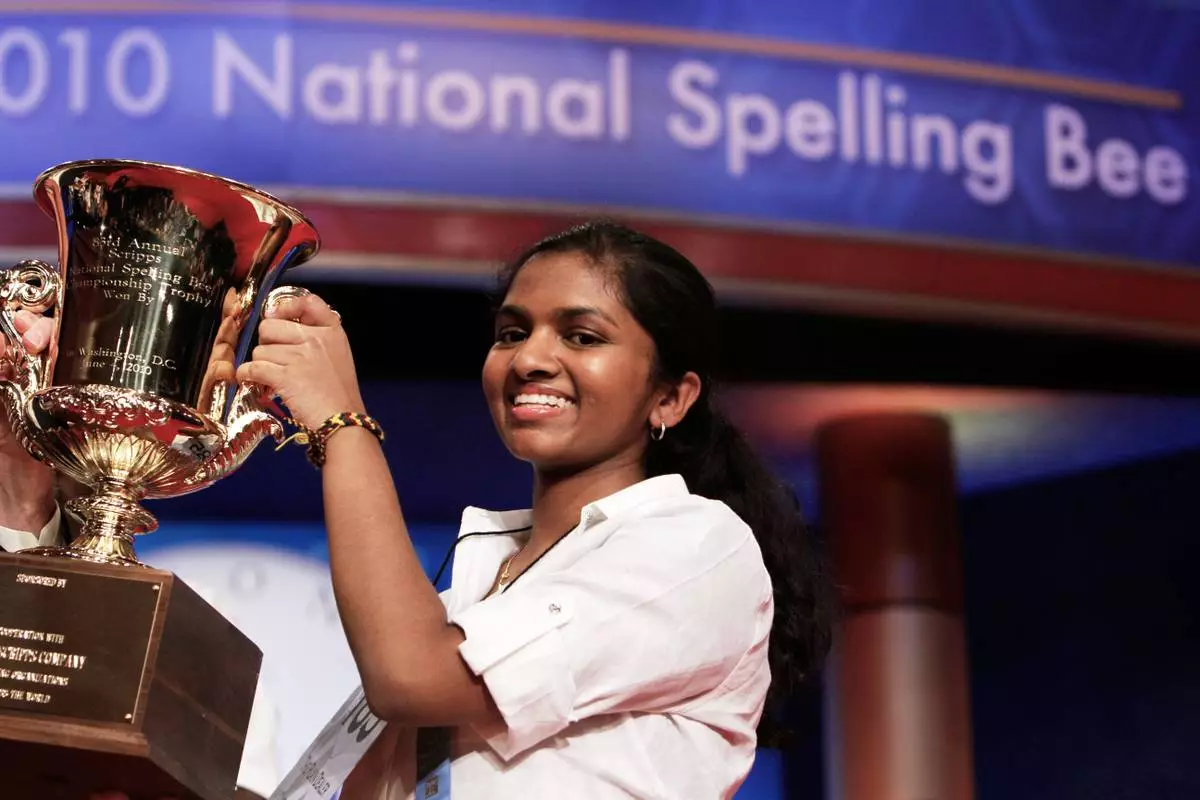
FILE - Anamika Veeramani, 14, of North Royalton, Ohio, holds her trophy after winning the 2010 National Spelling Bee in Washington, June 4, 2010. (AP Photo/Jacquelyn Martin, File)
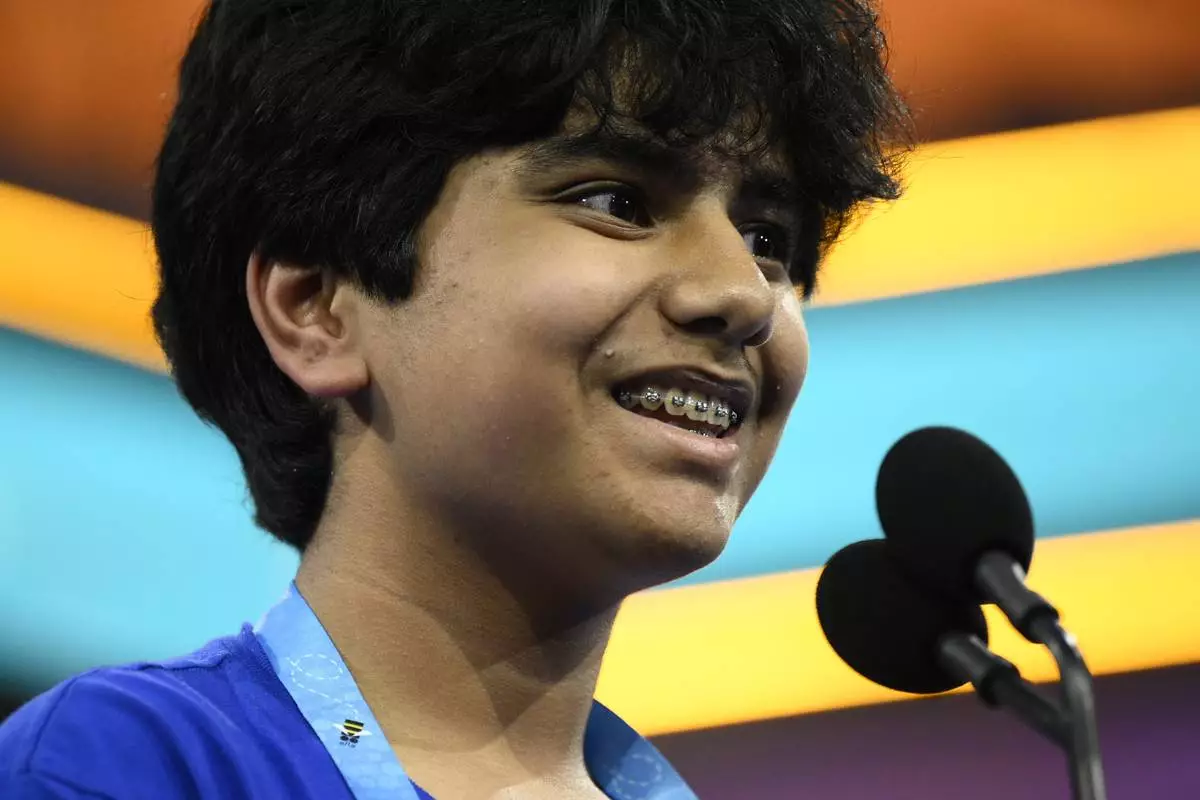
FILE - Dev Shah, 14, from Largo, Fla., competes during the Scripps National Spelling Bee finals, June 1, 2023, in Oxon Hill, Md. (AP Photo/Nick Wass, File)

FILE - Katharine "Kerry" Close, 13, poses at home in Spring Lake, N.J., May 24, 2006. (AP Photo/Tim Larsen, File)