Skip to Content Facebook Feature Image

Global transport resilience requires forward-looking policies and sci-tech innovation: ITF secretary-general

China

China

China

Global transport resilience requires forward-looking policies and sci-tech innovation: ITF secretary-general

2025-05-26 19:45 Last Updated At:20:07

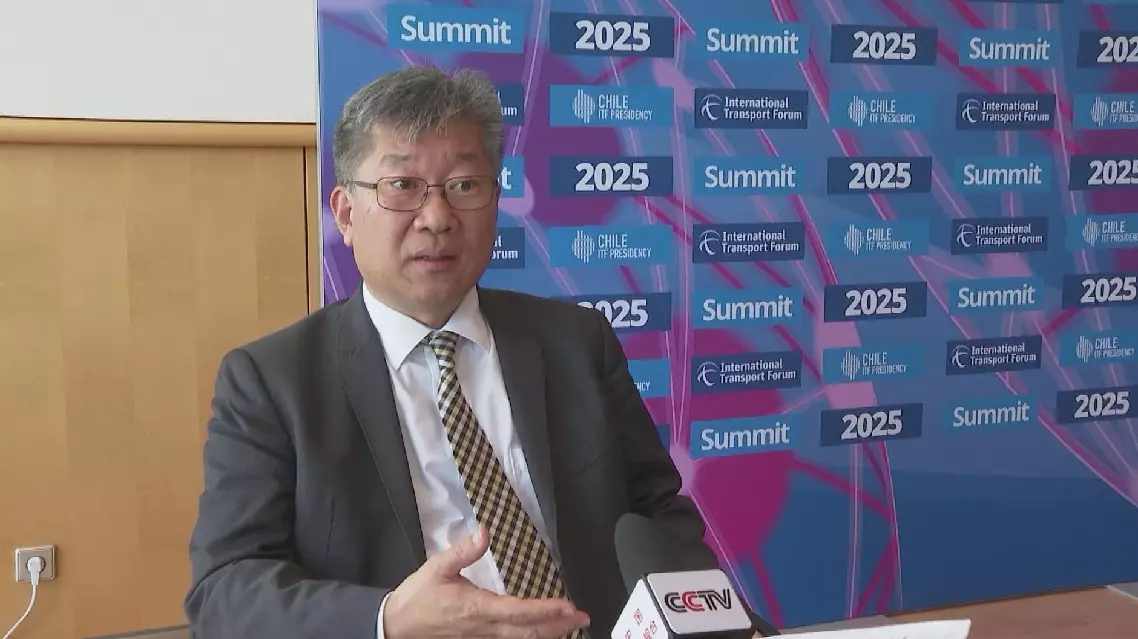
Forward-looking policies and sci-tech-driven innovation are crucial for enhancing global transportation resilience, said Young Tae Kim, Secretary-General of the International Transport Forum (ITF), during the ITF 2025 Summit in Leipzig, Germany, held from May 21–23. 

Kim highlighted unprecedented pressures on the transport system, pointing to threats such as cyberattacks, geopolitical conflicts, and natural disasters. He stressed the need for effective planning to boost resilience against global shocks.

"When we are exposed to the kind of threats, our transport system can easily break down. And once there is something wrong with our infrastructure, and we have to immediately restore it to have an immediate recovery of the system. And then from the planning stage, we can already consider those kind of things," he said.

Kim noted that China's policy continuity and sci-tech innovation in transportation have provided useful experience for promoting sustainable development of the global transport system.

"China has maintained quite a consistent approach. For example, One Belt and One Road. The Chinese government negotiated with many other countries on that route. So I think this kind of efforts that took many years and many decades can really make the system a bit solid and then it makes the system resilient," he said.

"In the case of China, recently, I think that the government and society and academia really cooperated to develop the new technologies in IT. And I think all these efforts combined with government support and also cooperation coming from academia and private sector, and I think it can be really a strong point of Chinese industry and society," Kim continued.

He called for more concerted efforts from ITF members to tackle mounting global issues.

"One country cannot solve any problem, and we are all discussing same questions. So in Africa, in Asia, in Europe, we are discussing decarbonizing transport, and digital issue, and gender issue, and connectivity issues. So I think China and also other members of ITF, they can sit together on this platform of ITF and exchange ideas and develop better policies for future," said Kim.
Global transport resilience requires forward-looking policies and sci-tech innovation: ITF secretary-general


Global transport resilience requires forward-looking policies and sci-tech innovation: ITF secretary-general
In his new year's call to world leaders, UN Secretary-General Antonio Guterres on Monday urged world leaders to get "priorities straight" and invest in development, not destruction.

"As we enter the new year, the world stands at a crossroads. Chaos and uncertainty surround us. Division. Violence. Climate breakdown. And systemic violations of international law. A retreat from the very principles that bind us together as a human family. People everywhere are asking: Are leaders even listening? Are they ready to act?" Guterres said in his New Year message for 2026.

The scale of global suffering remains severe. More than one-quarter of humanity lives in conflict-affected areas, over 200 million people require humanitarian assistance, and nearly 120 million have been forcibly displaced by war, crises, disasters or persecution, according to UN statistics.

"As we turn the page on a turbulent year, one fact speaks louder than words: Global military spending has soared to 2.7 trillion dollars, growing by almost 10 percent. That is thirteen times more than all development aid, equivalent to the entire Gross Domestic Product of Africa. All, while conflict rages at levels unseen since World War II. On this new year, let's resolve to get our priorities straight. A safer world begins by investing more in fighting poverty and less in fighting wars," said the UN chief.

A UN report released in September 2025 showed that rising military spending comes at a high opportunity cost, noting that less than 4 percent of current global military expenditure could end world hunger by 2030, just over 10 percent could vaccinate every child worldwide, and reallocating 15 percent would be sufficient to cover annual climate adaptation costs in developing countries.

"Peace must prevail. It's clear the world has the resources to lift lives, heal the planet, and secure a future of peace and justice. In 2026, I call on leaders everywhere: Get serious. Choose people and planet over pain. And I urge everyone who hears this message: Play your part. Our future depends on our collective courage to act. This new year, let‘’s rise together: For justice. For humanity. For peace," he said.

UN chief issues New Year's call to world leaders for peace, development

UN chief issues New Year's call to world leaders for peace, development

Recommended Articles