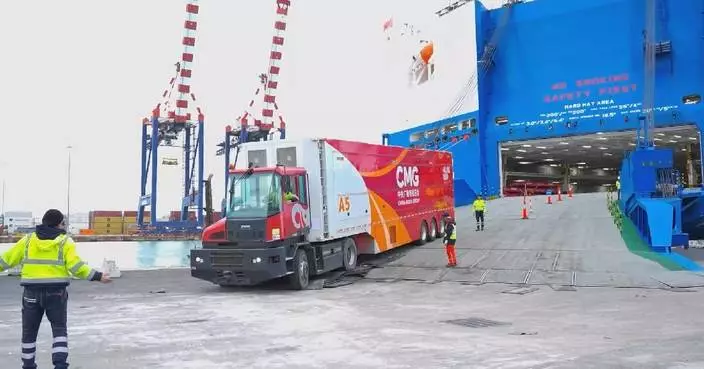
Bookings for containerships from China to the United States have soared as American importers rush to bring Chinese products stateside before the 90-day tariff truce ends.
According to a joint statement released by the world's two largest economies following the meeting on May 12, both sides agreed to a 90-day tariff pause, during which U.S. tariffs on Chinese imports will be reduced from 145 percent to 30 percent, while Chinese tariffs on U.S. goods will be cut from 125 percent to 10 percent.
Enterprises operating U.S.- and Canada-bound ocean cargo routes became the "top stars" at the third International Supply Chain Logistics Exposition. Held in Shanghai from May 21 to 23, the event brought together nearly 300 companies involved in water, rail and air transportation.
"Our main business is logistics to the United States and Canada. There were about 80 to 90 people coming for consultation in the morning," said an exhibitor.
Freight forwarder Zhang Wei went to the expo to help U.S. clients find space on containerships. However, with importers scrambling to resume orders and shipments after tariff adjustment measures came into effect, cargo carriers have become very scarce.
"Our major clients need 20 to 30 high cube containers on a freight ship, but there are actually only five or six high cube containers left now. Currently, it's extremely difficult to get shipping space on U.S.-bound routes," said Zhang.
A logistics company said its earliest available freight ships bound for the U.S. are scheduled for mid- to late June.
"The container space on route to the U.S. West Coast can only be reserved for departures around June 10, as all those before June 5 are fully booked," said an employee of an international cargo carrier.
A Guangzhou-based logistics company said that the shipping schedule from the end of May to the beginning of June had been snapped up.
"We received almost 200 groups of clients today. The current orders are estimated to be scheduled until mid-June. The shipping space is still extremely scarce," said Lai Xinling, the company's business manager.
Industry insiders believe that it will be difficult to balance supply and demand in the short term, and it is estimated that it will take about one month for transportation capacity to recover.
Many shipping companies are adjusting their routes, reallocating their surplus capacity to U.S.-bound routes.
"For example, we temporarily transferred one or two ships from the South American route to the U.S. route to increase capacity," said the manager of an international logistics company.
Many overseas warehousing enterprises are also exploiting resources to help traders stock more goods within the window period.
"We have warehouses in the central, eastern and western parts of the United States. We have contacted the idle warehouses in the surrounding parks and have been replenishing the storage capacity, hoping to help the sellers take advantage of the dividends during this window period," said Yu Ruixue, major account manager of Shiro Technology.

Shipping route to US overbooked as 90-day tariff window spurs surging demand
The U.S. military strike against Venezuela and capture of its president, Nicolas Maduro, has shocked the international community, triggering a steady stream of condemnation and serious concerns worldwide.
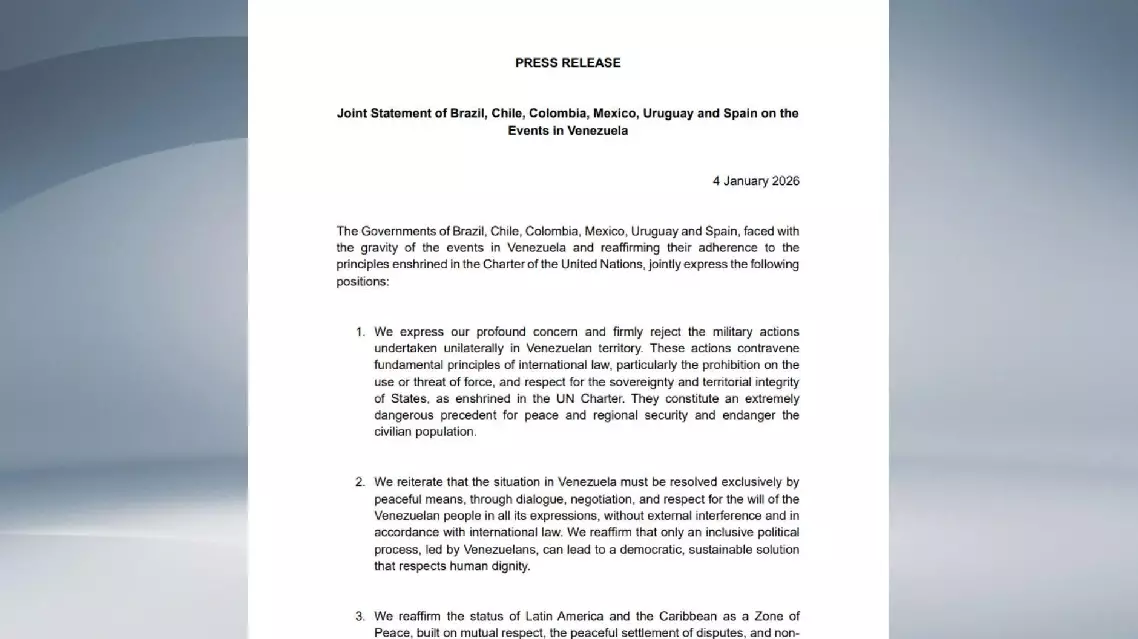
Brazil, Chile, Colombia, Mexico, Uruguay and Spain issued a joint statement on Sunday, expressing serious concern about and firm opposition to the U.S. unilateral military operations in Venezuela.
The U.S. actions contravene fundamental principles of international law, particularly the prohibition on the use or threat of force, and respect for the sovereignty and territorial integrity of States, as enshrined in the UN Charter, constituting an extremely dangerous precedent against peace and regional security, according to the statement.
In expressing profound concern and firm rejection, the six countries stressed in the statement that the situation in Venezuela must be resolved exclusively by peaceful means, and through dialogue, negotiation and respect for the will of the Venezuelan people in all its expressions, without external interference and in accordance with international law.
Only an inclusive political process, led by Venezuelans, can lead to a democratic, sustainable solution that respects human dignity, according to the statement.
Spanish Prime Minister Pedro Sanchez condemned the U.S. raid in Venezuela as a violation of international law, adding that the Spanish government always advocates and defends international law and peaceful resolution of conflicts.
Addressing a meeting of the Community of Latin American and Caribbean States (CELAC), Cuban Foreign Minister Bruno Rodriguez demanded the unconditional and immediate release of Maduro and his wife.
Noting that Latin America and the Caribbean are a zone of peace, he expressed his firm opposition to the use of force, which is an unshakable principle.
Any aggression against Venezuela shall be regarded as an attack against all CELAC member states, and nations must collectively oppose it, he stressed.
The South African government denounced the U.S. attack on Venezuela as a violation of international law, according to a statement released on Sunday.
History has repeatedly demonstrated that military invasions against sovereign states yield only instability and deepening crisis, the statement said.
South Africa calls on the UN Security Council to urgently convene a session to address this situation, according to the statement.
Serbian President Aleksandar Vucic said what happened in Venezuela demonstrates that international law and the UN Charter are losing their practical effectiveness.
U.S. military action against Venezuela marks a dangerous precedent, as similar actions could be taken against any other nations, he said.
In addition, the foreign ministries of Namibia, Singapore, Oman and Pakistan also issued statements on the same day, expressing grave concern over U.S. interference in Venezuela's internal affairs.
They emphasized the need to uphold international law and the principles of the UN Charter while respecting Venezuela's sovereignty.
They also called on all parties to exercise restraint and resolve the crisis through peaceful dialogue.
U.S. move against Venezuela sparks condemnation, concerns worldwide