TEL AVIV, Israel (AP) — A U.S.-backed group approved by Israel to take over aid distribution in Gaza says it has started operations, despite opposition from the U.N. and most humanitarian groups and the unexpected resignation of its executive director.
The Gaza Humanitarian Foundation is the linchpin of a new aid system that would wrest distribution away from aid groups led by the U.N., which have carried out a massive operation moving food, medicine, fuel, tents and other supplies across Gaza since the war began in October 2023.
The new mechanism limits food distribution to a small number of hubs under guard of armed contractors, where people must go to pick it up. Currently four hubs have been set up, all close to Israeli military positions.
Israel has demanded an alternative plan because it accuses Hamas of siphoning off aid. The United Nations and aid groups deny there is significant diversion. They reject the new mechanism, saying it allows Israel to use food as a weapon, violates humanitarian principles and won’t be effective.
Israel blocked food, fuel, medicine and all other supplies from entering Gaza for nearly three months, pushing the territory toward famine. Last week, it allowed in a trickle of supplies, saying it would let the U.N. distribute it only until GHF was running.
The Hamas-run Interior Ministry on Monday warned Palestinians in Gaza against dealing with GHF.
So, how will this plan work, who’s behind it and why are aid groups pushing back?
GHF said it moved trucks of food to its hubs on Monday and began distribution, without giving details on how much aid was distributed. It said the flow of supplies would be "increasing each day.” It has said it plans to reach more than 1 million Palestinians by the end of the week. Gaza has a population of around 2.3 million.
The Israeli military said two of the four hubs started distributing food, both in the Rafah area in the southernmost end of Gaza, where few Palestinians are located. On Tuesday, thousands of Palestinians walked from tent camps outside the city of Khan Younis, crossing Israeli military lines, to reach the distribution points.
At one point on Tuesday, chaos erupted as Palestinians overwhelmed a hub outside Rafah, breaking through fences. Nearby Israeli troops fired warning shots, sending people fleeing in panic. The military later said the situation was brought under control but at least three injured Palestinians were seen being brought from the scene.
GHF publicly launched early this year and is run by a group of American security contractors, ex-military officers and humanitarian aid officials. It has the support of Israel and the United States.
Until resigning, Jake Wood was the face of the foundation. Wood is a U.S. military veteran and co-founder of a disaster relief group called Team Rubicon. He said Sunday night he was resigning because it was clear the organization would not be allowed to operate independently.
It’s unclear who will now run GHF.
A proposal circulated by the group earlier this month and obtained by the AP included several names, including the former director of the U.N. World Food Program, David Beasley. Neither Beasley nor GHF have confirmed his involvement.
It’s also unclear who is funding GHF. It claims to have more than $100 million in commitments from a European Union government but has not named the donor. The U.S. and Israel have said they are not funding it.
The GHF’s plan to centralize distribution through hubs is similar to ones designed by Israel.
It says each of its initial four hubs would serve meals for roughly 300,000 people. It has said it will eventually be able to meet the needs of 2 million people. It said it will create more hubs within 30 days, including in the north, but did not specify their exact locations.
Aid will be delivered with the help of private subcontractors transporting supplies in armored vehicles from the Gaza border to the hubs, where they will also provide security. It said the aim is to deter criminal gangs or militants from redirecting aid.
One of the hubs is in central Gaza, close to the Netzarim Corridor, a strip of land held by Israeli troops, according to a map issued by the Israeli military. The three others are in the area of Rafah, south of the Morag Corridor, another military-held strip.
Almost the entire population is currently in northern Gaza — where no hub is currently located — or in central Gaza. They would have to cross through Israeli military lines to reach the hubs near Rafah.
Just before his resignation, Wood spoke of some adjustments, but it is not clear if Israel agreed to them.
In a letter to Israeli officials obtained by the AP, Wood said that until at least eight hubs are operating, the existing U.N.-led system will continue providing food in parallel to GHF. He also said the U.N.-led system would continue in the future to distribute all non-food humanitarian aid — everything from medical supplies to hygiene items and shelter materials. GHF was not capable of handling those supplies, Wood acknowledged.
In the letter, sent to Israel’s military body in charge of aid coordination in Gaza, COGAT, Wood said GHF and Israel had agreed on those terms. There was no confirmation from COGAT, however.
The U.N. and aid groups say that the plan would “weaponize aid” for Israel’s military and political purposes.
They say Israel would have power to determine who receives aid and to force the population to move to where it is being distributed, emptying large parts of the territory. That would potentially violate international laws against forced displacement.
“We cannot take part in a system that violates humanitarian principles and risks implicating us in serious breaches of international law,” said Shaina Low, communication adviser for the Norwegian Refugee Council, a leading aid group operating in Gaza.
Last week, Israeli Prime Minister Benjamin Netanyahu said that under the aid mechanism, Gaza’s population would eventually be moved to a “sterile zone” in Gaza’s far south. He said it was for their protection while Israeli forces fight Hamas elsewhere. He also said once the Palestinians enter the area, “they don’t necessarily go back.”
Israel also says that after Hamas is defeated, it will implement a plan proposed by U.S. President Donald Trump to relocate the territory’s population outside Gaza, though it portrays migration as “voluntary.” The Palestinians, along with nearly all of the international community, have rejected the idea.
GHF said in a statement it is independent and apolitical and will not be part of any mass displacement. It said its system is fully consistent with humanitarian principles including impartiality and independence.
Israel had previously told aid groups it intends to vet aid recipients and use facial recognition technology. GHF has said food will be given according to need, without eligibility requirements. However, aid groups say recipients will have to pass close to or through Israeli military positions to reach the hubs, exposing them to vetting.
The U.N and aid groups also say the GHF plan cannot possibly meet the needs of Gaza’s large and desperate population.
Plans for distributing non-food aid remain uncertain. Also, GHF has said each meal it distributes would have 1,750 calories. That is below the 2,100-calorie per day standard for meals in emergency situations used by the U.N.’s World Health Organization, UNICEF and World Food Program.
Aid workers say the change is simply not necessary.
The U.N. and other aid groups “have shown absolutely that they can meet the needs of that population, when allowed to,” UNICEF spokesperson James Elder said. “We need to just keep reverting back to what works.”
Associated Press writers Tia Goldenberg in Tel Aviv, Israel, and Sarah El Deeb in Beirut contributed to this report.
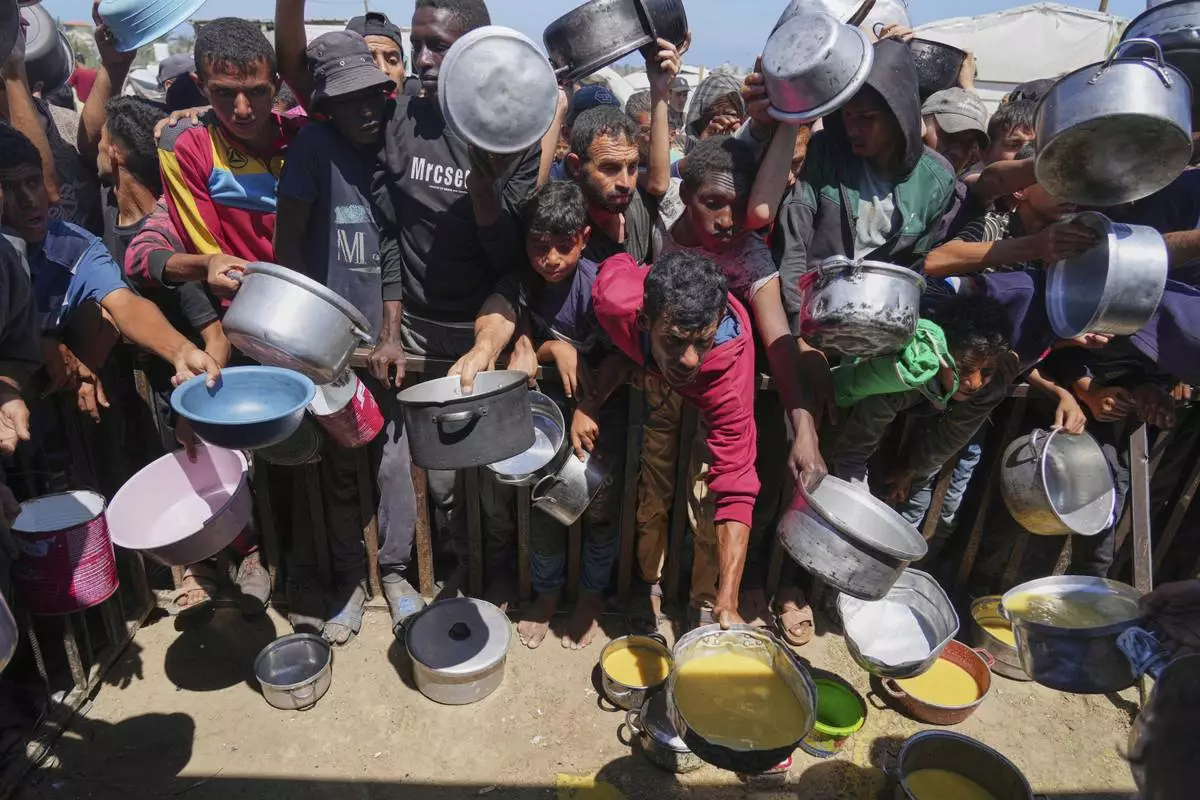
Palestinians struggle to receive cooked food distributed at a community kitchen in the Muwasi area of Khan Younis, in the Gaza Strip, Friday, May 23, 2025. (AP Photo/Abdel Kareem Hana)

Palestinians struggle to receive cooked food distributed at a community kitchen in the Muwasi area of Khan Younis, in the Gaza Strip, Friday, May 23, 2025. (AP Photo/Abdel Kareem Hana)