Skip to Content Facebook Feature Image

World's first robot boxing contest packs punch to optimize future algorithms

China

China

China

World's first robot boxing contest packs punch to optimize future algorithms

2025-05-27 17:10 Last Updated At:05-28 00:37

The world's first humanoid robot boxing competition has packed a punch that is sure to hit hard in the fast-growing sector's development, providing a testing ground for technicians to further optimize robot algorithms, improve performance and explore the potential to perform multiple useful functions in the future.

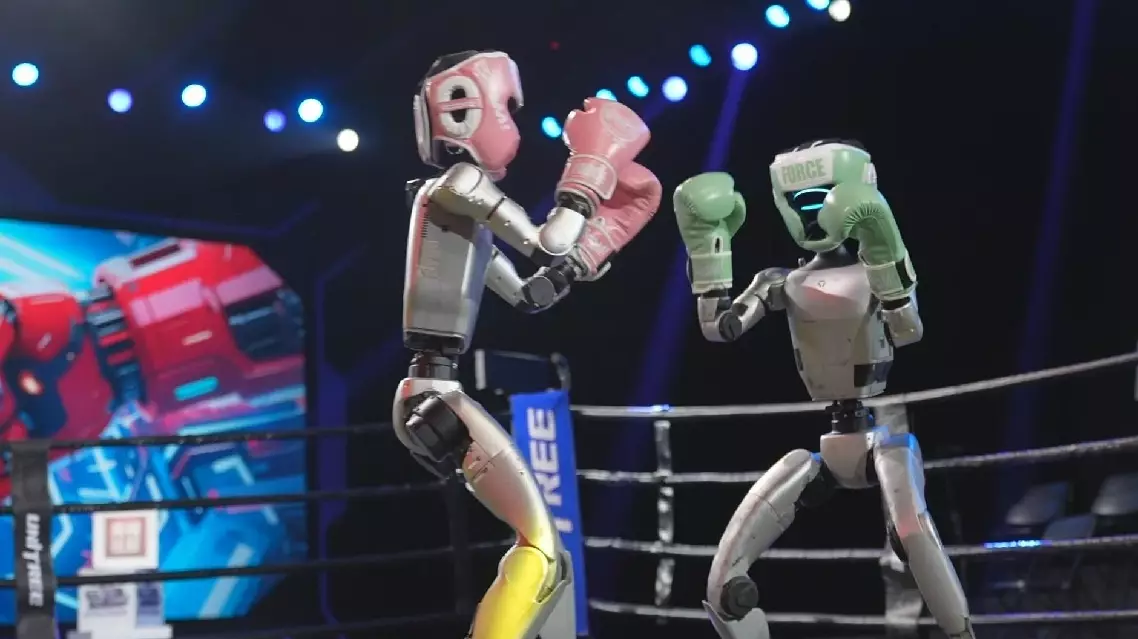
The competition, part of the China Media Group (CMG) World Robot Competition Series, took place in Hangzhou City of east China's Zhejiang Province on Sunday evening, and featured advanced G1 robots developed by the Hangzhou-based robotics firm Unitree.

Given their already impressive movement range, the high-tech G1 robots have now developed the skills needed to execute basic combat moves and various combination actions, including jabs, hooks, and kicks.

Operators controlled the robots using voice commands and remote controls from ringside, allowing for real-time human-robot collaboration in the heat of the battle.

Unlike the world's first humanoid robot half marathon which was held in Beijing this April, which focused more on endurance and speed, the boxing competition placed higher demands on the robots' agility and balance when responding to the unfolding challenges in the ring.

Prior to the event, the G1 robots underwent extreme tests, including shock resistance and overheating prevention, ensuring they could perform complex movements under tough conditions.

"During the fight, the robot has to execute aggressive moves while also facing strong attacks from the opponent robot. The key challenge is maintaining balance throughout the process, ensuring that it doesn't get knocked down while attacking," said Sun Baoyan, an equipment tester for the competition.

While the unique event highlighted the strong prowess and physical adaptability of the humanoid robots, experts have also emphasized the importance of unlocking their true potential to benefit more real-world applications.

"Some of the robot's abilities have already exceeded our expectations, but there are still bottlenecks when it comes to unlocking its full potential and generating real value. There's still a gap between what the robots can do and what people need. The next breakthrough may come in the areas of robotic dexterity, tactile feedback, and manipulation skills," said Li Gaofeng, a researcher at Zhejiang University's College of Control Science and Engineering.

The continuing CMG World Robot Competition Series will also feature more activities from robot football and basketball games, aiming to showcase the cutting-edge advancements in AI and robotics through competitive, and visually entertaining sports events. The series aims to promote industrial upgrades and accelerate the adoption of robotic technologies.
World's first robot boxing contest packs punch to optimize future algorithms
World's first robot boxing contest packs punch to optimize future algorithms

World's first robot boxing contest packs punch to optimize future algorithms

World's first robot boxing contest packs punch to optimize future algorithms

Attempts to curb China's scientific and technological advancement are futile, a fact that has already been proven, said Kishore Mahbubani, former permanent representative of Singapore to the United Nations, in an interview aired Friday.

In an exclusive interview with China Central Television (CCTV) in Beijing, Mahbubani said he had stated this position in one of his articles published in the United States.

"Actually, I published an article, you know the two, I guess two leading journals in the United States on international relations. One is Foreign Affairs and the other is Foreign Policy. And last year I co-authored an article with two other co-authors, saying that all the efforts to stop China's scientific and technological development will fail. And it has failed always. You know, for example, the Soviet Union tried to prevent the spread of nuclear technology to China, China develops its own. The United States didn't want to share its technology on international space station with China. China develops its own space station. So clearly, efforts to stop China in the area of scientific innovation and technological development have failed. And so it'd be wiser for the West, including United States, to work with China other than to try and stop China seek development," he said.

Regarding China's progress on robots, Mahbubani said China is leading the world in the sector and hopes the country will share its expertise with the rest of the world.

"If there's one country that is preparing for the future well, it is China, because one in six human beings in the world is Chinese. But one in three robots in the world is Chinese, and one in two baby robots being born every day is Chinese. So China is producing far more robots than any other country is. So clearly it's preparing for the world of the future when we will have, for example, labor shortages, as you know, as you develop an aging society. So China is wisely investing in robots. But I hope that China will also share its learning and expertise with other countries. Also because the robots like that can also be helpful even to developing countries cause you can enhance the productivity of their populations, of their factories and so on so forth. So the world should be happy that China is leading the world in manufacturing, producing robots," he said.

Attempts to stop China's sci-tech development doomed to fail: former Singaporean diplomat

Attempts to stop China's sci-tech development doomed to fail: former Singaporean diplomat

Recommended Articles