PITTSBURGH--(BUSINESS WIRE)--May 27, 2025--
Add "Forward-Looking Statements" after last paragraph of release.
This press release features multimedia. View the full release here: https://www.businesswire.com/news/home/20250527270225/en/
The updated release reads:
WATT FUEL CELL COMPLETES INSTALLATION OF ITS LATEST GENERATION FUEL CELL SYSTEM, WATT HOME™, WITHIN PEOPLES NATURAL GAS SERVICE TERRITORY
Locally made fuel cell systems can serve as backup power source for homes by connecting to existing natural gas infrastructure
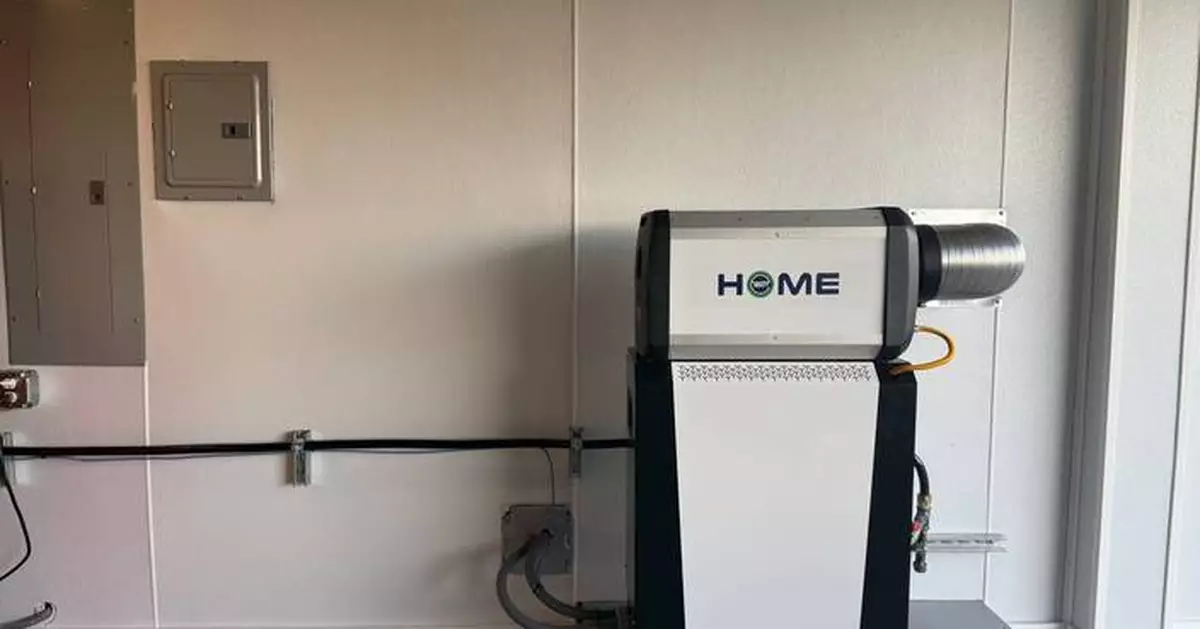
WATT Fuel Cell, in partnership with Essential Utilities, has successfully installed the next-generation WATT HOME solid oxide fuel cell system in Peoples Natural Gas’ Western Pennsylvania service territory. The installation marks a significant step forward in enhancing energy efficiency and reliability for residential customers.
The WATT HOME system is a cutting-edge technology designed to provide safe, clean, efficient, and reliable energy directly to homes. This system operates by converting natural gas into electricity through an electrochemical process without combustion, offering a sustainable complement or alternative to traditional energy sources.
The installation of a WATT HOME system brings numerous advantages to the homeowner and community at large. Those advantages include increased efficiency, reduced greenhouse gas emissions, and a smaller physical footprint. As a back-up power solution, the WATT HOME system provides a dependable source of electricity, minimizing the impact of grid outages.
With the increasing strain on the PJM electric grid from extreme weather events and the retirement of baseload generators, the need for reliable backup power has never been greater. On average, U.S. electricity customers experience approximately 5.5 hours of electricity interruptions annually. WATT HOME fuel cell systems keep the lights on during outages without the noise or pollution created by standard backup power generators.
"The rising frequency and severity of power disruptions highlight the urgent need for resilient, efficient, and clean energy solutions,” said Caine Finnerty, CEO and Founder of WATT Fuel Cell. “When the power goes out, the WATT HOME system activates to ensure your electricity is working all the time.”
Looking Ahead: Future Installations and Rollout Program
As part of Peoples’ commitment to advance innovative energy solutions, Pennsylvania’s largest natural gas utility plans pilot installations of the WATT HOME system in multiple company field offices. These projects will help define the installation and operational process across different use cases, informing a future public rollout.
“The partnership with WATT is the latest in a series of innovative concepts championed by Peoples to meet modern-day energy demands,” said Peoples President Michael Huwar. “The WATT HOME system’s groundbreaking technology has the potential to protect homeowners from volatility in power generation, offering a reliable, resilient and sustainable energy solution that leverages our region’s abundant natural gas supply.”
For more information about the WATT HOME system, visit WattFuelCell.com.
About WATT Fuel Cell
WATT Fuel Cell ( www.wattfuelcell.com ) is a manufacturer and developer of Solid Oxide Fuel Cell (“SOFC”) stacks and systems that operate on common, readily available fuels such as propane and natural gas. WATT’s proprietary, patented additive manufacturing process (AMP) has allowed it to produce commercially viable SOFC products for small-scale and remote power applications. WATT’s Hybrid Power Management system works in tandem with renewable power sources (solar and wind) and energy storage to provide quiet, efficient, affordable, and environmentally responsible energy solutions prioritizing a return on investment for customers across the globe.
About Peoples Natural Gas
Peoples, an Essential Utilities (NYSE:WTRG) company, provides clean, safe, affordable and reliable natural gas service to approximately 740,000 homes and businesses in Western Pennsylvania and Kentucky. Peoples is committed to its customers, its employees, the environment, and to the regions it serves.
About Essential Utilities
Essential Utilities, Inc. (NYSE:WTRG) delivers safe, clean, reliable services that improve quality of life for individuals, families, and entire communities. With a focus on water, wastewater and natural gas, Essential is committed to sustainable growth, operational excellence, a superior customer experience, and premier employer status. We are advocates for the communities we serve and are dedicated stewards of natural lands, protecting more than 7,600 acres of forests and other habitats throughout our footprint.
Operating as the Aqua and Peoples brands, Essential serves approximately 5.5 million people across 9 states. Essential is one of the most significant publicly traded water, wastewater service and natural gas providers in the U.S.
Forward-Looking Statements
This letter contains forward-looking statements within the meaning of the Private Securities Litigation Reform Act of 1995, which generally include words such as “believes,” “expects,” “intends,” “anticipates,” “estimates” and similar expressions. The Company can give no assurance that any actual or future results or events discussed in these statements will be achieved. Any forward-looking statements represent its views only as of today and should not be relied upon as representing its views as of any subsequent date. Readers are cautioned that such forward-looking statements are subject to a variety of risks and uncertainties that could cause the company’s actual results to differ materially from the statements contained in this release. Such forward-looking statements include, but are not limited to statements relating to the capital to be invested by the water, wastewater, and gas distribution divisions of the Company. There are important factors that could cause actual results to differ materially from those expressed or implied by such forward-looking statements including the factors discussed in our Annual Report on Form 10-K and our Quarterly Reports on Form 10-Q, which is filed with the Securities and Exchange Commission. For more information regarding risks and uncertainties associated with The Company’s business, please refer to the Company’s annual, quarterly and other SEC filings. The Company is not under any obligation - and expressly disclaims any such obligation - to update or alter its forward-looking statements whether as a result of new information, future events or otherwise.
WTRGG

A next-generation WATT HOME solid oxide fuel cell installed within the Western Pennsylvania service territory of Peoples Natural Gas, an Essential Utilities company. WATT HOME fuel cells convert natural gas into electricity through an electrochemical process without combustion, offering a sustainable alternative or complement to traditional energy sources.
U.S. President Donald Trump said Sunday the U.S. Navy will “immediately” begin a blockade to stop ships from entering or leaving the Strait of Hormuz, after U.S.-Iran peace talks in Pakistan ended without an agreement.
Iran has demanded the right to collect tolls from vessels traveling through the strait, but Trump said no one who pays them will “have safe passage on the high seas.”
Earlier in the day, the United States and Iran ended 21 hours of face-to-face talks in Islamabad without reaching a deal, leaving the fate of the fragile, two-week ceasefire still unclear.
“The simple fact is that we need to see an affirmative commitment that they will not seek a nuclear weapon, and they will not seek the tools that would enable them to quickly achieve a nuclear weapon,” Vice President JD Vance told reporters.
The war that has killed thousands of people and shaken global markets has entered its seventh week.
The U.S. delegation led by Vance and the Iranian delegation led by parliament Speaker Mohammad Bagher Qalibaf had discussed how to advance a ceasefire already threatened by deep disagreements and Israel’s continued attacks against the Iran-backed Hezbollah in Lebanon.
Here is the latest:
Nawaf Salam made his remarks on the eve of the 51st anniversary of the start of Lebanon’s 15-year civil war.
Lebanon and Israel will hold direct talks in Washington starting Tuesday in a bid to end Israel’s conflict with Hezbollah, an Iran-backed militant group in Lebanon.
Hezbollah supporters and critics of the decision to negotiate have protested in Beirut, saying the government is too weak to end the war.
The government has set a truce as a prerequisite for talks, and plans to demand an Israeli withdrawal, the release of Lebanese prisoners, and the return of over one million displaced Lebanese.
Lebanese authorities have criticized Israel’s airstrikes and ground invasion, but have also decried Hezbollah for launching rockets on March 2nd in solidarity with Iran, sparking the latest escalation.
The Lebanese government came to power just over a year ago promising to disarm all non-state groups.
“I feel the pain of the mother who lost her son combatting on the frontlines as I feel the pain of the mother who lost her child who did not choose this war and only wanted to live,” said Salam.
Kevin Book, the managing director of research at research firm ClearView Energy Partners, said Sunday that leaner volumes generally mean tighter markets and higher prices, but “much depends on the scope and implementation of the blockade.”
“How Tehran responds matters, too. Iranian and/or Houthi reprisals against Gulf producers’ alternative routes could drive prices still higher,” Book said.
Jonathan Elkind, senior research scholar at the Center on Global Energy Policy at Columbia University said Trump’s statement on Fox News that implementing the blockade will take some time also adds uncertainty.
“Is this a climb down because of concerns about how sharply oil markets were set to rise in tomorrow’s trading? No one knows,” he said.
U.S. Vice President JD Vance’s goal in the talks with Iran was to outline America’s red lines and where there was room to negotiate. But Iran’s delegates could not agree to all of the stated red lines.
That’s according to a U.S. official who spoke to The Associated Press on condition of anonymity because they were not authorized to describe negotiating positions on the record.
The core objective for U.S. negotiators was that Iran never obtain a nuclear weapon. But there were additional red lines set by the U.S. that Iran objected to, the official said.
The red lines include Iran ending uranium enrichment, dismantling its major enrichment facilities, allowing retrieval of its highly enriched uranium, ending funding for Hamas, Hezbollah and the Houthis, creating a broader framework for peace and security in the region, and opening the Strait of Hormuz.
The U.S. believes that blockading the strait will show Iran the limits of its leverage as it considers the offer, the official said.
__ By Josh Boak
Israel’s prime minister was making his first visit since the start of the current round of fighting between Israel and Hezbollah.
“One of the things we see here is that we have essentially changed the face of the Middle East,” Netanyahu said Sunday. “Our enemies — Iran and the Axis of Evil — they came to destroy us, and now they are simply fighting for their own survival.”
Netanyahu said Saturday that Israel was working to control an 8 to 10 km (5 to 6 mile) buffer zone inside Lebanon to ensure Hezbollah does not fire close-range rockets and anti-tank missiles over the border.
Iran’s Revolutionary Guard Navy said Sunday that military vessels approaching the Strait of Hormuz “will be met with a firm and forceful response,” according to two semi-official Iranian news agencies.
Earlier Sunday, Trump said the U.S. Navy would begin a blockade on the critical waterway to stop ships from entering or leaving.
The talks in Pakistan between Iran and the U.S. ended Sunday without an agreement to end the fighting.
The mission, known as UNIFIL, said Israeli ground troops twice rammed their vehicles with a Merkava tank on Sunday.
The soldiers were blocking a road in Bayada that peacekeepers have been using to access their positions, UNIFIL said in a statement.
UNIFIL has decried attacks on its personnel and damage to its facilities since
the latest war between Israel and Hezbollah militants started on March 2. Three peacekeepers have been killed in the past month.
“Israeli soldiers have continually blocked peacekeepers’ movements on this road in recent days, in addition to denials of freedom of movement recorded in other areas,” UNIFIL said. “They hinder peacekeepers’ ability to report violations by both sides on the ground.”
Britain’s Defense Ministry did not immediately respond to a message seeking comment about Trump’s assertion Sunday on Fox News.
In an April 2 meeting of top diplomats from 40 nations, British Foreign Secretary Yvette Cooper discussed mustering their collective powers to remove mines from strait once the conflict diminished.
Cooper convened a meeting with about 30 of those nations last week to discuss restoring free movement in the shipping channel and a follow-up is scheduled this week.
In March, James Cartlidge, the opposition Conservative Party’s defense secretary, said the British Navy removed its last minesweeper from the Persian Gulf a week before the war began.
Saudi Arabia’s Foreign Ministry submitted a “protest note” Sunday to the Iraqi ambassador following what it called ongoing drone attacks launched from Iraqi territories against Saudi Arabia and neighboring Gulf States.
It was not immediately clear if the Iraqi drone attacks are still taking place.
The Islamic Resistance in Iraq, an umbrella group of Iran-backed Iraqi militias, said last week that it would halt its operations in Iraq and the region for two weeks, hours after the U.S. and Iran agreed to a two-week ceasefire.
Iran-backed militias in Iraq have claimed responsibility for dozens of attacks on U.S. bases and other facilities in the country in solidarity with Tehran since the war began.
President Masoud Pezeshkian told Russian President Vladimir Putin on Sunday that his country is prepared to reach a deal that would ensure “lasting regional peace.”
Pezeshkian added that Iran’s national interests are a red line, according to a readout of the call carried by Iran’s state-media.
He criticized the U.S. use of bases in Gulf countries to carry out strikes against Iran, while maintaining that Gulf countries are “brothers” and that Tehran is willing to cooperate with them to achieve regional security “without outside powers”
Iran has said it has repeatedly struck U.S. facilities in neighboring Gulf countries since the war started in late February. Gulf countries say Iran has also targeted civilian infrastructure and facilities.
In the call with U.S. envoy Steve Witkoff, Foreign Minister Badr Abdelatty affirmed “the importance of adhering to the diplomatic path and prioritizing dialogue and peaceful solutions” to settle all disputes.
Abdelatty and his Pakistani counterpart, Mohammad Ishaq Dar, affirmed that they will continue their efforts to de-escalate and bridge the gaps between the U.S. and Iran.
Pakistan, Egypt and Turkey have been mediating between the U.S. and Iran since the start of the war.
Israel’s Ministry of Finance released its initial estimate of the cost of the Iran war on Sunday.
Some NIS 22 billion ($7.25 billion) has been spent on defense and military costs, including equipment and mobilizing more than 100,000 reserve soldiers, the ministry said.
Another NIS 12 billion ($4 billion) accounts for damages incurred by businesses and individuals from missiles or other related war losses, including missed days of work.
The ministry noted that some of the costs — including economic losses stemming from the war’s 40-day closure of the airports and many businesses — will only become apparent in the future.
At the height of its war with Gaza, Israel spent an estimated NIS 14 billion ($4.7 billion) per month on its military, more than double its monthly budget before the Oct. 7, 2023, attack.
Among the dead are 252 women, 165 children, and 87 medical workers, Lebanon’s Health Ministry said in its daily casualty count.
6,588 others have been wounded.
The U.S. president said his threat to impose 50% tariffs on goods from countries that sold weapons to Iran was aimed at China.
Trump told Fox News’ “Sunday Morning Futures” that has heard reports of China giving anti-aircraft “shoulder missiles” to Iran. He played down the possibility of China supplying weapons to Iran, but said their goods would be taxed if they did.
“I doubt they would do that, because I have a relationship, and I think they wouldn’t do that, but maybe they did a little bit at the beginning,” Trump said. “But if we catch them doing that, they get a 50% tariff.”
Trump posted on Truth Social on Tuesday that a “whole civilization will die tonight, never to be brought back again.”
He told Fox News’ Maria Bartiromo on Sunday that his threat brought Iran to the negotiating table. He also said the Islamic Republic has made worse statements, such as “Death to America. Death to Israel. America is a Satan.”
Trump issued new warnings to strike Iran’s civilian infrastructure if its leaders don’t agree to give up its nuclear program.
“In one half of a day they wouldn’t have one bridge standing, they wouldn’t have one electric generating plant standing and they’re back in the stone ages,” Trump said.
“I don’t understand how blockading the strait is going to somehow push the Iranians into opening it. I don’t get the connection there,” Sen. Mark Warner, a Virginia Democrat, told CNN’s “State of the Union” on Sunday.
Warner, the vice chairman of the U.S. Senate Intelligence Committee, said he didn’t see “how blockading the strait gets it open suddenly, I don’t get that logic.”
Authorities on Sunday removed the barricades, shipping containers and roadside checkpoints that had been in place since before the rare face-to-face talks.
The normally bustling city had taken on a near-curfew-like atmosphere after the government announced two holidays for security reasons. Roads in the capital were largely deserted for days and even ambulances were forced to take longer routes.
The incident happened 54 nautical miles (62 miles) southwest of the Red Sea port city of Hodeida, the UK Maritime Trade Operations said. UKMTO is part of the Royal Navy.
It said the skiff was turned away after the vessel’s master deployed a flare. The UKMTO report did not specify the nature or country of origin of the vessel that was approached.
Hodeida is controlled by the Iranian-backed Houthi rebels.
Defending his planned blockade, the U.S. president said Sunday that Iran cannot control which ships go through the Strait of Hormuz, declaring that either every ship should have safe passage or none would.
“We’re not going to let Iran make money on selling oil to people that they like,” Trump said on Fox News’ “Sunday Morning Futures.”
“It’s going to be all or none and that’s the way it is,” the president said.
The blockade will be similar to what the U.S. did with Venezuela, though on a larger scale, Trump said, suggesting that more tankers would come to the U.S. to buy oil as a result of the blockade.
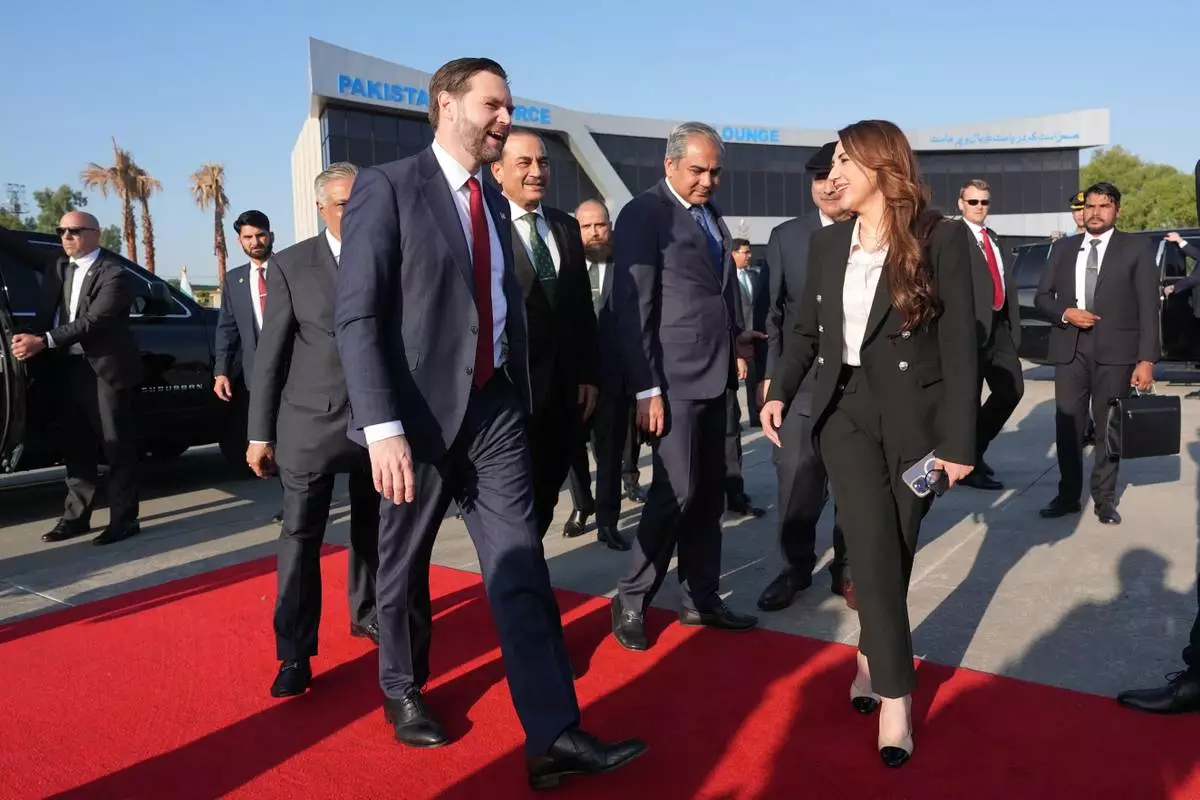
Vice President JD Vance walks with Pakistani Deputy Prime Minister and Foreign Minister Mohammad Ishaq Dar, partially seen on the left, Pakistan's Chief of Defence Forces and Chief of Army Staff Field Marshall Asim Munir, third left, Pakistan's Interior Minister Mohsin Naqvi, and Charge d'Affaires of the U.S. Embassy in Islamabad Natalie A. Baker, right, before boarding Air Force Two after attending talks on Iran in Islamabad, Pakistan, Sunday, April 12, 2026. (AP Photo/Jacquelyn Martin, Pool)
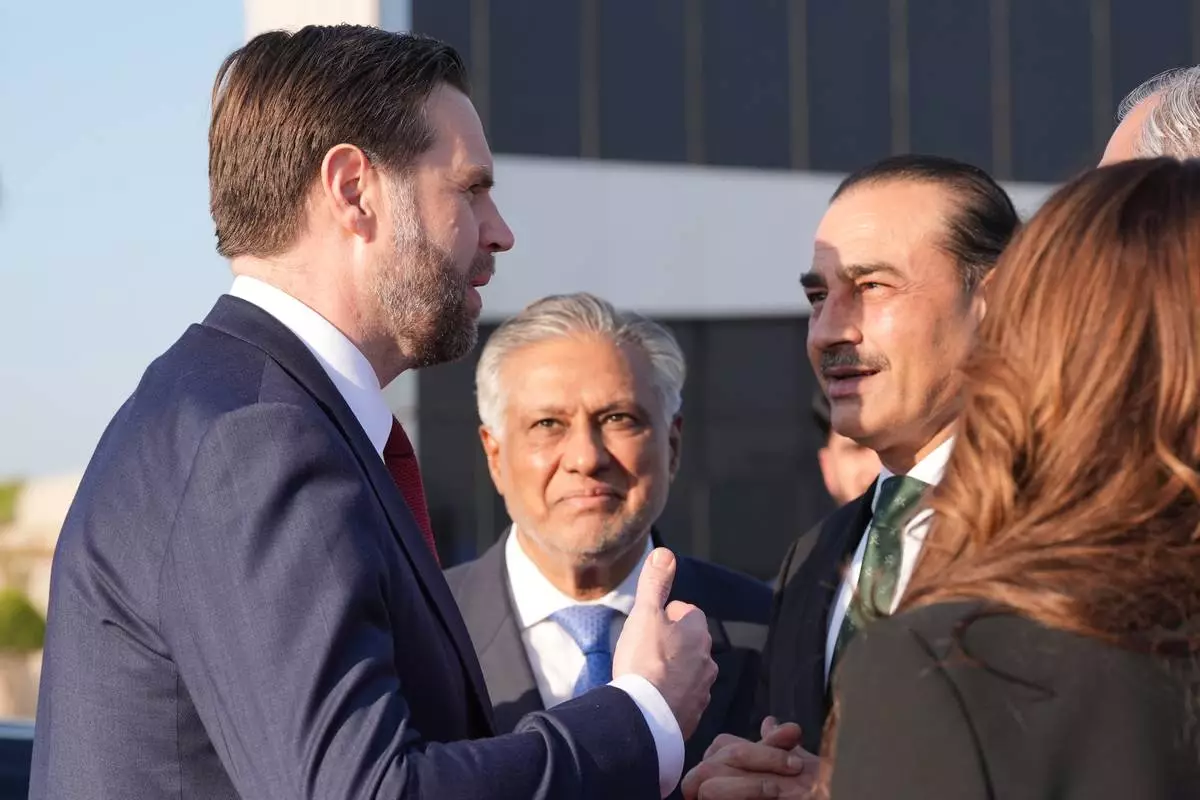
Vice President JD Vance, left, talks to Pakistan's Chief of Defence Forces and Chief of Army Staff Field Marshall Asim Munir, right, and Pakistani Deputy Prime Minister and Foreign Minister Mohammad Ishaq Dar, center, before boarding Air Force Two after attending talks on Iran in Islamabad, Pakistan, Sunday, April 12, 2026. (AP Photo/Jacquelyn Martin, Pool)
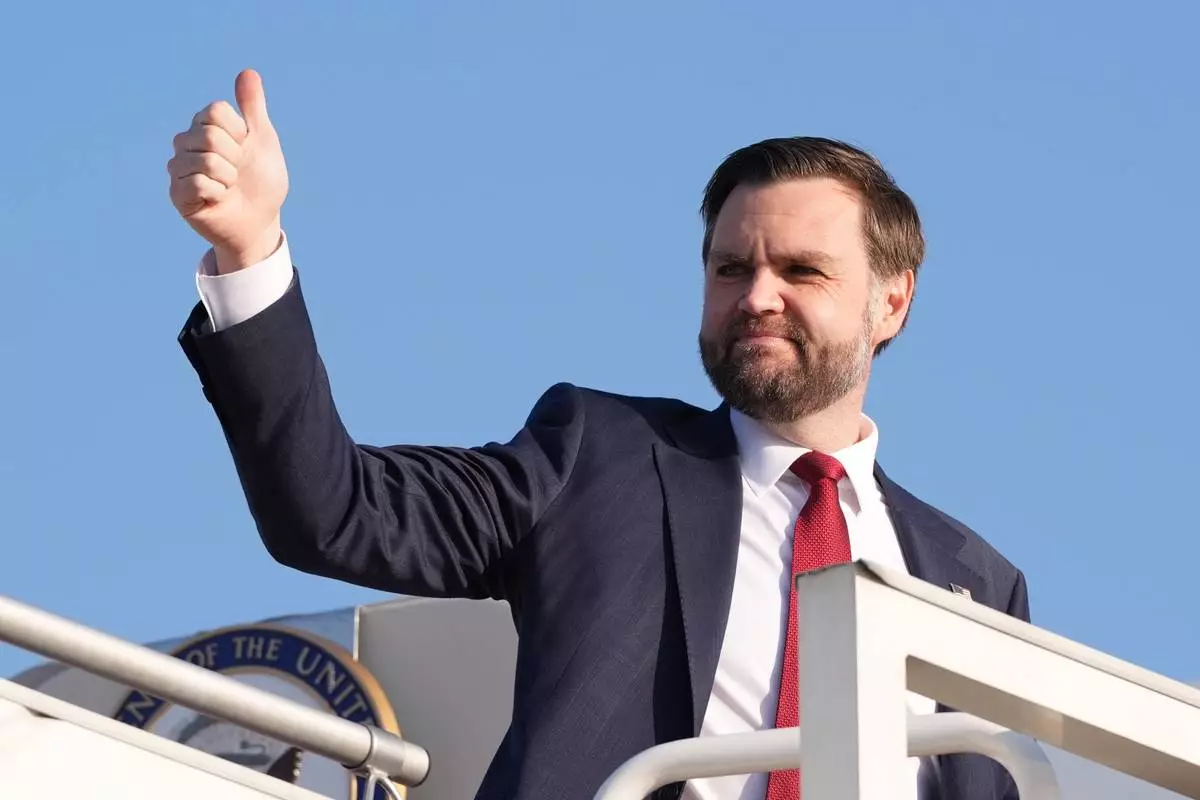
Vice President JD Vance gives a thumb up sign as he boards Air Force Two after attending talks on Iran in Islamabad, Pakistan, Sunday, April 12, 2026, . (AP Photo/Jacquelyn Martin, Pool)
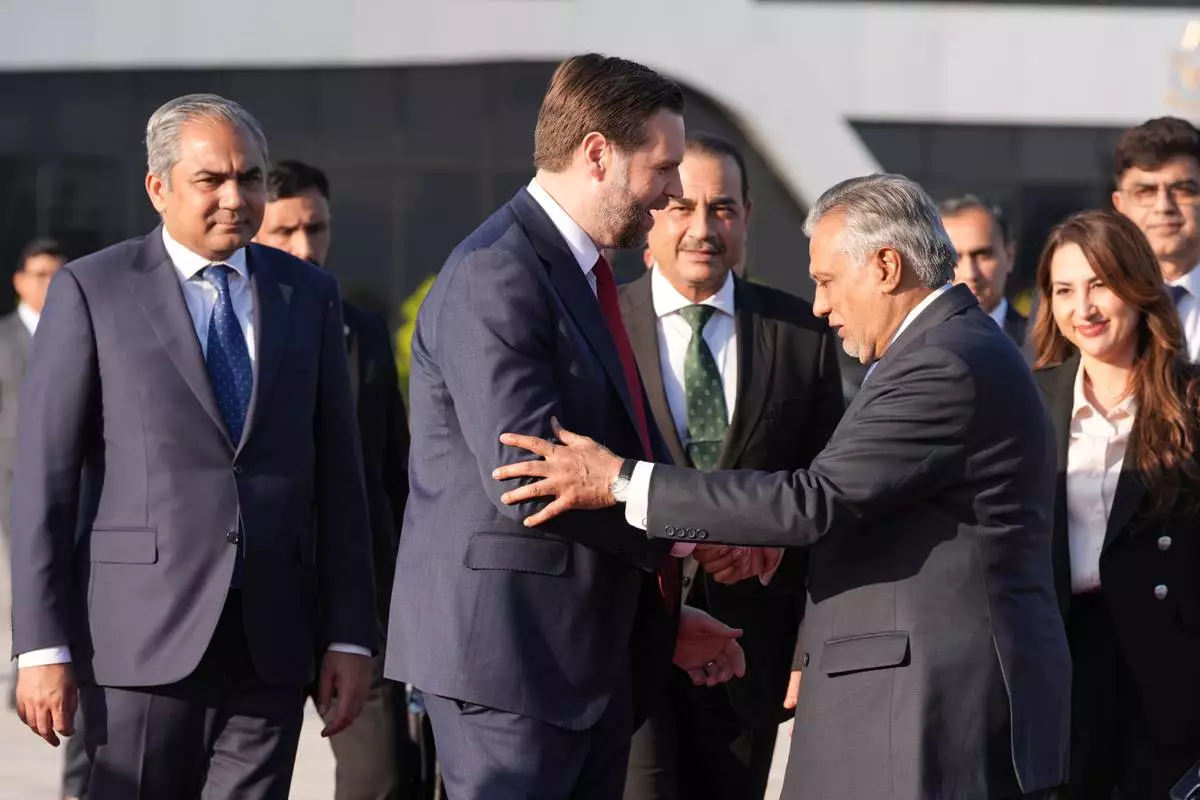
Vice President JD Vance, second left, shakes hands with Pakistani Deputy Prime Minister and Foreign Minister Mohammad Ishaq Dar, as Pakistan's Interior Minister Mohsin Naqvi, left, Pakistan's Chief of Defence Forces Chief of Army Staff Field Marshall Asim Munir, third left, and Charge d'Affaires of the U.S. Embassy in Islamabad Natalie A. Baker, right, look on, as he prepares to board Air Force Two after attending talks on Iran in Islamabad, Pakistan, Sunday, April 12, 2026. (AP Photo/Jacquelyn Martin, Pool)