Brazil and China, with a nearly four-decade legacy of space collaboration, have advanced from launching satellites to embarking on cutting-edge deep space exploration, marked by the construction of a colossal radio telescope in northeastern Brazil.
Over the years, the two countries have enhanced space research through the exchange of expertise, scientific data, and the joint construction of satellites.
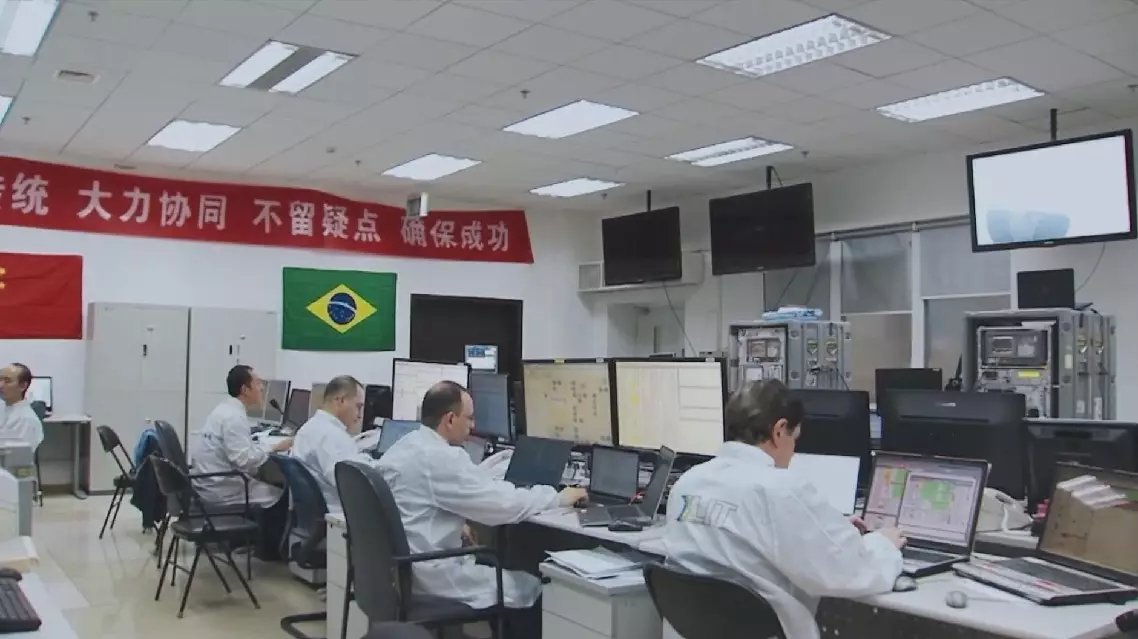
"We have already built six satellites and we are working on the seventh one," said Adenilson Roberto Da Silva, general coordinator of Space Technology, INPE.
It's a long-term collaboration shaped by daily cooperation on the ground.
"The Chinese were very welcoming. We really felt embraced and especially on a professional level," said Edilene Lira, civil engineer of BINGO radio telescope project.
"They respond very quickly. They like to communicate, that is they like to discuss," said Amilcar Queiroz, coordinator of BINGO radio telescope project.
It's also meaningful for getting two Global South countries working together in areas traditionally dominated by the North.
"It was a possibility for us, both countries, to show that a South-South partnership in high technology topics is meaningful and possible," said Marco Antonio Chamon, president of Brazilian Space Agency.
The CBERS satellites are the most advanced and visible aspect of the 37-year-old China-Brazil partnership in space. CBERS stands for Chines Brazilian Earth Resources Satellite. The project serves not only its partners, China and Brazil, but also governments, researchers, and individuals worldwide, who have free access to all the imagery it produces.
The CBERS images are the backbone of the PRODES and DETER systems, which analyze satellite pictures to acquire detailed data on the human impact on Brazil's environment, like the occurrence of deforestation and wildfires.
The program coordinator says the environment monitoring program was in its early stages when the China-Brazil partnership began — and that cooperation played a decisive role in its progress. The cameras developed through this partnership are specifically designed for the monitoring of Brazilian forests and biomes.
But there's more to this partnership than satellites. Another key project bringing Brazilian and Chinese scientists together is the construction of a massive radio telescope in Brazil's northeastern countryside.
The selected location is deep in Brazil's heartland - in the countryside of Paraiba state. This spot was chosen for a radio telescope for some key reasons: the hills and valleys help shield the equipment, and the remote location keeps it free from electromagnetic interference — like signals from cell phones and radios — that could affect its operation.
The civil engineering team has already prepared the site for the arrival of the equipment — much of it coming from China.
The radio telescope is also the centerpiece of a broader initiative to turn the region into a scientific hub - as the state secretary for science explained to us during a scientific conference held nearby.
"BINGO is not only for high-level research, but also to foster regional development based on science, technology, and innovation," said Claudio Furtado, Paraiba State Secretary for Science and Technology.
And as the radio telescope helps us look deeper into the universe, the partnership also continues to focus on something closer to home — using space to better understand and protect our own planet.
"We have now with China, our main partnership in space is building satellites, always trying to use the monitoring Earth in our benefit," said Chamon.
There are vast expanses of space to be explored — and space research also helps us better understand and protect the planet we call home. Brazil and China are good examples of how far international cooperation can take humankind's knowledge and technology.
China-Brazil enhance space collaboration, leading South-South cooperation
The latest artificial intelligence breakthroughs are dominating the 2026 Consumer Electronics Show (CES) in Las Vegas, with a number of firms showcasing how AI can be deployed to play a critical role in healthcare and even in the once futuristic notion of creating digital clones.
The four-day show, considered the world's premier annual technology event, is set to conclude Friday after attracting over 4,500 exhibitors from more than 155 countries and regions, according to organizers.
While many attendees are sampling the latest tech devices and gadgets on display, the event is also showcasing the big and bold ideas of a number of companies who are seeking to harness AI's potential for even greater causes.
A number of companies and entrepreneurs are using AI-powered software in the hope of improving healthcare and even extending our lives. One of the standout examples is 'Predictive AI', a Korean-founded medical startup focused on disease prevention through advanced genetic analysis.
Predictive AI is building digital twins of the human genome, which sees virtual replicas of some 20,000 genes and three billion DNA sequences. These are designed to predict diseases, flag risky prescriptions and even act as a patient's proxy during consultations.
Co-founded by twin brothers Sijung and Sajung Yun, both academics at Johns Hopkins University, their advanced software, named 'Dr. Twin', uses a supervising AI agent to coordinate multiple specialized systems to assess people's health.
By simply sending them a fingernail clipping, their company can extract a client's DNA and combine it with their health history. The software then makes predictions on more than 20,000 diseases - including everything from cancer to Alzheimer's - and then allows users to ask questions about their results.
"[We had to] be proactive for it. And then we provide the customized nutrition for it. We provide the customized recommendation for your pharmacogenomics, which is which drug you better take. So that's kind of the actionable things that you can do after these testing. For those who are afraid of [receiving] a result, the results can go to the their primary physician," said Sijung Yun.
His twin Sajung explained the predictive philosophy which lies behind the technology.
"The reason we are predictive is that when you want to prevent everything, you are not preventing anything. So you need to predict the high risk, and you need to watch out for those symptoms and then catch it early. With the genetic profiling and the AI doctor's algorithm we developed, we are enabling to do so," he said.
Beyond healthcare, AI is being showcased in many other novel and sometimes surprising ways, including a potentially groundbreaking concept which uses archived video and biographical information of users to then create and render themselves into AI clones.
Dubbed 'MyPersonas' and developed by software company IgniteTech, the platform generates an AI duplicate which draws specifically on the knowledge and experience of its human counterpart.
"The 'MyPersona' is grounded in your knowledge, and we've gone to great lengths with patent-pending technology to make certain that it doesn't attempt to answer something that you don't know," said Eric Vaughan, CEO of IgniteTech.
The AI clones are expected to be deployed in a wide range of scenarios — from customer service operations and education to the even more personal endeavor of preserving family histories, with memories and stories able to 'live on' in a virtual world for generations to come.
"I can't think of where it can't be used. It could be used by a one-man insurance company to answer questions about policies. It could be used by a teacher at a school about homework assignments. Could you show grandma and grandpa to future generations live and then actually have them interact and ask questions and share memories and tell stories in a way that makes them come alive?" said Vaughan.
With innovations like these on display, CES 2026 highlights how AI is not only reshaping technology — but redefining how humans understand health, memory, and legacy in both the physical and virtual worlds.
Futuristic potential of AI applications highlighted at top tech show in Las Vegas