RALEIGH, N.C. (AP) — The Trump administration accused North Carolina's election board on Tuesday of violating federal law by failing to ensure voter registration records of some applicants contained identifying numbers.
The Justice Department sued in federal court also asking a judge to force board officials to create a prompt method to obtain such numbers.
The department alleges that the state and the board aren't complying with the 2002 Help America Vote Act after board officials provided a statewide voter registration form that didn't make clear an applicant must provide either a driver's license number or the last four digits of a Social Security number. If an applicant lacks neither, the state must assign the person another unique number.
A previous edition of the state board, in which Democrats held a majority, acknowledged the problem in late 2023 after a voter complained. The board updated the form but declined to contact people who had registered to vote since 2004 in time for the 2024 elections so they could fill in the missing numbers.
According to the lawsuit, the board indicated that such information would be accumulated on an ad hoc basis as voters appeared at polling places. It's unclear exactly how many voters' records still lack identifying numbers.
Lawyers from the department's Civil Rights Division contend the board must act more aggressively. They want a judge to give the state 30 days to develop a plan to contact voters with records that don't comply with federal law, obtain an identifying number for each and add that to the electronic list.
The litigation follows similar efforts by the Republican Party and a state GOP candidate to address the registration records for the 2024 election.
The lawsuit also referred to President Donald Trump's broad executive order on elections in March to “guard against illegal voting, unlawful discrimination, and other forms of fraud, error, or suspicion.”
“Accurate voter registration rolls are critical to ensure that elections in North Carolina are conducted fairly, accurately, and without fraud,” Assistant Attorney General Harmeet Dhillon said in a press release. “The Department of Justice will not hesitate to file suit against jurisdictions that maintain inaccurate voter registration rolls in violation of federal voting laws.”
This month, the board’s composition changed to reflect a 2024 law approved by the GOP-dominated General Assembly that shifted the board’s appointment powers from the now-Democratic governor to Republican State Auditor Dave Boliek. A previous 3-2 Democratic majority is now a 3-2 Republican majority.
The new iteration of the board sounds open to embrace the Justice Department’s wishes.
Executive Director Sam Hayes said late Tuesday the lawsuit was being reviewed, “but the failure to collect the information required by HAVA has been well documented. Rest assured that I am committed to bringing North Carolina into compliance with federal law.”
Local elections start in September.
The state and national GOP last year sued over the lack of identifying numbers, which they estimated could have affected 225,000 registrants. But federal judges declined to make changes so close to the general election.
The issue also was litigated after Election Day as part of formal protests filed by the Republican candidate for a seat on the state Supreme Court who challenged about 60,000 ballots he contended were cast by registrants whose records failed to contain one of the two identifying numbers.
The election board said earlier this year at least roughly half of those voters actually did provide an identifying number.
State appeals courts criticized the board's handling of the registration records but ultimately ruled the challenged ballots had to remain in the final election tally. Democratic Associate Justice Allison Riggs defeated Republican challenger Jefferson Griffin by 734 votes out of over 5.5 million ballots cast.
This story has been updated to corrected that the Help America Vote Act was passed in 2002, not 2003.

President Donald Trump arrives on Air Force One at Morristown Municipal Airport in Morristown, N.J., Friday, May 23, 2025. (AP Photo/Manuel Balce Ceneta)
SAN FRANCISCO & JACKSONVILLE, Fla.--(BUSINESS WIRE)--Jan 12, 2026--
Abridge, the leading enterprise-grade AI for clinical conversations, is collaborating with Availity, the nation’s largest real-time health information network, to launch a first-of-its kind prior authorization experience. The engagement uses cutting-edge technology grounded in the clinician-patient conversation to facilitate a more efficient process between clinicians and health plans in medical necessity review.
This press release features multimedia. View the full release here: https://www.businesswire.com/news/home/20260112960386/en/
Rather than creating parallel AI systems across healthcare stakeholders, Abridge and Availity are working together to ensure shared clinical context at the point of conversation powers administrative processes, such as prior authorization review and submission, improving outcomes for patients and the teams delivering care.
This collaboration unites two trusted and scaled organizations: combining Abridge’s enterprise-grade AI platform, serving over 200 health systems and projected to support over 80 million patient-clinician conversations in 2026, with Availity’s next-generation, FHIR-native Intelligent Utilization Management solution, which helps payers and providers digitize and operationalize coverage requirements within administrative workflows.
Availity’s FHIR-native APIs enable fast, scalable, and secure connectivity of payer information across the entire healthcare ecosystem. With Abridge’s Contextual Reasoning Engine technology, clinicians can gain visibility into relevant clinical information during the conversation to support documentation aligned with prior authorization requirements.
“At Availity, we’ve invested in building AI-powered, FHIR-native APIs designed to bring clinical policy logic directly into provider workflows,” said Russ Thomas, CEO of Availity. “By embedding our technology at the point of conversation, we’re enabling faster, more transparent utilization management decisions rooted in clinical context. We’re excited to collaborate with Abridge and to demonstrate what’s possible when payer intelligence meets real-time provider workflows.”
The development of real-time prior authorization is just a component of a broader revenue cycle collaboration that is focused on applying real-time conversational intelligence across the patient, provider, and payer experiences. The companies intend to support integration by collaborating on workflow alignment between their respective platforms in the following areas:
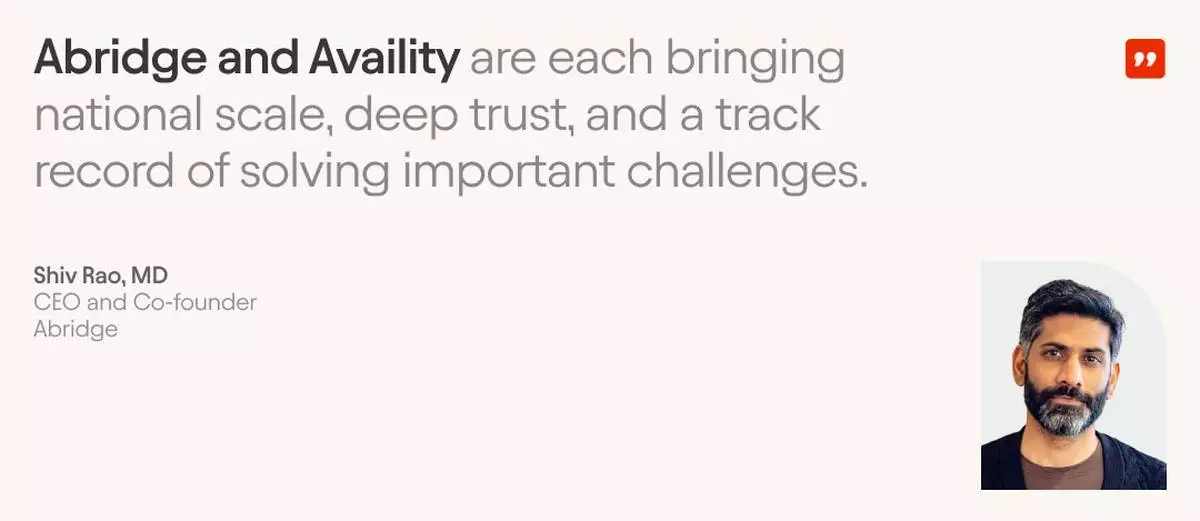
“Abridge and Availity are each bringing national scale, deep trust, and a track record of solving important challenges across the care and claims experience to this partnership,” said Dr. Shiv Rao, CEO and Co-Founder of Abridge. “We’re building real-time bridges between patients, providers, and payers, unlocking shared understanding, focused at the point of conversation.”
About Availity
Availity empowers payers and providers to deliver transformative patient experiences by enabling the seamless exchange of clinical, administrative, and financial information. As the nation's largest real-time health information network, Availity develops intelligent, automated, and interoperable solutions that foster collaboration and shared value across the healthcare ecosystem. With connections to over 95% of payers, more than 3 million providers, and over 2,000 trading partners, Availity provides mission-critical connectivity to drive the future of healthcare innovation. For more information, including an online demonstration, please visit www.availity.com or call 1.800.AVAILITY (282.4548). Follow us on LinkedIn.
About Abridge
Abridge was founded in 2018 to power deeper understanding in healthcare. Abridge is now trusted by more than 200 of the largest and most complex health systems in the U.S. The enterprise-grade AI platform transforms medical conversations into clinically useful and billable documentation at the point of care, reducing administrative burden and clinician burnout while improving patient experience. With deep EHR integration, support for 28+ languages, and 50+ specialties, Abridge is used across a wide range of care settings, including outpatient, emergency department, and inpatient.
Abridge’s enterprise-grade AI platform is purpose-built for healthcare. Supported by Linked Evidence, Abridge is the only solution that maps AI-generated summaries to source data, helping clinicians quickly trust and verify the output. As a pioneer in generative AI for healthcare, Abridge is setting the industry standard for the responsible deployment of AI across health systems.
Abridge was awarded Best in KLAS 2025 for Ambient AI in addition to other accolades, including Forbes 2025 AI 50 List, TIME Best Inventions of 2024, and Fortune’s 2024 AI 50 Innovators.

Abridge and Availity Collaborate to Redefine Payer-Provider Synergy at the Point of Conversation
Abridge and Availity Collaborate to Redefine Payer-Provider Synergy at the Point of Conversation