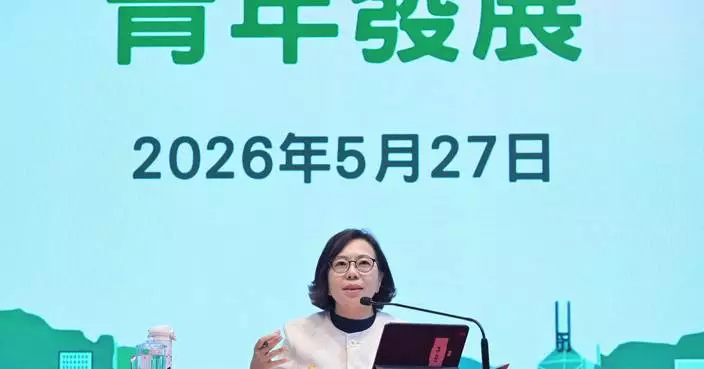
Acting SFST's speech at HKVCA Greater China Private Equity Summit 2025
Following is the speech by the Acting Secretary for Financial Services and the Treasury, Mr Joseph Chan, at the HKVCA (Hong Kong Venture Capital and Private Equity Association) Greater China Private Equity Summit 2025 today (May 28):
Rebecca (Co-Founder and Managing Director of Asia Alternatives, Ms Rebecca Xu), Conrad (Founder and Chairman of Strategic Year Holdings, Mr Conrad Tsang), distinguished guests, ladies and gentlemen,
Good morning. It is my great pleasure to join you at the HKVCA's flagship event - the Greater China Private Equity Summit - a global gathering of professionals and industry leaders of the private equity and venture capital sector.
Today, the global economy is confronted by geopolitical tensions and economic fragmentation, and threatened by the rise of unilateralism and protectionism. Against this backdrop, it is all the more necessary to have a stable and predictable "super connector" with an overall conducive business environment.
This is exactly what Hong Kong stands to provide. Earlier this year, the International Monetary Fund has reaffirmed Hong Kong's position as an international financial centre and recognised Hong Kong's resilient financial system, as supported by robust institutional frameworks, ample policy buffers, and the smooth functioning of the Linked Exchange Rate System. Indeed, Hong Kong ranked third in the world and first in Asia in the latest Global Financial Centers Index, whilst topping its "investment management" and "finance" matrix globally.
China connectivity
One unique advantage of Hong Kong is our preferential access to the Mainland China market. Last year (2024) marked the 10th anniversary of the mutual market access programmes between the Mainland and Hong Kong financial markets. Various mutual access programmes have been introduced one after another and have thrived over the past few years. The Connect Schemes allow international investors to conveniently invest in the Mainland China market through Hong Kong. At the same time, they enable Mainland investors to diversify their asset allocation through Hong Kong, facilitating the two-way flow of capital between the Mainland market and international markets, as well as the internationalisation of the Renminbi.
The content and scope of mutual access have continued to deepen and expand, now encompassing a wide range of offerings, including stocks, bonds, exchange-traded funds, derivatives for risk management, and more. Real estate investment trusts will also soon be included in the Connect Schemes.
Meanwhile, the Guangdong-Hong Kong-Macao Greater Bay Area (GBA) is fast emerging as a young and massive consumer market that is increasingly affluent, and has a growing demand for quality financial products and services, and a need for diversified asset allocation. Home to 87 million people with a GDP (Gross Domestic Product) per capita of US$40,000 on a purchasing power parity basis, the GBA presents immense potential in driving the synergistic development of Hong Kong and other GBA cities.
Tapping into the potential of this market, the GBA Cross-boundary Wealth Management Connect (WMC) was launched in 2021 and enhanced in February last year. The WMC provides GBA residents with a formal, direct and convenient channel for cross-boundary investment in diversified wealth management products. As of the end of April this year, about 154 000 individual investors in the GBA participated in the WMC, and cross-boundary fund remittances totalled close to RMB112 billion.
Another recent case of our continued endeavour to deepen the mutual access and strengthen financial market development is the enhancements to the Mainland-Hong Kong Mutual Recognition of Funds (MRF) arrangement in January this year. By relaxing sales restrictions and allowing Hong Kong funds to delegate investment management functions overseas, the measures significantly increased the diversity of fund products, enhanced the scale of funds, and brought a positive effect to the distribution of MRF funds.
Asset and wealth management hub
With the your staunch support, we are solidifying Hong Kong's role as an international asset and wealth management centre. As at the end of 2023, the assets under management (AUM) of the Hong Kong's asset and wealth management business reached about US$4 trillion, registering a growth of about 30 per cent over five years, and 64 per cent of the capital was sourced from non-Hong Kong investors, underscoring our city's role as a trusted gateway for global capital seeking access to opportunities across Asia and beyond. Our leadership is further evidenced by our standing as Asia's largest hedge fund hub and Asia's largest cross-border wealth management centre.
As of the end of April this year, there were 1 125 limited partnership funds registered in Hong Kong, representing a growth of over 30 per cent on a year-on-year basis. According to an industry report, as of the end of first quarter this year, the AUM of Hong Kong's private equity business amounted to about US$230 billion, ranked second in Asia, just trailing the Mainland China market.
To drive development on this front, we are welcoming alternative asset funds to list in Hong Kong. The Securities and Futures Commission has recently issued a circular to clarify the regulatory requirements for authorising closed-ended funds that invest mainly in private and less liquid assets, thereby encouraging sizeable alternative asset funds, including those investing in private equity, private credit, and infrastructure equity or debt, to list in Hong Kong.
I am sure this is a move welcomed by the industry, with benefits to investors that are multifold. On one hand, investors have broadened investment choices for diversification. On the other hand, investors may tap into opportunities previously only available to institutional and professional investors. Those with a long-term investment horizon may potentially achieve higher returns and a more stable valuation.
Another welcome move, I believe, is our proposal to enhance the tax incentives for funds, single family offices and carried interest. These proposals aim to expand the scope of qualifying funds to include vehicles such as pension and endowment funds, while also increasing the range of eligible asset classes for tax concessions including emerging instruments like carbon credits, emission derivatives, insurance-linked securities, private credit investments, and virtual assets. In addition, we plan to enhance the tax concession arrangement on the distribution of carried interest by private equity funds by removing the existing HKMA (The Hong Kong Monetary Authority)'s certification requirement and eliminating the reference to a hurdle rate. We have completed the industry consultation and we are now formulating the relevant enhancement measures with financial regulators based on the feedback received. We target to work out the details of the proposals this year and submit the legislative proposals to the Legislative Council for consideration next year. If approved, the relevant measures will take effect from the year of assessment 2025/26, which begins on April 1 this year.
Another focus area of ours is the family office sector. The growth of family offices has been particularly noteworthy, with over 2 700 single family offices operating in Hong Kong as of the end of 2023. More than half of them are managing portfolios exceeding US$50 million, and in particular, over 30 percent are managing portfolios over US$100 million, reflecting Hong Kong's appeal to ultra-high-net-worth individuals (UHNWIs) and institutional investors alike. Backing this claim is a market report last year that ranked Hong Kong first in Asia and second in the world in terms of the population size of UHNWIs in 2023 among global cities. This is a testament to our city's potential and capacity to attract and nurture wealth, further solidifying our position as a global wealth management and family office hub.
Targeting this segment with promising growth potential, we have been implementing a series of policy measures to support the development of the family office business after we issued the Policy Statement on Developing Family Office Businesses in Hong Kong in 2023. Among others, we are fostering collaboration, networking and knowledge sharing across the family offices from around the world via the Hong Kong Academy for Wealth Legacy for the current and next generation of wealth owners.
We also launched the New Capital Investment Entrant Scheme in March 2024 where Limited Partnership Funds are included as Permissible Investment Assets. As of the end of April this year, 1 257 applications have been received, potentially bringing in an investment amount of over HK$37 billion to Hong Kong.
Closing
Ladies, and gentlemen, Hong Kong is well-positioned to maintain and enhance its status as a leading international financial centre, notable for our certainty, transparency, and predictability. Our ongoing efforts to establish new ties, attract new capital and foster innovation will ensure our continued strength as a "super connector" in an ever-changing world.
As we continue to bridge global investors with opportunities in the international and Mainland markets, we look to the HKVCA and other professionals alike to foster industry development through leveraging on our distinct advantages.
On this note, I would like to thank the HKVCA again for hosting today's event and your continued contribution to the industry. I wish you all an enjoyable and rewarding summit today. Thank you.