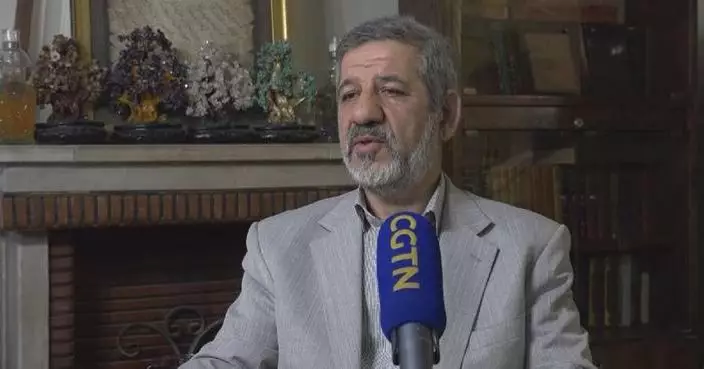
Five senior officials from Pacific Island nations have underscored the importance of their partnerships with China in driving mutual prosperity during a group interview held by China Global Television Network (CGTN).
Senior officials from Pacific Island countries gathered in Xiamen, east China's Fujian Province, on Wednesday and Thursday to attend the Third China-Pacific Island Countries (PICs) Foreign Ministers' Meeting, chaired by Chinese Foreign Minister Wang Yi, also a member of the Political Bureau of the Communist Party of China Central Committee.
Among the attendees in the group interview were Premier and Foreign Minister Dalton Tagelagi of Niue, Secretary of Foreign Affairs Lorin S. Robert of Federated States of Micronesia, Minister of Foreign Affairs, International Cooperation and External Trade Marc Ati of Vanuatu, Minister for Foreign Affairs Justin Tkatchenko of Papua New Guinea, Assistant Minister for Foreign Affairs and Deputy Speaker of the Parliament Lenora Qereqeretabua of Fiji.
Tagelagi emphasized the importance of mutual understanding in the evolving partnership between Niue and China.
"For the relationship, it's very important for China and within the Pacific region as long as we have and understand, respect each other, but also respect the sovereign rights of the individual countries. And there's no doubt to the rest of the Pacific countries in the Pacific. So that is important, but more so is the friendship. As we all know, we all share one world. And it's important that we all come together, whether it's the Pacific and China or the Pacific and the rest of the world," he said.
China's decades-long initiative to help Pacific countries learn Juncao technology was also highlighted by officials from Vanuatu and Micronesia. Juncao is a hybrid grass that serves as an important agricultural resource for mushroom farming in China.
"Moreover, the initiative fosters the broader value of South-South cooperation by producing low-cost, high-impact solutions that respect our local context. It mirrors the spirit of collective management. This model of partnership rooted in equity and mutual benefit strengthens regional connectivity by demonstrating how shared challenges can be met through shared innovations," Robert said.
"Our indigenous farming methods as inter-cropping and permaculture can be strengthened with China innovation when they come in sustainable agriculture, water management and climate resilient crops and boosting food security without [destroying] our ecosystem. So you can help us a lot about this," said Marc Ati.
Stressing Papua New Guinea's adherence to the one-China principle, Tkatchenko noted that cooperation between his country and China has grown under the Belt and Road Initiative (BRI).
"Our country since 1975 has always adapted, pursued and supported the one-China policy, which is very important to move forward and respect one's sovereignty and this is something that Papua New Guinea has enhanced and going forward we will have a prosperous relationship with China. We have a lot of ongoing projects that will enhance the lives of Papua New Guineans. We are working through the Belt and Road initiative of China, which greatly enhances the economic and trade with Papua New Guinea and China and increases the prosperity of our people going forward in many different sectors from education to health, and to the well-being of our people and their future going forward. So for us, the relationship with China is no mistake," he said.
Qereqeretabua highlighted that mutual respect and understanding are key to building and sustaining strong bilateral relations.
"For us in Fiji, as I know is reciprocated by the People's Republic of China, it's about mutual respect and understanding of country and of people. China understands the Pacific way how Fiji is part of the Pacific and how we have our cultures and traditions and us in Fiji also reciprocating that understanding so that we can build this relationship together. We have many, many examples, many great examples. But at the same time, while we agree on many things, we also understand that as two sovereign nations, we have divergent interests. So for us, the conversations, doing things the specific way, speaking about it over conversations, over food, over a cover, if you will, helps build this relationship. So it's about mutual trust, mutual understanding," she said.
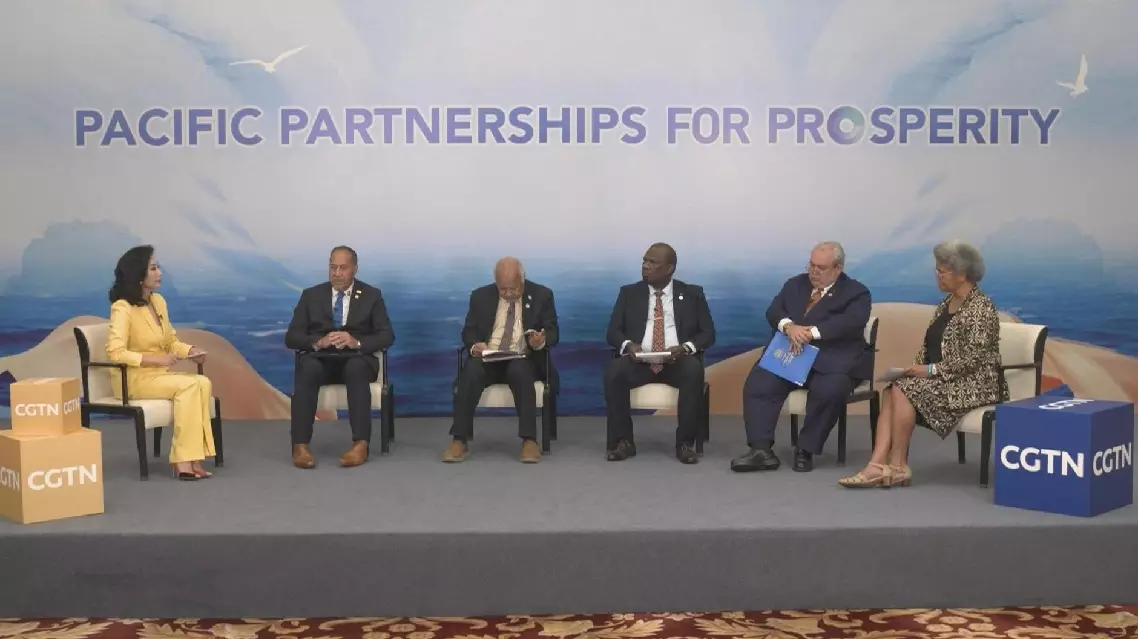
Pacific Island countries officials highlight role of partnerships in fostering prosperity