Skip to Content Facebook Feature Image

Phase II of Breast Cancer Screening Programme Launches June 10 for High-Risk Women in Hong Kong.

HK

HK

HK

Phase II of Breast Cancer Screening Programme Launches June 10 for High-Risk Women in Hong Kong.

2025-05-29 15:05 Last Updated At:22:48

DH to subsidise high-risk women for breast cancer screening services from June 10 (with photo/video)

The Department of Health (DH) today (May 29) announced that Phase II of the Breast Cancer Screening Pilot Programme (BCSPP) will be launched on June 10 to provide subsidised breast cancer screening services to female Hong Kong residents aged 35 to 74 who are at high risk of developing breast cancer. The goal is to enhance the recovery rate of breast cancer patients through early detection and treatment.

Breast cancer is the most common cancer among females and the third leading cause of cancer deaths of females in Hong Kong. Over the past decade, the age-standardised incidence and age-standardised mortality rates of breast cancer have both increased. In 2022, there were 5 182 newly diagnosed invasive female breast cancer cases, accounting for 28.6 per cent of all new cancer cases in women in Hong Kong. In 2023, the disease led to 834 deaths among women, accounting for 13.1 per cent of female cancer deaths.

The Government attaches great importance to cancer prevention and control work. Based on the recommendations of the Cancer Expert Working Group on Cancer Prevention and Screening under the Cancer Coordinating Committee, the Government launched Phase I of the BCSPP as early as in 2021 and subsequently Phase II of the BCSPP will be launched in accordance with the risk-based approach of cancer prevention and control as set out in the "Chief Executive's 2024 Policy Address".

Details of Phase II of BCSPP

-------------------------------

Eligible persons are high-risk women aged 35 to 74 who are at high risk of developing breast cancer, i.e. carriers of certain gene mutation(s) or with a strong family history of breast cancer/ovarian cancer (see Annex 1). Participants must be holders of a Hong Kong Identity Card or Certificate of Exemption and have registered in the Electronic Health Record Sharing System (eHealth).

Phase II of the BCSPP provides services to the public through public-private partnership programmes in collaboration with non-governmental organisations (NGOs). The three service providers are Hong Kong Breast Cancer Foundation, United Christian Nethersole Community Health Service, and Haven of Hope Christian Service.

Starting from tomorrow (May 30), eligible women may contact any one of the three NGO designated clinics (see Annex 2) to make an appointment for assessment and arrange for mammography (MMG) screening on or after June 10. Additional ultrasound MMG will be arranged for those who are confirmed to carry specific genetic mutations.

To encourage high-risk women to undergo screening, the Government provides a high level of subsidy for Phase II of the BCSPP. Service providers may only charge participants a co-payment of not more than $225 for each mammogram or ultrasound breast examination. Currently, all of the service providers will not charge any co-payment from the service users.

Members of the public may visit the dedicated website (www.breastscreen.gov.hk) or call the DH hotline (3586 3088) to learn more about Phase II of the BCSPP. The hotline operates from 9am to 5pm from Monday to Friday (except public holidays).

Government's work in cancer prevention and control

----------------------------------------------------------

Under Phase I of the BCSPP launched in 2021, three Woman Health Centres (WHCs), four Maternal and Child Health Centres (MCHCs) and 18 Elderly Health Centres (EHCs) of the DH provided biennial MMG screening for women aged 44 to 69 with certain risk factors.

In the two-year Phase I of the BCSPP (which ran from September 2021 to December 2023), a total of 27 807 women have received breast cancer risk assessment. Among them, 7 785 (about 28 per cent) underwent MMG screening on referral based on the risk assessment. Among the women with abnormal MMG results who had been referred to specialists for treatment, 409 cases were followed up in public hospitals, among which 68 (about 16.6 per cent) were confirmed to have breast cancer. The breast cancer detection rate per 1 000 MMG screenings was 8.7, which was comparable to the international standard of about five cases per 1 000 MMG screenings. Of the 68 breast cancer cases identified through MMG screening, 97 per cent were at stage II or below.

The breast cancer risk assessment and screening have been included as part of the services provided by the Woman Health Service and the Elderly Health Service in 2024. In 2024, 9 230 women aged 44 to 69 were assessed for breast cancer risk. Among them, 2 689 women (about 29 per cent) had undergone MMG screening based on the risk assessment. Among the women who received MMG screening, 321 (about 12 per cent) were referred to specialists for further investigation and treatment.

To utilise resources more effectively and expand the multidisciplinary primary healthcare service network, the DH's Woman Health Services provided at the WHCs and the designated MCHCs are being integrated into the district health network of the Primary Healthcare Commission (PHC Commission). During the transition period of service integration, those who have already paid their annual fee and are still within the service period will continue to receive relevant services from the DH. The PHC Commission will commence the integrated women's health services within this year in an orderly manner, whereby women's primary healthcare services will be provided through three service points named Women Wellness Satellites (WWS) to replace the Woman Health Services of the DH. Among them, the WWS (Hong Kong) located in Chai Wan will commence operation in June this year. Women aged 64 or below can receive screening services at the WWS, while those aged 65 to 69 will continue to receive services at the EHCs of the DH.

In addition, to further expand the services, the Hospital Authority's General Out-patient Clinics have been providing breast cancer risk assessment and screening services to eligible underprivileged women (including Comprehensive Social Security Assistance recipients or persons granted medical fee waivers) since March this year.

The DH encourages the public to adopt a healthy lifestyle, including avoiding tobacco and alcohol, eating a healthy diet, engaging in regular physical activity, and maintaining a healthy body weight, in order to minimise the risk of non-communicable diseases, including cancer. For more health information on cancer prevention, please visit the website of the Centre for Health Protection.
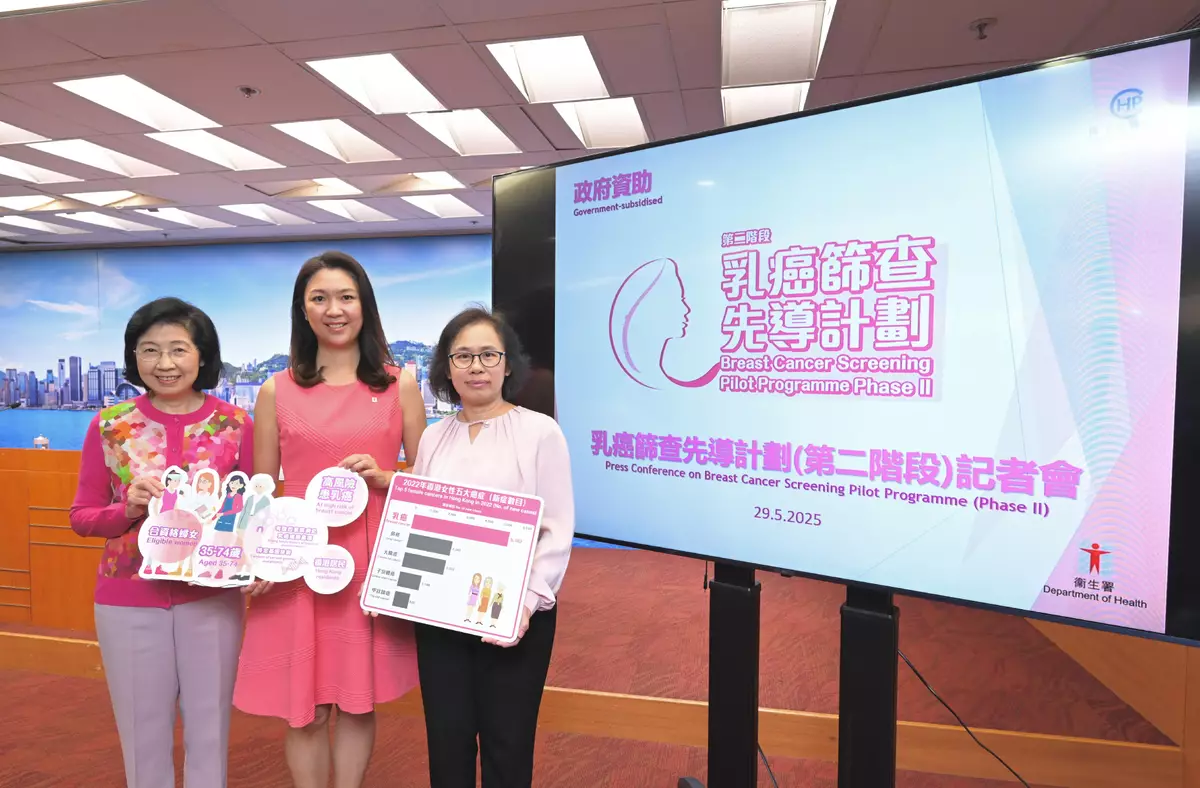
DH to subsidise high-risk women for breast cancer screening services from June 10 Source: HKSAR Government Press Releases
DH to subsidise high-risk women for breast cancer screening services from June 10 Source: HKSAR Government Press Releases

EDB reminds parents to choose primary schools under Central Allocation process for their children

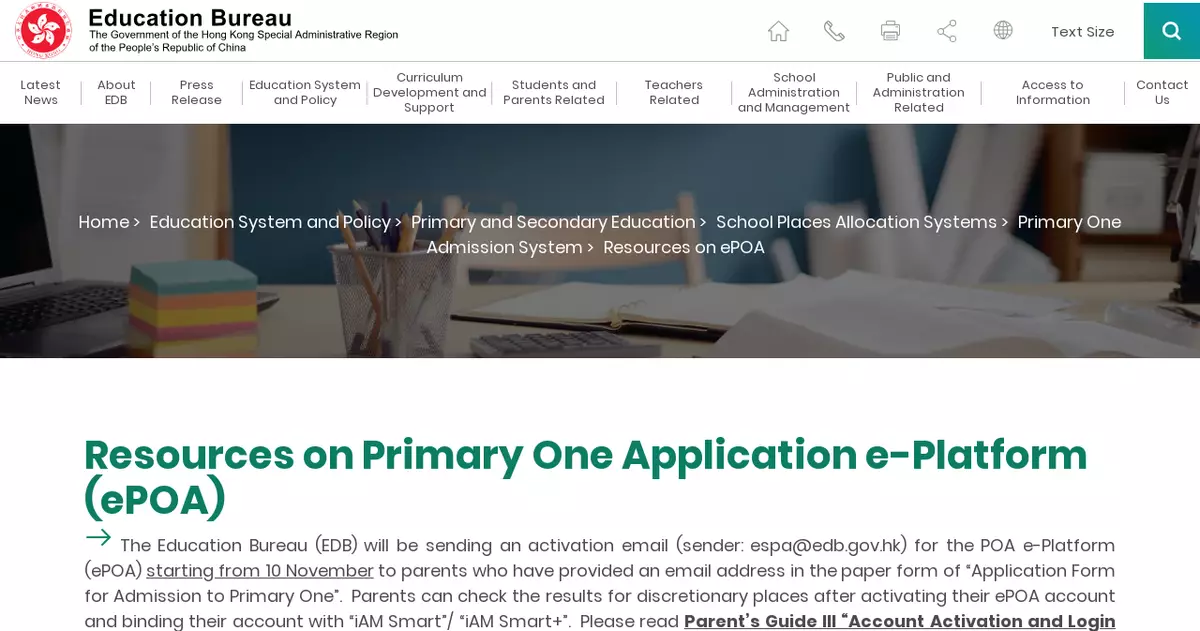
The Education Bureau (EDB) today (January 12) reminded parents that children who have joined the Primary One Admission (POA) System for 2026 but have not yet secured a discretionary place can take part in the Central Allocation process for a Primary One (P1) place in a government or aided primary school. Parents concerned should make their choice of schools within the period from January 19 to 25.

Digitalisation of POA

---------------------------

In line with the Smart Government strategy, the EDB has fully implemented digitalisation of the POA. Parents who have registered as POA e-Platform (ePOA) users and have bound their account to "iAM Smart+" may submit the Choice of Schools Form for Central Allocation from January 19 to 25 through the ePOA. Please refer to the related videos and Parent's Guide on the EDB's website (www.edb.gov.hk/en/edu-system/primary-secondary/spa-systems/primary-1-admission/poa_eplatform/index.html) for details of the procedures for activating and logging into an ePOA account and for making school choices for the Central Allocation of POA via the e-Platform.

Making school choices at Central Allocation Centres

-----------------------------------------------------------------

The EDB will send letters to parents on January 14 inviting them to make their choice of schools. To cater for the needs of different parents, parents can still submit the Choice of Schools Form in paper form by visiting the designated Central Allocation Centre at the suggested time slot (i.e. 9.30am to 12.30pm or 1.30pm to 4.30pm on January 24 (Saturday) or 9.30am to 12.30pm on January 25 (Sunday)) stated in the letter.

Parents who are ePOA users may choose to submit the Central Allocation Application via the ePOA or in paper form to the Central Allocation Centre but should not submit duplicate applications. Parents who have not yet received the letter by January 19 should call the School Places Allocation Section of the EDB (Hotline: 2832 7700) as soon as possible.

Only one parent of an applicant child is required to complete the school choice-making procedures. Parents are advised not to take their children to the Central Allocation Centre if possible. Parents who cannot make school choices within the suggested time slot can go to the designated Central Allocation Centre from 1.30pm to 4.30pm on January 25. The Choice of Schools Form will be sent together with the letter to parents who have submitted a paper Application Form at the Discretionary Places stage for filling out in advance.

In the event of adverse weather or other special conditions on any day during the period of making school choices, please pay heed to radio or television announcements on the relevant special arrangements.

Unable to submit application within specified choice-making period

------------------------------------------------------------------------------------

For individual parents who are unable to use the ePOA or go to the Central Allocation Centre to make school choices, they can authorise in writing a representative to bring the completed Choice of Schools Form and their signed Letter of Authorisation to the Central Allocation Centre to proceed with the related procedures.

To apply for POA 2026 for their children after January 25, parents need to complete necessary procedures with the School Places Allocation Section, which will separately arrange P1 places for the applicant children in June.

Change of residential address

--------------------------------------

An EDB spokesman reminded parents that, if they have recently moved their residence or have such plans in the near future, they are required to inform the School Places Allocation Section as soon as possible so that they can make school choices in the POA School Net where their new home is located. Parents should fill in the actual residential address of their child. If they provide a false address for securing a P1 place, the POA application of their child will be rendered void and the P1 place allocated will be withdrawn.

The EDB has put in place a monitoring mechanism to verify the residential addresses of applicant children as given by the parents. Random checks have also been stepped up. The public may call the School Places Allocation Section to report suspected cases of using a false address by parents for their children's POA application. The EDB will take action against false address cases.

Mechanism of Central Allocation

----------------------------------------

Central Allocation is composed of two parts. Part A, which takes up 10 per cent of the P1 places earmarked for Central Allocation, is for unrestricted school choices. Parents can choose up to three government or aided primary schools in any school net. Part B takes up the remaining 90 per cent of the P1 places earmarked for Central Allocation. Parents of applicant children residing in the school net concerned are to select schools from the "Choice of Schools List for Central Allocation (Primary One Admission 2026)" of their school net, while parents of applicant children who intend to commute daily to schools in Hong Kong are to select schools from the "2026 Choice of Schools List for Central Allocation (For Applicant Children who intend to commute daily to schools in Hong Kong)". Parents should fill in the Choice of Schools Form in the order of their preference.

The mechanism of the Central Allocation is based on parents' choices in general. The computer-programmed allocation will first process the school choices in Part A and then the school choices in Part B. For oversubscribed schools, the order of priority in allocating places will be determined by random numbers generated by the computer for individual applicants to ensure fairness.

For information about the procedures for Central Allocation, please call the EDB's 24-hour automatic telephone enquiry service at 2891 0088.

Release of Central Allocation results

----------------------------------------------

For parents who have already activated their ePOA account via "iAM Smart" or "iAM Smart+", they will receive their Central Allocation results through the ePOA from 10am on June 3. Parents who wish to receive the allocation results via SMS on June 3 may choose such an option in the Choice of Schools Form. In addition, the allocation results will be sent to parents by post on June 3 and 4.

Source: AI-found images

Source: AI-found images

Recommended Articles