Skip to Content Facebook Feature Image

Best Buy cuts its annual profit and sales outlook as it wrestles with tariffs

Business

Best Buy cuts its annual profit and sales outlook as it wrestles with tariffs
Business

Business

Best Buy cuts its annual profit and sales outlook as it wrestles with tariffs

2025-05-29 22:59 Last Updated At:23:01

NEW YORK (AP) — Best Buy cut its annual outlook on Thursday after the nation's largest consumer electronics chain reported a profit decline and stagnating sales for its fiscal first quarter amid shoppers' worries about the economy and tariffs.

The Minneapolis-based company said the outlook assumed that tariffs will remain at the current levels for the rest of the year, and “there is no material change in consumer behavior” in the trends it has seen in recent quarters.

Like other retailers, Best Buy has been wrestling with ever-changing tariff news. And adding more confusion was a federal court ruling on Wednesday that handed President Donald Trump a big setback, blocking his audacious plan to impose massive taxes on imports.

A three-judge panel of the U.S. Court of International Trade ruled that Trump overstepped his authority when he declared a national emergency to justify the sweeping tariffs.

That comes after Trump’s threatened 145% import taxes on Chinese goods were reduced to 30% in a deal announced May 12, with some of the higher tariffs on pause for 90 days. Trump on Friday threatened a 50% tax on all imports from the European Union as well as a 25% tariff on smartphones unless they’re made in America.

On Sunday, Trump said that the U.S. will delay implementation of a 50% tariff on goods from the EU until July 9 to negotiate.

During a media interview on Thursday, Best Buy CEO Corie Barry said the latest court decision underscored how volatile the tariff climate has been.

“I don’t think there’s anything we would do differently based on the news overnight,” Barry told reporters. “What I really tried to work with the team on is to not actually overreact to any given moment in time, but instead to stay maniacally focused on our customers and ensure we are bringing the right assortment, price, and (promotions) to them, whatever the backdrop.”

Barry told analysts that Best Buy has been taking a variety of steps to offset higher tariff costs like pushing its vendors to diversify their manufacturing. The company is increasing some prices to absorb tariff-related costs but called that a “last resort." She declined to be specific because the situation was fluid.

Best Buy has very little control of sourcing, directly importing only about 2% to 3% of its cost of goods sold, she reiterated. Barry noted that product costs that are flowing to Best Buy are lower than the tariff rates.

Barry said that China remains the No. 1 source for its products, estimating that the percentage of product cost it represents is approximately 30% to 35%, down from the 55% number it shared with analysts in March. That’s because suppliers are expanding production outside of China, among other actions. The U.S. and Mexico account for roughly 25% of its cost.

The Minneapolis-based company reported net income of $202 million, or 95 cents per share, for the three-month period ended May 3. That compares with $246 million, or $1.13 per share, a year ago.

Adjusted earnings was $1.15 per share.

Sales fell slightly to $8.77 billion from $8.85 billion.

Analysts were expecting $1.09 per share on sales of $8.81 billion

Comparable sales — those coming from established physical stores and online channels — slipped 0.7% in the quarter. Entertainment products, appliances and consumer electronics took a hit, while the company enjoyed sales growth in computing and mobile devices.

Shares slipped 9% in regular trading on Thursday.

Best Buy joins many other retailers trying to grappling with how to manage their business at a time when new tariff developments are happening almost every day.

Walmart, the nation’s largest retailer, got a public scolding from President Trump this month after it said that it has already raised prices on some items and would have to do so again this summer. Trump told the retail giant that it should “eat” the additional costs.

Macy's trimmed its annual forecast this week, while Target’s sales fell more than expected in the first quarter and warned they will continue to flag this year.

Best Buy said Thursday that it now expects annual earnings per share in the range of $6.15 to $6.30. That's down from the company's earlier per-share range of $6.20 to $6.60.

Analysts expect $6.13 per share, according to FactSet.

For the year, the company now expects sales between $41.1 billion and $41.9 billion, down from $41.4 billion to $42.2 billion.

Analysts expected $41.38 billion, according to FactSet.

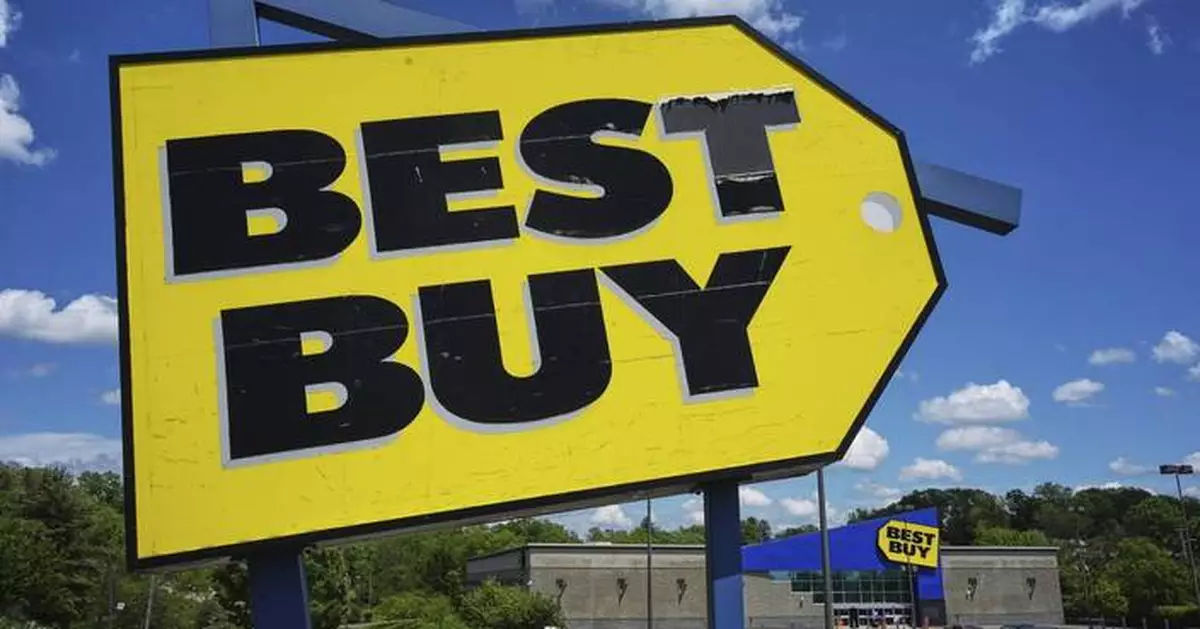
FILE - This is a sign outside a Best Buy store in Bethel Park, Pa., on Thursday, May 15, 2025. (AP Photo/Gene J. Puskar, file)
FILE - This is a sign outside a Best Buy store in Bethel Park, Pa., on Thursday, May 15, 2025. (AP Photo/Gene J. Puskar, file)
WASHINGTON (AP) — President Donald Trump is meeting with oil executives at the White House on Friday in hopes of securing $100 billion in investments to revive Venezuela’s ability to fully tap into its expansive reserves of petroleum — a plan that rides on their comfort in making commitments in a country plagued by instability, inflation and uncertainty.

Since the U.S. military raid to capture former Venezuelan leader Nicolás Maduro on Saturday, Trump has quickly pivoted to portraying the move as a newfound economic opportunity for the U.S., seizing tankers carrying Venezuelan oil, saying the U.S. is taking over the sales of 30 million to 50 million barrels of previously sanctioned Venezuelan oil and will be controlling sales worldwide indefinitely.

On Friday, U.S. forces seized their fifth tanker over the past month that has been linked to Venezuelan oil. The action reflected the determination of the U.S. to fully control the exporting, refining and production of Venezuelan petroleum, a sign of the Trump administration's plans for ongoing involvement in the sector as it seeks commitments from private companies.

It's all part of a broader push by Trump to keep gasoline prices low. At a time when many Americans are concerned about affordability, the incursion in Venezuela melds Trump’s assertive use of presidential powers with an optical spectacle meant to convince Americans that he can bring down energy prices.

The meeting, set for 2:30 p.m. EST, will be open to the news media, according to an update to the president's daily schedule. “At least 100 Billion Dollars will be invested by BIG OIL, all of whom I will be meeting with today at The White House,” Trump said Friday in a pre-dawn social media post.

Trump is set to meet with executives from 17 oil companies, according to the White House. Among the companies attending are Chevron, which still operates in Venezuela, and ExxonMobil and ConocoPhillips, which both had oil projects in the country that were lost as part of a 2007 nationalization of private businesses under Maduro’s predecessor, Hugo Chávez.

The president is meeting with a wide swath of domestic and international companies with interests ranging from construction to the commodity markets. Other companies slated to be at the meeting include Halliburton, Valero, Marathon, Shell, Singapore-based Trafigura, Italy-based Eni and Spain-based Repsol.

Large U.S. oil companies have so far largely refrained from affirming investments in Venezuela as contracts and guarantees need to be in place. Trump has suggested on social media that America would help to backstop any investments.

Venezuela’s oil production has slumped below one million barrels a day. Part of Trump's challenge to turn that around will be to convince oil companies that his administration has a stable relationship with Venezuela’s interim President Delcy Rodríguez, as well as protections for companies entering the market.

Secretary of State Marco Rubio, Energy Secretary Chris Wright and Interior Secretary Doug Burgum are slated to attend the oil executives meeting, according to the White House.

Meanwhile, the United States and Venezuelan governments said Friday they were exploring the possibility of r estoring diplomatic relations between the two countries, and that a delegation from the Trump administration arrived to the South American nation on Friday.

The small team of U.S. diplomats and diplomatic security officials traveled to Venezuela to make a preliminary assessment about the potential re-opening of the U.S. Embassy in Caracas, the State Department said in a statement.

Trump also announced on Friday he’d meet with President Gustavo Petro in early February, but called on the Colombian leader to make quick progress on stemming flow of cocaine into the U.S.

Trump, following the ouster of Maduro, had made vague threats to take similar action against Petro. Trump abruptly changed his tone Wednesday about his Colombian counterpart after a friendly phone call in which he invited Petro to visit the White House.

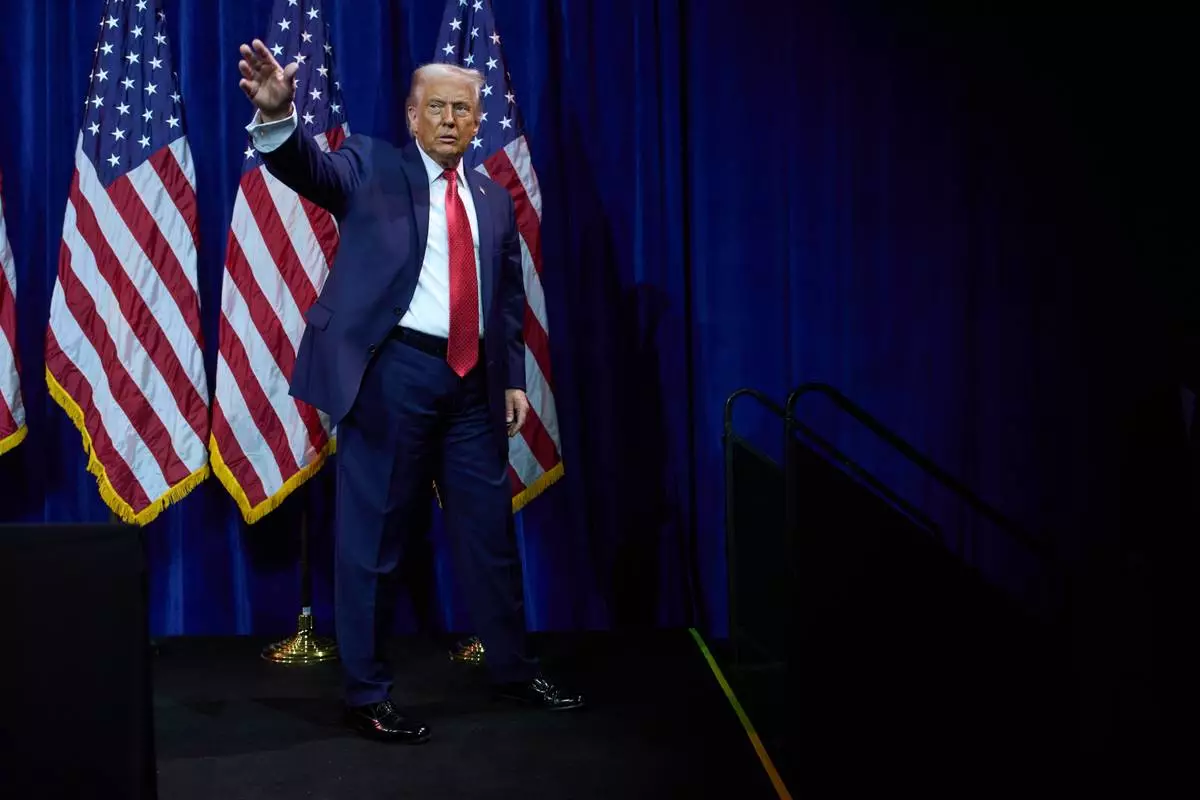
President Donald Trump waves as he walks off stage after speaking to House Republican lawmakers during their annual policy retreat, Tuesday, Jan. 6, 2026, in Washington. (AP Photo/Evan Vucci)

President Donald Trump waves as he walks off stage after speaking to House Republican lawmakers during their annual policy retreat, Tuesday, Jan. 6, 2026, in Washington. (AP Photo/Evan Vucci)

Recommended Articles