Skip to Content Facebook Feature Image

Wrongful death lawsuit says Big Oil contributed to heat wave and woman's death

Business

Wrongful death lawsuit says Big Oil contributed to heat wave and woman's death
Business

Business

Wrongful death lawsuit says Big Oil contributed to heat wave and woman's death

2025-05-30 09:41 Last Updated At:09:50

In one of the nation’s first wrongful-death claims seeking to hold the fossil fuel industry accountable for its role in the changing climate, a Washington state woman is suing seven oil and gas companies, saying they contributed to an extraordinarily hot day that led to her mother's fatal hyperthermia.

The lawsuit filed in state court this week says the companies knew that their products have altered the climate, including contributing to a 2021 heat wave in the Pacific Northwest that killed 65-year-old Juliana Leon, and that they failed to warn the public of such risks.

On June 28, 2021, an unusual heat wave culminated in a 108-degrees Fahrenheit (42.22 degrees Celsius) day — the hottest ever recorded in the state, according to the filing. Leon had just driven 100 miles from home for an appointment, and she rolled down her windows on the way back because her car's air conditioning wasn't working.

Leon pulled over and parked her car in a residential area, according to the lawsuit. She was found unconscious behind the wheel when a bystander called for help. Despite medical interventions, Leon died.

The filing names Exxon Mobil, Chevron, Shell, BP, ConocoPhillips, Phillips 66 and BP subsidiary Olympic Pipeline Company.

“Defendants knew that their fossil fuel products were already altering the earth’s atmosphere,” when Juliana was born, Thursday’s filing said. “By 1968, Defendants understood that the fossil fuel-dependent economy they were creating and perpetuating would intensify those atmospheric changes, resulting in more frequent and destructive weather disasters and foreseeable loss of human life.”

The filing adds: “The extreme heat that killed Julie was directly linked to fossil fuel-driven alteration of the climate.”

Chevron Corporation counsel Theodore Boutrous Jr. said in a statement: “Exploiting a personal tragedy to promote politicized climate tort litigation is contrary to law, science, and common sense. The court should add this far-fetched claim to the growing list of meritless climate lawsuits that state and federal courts have already dismissed.”

ConocoPhillips, BP, Shell and BP subsidiary Olympic Pipeline Company declined to comment when reached by The Associated Press. The other companies did not respond to requests for comment.

The lawsuit accuses the companies of hiding, downplaying and misrepresenting the risks of climate change caused by humans burning oil and gas and obstructing research.

International climate researchers said in a peer-reviewed analysis that the 2021 “heat dome” was “virtually impossible without human-caused climate change.”

Scientists have broadly attributed the record-breaking, more frequent, longer-lasting and increasingly deadly heat waves around the world to climate change that they say is a result of burning fossil fuels. Oil and gas are fossil fuels that, when burned, emit planet-warming greenhouse gas emissions, such as carbon dioxide.

“We’ve seen a really advanced scientific understanding about the specific effects that climate change can cause in individual extreme weather events,” said Korey Silverman-Roati, a senior fellow at the Columbia Law School's Sabin Center for Climate Change Law. “Scientists today are a lot more confident in saying that but for climate change, this would not have happened."

Silverman-Roati said the specificity of the case could clarify for people the consequences of climate change and the potential consequences of company behavior.

The lawsuit was first reported by The New York Times.

“Big Oil companies have known for decades that their products would cause catastrophic climate disasters that would become more deadly and destructive if they didn’t change their business model,” said Richard Wiles, president of the Center for Climate Integrity, said in a statement on the case. “But instead of warning the public and taking steps to save lives, Big Oil lied and deliberately accelerated the problem.”

States and cities have long gone after fossil fuel industry stakeholders for contributing to the planet’s warming. Recently, Hawaii and Michigan announced plans for legal action against fossil fuel companies for harms caused by climate change, though the states have been met by counter lawsuits from the U.S. Justice Department.

The Trump administration has been quick to disregard climate change and has moved against initiatives aimed at combating it. The U.S. withdrew from the Paris climate agreement. The National Oceanic and Atmospheric Administration — an agency whose weather forecasting and research workforce has been gutted — will no longer track the cost of weather disasters fueled by climate change. And the Environmental Protection Agency has been called on to a rewrite its long-standing findings that determined planet-warming greenhouse gases endanger public health and welfare.

Meanwhile, the federal government has ramped up support for oil and gas production in the name of an “American energy dominance” agenda, and it rolled back a host of other efforts and projects to address climate change.

Around the world, other climate cases are being watched closely as potentially setting unique precedent in the effort to hold major polluters accountable. A German court ruled this week against a Peruvian farmer who claimed an energy company's greenhouse gas emissions fueled global warming and put his home at risk.

Still, a case that looks to argue these companies should be held liable for an individual’s death is rare. Misti Leon is seeking unspecified monetary damages.

“Looking ahead, it’s hard to imagine this will be an isolated incident,” said Don Braman, associate professor at George Washington University Law School. "We’re facing an escalating climate crisis. It’s a sobering thought that this year, the hottest on record, will almost certainly be one of the coolest we’ll experience for the foreseeable future.

“It is predictable or — to use a legal term, foreseeable — that the loss of life from these climate-fueled disasters will likely accelerate as climate chaos intensifies,” he added. “At the heart of all this is the argument about the culpability of fossil fuel companies, and it rests on a large and growing body of evidence that these companies have understood the dangers of their products for decades.”

Alexa St. John is an Associated Press climate reporter. Follow her on X: @alexa_stjohn. Reach her at ast.john@ap.org.

Read more of AP’s climate coverage at http://www.apnews.com/climate-and-environment

The Associated Press’ climate and environmental coverage receives financial support from multiple private foundations. AP is solely responsible for all content. Find AP’s standards for working with philanthropies, a list of supporters and funded coverage areas at AP.org.
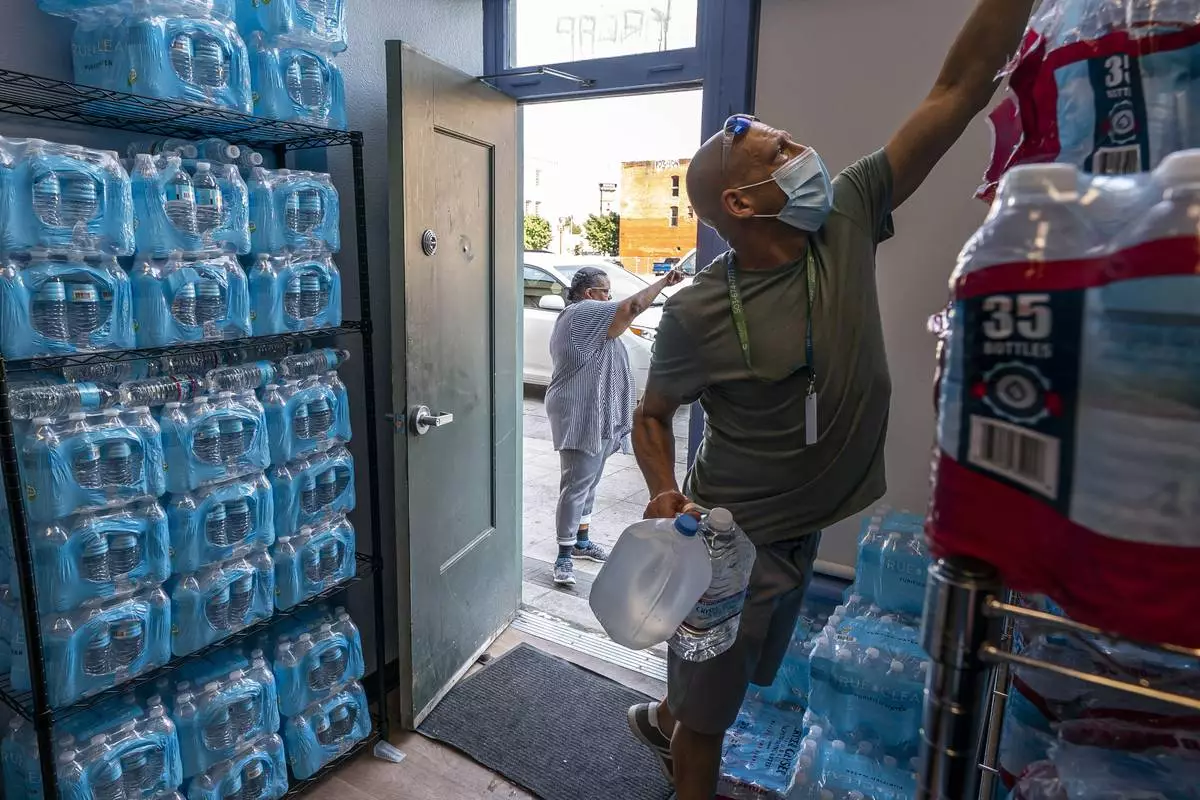
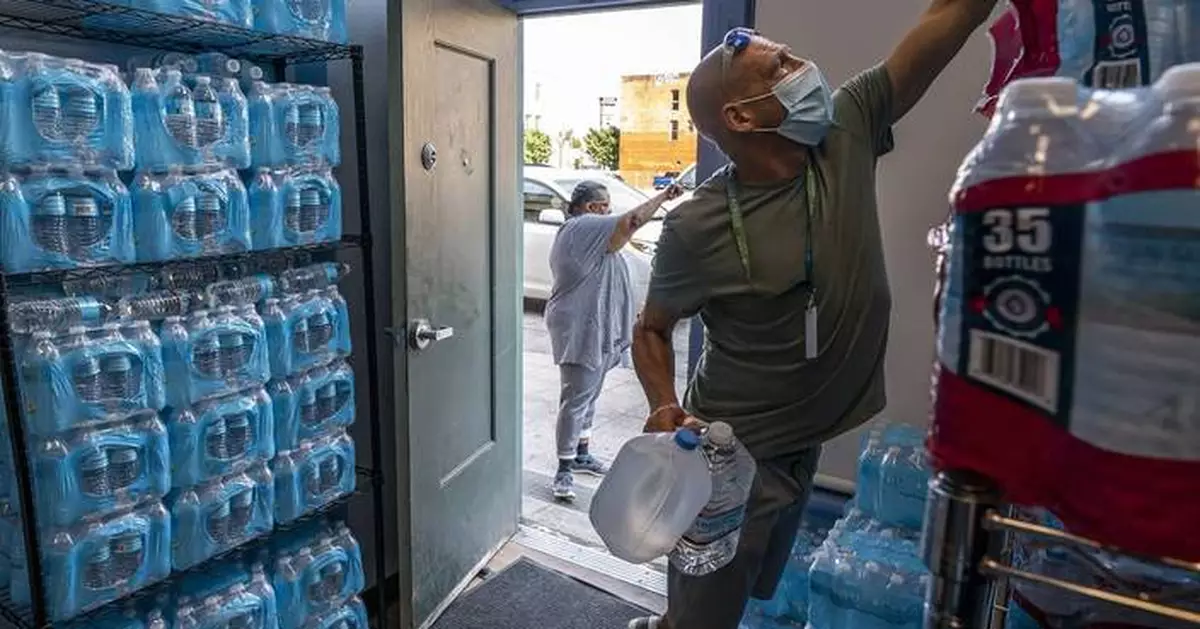
FILE - Chris Cowan, with Cascadia Behavioral Healthcare's street outreach team, loads water and other cooling supplies before visiting homeless camps on Aug. 12, 2021, in Portland, Ore. (AP Photo/Nathan Howard, File)


FILE - Chris Cowan, with Cascadia Behavioral Healthcare's street outreach team, loads water and other cooling supplies before visiting homeless camps on Aug. 12, 2021, in Portland, Ore. (AP Photo/Nathan Howard, File)

WASHINGTON (AP) — Becky Pepper-Jackson finished third in the discus throw in West Virginia last year though she was in just her first year of high school. Now a 15-year-old sophomore, Pepper-Jackson is aware that her upcoming season could be her last.

West Virginia has banned transgender girls like Pepper-Jackson from competing in girls and women's sports, and is among the more than two dozen states with similar laws. Though the West Virginia law has been blocked by lower courts, the outcome could be different at the conservative-dominated Supreme Court, which has allowed multiple restrictions on transgender people to be enforced in the past year.

The justices are hearing arguments Tuesday in two cases over whether the sports bans violate the Constitution or the landmark federal law known as Title IX that prohibits sex discrimination in education. The second case comes from Idaho, where college student Lindsay Hecox challenged that state's law.

Decisions are expected by early summer.

President Donald Trump's Republican administration has targeted transgender Americans from the first day of his second term, including ousting transgender people from the military and declaring that gender is immutable and determined at birth.

Pepper-Jackson has become the face of the nationwide battle over the participation of transgender girls in athletics that has played out at both the state and federal levels as Republicans have leveraged the issue as a fight for athletic fairness for women and girls.

“I think it’s something that needs to be done,” Pepper-Jackson said in an interview with The Associated Press that was conducted over Zoom. “It’s something I’m here to do because ... this is important to me. I know it’s important to other people. So, like, I’m here for it.”

She sat alongside her mother, Heather Jackson, on a sofa in their home just outside Bridgeport, a rural West Virginia community about 40 miles southwest of Morgantown, to talk about a legal fight that began when she was a middle schooler who finished near the back of the pack in cross-country races.

Pepper-Jackson has grown into a competitive discus and shot put thrower. In addition to the bronze medal in the discus, she finished eighth among shot putters.

She attributes her success to hard work, practicing at school and in her backyard, and lifting weights. Pepper-Jackson has been taking puberty-blocking medication and has publicly identified as a girl since she was in the third grade, though the Supreme Court's decision in June upholding state bans on gender-affirming medical treatment for minors has forced her to go out of state for care.

Her very improvement as an athlete has been cited as a reason she should not be allowed to compete against girls.

“There are immutable physical and biological characteristic differences between men and women that make men bigger, stronger, and faster than women. And if we allow biological males to play sports against biological females, those differences will erode the ability and the places for women in these sports which we have fought so hard for over the last 50 years,” West Virginia's attorney general, JB McCuskey, said in an AP interview. McCuskey said he is not aware of any other transgender athlete in the state who has competed or is trying to compete in girls or women’s sports.

Despite the small numbers of transgender athletes, the issue has taken on outsize importance. The NCAA and the U.S. Olympic and Paralympic Committees banned transgender women from women's sports after Trump signed an executive order aimed at barring their participation.

The public generally is supportive of the limits. An Associated Press-NORC Center for Public Affairs Research poll conducted in October 2025 found that about 6 in 10 U.S. adults “strongly” or “somewhat” favored requiring transgender children and teenagers to only compete on sports teams that match the sex they were assigned at birth, not the gender they identify with, while about 2 in 10 were “strongly” or “somewhat” opposed and about one-quarter did not have an opinion.

About 2.1 million adults, or 0.8%, and 724,000 people age 13 to 17, or 3.3%, identify as transgender in the U.S., according to the Williams Institute at the UCLA School of Law.

Those allied with the administration on the issue paint it in broader terms than just sports, pointing to state laws, Trump administration policies and court rulings against transgender people.

"I think there are cultural, political, legal headwinds all supporting this notion that it’s just a lie that a man can be a woman," said John Bursch, a lawyer with the conservative Christian law firm Alliance Defending Freedom that has led the legal campaign against transgender people. “And if we want a society that respects women and girls, then we need to come to terms with that truth. And the sooner that we do that, the better it will be for women everywhere, whether that be in high school sports teams, high school locker rooms and showers, abused women’s shelters, women’s prisons.”

But Heather Jackson offered different terms to describe the effort to keep her daughter off West Virginia's playing fields.

“Hatred. It’s nothing but hatred,” she said. "This community is the community du jour. We have a long history of isolating marginalized parts of the community.”

Pepper-Jackson has seen some of the uglier side of the debate on display, including when a competitor wore a T-shirt at the championship meet that said, “Men Don't Belong in Women's Sports.”

“I wish these people would educate themselves. Just so they would know that I’m just there to have a good time. That’s it. But it just, it hurts sometimes, like, it gets to me sometimes, but I try to brush it off,” she said.

One schoolmate, identified as A.C. in court papers, said Pepper-Jackson has herself used graphic language in sexually bullying her teammates.

Asked whether she said any of what is alleged, Pepper-Jackson said, “I did not. And the school ruled that there was no evidence to prove that it was true.”

The legal fight will turn on whether the Constitution's equal protection clause or the Title IX anti-discrimination law protects transgender people.

The court ruled in 2020 that workplace discrimination against transgender people is sex discrimination, but refused to extend the logic of that decision to the case over health care for transgender minors.

The court has been deluged by dueling legal briefs from Republican- and Democratic-led states, members of Congress, athletes, doctors, scientists and scholars.

The outcome also could influence separate legal efforts seeking to bar transgender athletes in states that have continued to allow them to compete.

If Pepper-Jackson is forced to stop competing, she said she will still be able to lift weights and continue playing trumpet in the school concert and jazz bands.

“It will hurt a lot, and I know it will, but that’s what I’ll have to do,” she said.

Heather Jackson, left, and Becky Pepper-Jackson pose for a photograph outside of the U.S. Supreme Court in Washington, Sunday, Jan. 11, 2026. (AP Photo/Jose Luis Magana)

Heather Jackson, left, and Becky Pepper-Jackson pose for a photograph outside of the U.S. Supreme Court in Washington, Sunday, Jan. 11, 2026. (AP Photo/Jose Luis Magana)

Heather Jackson, left, and Becky Pepper-Jackson pose for a photograph outside of the U.S. Supreme Court in Washington, Sunday, Jan. 11, 2026. (AP Photo/Jose Luis Magana)

Heather Jackson, left, and Becky Pepper-Jackson pose for a photograph outside of the U.S. Supreme Court in Washington, Sunday, Jan. 11, 2026. (AP Photo/Jose Luis Magana)

Becky Pepper-Jackson poses for a photograph outside of the U.S. Supreme Court in Washington, Sunday, Jan. 11, 2026. (AP Photo/Jose Luis Magana)

Becky Pepper-Jackson poses for a photograph outside of the U.S. Supreme Court in Washington, Sunday, Jan. 11, 2026. (AP Photo/Jose Luis Magana)

The Supreme Court stands is Washington, Friday, Jan. 9, 2026. (AP Photo/J. Scott Applewhite)

The Supreme Court stands is Washington, Friday, Jan. 9, 2026. (AP Photo/J. Scott Applewhite)

FILE - Protestors hold signs during a rally at the state capitol in Charleston, W.Va., on March 9, 2023. (AP Photo/Chris Jackson, file)

FILE - Protestors hold signs during a rally at the state capitol in Charleston, W.Va., on March 9, 2023. (AP Photo/Chris Jackson, file)

Recommended Articles