European "hidden champions" -- small and medium-sized enterprises (SMEs) that lead in niche industries -- affirmed their strategic interest in China at the 2025 China-Germany (Europe) Hidden Champions Forum.
More than 100 representatives from such companies gathered at the forum, which ran from May 25-27. Participation more than doubled compared to last year, signaling clear intent to deepen investment and cooperation.
"Last year, my delegation, there were around about 60 companies. This year, [there are] more than 150. I think this shows everything," said Walter Doring, chairman of the Senate of Economy Europe and chairman of the Organizing Committee of the Summit of World Market Leaders (World Hidden Champion Summit).
"China is growing to be a major manufacturing country, a strong manufacturing powerhouse, with impressive innovation capabilities. China has a vast market, while Germany has a lot of advanced technologies. Therefore, these small and medium-sized enterprises are eager to expand internationally, seeking opportunities to collaborate and enter the Chinese market," said Yang Ming, vice chairman of the Senate of Economy Europe and the Chinese representative of the Summit of World Market Leaders (World Hidden Champion Summit).
European hidden champions plan to increase their investment in the Chinese market, as China continues to expand its role as a global manufacturing powerhouse.
"We've invested about 500 million euros in China. We want to expand cooperation to more areas where we are active, such as electronics and the fastening technology," said Harald Unkelbach, a board member of Wurth Group, a German multinational corporation and the global market leader in fastening materials.
"This 'something more' could be to have our own sales representative here, or to have our assembly line here, or even more, bigger production. Now is the point to increase this market share. We need to be present here in the country," said Carlos Riveros, managing director of valve technology firm M-tech GmbH.
"On exhibitions and so on all over the world, we get a lot of questions from Chinese scientists, from Chinese doctors. And so this is the reason why we said, OK, this is it. We will come here. We will find partners that just want to get the product and to sell them, or do we find partners who really say, 'OK, we would like to produce in China.' We are completely open for that," said Anita Frauwallner, the president of the Institut Allergosan, which is dedicated to microbiome research.
Beyond investment, European businesses are exploring long-term collaboration models through regulatory alignment and joint innovation.
"I really suggest in future to create common teams, to concentrate on priorities, on discipline priorities, to get the regulation, the agreement of our governments, and to start to work on specialized application," said Jivka Ovtcharova, an EU commission advisor and head of the Institute for Information Management in Engineering with the Karlsruhe Institute of Technology, a German public research university and research center.
"We are very happy that we already can celebrate the 50th anniversary of our mutual cooperation. I think it is most important today that we go on cooperating, especially in this moment. Oh, I think there are lots of promising areas, particularly of course, in the machineries, but also all sorts of high-tech qualities," said Benita Ferrero-Waldner, former EU trade commissioner and vice chairman of the European Senate of Economy.
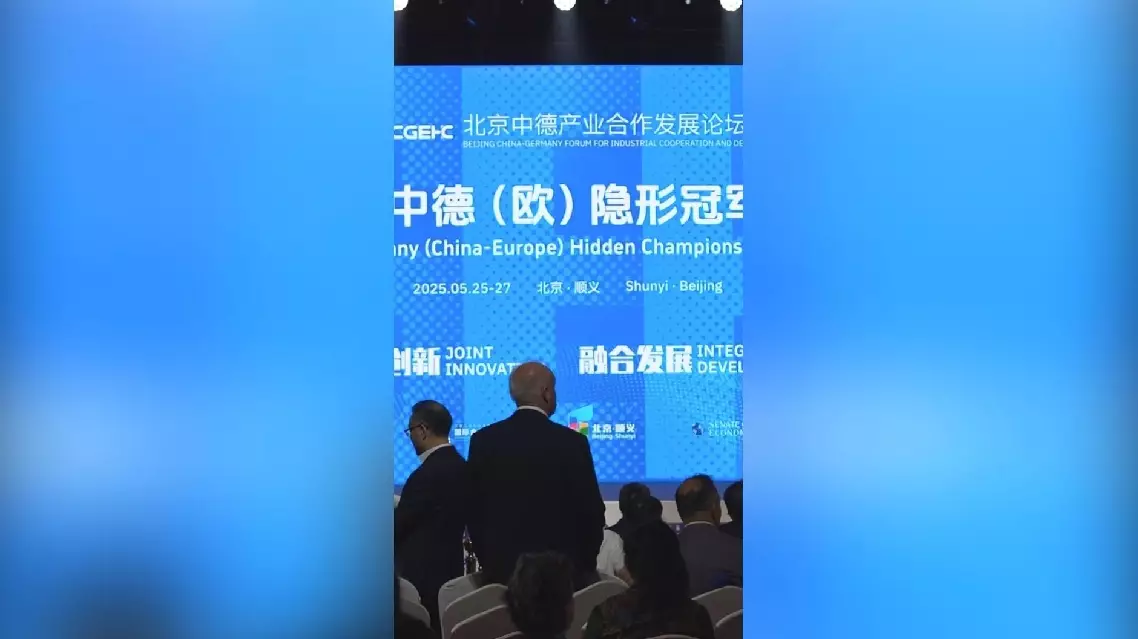
European "hidden champion" companies eye opportunities in Chinese market