Skip to Content Facebook Feature Image

Putin’s tough stance on a Ukraine peace plan shows his resolve on Russia’s demands

News

Putin’s tough stance on a Ukraine peace plan shows his resolve on Russia’s demands
News

News

Putin’s tough stance on a Ukraine peace plan shows his resolve on Russia’s demands

2025-06-01 12:09 Last Updated At:12:41

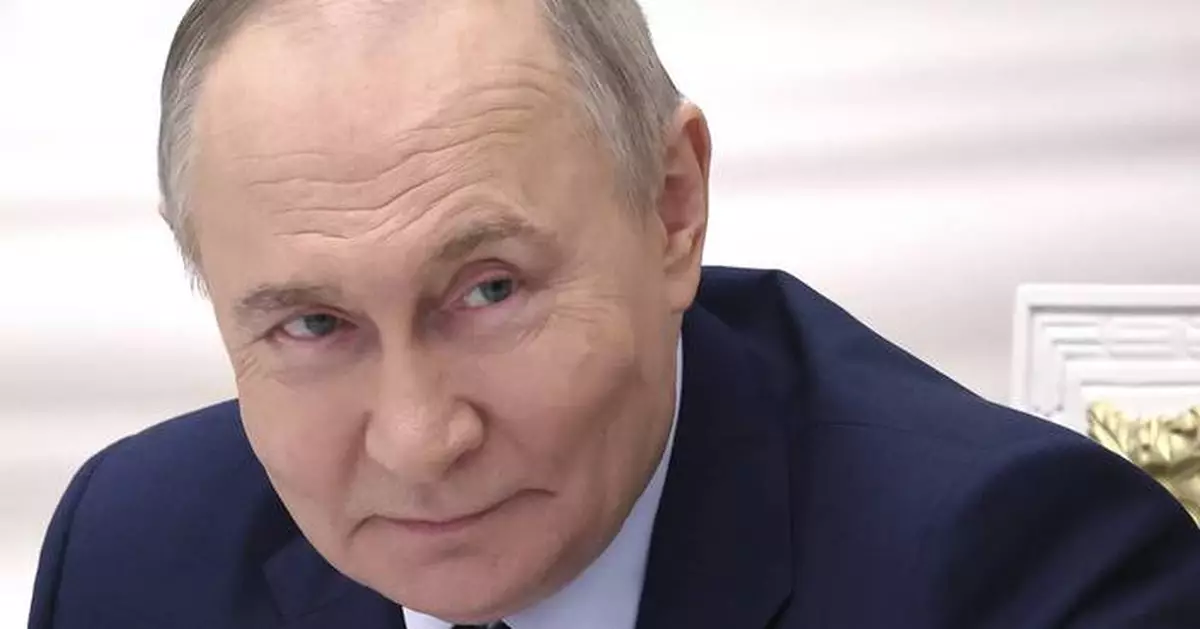
By making harsh, uncompromising demands in peace talks with Ukraine while continuing to pummel it with waves of missiles and drones, Russian President Vladimir Putin is sending a clear message: He will only accept a settlement on his terms and will keep fighting until they're met.

At the same time, he has sought to avoid angering U.S. President Donald Trump by praising his diplomacy and declaring Moscow’s openness to peace talks — even as he set maximalist conditions that are rejected by Kyiv and the West.

Trump, who once promised to end the 3-year-old war in 24 hours, has upended the U.S. policy of isolating Russia by holding calls with Putin and denigrating Ukrainian President Volodymyr Zelenskyy. At the same time, however, Trump warned Putin against “tapping me along” and threatened Moscow with sanctions if it fails to back his peace proposals.

In recent days, Trump signaled he was losing patience with Putin, declaring the Russian leader had gone “crazy” by stepping up aerial attacks on Ukraine. He also said: “What Vladimir Putin doesn’t realize is that if it weren’t for me, lots of really bad things would have already happened to Russia, and I mean REALLY BAD. He’s playing with fire!”

Dmitry Medvedev, a former Russian president who serves as deputy head of Putin’s Security Council, fired back: “I only know of one REALLY BAD thing — WWIII. I hope Trump understands this!”

Fyodor Lukyanov, a Moscow-based analyst familiar with Kremlin thinking, said Putin is engaged in a “psychological game” with Trump, with both men thinking they understand each other well.

“Putin’s tactics is apparently based on an assumption that the issue has a lesser priority for his interlocutor, who wants to get rid of it one way or another, while for the Russian side, nothing compares to it in importance,” Lukyanov wrote a commentary. “In this logic, the one who sees it as something of lesser importance will eventually make concessions.”

While Ukraine’s European allies urge Trump to ramp up sanctions against Moscow to force it to accept a ceasefire, some fear that Trump may end up distancing the U.S. from the conflict. If the U.S. halts or reduces military aid to Kyiv, it would badly erode Ukraine’s fighting capability.

Kyiv already is experiencing a weapons shortage, particularly air defense systems, leaving it increasingly vulnerable to Russian missile and drone attacks.

Across the over 1,000-kilometer (over 600-mile) front line, the exhausted and outgunned Ukrainian troops are facing increasing Russian pressure. This month, Russian forces accelerated their slow push across the Donetsk region, the focus of Moscow’s offensive, grinding through Ukrainian defenses at the quickest pace since last fall. Russia also expanded its attacks in the northeastern Sumy and Kharkiv regions following Putin’s promise to create a buffer zone along the border.

Many observers expect Russia to expand its offensive over the summer to try to capture more land and set even tougher conditions for peace.

“Moscow thinks its leverage over Ukraine will build over time, and since Trump has strongly implied that he will withdraw from negotiations the Russian military is set to intensify its operations,” said Jack Watling of the Royal United Services Institute in London. He predicted Russia would intensify efforts to take all of the Donetsk region while also pressing a bombing campaign.

“The Kremlin will want to suggest a deteriorating situation as negotiations continue and to signal to Europe that the rear is not safe, to discourage European militaries from putting forces in country,” Watling said in an analysis.

Sergei Markov, a pro-Kremlin, Moscow-based analyst, said the long-expected offensive hasn’t yet begun in earnest as Russia is cautious not to anger Trump. “If Kyiv derails peace talks, the Russian army will start a big offensive,” he said.

Putin has demanded that Ukraine withdraw its forces from Donetsk, Luhansk, Zaporizhzhia and Kherson — the four regions that Russia illegally annexed in September 2022 but never fully controlled. That demand had been rejected by Kyiv and its allies, but the Russian delegation reportedly repeated it during talks with Ukraine in Istanbul on May 16.

Those talks, the first since botched negotiations in the opening weeks of the war, came after Putin effectively rejected a 30-day truce proposed by Trump that was accepted by Kyiv. Russia had linked such a ceasefire to a halt in Ukraine’s mobilization effort and a freeze on Western arms supplies.

Putin proposed talks to discuss conditions for a possible truce. Trump quickly prodded Kyiv to accept the offer, but the negotiations yielded no immediate progress except an agreement to exchange 1,000 prisoners each.

Russia offered to hold another round of talks Monday in Istanbul, where it said it will present a memorandum setting conditions for ending hostilities. It refused to share the document before the negotiations.

Some observers see the talks as an attempt by Putin to assuage Trump’s growing impatience.

“Putin has devised a way to offer Trump an interim, tangible outcome from Washington’s peace efforts without making any real concessions,” said Tatiana Stanovaya of the Carnegie Russia Eurasia Center.

Facing Western accusations of stalling, the Kremlin responded that the conflict can’t be resolved quickly and emphasized the need to address its “root causes.”

When Putin invaded Ukraine, he said the move was needed to prevent Ukraine from joining NATO and protect Russian speakers in the country -– arguments strongly rejected by Kyiv and its Western allies as a cover for an unprovoked act of aggression.

Along with those demands, Putin also wants limits on Ukraine's sovereignty, including the size of Ukraine's military, and for Kyiv to end what Moscow sees as glorification of Ukraine’s World War II-era nationalist leaders, some of whom sided with the invading forces of Nazi Germany over the Soviet leadership in the Kremlin.

Seeking to underline that Moscow will press home its initial demands, Putin appointed his aide Vladimir Medinsky to lead the Russian delegation in Istanbul. He also led the Russian side in the 2022 talks. Kyiv reportedly has asked the U.S. to encourage Putin to replace him.

The soft-spoken, 54-year-old career bureaucrat, who was born in Ukraine, ascended through the Kremlin ranks after writing a series of books exposing purported Western plots against Russia.

In an interview with Russian state television after the May 16 talks, Medinsky pointed to Russia’s 18th century war with Sweden that lasted 21 years, a signal that Moscow is prepared to fight for a long time until its demands are met.

“History repeats itself in a remarkable way,” he said.
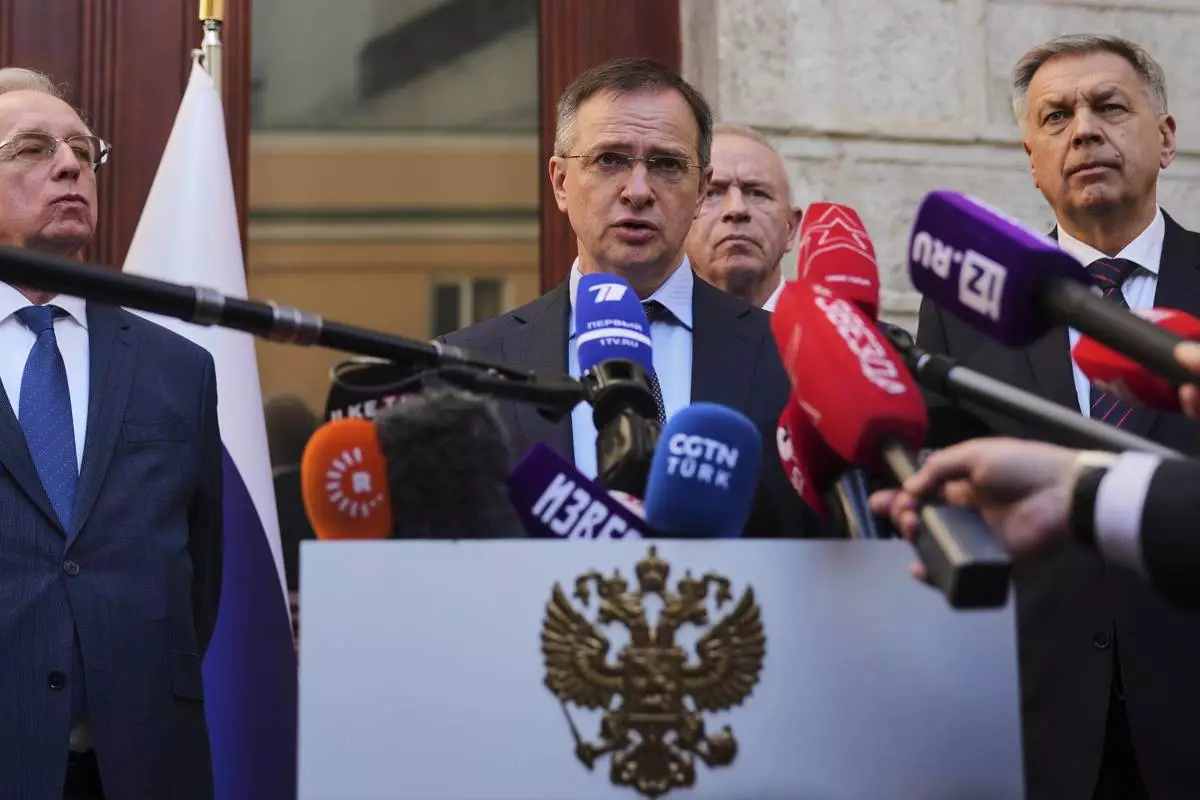
Russian presidential aide Vladimir Medinsky gives an statement to journalists at the Russian Consulate in Istanbul, Turkey, Thursday, May 15, 2025. (AP Photo/Francisco Seco)

Russian presidential aide Vladimir Medinsky gives an statement to journalists at the Russian Consulate in Istanbul, Turkey, Thursday, May 15, 2025. (AP Photo/Francisco Seco)

President Donald Trump acknowledges reporters as he disembarks Marine One upon arrival on the South Lawn of the White House in Washington, Sunday, May 25, 2025. (AP Photo/Rod Lamkey, Jr.)
President Donald Trump acknowledges reporters as he disembarks Marine One upon arrival on the South Lawn of the White House in Washington, Sunday, May 25, 2025. (AP Photo/Rod Lamkey, Jr.)

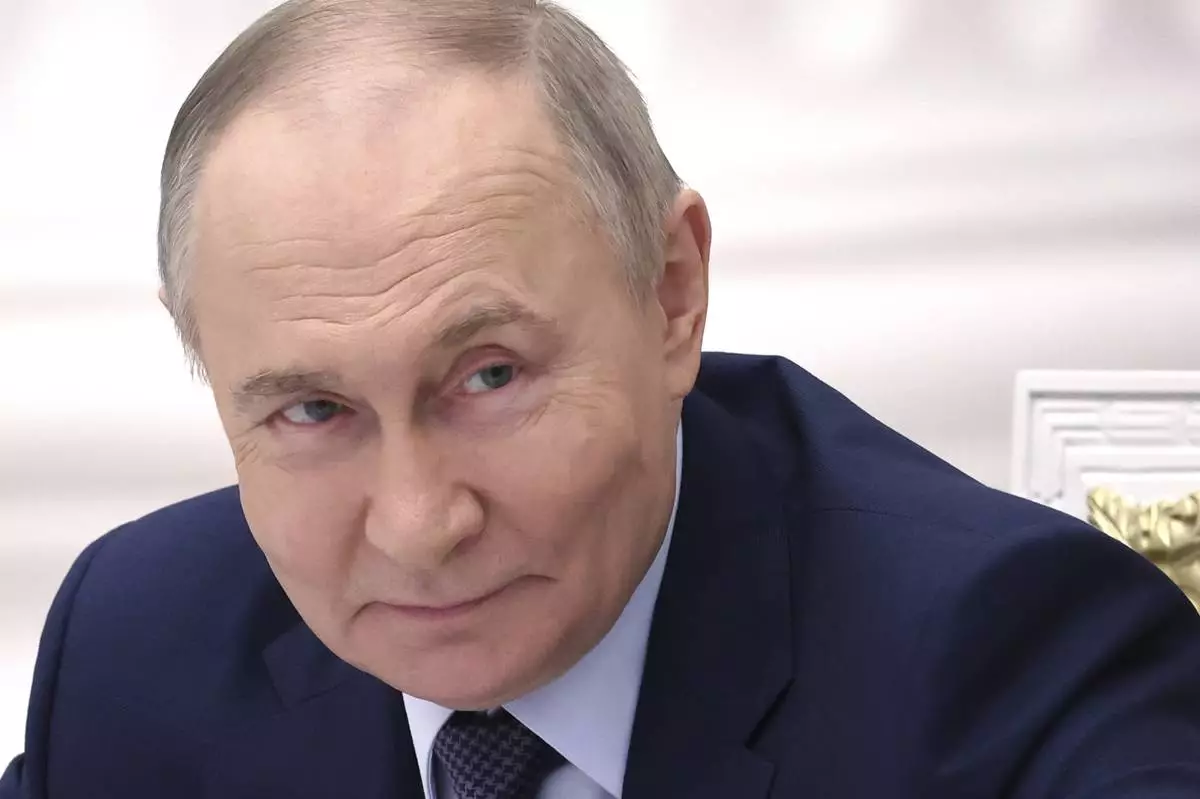
Russian President Vladimir Putin attends a meeting of the Russia - Land of Opportunities Supervisory Board at the Kremlin in Moscow, Tuesday, May 27, 2025. (Alexander Kazakov, Sputnik, Kremlin Pool Photo via AP)

Russian President Vladimir Putin attends a meeting of the Russia - Land of Opportunities Supervisory Board at the Kremlin in Moscow, Tuesday, May 27, 2025. (Alexander Kazakov, Sputnik, Kremlin Pool Photo via AP)
RHO, Italy (AP) — No ice is colder and harder than speedskating ice. The precision it takes has meant that Olympic speedskaters have never competed for gold on a temporary indoor rink – until the 2026 Milan Cortina Winter Games.

In the pursuit of maximum glide and minimum friction, Olympic officials brought on ice master Mark Messer, a veteran of six previous Olympic speedskating tracks and the ice technician in charge of the Olympic Oval in Calgary, Canada — one of the fastest tracks in the world with over 300 records.

Messer has been putting that experience to work one thin layer of ice at a time since the end of October at the new Speed Skating Stadium, built inside adjacent trade fair halls in the city of Rho just north of Milan.

“It’s one of the biggest challenges I’ve had in icemaking,’’ Messer said during an interview less than two weeks into the process.

If Goldilocks were a speedskater, hockey ice would be medium hard, for fast puck movement and sharp turns. Figure skating ice would be softer, allowing push off for jumps and so the ice doesn’t shatter on landing. Curling ice is the softest and warmest of all, for controlled sliding.

For speedskating ice to be just right, it must be hard, cold and clean. And very, very smooth.

“The blades are so sharp, that if there is some dirt, the blade will lose the edge,’’ Messer said, and the skater will lose speed.

Speedskater Enrico Fabris, who won two Olympic golds in Turin in 2006, has traded in his skates to be deputy sports manager at the speedskating venue in Rho. For him, perfect ice means the conditions are the same for all skaters — and then if it's fast ice, so much the better.

"It's more of a pleasure to skate on this ice,'' he said.

Messer’s first Olympics were in Calgary in 1988 — the first time speedskating was held indoors. “That gave us some advantages because we didn’t have to worry about the weather, wind blowing or rain,’’ he said. Now he is upping the challenge by becoming the first ice master to build a temporary rink for the Olympics.

Before Messer arrived in Italy, workers spent weeks setting up insulation to level the floor and then a network of pipes and rubber tubes that carry glycol — an antifreeze — that is brought down to minus 7 or minus 8 degrees Celsius (17.6 to 19.4 degrees Fahrenheit) to make the ice.

Water is run through a purification system — but it can’t be too pure, or the ice that forms will be too brittle. Just the right amount of impurities “holds the ice together,’’ Messer said.

The first layers of water are applied slowly, with a spray nozzle; after the ice reaches a few centimeters it is painted white — a full day’s work — and the stripes are added to make lanes.

“The first one takes about 45 minutes. And then as soon as it freezes, we go back and do it again, and again and again. So we do it hundreds of times,’’ Messer said.

As the ice gets thicker, and is more stable, workers apply subsequent layers of water with hoses. Messer attaches his hose to hockey sticks for easier spreading.

What must absolutely be avoided is dirt, dust or frost — all of which can cause friction for the skaters, slowing them down. The goal is that when the skaters push “they can go as far as possible with the least amount of effort,’’ Messer said.

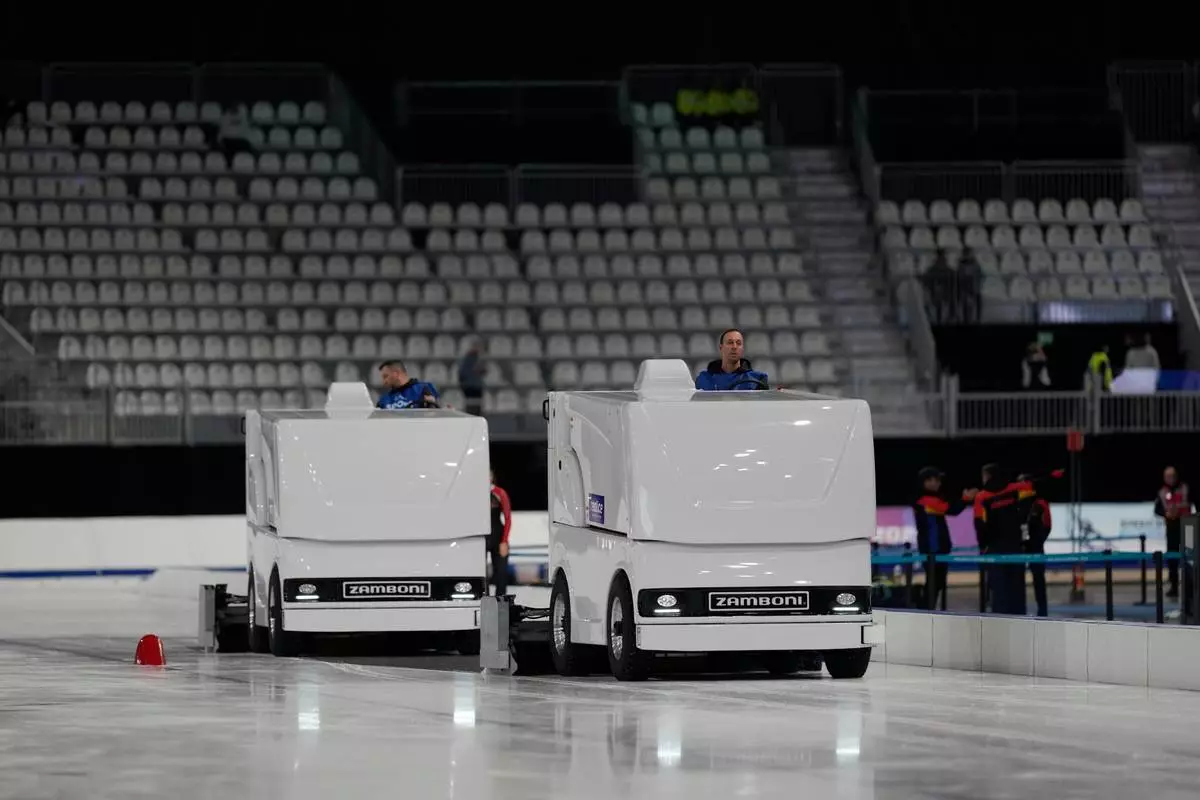
The Zamboni ice resurfacing machine plays a key role in keeping the track clean, cutting off a layer and spraying water to make a new surface.

One challenge is gauging how quickly the water from the resurfacing machine freezes in the temporary rink.

Another is getting the ice to the right thickness so that the Zamboni, weighing in at six tons, doesn’t shift the insulation, rubber tubing or ice itself.

“When you drive that out, if there’s anything moving it will move. We don’t want that,’’ Messer said.

The rink got its first big test on Nov. 29-30 during a Junior World Cup event. In a permanent rink, test events are usually held a year before the Olympics, leaving more time for adjustments. “We have a very small window to learn,’’ Messer acknowledged.

Dutch speedskater Kayo Vos, who won the men’s neo-senior 1,000 meters, said the ice was a little soft — but Messer didn’t seem too concerned.

“We went very modest to start, now we can start to change the temperatures and try to make it faster and still maintain it as a safe ice,’’ he said.

Fine-tuning the air temperature and humidity and ice temperature must be done methodically — taking into account that there will be 6,000 spectators in the venue for each event. The next real test will be on Jan. 31, when the Olympians take to the ice for their first training session.

“Eighty percent of the work is done but the hardest part is the last 20 percent, where we have to try to find the values and the way of running the equipment so all the skaters get the same conditions and all the skaters get the best conditions,’’ Messer said.

AP Winter Olympics: https://apnews.com/hub/milan-cortina-2026-winter-olympics

Serpentines are set on the ice of the stadium where speed skating discipline of the Milan Cortina 2026 Winter Olympics will take place, in Rho, outskirt of Milan, Tuesday, Nov. 11, 2025. (AP Photo/Luca Bruno)

Serpentines are set on the ice of the stadium where speed skating discipline of the Milan Cortina 2026 Winter Olympics will take place, in Rho, outskirt of Milan, Tuesday, Nov. 11, 2025. (AP Photo/Luca Bruno)

Ice Master Mark Messer poses in the stadium where speed skating discipline of the Milan Cortina 2026 Winter Olympics will take place, in Rho, outskirt of Milan, Tuesday, Nov. 11, 2025. (AP Photo/Luca Bruno)

Ice Master Mark Messer poses in the stadium where speed skating discipline of the Milan Cortina 2026 Winter Olympics will take place, in Rho, outskirt of Milan, Tuesday, Nov. 11, 2025. (AP Photo/Luca Bruno)

Workers clean the ice surface during a peed skating Junior World Cup and Olympic test event, in Rho, near Milan, Italy, Saturday, Nov. 29, 2025. (AP Photo/Luca Bruno)

Workers clean the ice surface during a peed skating Junior World Cup and Olympic test event, in Rho, near Milan, Italy, Saturday, Nov. 29, 2025. (AP Photo/Luca Bruno)

Ice Master Mark Messer poses in the stadium where speed skating discipline of the Milan Cortina 2026 Winter Olympics will take place, in Rho, outskirt of Milan, Tuesday, Nov. 11, 2025. (AP Photo/Luca Bruno)

Ice Master Mark Messer poses in the stadium where speed skating discipline of the Milan Cortina 2026 Winter Olympics will take place, in Rho, outskirt of Milan, Tuesday, Nov. 11, 2025. (AP Photo/Luca Bruno)

Ice Master Mark Messer poses in the stadium where speed skating discipline of the Milan Cortina 2026 Winter Olympics will take place, in Rho, outskirt of Milan, Tuesday, Nov. 11, 2025. (AP Photo/Luca Bruno)

Ice Master Mark Messer poses in the stadium where speed skating discipline of the Milan Cortina 2026 Winter Olympics will take place, in Rho, outskirt of Milan, Tuesday, Nov. 11, 2025. (AP Photo/Luca Bruno)

Recommended Articles