Skip to Content Facebook Feature Image

Young Syrian girl struggles to earn meager living amid war, hardship

China

China

China

Young Syrian girl struggles to earn meager living amid war, hardship

2025-06-01 17:12 Last Updated At:21:17

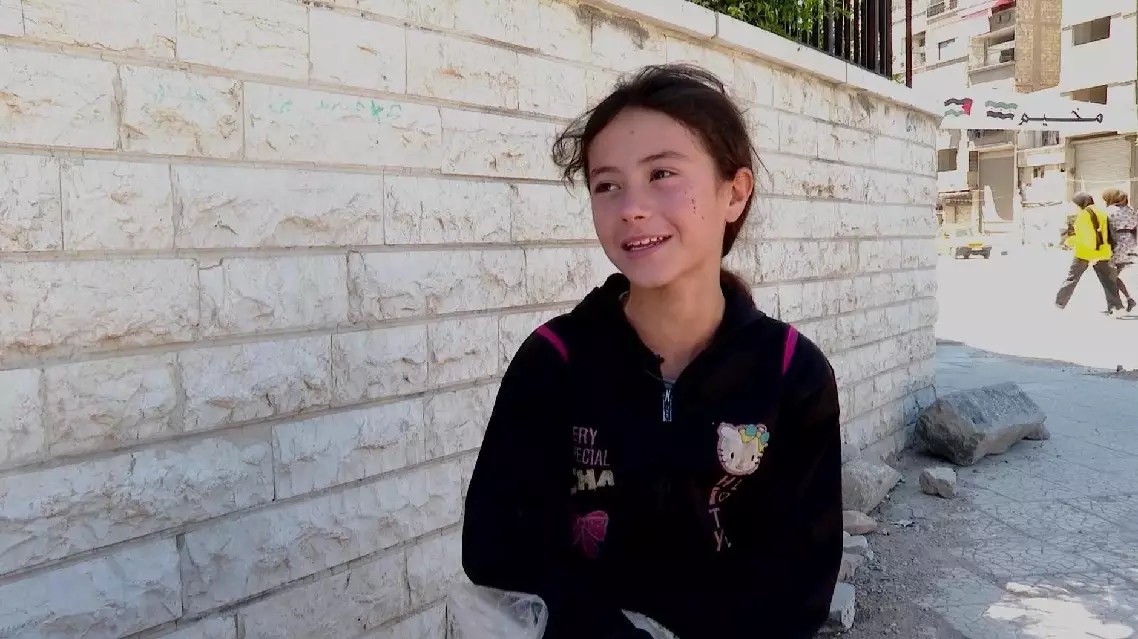
In the war-torn streets of Damascus, an 11-year-old girl named Selina rises before dawn, not only to attend school, but also to support her family by reselling bread, a harsh reality that reflects the burden Syria's youngest generation bears after over a decade of conflict.

Under the scorching sun on the streets of Damascus, 11-year-old Selina stands in line at a bread shop, waiting to buy flatbread -- the most common foodstuff for local people -- to sell for a sliver of profit, a routine she repeats daily to help feed her displaced family.

"When we line up to buy flatbread, there are often conflicts in the crowd. This job is really exhausting. I often feel very tired. Just standing in the sun for a little while makes me dizzy. My mom took me to see a doctor, and they said I have a respiratory illness," said Selina.

Selina comes from Syria's eastern Deir ez-Zor province, and her hometown has been devastated by the war. Now living in the capital with her mother and four younger siblings, Selina's days start at 06:00 with school. After class, she heads straight to buy bread and then to the streets to sell.

"I don't have money, so I have to help my mom and sisters sell flatbread. I go to school, then rush home, get everything ready, and go to the bakery to buy bread to sell. Many times, I end up staying on the street until 01:00 or even 03:00, only going home after I've sold everything. These days, after school, I also have to go to Quneitra to help with the harvest," she said.

Despite her dedication, Selina said the hardest moments come not from physical exhaustion, but from how she's perceived by her peers.

"My classmates bully me because I sell bread. I'm poor but I didn't choose this. What worries me most is my friends finding out I sell bread for money," said Selina.

Her father hasn't been able to join the family in Damascus due to identification and permit issues, a lasting consequence of the conflict.

"War changed everything in my family. My father isn't allowed to come to Damascus, so he can't be here with us. I just wish I could wake up and see my whole family together. I imagine that sometimes all of us are in one home again. If he were here, life would be better," said Selina.

But even in the shadow of war, Selina holds tightly to her hopes for the future.

"In the future, I want to be a kind person. I want to help others. I want us to have toys like other children. I have a little sister. I save 25 lira a day to buy her clothes. I hope one day we can all go back to our home in Deir ez-Zor. And I hope my father's diabetes can be treated," said Selina.

Now, more than a decade into Syria's conflict, children like Selina continue to shoulder adult burdens beneath the ruins of broken cities and dreams. On streets where laughter should echo, voices instead speak of hunger, illness, and loss. As the world marks the International Children's Day on June 1, it's a distant concept for Selina, but she still dreams of a day filled with toys, health, and, most of all, the reunion of her family.
Young Syrian girl struggles to earn meager living amid war, hardship

Young Syrian girl struggles to earn meager living amid war, hardship
Young Syrian girl struggles to earn meager living amid war, hardship
Young Syrian girl struggles to earn meager living amid war, hardship
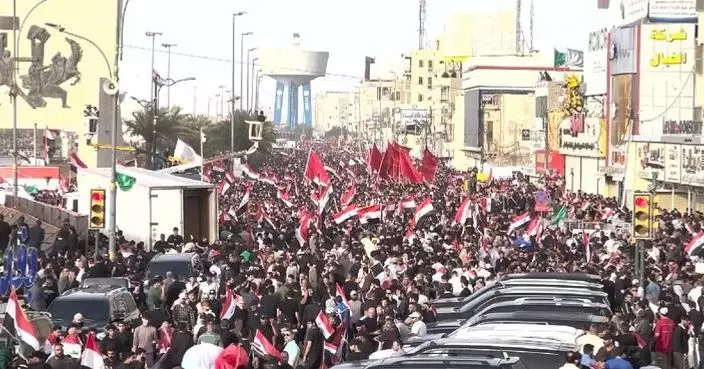
The Iranian government is focusing on public concerns and maintaining stable supplies of essential goods amid recent protests, Iranian President Masoud Pezeshkian said in a televised interview on Sunday.

In the city of Karaj, northwest of the capital Tehran, daily life has largely continued as normal. A video filmed by a local resident on Sunday shows food stores open and grocery shelves fully stocked.

"This is the block near my home, and there are some food stores here. Daily life continues here. Last night we did not see many protests in Karaj. Right now the city is very safe. This is a grocery store close to my home. All the food is available; nothing is in shortage. Here are noodles and different types of beans. Here are dairy products, cheese, and yogurt. I also checked other grocery stores and didn't see any shortages. Everything is available," said local resident Ali Reza.

Iranian officials have described recent disturbances as acts orchestrated by the "enemy," including some carried out by well-trained and armed "terrorists." The incidents have caused casualties among security personnel and civilians, as well as property damage.

The Secretary of Iran's Supreme National Security Council Ali Larijani has directed authorities to severely punish the "terrorists."

Meanwhile, Iran's police chief Ahmad-Reza Radan said on Sunday that the police had raised alert levels and arrested several leaders of the troublemakers during the operations on Saturday.

President Pezeshkian noted in the interview that the normal demands of the Iranian people are reasonable and justified, but they must realize that triggering riots and carrying out terrorist acts are the enemy's attempts to undermine the country. He urged the public to remain vigilant.

Also on Sunday, Iranian Parliament Speaker Mohammad Baqer Qalibaf warned that Tehran would regard U.S. and Israeli bases and facilities in the Middle East as "legitimate targets" if Washington takes military action against Iran. His remarks followed media reports saying U.S. President Donald Trump is "seriously considering authorizing a strike" against Iran.

Iranian state media reported that at least 109 members of Iran's security forces have been killed in clashes since the protests began 14 days ago. Meanwhile, human rights groups based outside the country said the number of protesters killed has exceeded 200, though the figure could not be independently verified.

The protests initially erupted over a sharp depreciation of the rial and sweeping subsidy reforms. Iranian authorities have blamed the unrest on foreign-linked agents and sanctions imposed by the United States.

Iranian president says government focusing on ensuring supplies amid protests

Iranian president says government focusing on ensuring supplies amid protests

Recommended Articles