Many foreign visitors tried their hand at the unique "water drifting" style of the Diejiao Village Dragon Boat race in Foshan City of south China's Guangdong Province during the ongoing three-day Dragon Boat Festival holiday.
The Diejiao Dragon Boat race is a city-level intangible cultural heritage project in Foshan. The narrow and winding rivers there allow athletes, who are locally addressed as "Pa Zai" (rowers), to perform dramatic stunts such as drifting and sudden stops during the race, earning it the nickname "speed and passion" of dragon boat racing.
In the midst of this year's competition, some foreigners were paddling alongside Chinese dragon boat athletes. Forty-three-year-old Benjamin, a beer brewer from Germany, had been captivated by dragon boat racing after watching the Diejiao competition last year. This year, he specifically sought out a local dragon boat team to learn the sport.
"We got totally fascinated with the whole thing, with a chance to get in the boat and practice with the real team here and yeah, that was pretty cool. You have to try to follow the speed. I can definitely feel my arms now, it hurts," said Benjamin.
Despite his years of exercise and experience in rowing, he found dragon boating to be more challenging than he had imagined. With nearly 40 members on the boat, everyone's movements have to be perfectly synchronized to succeed, requiring all paddlers to unite as one.
Beyond training, his teammate, Wen Yongcheng, introduced him to local dragon boat cultural activities, sparking Benjamin's interest in this centuries-old intangible cultural heritage.
"More and more foreigners now want to know about the dragon boat culture. I think it is my duty to promote it. When I share it with them, I also feel a deep sense of pride. This is kind of cultural confidence," said Wen.
Another dragon boat enthusiast, Michael, also joined a dragon boat team in February. Despite the two-hour commuting to Diejiao, Michael never missed a practice over the past three months. His dedication to the sport is fueled not only by passion but also by the brotherhood with his teammates.
"It's very nice to be welcomed so warmly. They treated me like one of them from the beginning. We had another crash and I fell from the boat into the water. Then I was not even above the water and, already, two hands were grabbing me back into the into the boat. Culture has no borders. We can all embrace the beautiful things in life together," said Michael.
Dragon boat "Pa Zais" from around the world, working alongside local team members, have become a unique and vibrant part of this intangible cultural heritage, bringing new vitality into the centuries-old Diejiao Dragon Boat tradition.
"Watch the boat races here reminds me of a great winning spirit, team spirit, good effort, hard work. Much like we have a win-win relationship with our partner here," said Mike, a visitor from the U.S.
The Dragon Boat Festival is a traditional holiday that commemorates ancient patriotic poet Qu Yuan living in the latter part of the Warring States Period (476 BC - 221 BC). The festival falls upon the fifth day of the fifth month of the Chinese lunar calendar. On the day people will have dragon boat contests, eat zongzi (glutinous rice treats wrapped in bamboo leaves) and drink realgar wine. This year's Dragon Boat Festival fell on Saturday.
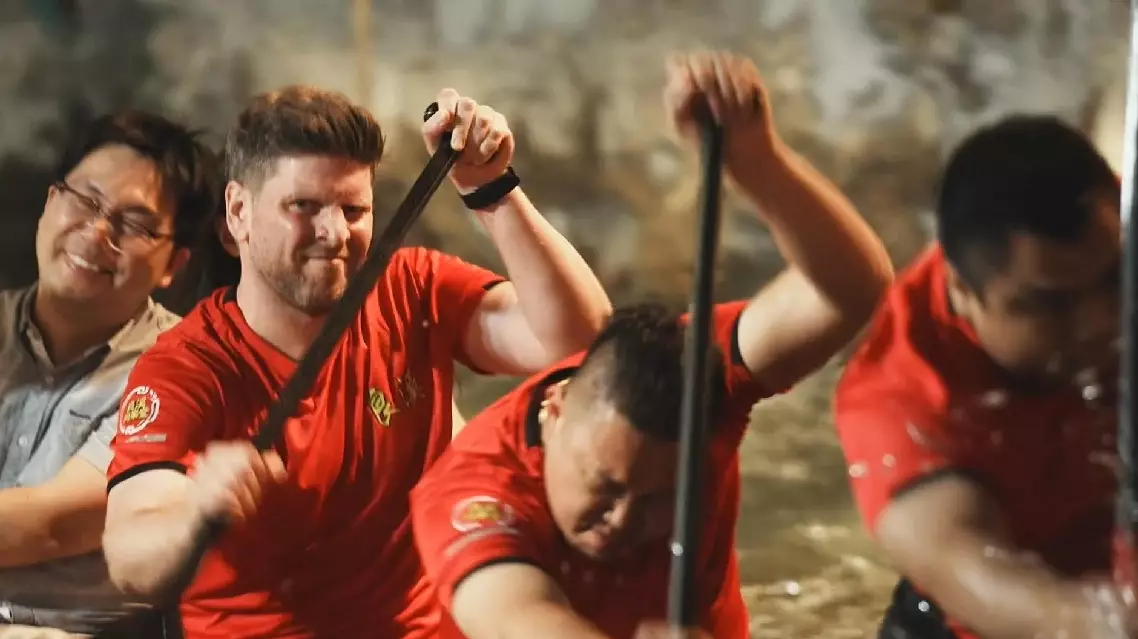
Traditional dragon boat race in south China's Guangdong attracts global competitors