Hong Kong celebrated this year's Duanwu Festival with vibrant dragon boat races and intangible cultural heritage-themed activities, offering visitors a blend of sport and tradition.
The Duanwu Festival, also known as Dragon Boat Festival, falls on the fifth day of the fifth month in the Chinese lunar calendar. This year, it was celebrated on May 31, and the holiday runs from May 31 to June 2.
During this year's festival, Hong Kong hosted multiple dragon boat races, blending over a century of tradition with international events that drew paddlers and visitors from across the globe.
The Stanley International Dragon Boat Championships drew 5,000 paddlers of 200 teams worldwide, competing in 51 races.
"Dragon boat racing is not only a highly popular sport in Hong Kong but also an important cultural heritage. We all hope to further promote this tradition and invite participation from around the world. We also want to promote exchanges between the East and the West, and share the Chinese culture with the world," said Henry Lai, District Officer of Eastern District in Hong Kong.
Meanwhile, Hong Kong inaugurated Intangible Cultural Heritage Month on Saturday, presenting more than 100 cultural heritage items, including the Tai O Dragon Boat Water Parade, Hakka Unicorn Dance in Hang Hau in Sai Kung, and Nanyin, a musical performing art central to the culture of the people of Minnan in southern Fujian Province.
Visitors explored the wonders of intangible cultural heritage through more than 80 live performances and 60 interactive activity booths.

Hong Kong celebrates Duanwu Festival with vibrant activities
U.S. stocks ended higher on Monday, recovering from early session heavy losses, as indications of a potential swift conclusion to the ongoing U.S.-Israeli strikes on Iran triggered a sharp pullback in global oil prices.
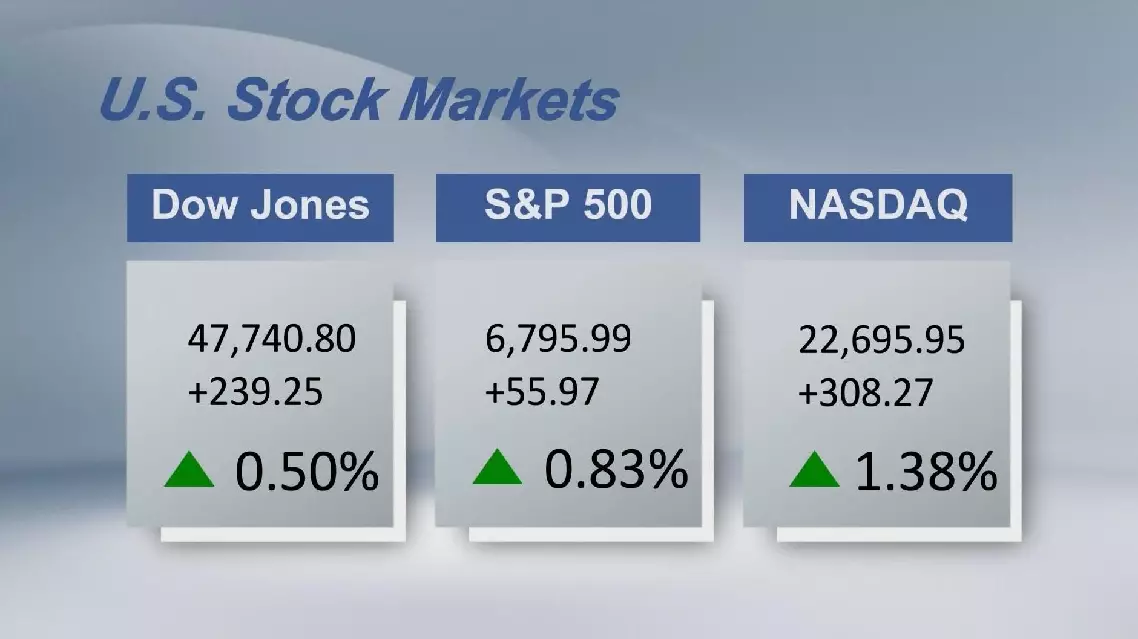
The Dow Jones Industrial Average rose 239.25 points or 0.5 percent, to 47,740.8. The S and P 500 added 55.97 points or 0.83 percent to 6,795.99. The Nasdaq Composite Index increased by 308.27 points or 1.38 percent, to 22,695.95.
Nine of the 11 primary S and P 500 sectors ended in the green. Technology and communication services led the gainers, advancing 1.8 percent and 1.13 percent, respectively. Meanwhile, the financials and energy sectors led the laggards, declining 0.52 percent and 0.43 percent, respectively.
The broader market turned positive in afternoon trading following remarks from U.S. President Donald Trump suggesting the war with Iran could conclude sooner than anticipated. He reportedly told a CBS journalist that "the war is very complete, pretty much."
The geopolitical developments prompted a dramatic reversal in energy markets. West Texas Intermediate crude oil futures for April delivery, which had surged past 119 U.S. dollars per barrel in overnight trading for the first time since 2022, settled at 94.77 dollars a barrel.
The sudden drop in oil prices immediately relieved travel and leisure equities, which are highly sensitive to fuel costs. Shares of major U.S. carriers, including Delta Air Lines, United Airlines, and American Airlines, alongside cruise operators such as Norwegian Cruise Line, Carnival, and Royal Caribbean, erased earlier losses to finish higher.
In the technology sector, all of the major "Magnificent Seven" stocks rebounded from early declines to post gains. Additionally, memory chip manufacturers saw significant upward movement, with SanDisk and Western Digital finishing up nearly 12 percent and 7 percent, respectively.
Despite the session's optimism, some market experts warned that investors might underestimate the risks of a broader economic recession or an equity market correction. Analysts at Deutsche Bank noted that a continuous stream of global shocks over the past four years has left investors somewhat desensitized to short-term disruptions, leaving overall equity positioning slightly below neutral.
Conversely, analysts at Morgan Stanley offered a more optimistic outlook, forecasting that U.S. equities will likely remain constructive for at least another year despite the elevated geopolitical risks. "We think we're closer to the end of this rolling correction than the beginning and remain constructive over the next 6-12 months," analysts said.
U.S. stocks finish higher as Trump says war could be over soon