Remarks by CE at media session before ExCo (with video)
Following are the remarks by the Chief Executive, Mr John Lee, at a media session before the Executive Council meeting today (June 3):
Reporter: Good morning, Mr Lee. Some English questions. First, can you tell us more about the way forward between your administration and the Beijing's liaison office with the new appointment of Mr Zhou Ji? And the second question, how will the Government proceed with a review on tunnel tolls after taking back the Tai Lam Tunnel, and will that have any implication on new infrastructure, such as the Central Kowloon Route? Thank you.
Chief Executive: The work of the Liaison Office of the Central People's Government (LOCPG) in the Hong Kong SAR (Special Administrative Region) is to facilitate exchanges and co-operation between Hong Kong and the Mainland, enhancing interactions between the two places. I think good communication and understanding with the LOCPG will be beneficial to both the governance of the Hong Kong Government and also in assisting the Central Government in designing policies for Hong Kong. I think communication and understanding are important, so that the actual situation of Hong Kong is correctly reflected, and the aspirations and requests of the Hong Kong Government can also be duly reflected.
I respect Director Zhou because he has a humble personality and a pragmatic character. In my dealing with him while he was working in the Hong Kong and Macao Work Office (of the CPC Central Committee) in the last two years, my communication with him was very good, and it was always a pleasant experience. He has a lot of local administration experience, and he takes the interests of Hong Kong close to his heart, and he is a staunch supporter for the faithful and correct implementation of the "one country, two systems" principle, which, of course, is the cornerstone for the success and prosperity of Hong Kong. I will work my very best to ensure that my communication and understanding with Director Zhou and also with the Liaison Office as a whole will be enhanced, so that the best policies for Hong Kong will be made as a result of full and accurate reflection of the situation of Hong Kong.
I thank Director Zhou for stating categorically and publicly that he will continue to support the Chief Executive and the Hong Kong SAR Government to dutifully govern Hong Kong in accordance with the law. Good communication and liaison with the LOCPG will benefit Hong Kong as a whole; especially it is in the interest of the people of Hong Kong and the long-term stability and prosperity of Hong Kong.
As regards the Government taking over the Tai Lam Tunnel and implementing the HKeToll, we have already seen that the tolls for different kinds of vehicles have dropped significantly, and the drop ranges from about 20 per cent to 80 per cent. The drop for, for example, a private vehicle - if we talk about the off-peak time - is something like 70 per cent, which is a reduction from $58 to $18. Because we have adopted HKeToll, it gives us the flexibility of fixing different charges at different times for different vehicles. The HKeToll allows us to do good rationalisation of traffic control and overall traffic enforcement. I am glad to see that now all tolled tunnels in Hong Kong have implemented the free-flow tolling service. They do not have to stop when they pay their tolls.
In assessing which tunnels will be charged, I think the Budget has already laid down a good framework for this to be tackled. The Budget has already stated very clearly that a lot of money is spent on building and also managing different tunnels and trunk roads. There are several principles I think we should adopt. First of all, "user pays", I think, is a fair policy. There is a need to have charges for particularly major tunnels and trunk roads, because there is a need for traffic management. Charges will help in managing the traffic flow, and it will also help to ensure that public transport will be given priority in the use of roads. It will also ensure that there will be maximum efficiency as a result of good traffic management. Then, of course, in assessing how much will be charged, the public's affordability will be taken into consideration. Overall, we have about 19 sets of government tunnels and trunk roads. Nine of them are tolled tunnels. We will continue to make assessment of the different tunnels and trunk roads to examine how we will go about designing the tunnel charges. Then, of course, priority will be placed on the tunnels for which the charges have remained unchanged for a long, long time; because of inflation and various factors, the charges do not actually reflect the present situation. And then, of course, another priority will be new tunnels or new trunk roads, because they will be opened up for use. We need to design the appropriate level of charging.
The Central Kowloon Route will be completed at the end of this year. Yes, we will design the appropriate charges, and we will also report to the Legislative Council's panel appropriately. Thank you.
(Please also refer to the Chinese portion of the remarks.)
CFS to follow up certain batches of powdered infant and young children formula with possible presence of Cereulide produced by Bacillus cereus
The Centre for Food Safety (CFS) of the Food and Environmental Hygiene Department (FEHD) today (January 10) said that, it took initiative to meet with Nestlé Hong Kong again today, and confirmed the company's today announcement of an additional batch of powdered infant and young children formula suspected to have possibly used the raw material concerned. Nestlé Hong Kong has voluntarily stopped sales, removed from shelves the affected products and has initiated a precautionary recall. The CFS has collected samples of powdered infant and young children formula from the market for Bacillus cereus testing, the test results so far were satisfactory. The Environmental and Ecology Bureau is also closely monitoring the supply situation of other formula milk powder and maintaining communication with other major suppliers. It is noted that there is sufficient formula milk powder to meet the demand.
The Centre for Food Safety (CFS) of the Food and Environmental Hygiene Department (FEHD), Photo source: reference image
The spokesman said, the CFS has been actively following up on Nestlé company's voluntary and precautionary recalls of certain batches of its powdered infant and young children formula in certain areas in Europe due to possible presence of Cereulide produced by Bacillus cereus in the individual raw material. According to the latest information from Nestlé Hong Kong today, an additional batch of its powdered infant and young children formula imported into Hong Kong might have used the raw material concerned. The CFS had earlier enhanced surveillance in the market and collected a sample from the above batch for testing of Bacillus cereus. The test result of the sample was satisfactory. Nevertheless, as a precautionary measure, Nestlé Hong Kong has voluntarily stopped sales, removed from shelves the affected products and has initiated a precautionary recall.
Product details are as follows:
Product name (Net weight): NAN PRO 1 2 HMO (800g)
Batch number: 51670742F2
Best-before date: June 16, 2027
Place of Origin: Germany
"The CFS met Nestlé Hong Kong again today, urging them to properly handle the product recall issue and respond to public enquiries, in order to safeguard consumers' legitimate rights and interests. In addition, the CFS and Nestlé Hong Kong have jointly followed up, six suspected affected batches of infant and young children formula products that had not entered the market were marked and sealed. An additional 15 batches are currently en route to Hong Kong and will also be marked and sealed upon arrival. The CFS will continue to closely monitor the recall matters and remain fully committed to ensuring food safety, " the spokesman said.
Nestlé Hong Kong has initiated a recall of the affected batches of the products concerned. For enquiries about the recall, members of the public may contact the company through the following channels:
Consumer services hotline: 2599 8874 / 2797 6031/ 2179 8136 (Monday to Sunday, 9am to 9pm)
Email: consumerservices@hk.nestle.com
WhatsApp: 5283 4139 (NESTLÉ® NAN®) / 2599 8871 (Wyeth® Nutrition)
Online form: forms.office.com/e/BhqMhWfsUG?origin=lprLink
Consumers may choose to bring along the products (brand new or opened) for refund at place of purchase, or at exclusive service counters of Nestlé Nutrition Services from January 13 (Tuesday) onwards, to settle the recall and refund of the batches of the products concerned. Details of the exclusive service counters are as follows:
Kowloon Services Counter
Address: G/F, Park Hovan Commercial Building, 18 Hillwood Road, Tsim Sha Tsui, Kowloon (MTR Jordon Station Exit D)
Contact number: 3996 8196
Office hour: Monday to Saturday, 11am to 7.30pm; Sunday, 1pm to 5.30pm (except public holidays)
Hong Kong Services Counter
Address: 1/F, Ka Nin Wah Commercial Building, 423-425 Hennessy Road, Hong Kong (MTR Causeway Bay Station Exit B)
Contact number: 3996 8197
Office hour: Monday to Saturday, 11am to 7.30pm (except Sundays and public holidays)
The CFS, through its Food Incident Surveillance System, noted earlier that certain batches of Nestlé powdered infant formula were being voluntarily recalled in Europe due to possible contamination with Bacillus cereus. Upon learning of the incident, the CFS has immediately initiated follow up actions, published food incident posts to inform the public and the trade about the issue, and has been actively following up on the incident and enhanced surveillance.
Over the past three days (as of 4pm on January 9), the FEHD received a total of 18 food complaints and enquiries suspected to be related to the infant and young children formula products, including one anonymous complaint without contact information. The CFS and the Environmental Hygiene Branch have promptly followed up on all cases, including contacting the parties concerned to obtain details and collecting samples for testing. In addition, the CFS has referred the cases to the health department for follow-up. At present, no food poisoning cases related to the formula have been recorded.
Bacillus cereus is commonly found in the environment. Unhygienic conditions in food processing and storage may give rise to its growth. Cereulide is a heat-stable toxin produced in food by some strains of Bacillus cereus. Consuming food contaminated with excessive Bacillus cereus or its heat-stable toxins may cause gastrointestinal upset such as vomiting and diarrhoea.
The spokesman urged members of the public not to let infants and young children consume the affected batches of the products, and to seek medical treatment for infants or young children who felt unwell after taking the products concerned. The trade should also stop using or selling the affected batches of the products immediately.
"The CFS continues to closely monitor the developments of the situation, follow up and take appropriate action," the spokesman said.
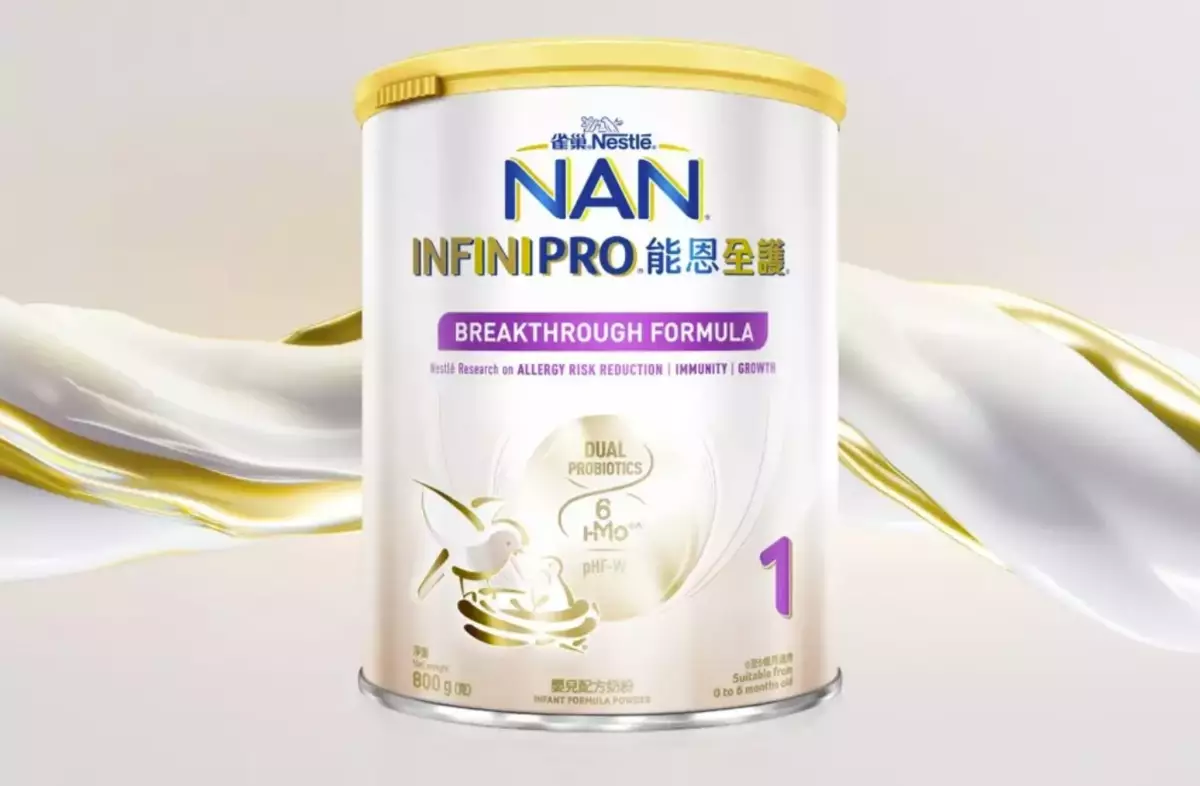
The infant formula of Nestlé, Photo source: online image