Skip to Content Facebook Feature Image

Boston captain Hilary Knight tops list of unprotected players available to PWHL expansion teams

Sport

Boston captain Hilary Knight tops list of unprotected players available to PWHL expansion teams
Sport

Sport

Boston captain Hilary Knight tops list of unprotected players available to PWHL expansion teams

2025-06-04 03:07 Last Updated At:03:10

Boston Fleet captain and MVP candidate Hilary Knight heads a star-caliber list of players left unprotected by their respective teams in being made available to the PWHL’s expansion franchises in Seattle and Vancouver.

Among the other high-profile players left unprotected in a list released by the league on Tuesday were Minnesota’s Kelly Pannek and Grace Zumwinkle, New York’s Alex Carpenter, Ottawa captain Brianne Jenner and veteran defenseman Jocelyne Larocque and Toronto’s Sarah Nurse.

The release of the list opens the first part of the PWHL’s two-phased roster-building process, which opens with a five-day exclusive signing window Wednesday. It will be followed by an expansion draft on Monday.

Seattle and Vancouver can sign up to five players each, and will then fill out their remaining first 12 roster spots in the expansion draft.

The wealth of talent being made available is a result of the PWHL placing an emphasis on ensuring its two newest teams can be competitive for the league’s third season expected to open in November. The PWHL limited its six existing teams to protecting just three players, with the ability to add a fourth once they lose two players.

The six teams will lose four players each in the expansion process, after which all eight teams will participate in the PWHL draft on June 24.

Knight is coming off a stellar season in which she had 29 points (15 goals, 14 assists) to finish tied for the league lead with New York rookie Sarah Fillier. And it comes as Knight, who turns 36 in July, is winding down her international career upon announcing the 2026 Winter Games will be her fifth and final representing the United States.

Knight intends to continue her PWHL career, and could be open to a move to the Pacific Northwest given she makes her offseason home in Idaho. Knight is also familiar with Seattle GM Meghan Turner, who spent the past two seasons as the Fleet's assistant GM.

The list of unprotected players include five of the six selected in the first round of last year’s draft in Ottawa’s Danielle Serdachny, Minnesota’s Claire Thompson, Boston’s Hannah Bilka, Montreal’s Cayla Barnes and Toronto’s Julia Gosling.

Thompson's future is uncertain as she has yet to announce whether she plans to resume pursuing her medical degree at NYU after being scheduled to represent Canada at the 2026 Winter Games in February. She has ties to Vancouver general manager Cara Gardner Morey, who coached Thompson as Princeton.

Both expansion teams will have numerous goaltending options, with New York’s Corinne Schroeder, Minnesota’s Nicole Hensley, Ottawa’s Emerance Maschmeyer and Toronto’s Kristen Campbell available.

Boston protected goalie Aerin Frankel, defenseman Megan Keller and forward Alina Muller. The defending champion Frost protected captain Kendall Coyne Schofield, forward Taylor Heise and defenseman Lee Stecklein. New York protected Fillier and defensemen Ella Shelton and Micah Zandee-Hart.

Montreal protected goalie Ann-Renée Desbiens and forwards Marie-Philip Poulin and Laura Stacey. Ottawa protected forward Emily Clark, goalie Gwyneth Philips and defenseman Ronja Savolainen. Toronto protected captain Blayre Turnbull, forward Daryl Watts and defenseman Renata Fast.

The PWHL also issued a list of prospective unrestricted free agents, who are available to the expansion teams during the signing period, but not eligible to be drafted. The group includes the PWHL's inaugural season MVP, Toronto's Natalie Spooner, Boston's Susanna Tapani and Minnesota's Liz Schepers, who has scored the Walter Cup Finals series-clinching goal in each of the past two years.

AP Women’s Hockey: https://apnews.com/hub/womens-hockey
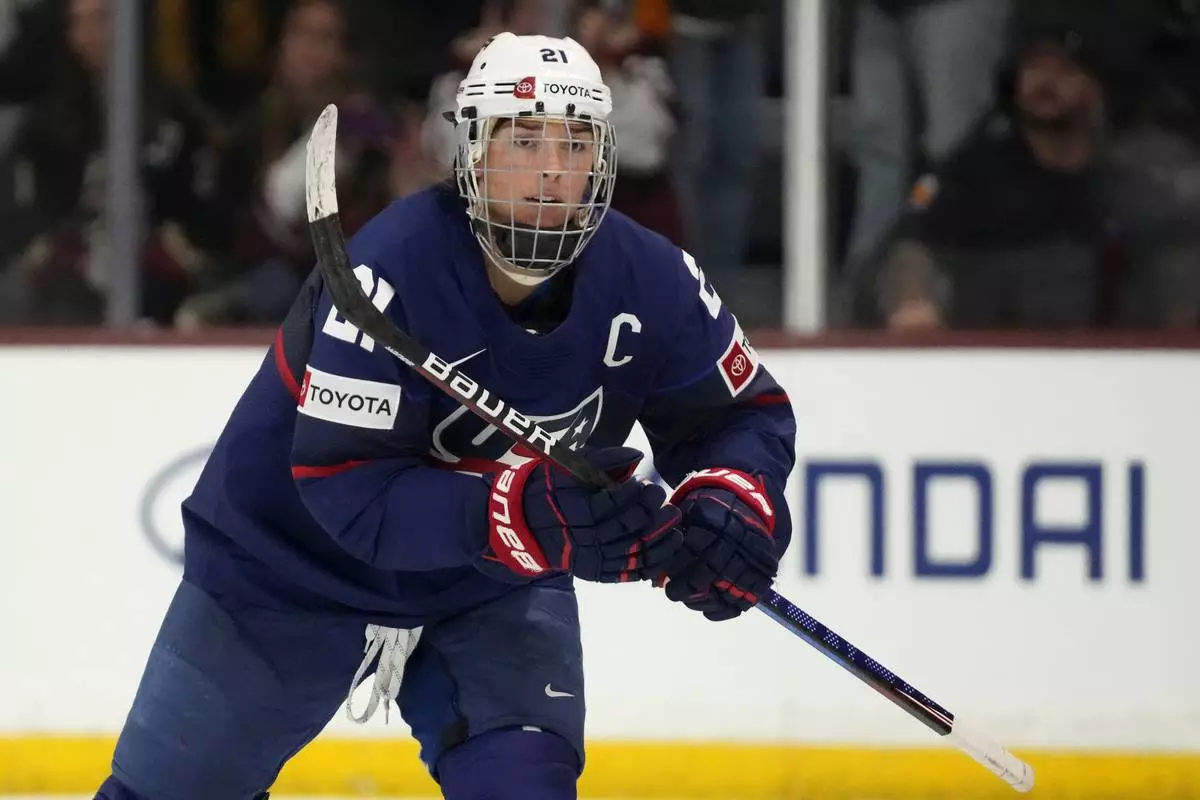
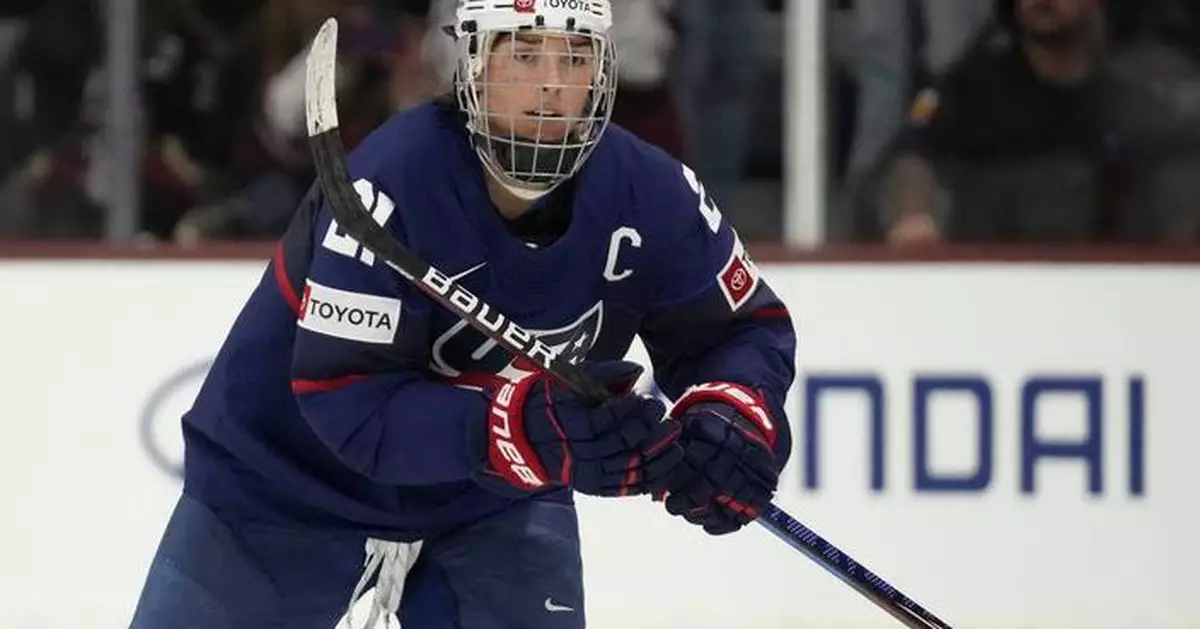
FILE - United States forward Hilary Knight skates to the bench to celebrate her goal against Canada during the first period of a rivalry series women's hockey game, Nov. 8, 2023, in Tempe, Ariz. (AP Photo/Ross D. Franklin, File)
FILE - United States forward Hilary Knight skates to the bench to celebrate her goal against Canada during the first period of a rivalry series women's hockey game, Nov. 8, 2023, in Tempe, Ariz. (AP Photo/Ross D. Franklin, File)
WASHINGTON (AP) — In a lightning military strike, the U.S. captured Venezuelan President Nicolás Maduro and his wife, Cilia Flores, and spirited them out of the country to face justice in the United States.

Now President Donald Trump says the U.S. is “going to run” Venezuela until a transition of power can take place, but it's not clear what that will mean on the ground in the South American country.

The overnight operation left Venezuela reeling, with its leadership uncertain and details of casualties and the impact on its military still to emerge. Much is still unknown about how the U.S. ouster of Maduro will ricochet across the country and the region.

Here’s what we know — and what we don’t.

Explosions rang out and low-flying aircraft swept through Venezuela’s capital, Caracas, early Saturday. At least seven blasts were heard in an attack that lasted less than 30 minutes. The targets appeared to include military infrastructure.

Venezuelan ruling party leader Nahum Fernández said Maduro and Flores were captured at their home within the Ft. Tiuna military installation outside Caracas.

Venezuelan officials said people had been killed, but the scale of casualties was unclear.

The attack followed months of escalating pressure by the Trump administration, which has built up naval forces in the waters off South America and since early September has carried out deadly strikes on alleged drug-smuggling boats in the eastern Pacific and Caribbean. Late last month, the CIA carried out a drone strike at a docking area alleged to have been used by drug cartels.

Trump said during a news conference Saturday the U.S. would run the country and gestured to officials arrayed behind him, including Secretary of State Marco Rubio, Defense Secretary Pete Hegseth and Dan Caine, chairman of the Joint Chiefs of Staff, and said they’d be the ones doing it “for a period of time.”

Trump claimed the American presence was already in place, although across Venezuela's capital there were no signs that the U.S. had taken control of the government or military forces.

Trump claimed that Venezuelan Vice President Delcy Rodríguez had been sworn in as president shortly before he spoke to reporters and added she had spoken with Rubio.

“She is essentially willing to do what we think is necessary to make Venezuela great again. Very simple,” Trump said.

Rodriquez made no mention of talking to Rubio or being sworn in during a televised address after Trump's news conference.

Instead, she demanded the U.S. free Maduro and called him the country’s rightful leader. Rodriquez left open the door for dialogue with the U.S., while seeking to calm ruling party supporters.

“Here, we have a government with clarity, and I repeat and repeat again … we are willing to have respectful relations,” she said, referring to the Trump administration. “It is the only thing we will accept for a type of relationship after having attacked (Venezuela).”

Armed individuals and uniformed members of a civilian militia took to the streets of a Caracas neighborhood long considered a stronghold of the ruling party. But in other areas of the city, the streets remained empty hours after the attack. Parts of the city remained without power, but vehicles moved freely.

Trump offered no details on what U.S. leadership in Venezuela would mean or specify whether it would involve more military involvement.

The State Department did not immediately respond to questions about how the U.S. would run Venezuela, what authority it would use to administer it or whether it would involve any American personnel — either civilian or military — on the ground in Caracas or other areas of Venezuela.

Trump mentioned the country's oil infrastructure repeatedly during the news conference. He suggested there would be a substantial U.S. role in Venezuela's oil industry, saying that U.S. oil companies would go in and fix the broken infrastructure.

And Trump said the U.S. would use revenues from oil sales to pay for running the country.

“We’re going to get reimbursed for everything that we spend,” he said.

According to an indictment made public Saturday, Maduro is charged alongside his wife, his son and three others. Maduro is indicted on four counts: narco-terrorism conspiracy, cocaine importation conspiracy, possession of machine guns and destructive devices and conspiracy to possess machine guns and destructive devices.

Authorities allege powerful and violent drug trafficking organizations, such as the Sinaloa Cartel and Tren de Aragua gang, worked directly with the Venezuelan government and then sent profits to high-ranking officials who helped and protected them in exchange.

It was not immediately clear when Maduro and his wife would make their first court appearance in New York or where they would be detained once in the U.S.

Trump gave some details of the operation during a Saturday morning interview on “Fox and Friends," and he and Caine went into more depth during the news conference.

Trump said a few U.S. members of the operation were injured but he believed no one was killed.

He said Maduro was “highly guarded” in a presidential palace akin to a “fortress” and he tried to get to a safe room but wasn’t able to get there in time.

Trump said U.S. forces practiced the operation ahead of time on a replica building, and the U.S. turned off “almost all of the lights in Caracas,” although he didn’t detail how they accomplished that.

Caine said the mission had been “meticulously planned” for months, relying on work by the U.S. intelligence community to find Maduro and detail how he moved, lived, ate and what he wore.

The mission involved more than 150 aircraft launched across the Western Hemisphere, Caine said. Helicopters came under fire as they approached “the target area,” he said, and responded with “overwhelming force.”

The U.S. does not recognize the jurisdiction of the International Criminal Court, and the legal implications of the strike under U.S. law were not immediately clear.

The Trump administration maintains that Maduro is not the legitimate leader of Venezuela and claims he has effectively turned Venezuela into a criminal enterprise at the service of drug traffickers and terrorist groups.

Mike Lee, a U.S. senator from Utah, said on X that the action “likely falls within the president’s inherent authority under Article II of the Constitution to protect U.S. personnel from an actual or imminent attack.”

But some Democrats were more critical.

Sen. Tim Kaine, a Virginia Democrat, said in a statement, “President Trump’s unauthorized military attack on Venezuela to arrest Maduro — however terrible he is — is a sickening return to a day when the United States asserted the right to dominate the internal political affairs of all nations in the Western Hemisphere.”

Venezuelan opposition leader and Nobel Peace Prize winner María Corina Machado had intended to run against Maduro in the 2024 presidential election, but the government barred her from running for office. She went into hiding and wasn't seen for nearly a year.

Trump said Saturday that he hadn't been in touch with Machado and said it would be “very tough” for her to lead Venezuela.

“She doesn’t have the support within or the respect within the country. She’s a very nice woman, but she doesn’t have the respect,” Trump said.

Lawless reported from London. Associated Press Writer Danica Kirka in London contributed to this story.

President Donald Trump speaks at his Mar-a-Lago club, Saturday, Jan. 3, 2026, in Palm Beach, Fla. (AP Photo/Alex Brandon)

President Donald Trump speaks at his Mar-a-Lago club, Saturday, Jan. 3, 2026, in Palm Beach, Fla. (AP Photo/Alex Brandon)

FILE - President Nicolas Maduro acknowledges supporters alongside first lady Cilia Flores during his closing election campaign rally in Caracas, Venezuela, July 25, 2024. (AP Photo/Fernando Vergara, File)

FILE - President Nicolas Maduro acknowledges supporters alongside first lady Cilia Flores during his closing election campaign rally in Caracas, Venezuela, July 25, 2024. (AP Photo/Fernando Vergara, File)

Pro-government armed civilians patrol in La Guaira, Venezuela, Saturday, Jan. 3, 2026, after U.S. President Donald Trump announced that President Nicolás Maduro had been captured and flown out of the country. (AP Photo/Matias Delacroix)

Pro-government armed civilians patrol in La Guaira, Venezuela, Saturday, Jan. 3, 2026, after U.S. President Donald Trump announced that President Nicolás Maduro had been captured and flown out of the country. (AP Photo/Matias Delacroix)

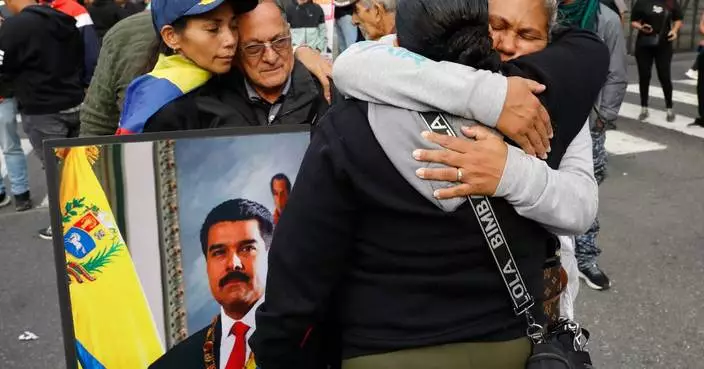
Supporters of Venezuelan President Nicolás Maduro embrace in downtown Caracas, Venezuela, Saturday, Jan. 3, 2026, after U.S. President Donald Trump announced that Maduro had been captured and flown out of the country. (AP Photo/Cristian Hernandez)

Supporters of Venezuelan President Nicolás Maduro embrace in downtown Caracas, Venezuela, Saturday, Jan. 3, 2026, after U.S. President Donald Trump announced that Maduro had been captured and flown out of the country. (AP Photo/Cristian Hernandez)

Men watch smoke rising from a dock after explosions were heard at La Guaira port, Venezuela, Saturday, Jan. 3, 2026. (AP Photo/Matias Delacroix)

Men watch smoke rising from a dock after explosions were heard at La Guaira port, Venezuela, Saturday, Jan. 3, 2026. (AP Photo/Matias Delacroix)

Smoke raises at La Carlota airport after explosions and low-flying aircraft were heard in Caracas, Venezuela, Saturday, Jan. 3, 2026. (AP Photo/Matias Delacroix)

Smoke raises at La Carlota airport after explosions and low-flying aircraft were heard in Caracas, Venezuela, Saturday, Jan. 3, 2026. (AP Photo/Matias Delacroix)

Recommended Articles