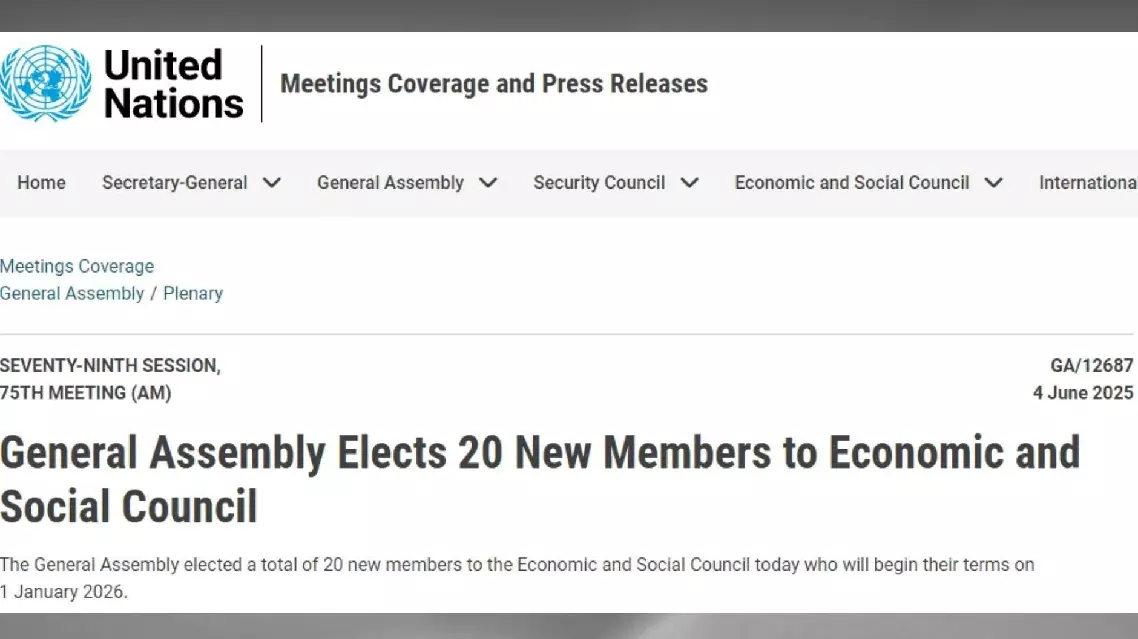
China was re-elected on Wednesday to the United Nations Economic and Social Council (ECOSOC), the coordinating body for the economic and social work of UN agencies and funds, for a three-year term.
The UN General Assembly elected 20 new members to the ECOSOC, who will begin their terms on January 1, 2026.
The elected countries are China, India, Lebanon, and Turkmenistan from the Asia-Pacific states; Burundi, Chad, Mozambique, and Sierra Leone from the African states; Ecuador, Peru, and Saint Kitts and Nevis from the Latin America and Caribbean states; Croatia, Russia, and Ukraine from the Eastern European states; Australia, Finland, Norway, and Türkiye from the Western European and other states.
Among them, China, Australia, Finland, and Türkiye were re-elected.
In the first round of voting, 17 countries were selected, with one seat remaining vacant in the Eastern European states group. Russia then secured the seat in a restrictive round against Belarus.
In a by-election for rotation within the Western European and other states group, Germany was elected to a one-year term beginning January 1, 2026, replacing Liechtenstein. The United States was elected to a two-year term starting January 1, 2026, replacing Italy.
The ECOSOC, as one of the organs established by the UN Charter, oversees economic, social, developmental, cultural, and educational affairs within the UN. Comprising 54 member states, one-third of its membership is elected annually by the UN General Assembly for rotating terms.
China has maintained continuous membership in ECOSOC since 1972 and has actively contributed to the council's work throughout its tenure.
China re-elected to UN Economic and Social Council for three-year term

The World Data Organization (WDO) has brought together more than 200 members from over 40 countries worldwide, as a newly established international platform for cross-border data collaboration.
The World Data Organization is the first professional international organization focused on advancing data development and governance practices. Established on Monday with its headquarters in Beijing, the organization serves as a global, non-governmental, and non-profit platform for dialogue, rule-making, and collaboration.
The diverse membership of the WDO includes enterprises, universities, think tanks, international organizations and financial institutions, spanning 14 industries such as manufacturing, finance, healthcare, e-commerce, transportation, energy and agriculture, with members from over 40 countries. This broad global footprint and diversified membership have enabled the WDO to preliminarily form a collaborative ecosystem with broad coverage and multi-party synergy.
Zhao Houlin, former secretary-general of the International Telecommunication Union, noted its unique value in nurturing global digital talent and facilitating cross-border knowledge sharing.
"This platform can help us train and cultivate leading talent in the field of data communications from all countries. Through this platform, these professionals will gain insights into China's development experience as well as that of other nations, and can better apply what they have learned to the economic construction and technological advancement of their home countries," said Zhao Houlin, former secretary-general of the International Telecommunication Union.
While talent development stands as a core pillar of the WDO's mission, global industry leaders also highlighted the organization's critical role in bridging data division and advancing inclusive digital growth, as cross-border data flows face rising risks of division and barriers.
"Data in the cloud is one thing that can create huge borders, so we must work together. So I think what you're seeing now is China saying we're looking into the problems and the solutions and we're trying to address that," said Jack Perry, chairman of the 48 Group.
Looking ahead, the WDO will focus on two core missions. The first is breaking barriers by harmonizing global data policies to support governments and research institutions, while lowering compliance costs for multinational enterprises. The second is building ecosystems through the deployment of data applications in sectors such as healthcare and education. Through these efforts, the organization aims to strengthen talent development, particularly in the Global South, to effectively bridge the digital divide.
It is expected that by 2030, the World Data Organization will become an internationally influential platform and a trusted hub in the data field.
World Data Organization gathers over 200 members across more than 40 countries