SEOUL, South Korea (AP) — North Korea said Friday it had righted a capsized destroyer and moored it at a pier in the northeastern port of Chongjin as it continues to repair the new warship leader Kim Jong Un has described as a significant asset for his nuclear-armed military.
The report by North Korean state media aligned with South Korean military assessments and recent commercial satellite images.
North Korea’s official Korean Central News Agency said experts will closely examine the ship’s hull before beginning the next phase of restoration, which will take place at a dry dock at the neighboring port of Rajin and is expected to last seven to 10 days.
Satellite images taken Thursday by Planet Labs PBC analyzed by The Associated Press showed the stricken destroyer upright and floating. It wasn’t immediately clear from the image just how much damage had been done to the vessel, which had been in the water for days after the failed launch. However, the ship did not appear to be noticeably listing, meaning Pyongyang is likely able to send it onward to the other port to inspect the vessel’s electronics.
Jo Chun Ryong, a senior official from the ruling Workers’ Party, told the agency that the “perfect restoration of the destroyer will be completed without fail” before a major party congress in late June, a deadline set by Kim.
Outside experts say it remains unclear how severely the 5,000-ton-class destroyer was damaged during a botched launching ceremony in late May, which triggered a furious response from Kim, who called the failure a “criminal act caused by absolute carelessness, irresponsibility, and unscientific empiricism.”
North Korean law enforcement authorities have detained at least four officials over the incident, including the vice director of the Workers’ Party’s munitions industry department, according to state media. The North’s main military committee said those responsible would be held accountable for their “unpardonable criminal act.”
Lee Sung Joon, spokesperson for South Korea’s Joint Chiefs of Staff, told reporters Thursday that the South’s military assesses that the North Koreans righted the ship earlier this week and are likely conducting drainage operations while examining the damage.
“The nature and duration of the repair process will vary, depending on internal repairs, additional work or whether the incident affected the keel,” Lee said, referring to the ship’s structural backbone. “This could also affect how the ship is used going forward.”
The damaged warship was North Korea’s second known destroyer and seen as a crucial asset toward Kim’s goal of modernizing its naval forces. It was in the same class as the country’s first destroyer unveiled in April, which experts assessed as the North’s largest and most advanced warship to date. Kim lavishly praised that ship, which was launched in the western port of Nampo, saying it advances his goal of expanding the military’s operations range and nuclear strike capabilities.
State media described that ship as designed to handle various weapons systems, including anti-air and anti-ship weapons as well as nuclear-capable ballistic and cruise missiles. Kim also supervised test-firings of missiles from the destroyer afterward, and state media said the ship was expected to enter active duty early next year.
While North Korea’s naval forces are widely seen as far inferior to those of its rivals, analysts say a destroyer equipped with modern missile and radar systems could still boost the North’s offensive and defensive capabilities.
South Korean officials and experts say the North’s destroyer was likely built with Russian assistance as the two countries’ military cooperation have intensified amid Russian President Vladimir Putin’s war on Ukraine. Kim’s government has supplied Russia with thousands of troops and large shipments of military equipment, including artillery and ballistic missiles, to support its warfighting. Washington and Seoul have expressed concern that, in return, Kim may seek Russian technology transfers that could enhance the threat posed by his nuclear-armed military.
Kim met with Russian Security Council Secretary Sergei Shoigu in Pyongyang on Wednesday in the latest sign of the countries’ deepening ties.
Kim has framed his arms buildup as a response to perceived threats from the United States and South Korea, which have been expanded joint military exercises in reaction to the North’s advancing nuclear program. Kim says the acquisition of a nuclear-powered submarine would be his next big step in strengthening the North Korean navy.
This report has been edited to correct that North Korea's statement was issued Friday, not Saturday.
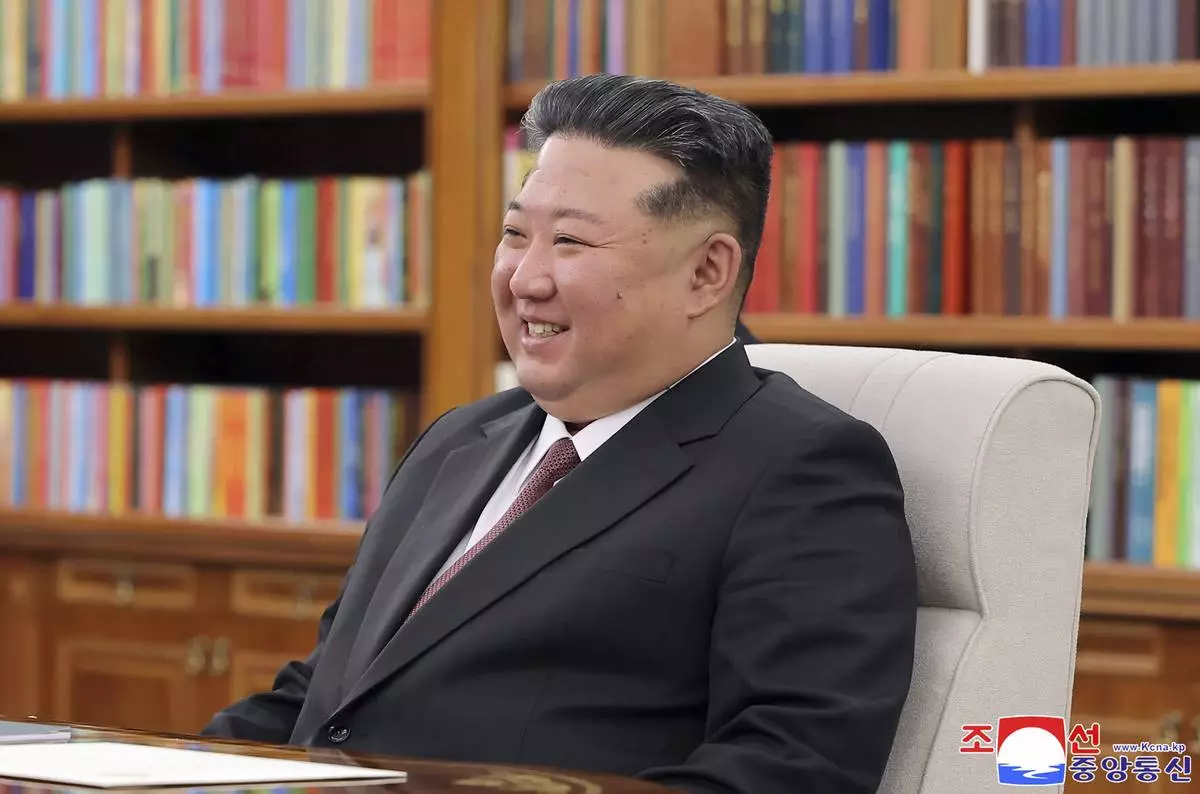
In this photo provided by the North Korean government, North Korean leader Kim Jong Un meets with Russian Security Council Secretary Sergei Shoigu in Pyongyang, North Korea, Wednesday, June 4, 2025. Independent journalists were not given access to cover the event depicted in this image distributed by the North Korean government. The content of this image is as provided and cannot be independently verified. Korean language watermark on image as provided by source reads: "KCNA" which is the abbreviation for Korean Central News Agency. (Korean Central News Agency/Korea News Service via AP)