From sand barrier laying machines to drones, machinery has been widely used in desert control in China over the past two years, with close to 50 percent of sand control and afforestation work done by various equipment.
In north China's Inner Mongolia Autonomous Region, machines capable of both laying sand barriers and seeding are in operation in a sandy area. Also, machines which can quickly drill holes for seedlings are busy working.
The devices have greatly improved afforestation efficiency.
"In the past, sand barrier laying was one process, and seeding was another separate process. People had to do it twice for these two procecsses. The machines' efficiency is more than 20 to 30 times that of manual labor," said Wang Lei, director of Mengcao Intelligent Equipment Research Institute.
In another location in Inner Mongolia, tree-planting robots have been used in afforestation. The robots can plant a tree in about five seconds, while manually planting a tree takes more than one hour.
Besides, drones have been used to transport seeds and desert shrub willow Salix psammophila, which plays an important role in maintaining local ecosystems.
One single drone can handle workload 10 times as much as a person, at a cost of only 30 percent of traditional manual operation.
Officials said more efforts are underway to promote the adoption of machines in sand control.
"We will intensify efforts in research and development and production, and increase the use of machinery in sand control, to improve the overall operation efficiency," said Bao Chunsheng, director of the science and technology department at the Forestry and Grassland Bureau of Inner Mongolia Autonomous Region.
In Liulin County, north China's Shanxi Province, drones have been used to airlift pine saplings to the hands of members of tree planting team on steep mountains. "We use drones to transport saplings. This method has some benefits. First, it keeps the soil ball intact. Second, it helps ensure that every plant we grow will survive. Besides, it helps to save time, speed up the process, and complete the afforestation task ahead of schedule," said Jing Junqi, a member of the tree planting team.
In northwest China's Ningxia Hui Autonomous Region, technicians have combined grass grid and biological soil crust techniques, shortening the time for plants within grass grids to form a relatively stable vegetation community from the initial 10 to 20 years to about two years.
Launched in 1978, the Three-North Shelterbelt Forest Program (TSFP) consists of afforestation in northwest, north and northeast China. Over the years, China has made constant efforts to shore up the ecological barrier in northern China.
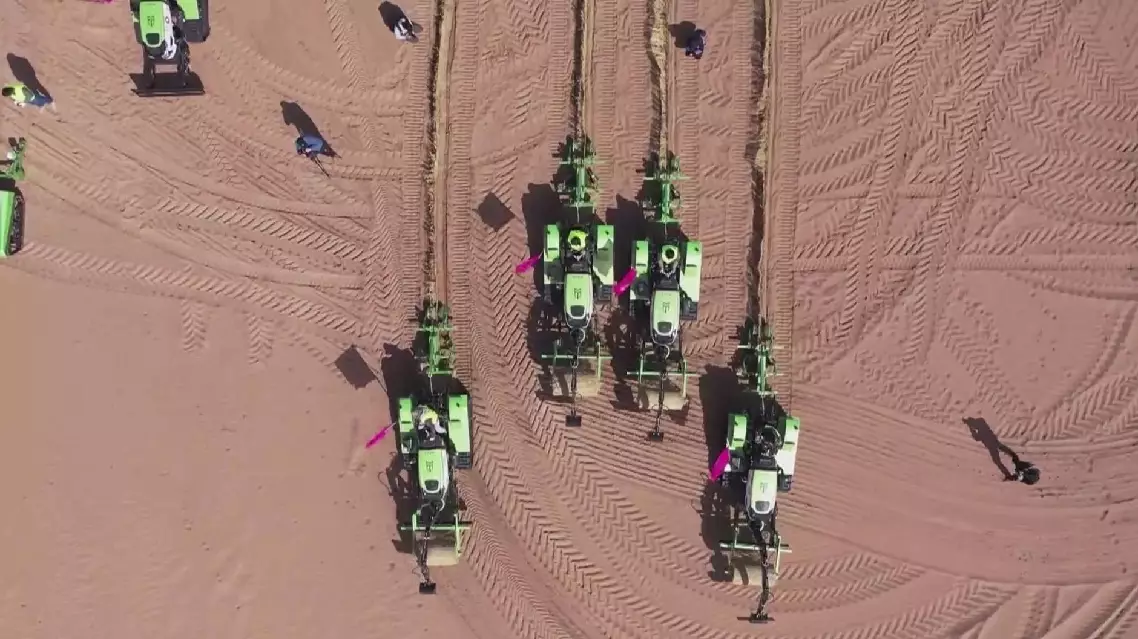
Machinery helps increase sand control efficiency in China