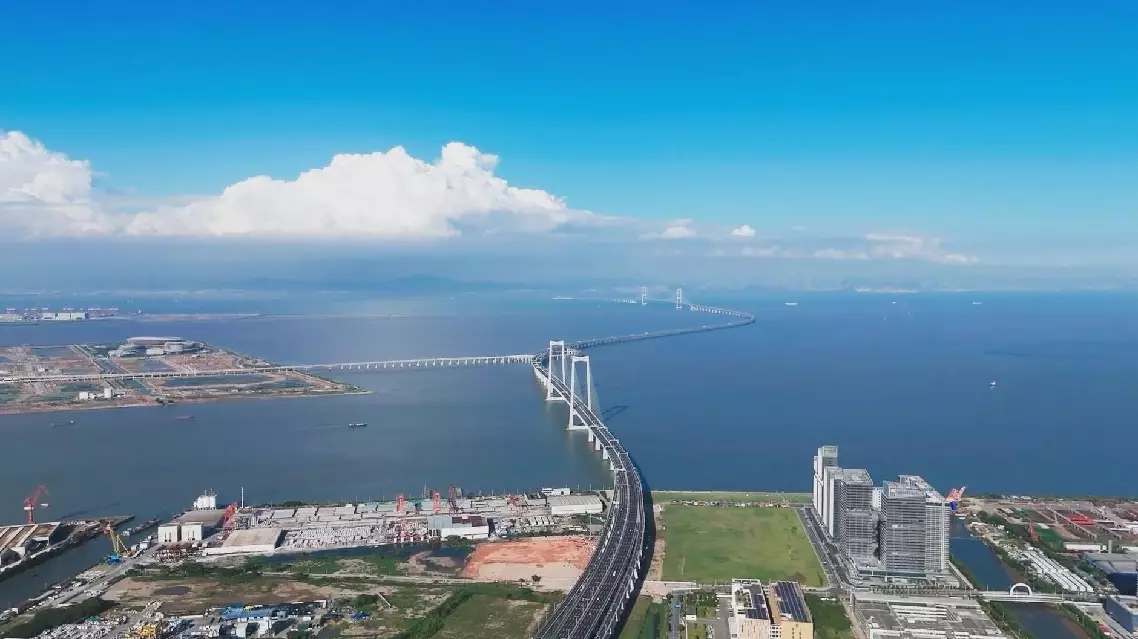
Guangdong, a coastal province in southern China, has significantly improved the water quality of both nearshore areas and rivers flowing into the sea by adopting an integrated approach to manage land and marine resources.
Thanks to the efforts of local authorities, Chinese white dolphins are now seen leaping and swimming in pods in the waters beneath the Hong Kong-Zhuhai-Macao Bridge, demonstrating Guangdong's achievements in marine ecological protection.
The Chinese white dolphin, also known as the Indo-Pacific humpback dolphin, is often referred to as the "giant panda of the sea" and is under first-class state protection. It is also listed as a vulnerable species on the International Union for the Conservation of Nature Red List.
As these rare creatures have high water quality requirements, their presence speaks volumes for the stability and health of the marine ecosystem.
In 2024, Guangdong's coastal waters maintained a good water quality proportion of 90.6 percent, staying around 90 percent for five consecutive years.
The province has a mainland coastline of approximately 4,100 kilometers, the longest in the country. It also has a total of 59 bays.
"Our surveys and estimates indicate that over 80 percent of marine pollutants originate from rivers. Therefore, the integrated management of both sea and rivers is crucial for addressing marine ecological environment issues," said Zhang Yuming, deputy director of the marine ecological environment division of Guangdong Ecology and Environment Department.
Zhongshan in Guangdong has several estuaries, making river management in the city crucial for enhancing the marine water quality.
"We have made efforts to improve the water quality of 1,041 rivers and creeks in Zhongshan, so as to improve the water environment of the South China Sea," said Liang Jianxi, a technical expert at the Zhongshan water conservancy office.
The 2,550-meter-long Anfu Creek in Zhongshan was once black and foul-smelling, making it a priority of management.
As industrial wastewater is a significant source of pollution in Zhongshan's rivers, local authorities have demolished or reorganized 706 inefficient industrial plots near the heavily polluted river basins and integrated them into 25 environmentally friendly industrial parks where wastewater can be discharged collectively.
"In our park, we categorize wastewater into four types and use four separate pipelines for their discharge," said Wu Zhongchun, a staff member working at an industrial park.
The industrial parks have enabled the treatment of industrial wastewater at its source, resulting in reduced costs.
"By centralizing the collection and treatment of industrial wastewater from enterprises, the parks lower treatment expenses for them. Each park has only one discharge outlet, which enhances our regulatory efficiency," said Jiang Feng, a staff member from the Zhongshan ecological environment bureau.
"As bay-specific policies can facilitate the development of beautiful bays, we encourage eligible cities to launch the construction of these beautiful bays across the region," said Zhang.
During the Dragon Boat Festival this year on May 31, an exciting dragon boat race was held on Anfu Creek, the first time in 20 years since the water quality was improved.
"I used to notice a strong odor when I passed by here. Now I don't smell that anymore. The creek is very clear," said a local resident.
Guangdong adopts integrated approach to improve water quality of rivers, nearshore areas