China has advanced in marine energy technologies, particularly in tidal energy, according to experts.
China has built an intelligent tidal power plant and the world's first tidal current power plant consisting of homegrown megawatt-scale generators, both in the eastern province of Zhejiang.
The Jiangxia Tidal Power Station in Wenling City is currently installing the last batch of new-generation control hardware on its six generators, five sluices and other public devices to build a self-decision-making system.
Upon the completion of hardware installation, the power station will start building software platforms and debugging.
"We have upgraded the equipment with new-generation hardware, which can collect various data on our tidal generator units and more importantly, is embedded with underlying execution programs of the self-decision-making system, enabling it to accept instructions from the system and then execute them automatically," said Xiang Zhili, a maintenance technician of the power plant.
With the help of the self-decision-making system, the start-up, shutdown and operating parameters of the tidal power plant will all be controlled by computers to minimize human errors, marking China's new achievement in developing smart tidal power technologies.
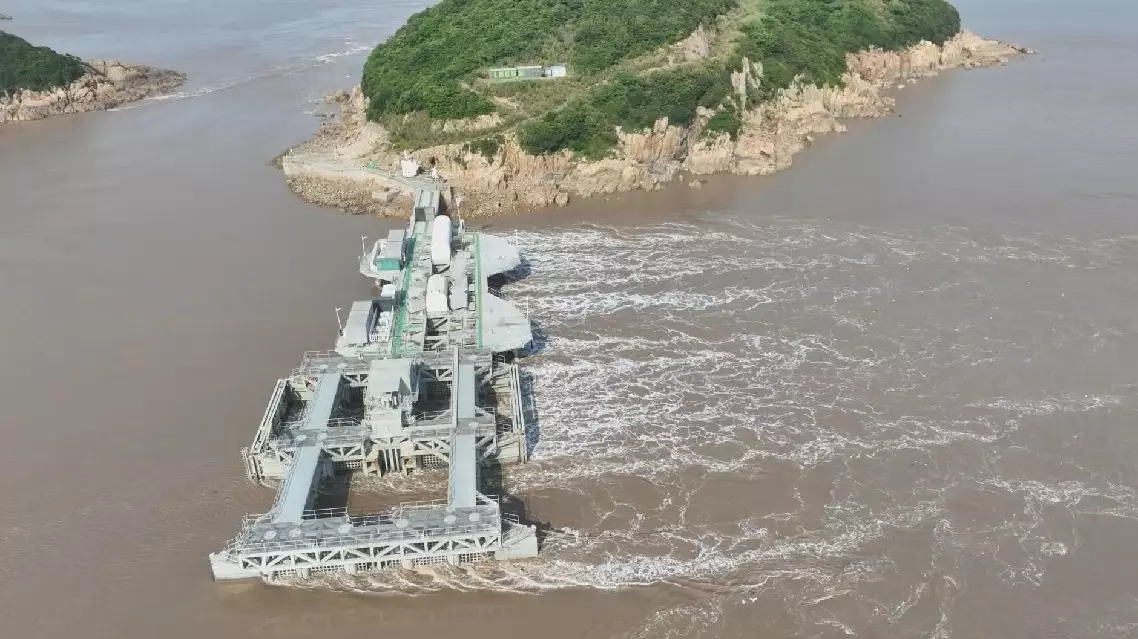
In the waters of Zhoushan, the LHD (initials of the three developers) Tidal Current Power Station has been incorporated into the power grid for eight years. Its self-developed generator unit "Endeavor" is the first of its kind to achieve stable megawatt-scale power generation.
Integrating a platform and modules, the tidal turbine can overcome various challenges in offshore installation, operation and maintenance, garbage prevention, and power transmission, effectively improving tidal current utilization and stability.
"Its advantage lies in that it is easy to manage. Unlike its foreign counterparts, it doesn't need humans to dive underwater to operate. The platform-base and modular approach make it convenient to manage and duplicate," said Lin Dong, director of the project's research center.
At present, Zhejiang is working on the construction of 100-megawatt-scale generators, hoping to scale up the utilization of sea tidal current energy and promote the development of relevant industries and businesses.
China advances in marine energy technologies
The Iranian government is focusing on public concerns and maintaining stable supplies of essential goods amid recent protests, Iranian President Masoud Pezeshkian said in a televised interview on Sunday.
In the city of Karaj, northwest of the capital Tehran, daily life has largely continued as normal. A video filmed by a local resident on Sunday shows food stores open and grocery shelves fully stocked.
"This is the block near my home, and there are some food stores here. Daily life continues here. Last night we did not see many protests in Karaj. Right now the city is very safe. This is a grocery store close to my home. All the food is available; nothing is in shortage. Here are noodles and different types of beans. Here are dairy products, cheese, and yogurt. I also checked other grocery stores and didn't see any shortages. Everything is available," said local resident Ali Reza.
Iranian officials have described recent disturbances as acts orchestrated by the "enemy," including some carried out by well-trained and armed "terrorists." The incidents have caused casualties among security personnel and civilians, as well as property damage.
The Secretary of Iran's Supreme National Security Council Ali Larijani has directed authorities to severely punish the "terrorists."
Meanwhile, Iran's police chief Ahmad-Reza Radan said on Sunday that the police had raised alert levels and arrested several leaders of the troublemakers during the operations on Saturday.
President Pezeshkian noted in the interview that the normal demands of the Iranian people are reasonable and justified, but they must realize that triggering riots and carrying out terrorist acts are the enemy's attempts to undermine the country. He urged the public to remain vigilant.
Also on Sunday, Iranian Parliament Speaker Mohammad Baqer Qalibaf warned that Tehran would regard U.S. and Israeli bases and facilities in the Middle East as "legitimate targets" if Washington takes military action against Iran. His remarks followed media reports saying U.S. President Donald Trump is "seriously considering authorizing a strike" against Iran.
Iranian state media reported that at least 109 members of Iran's security forces have been killed in clashes since the protests began 14 days ago. Meanwhile, human rights groups based outside the country said the number of protesters killed has exceeded 200, though the figure could not be independently verified.
The protests initially erupted over a sharp depreciation of the rial and sweeping subsidy reforms. Iranian authorities have blamed the unrest on foreign-linked agents and sanctions imposed by the United States.
Iranian president says government focusing on ensuring supplies amid protests