As summer harvest is in full swing in China's wheat-producing provinces, smart agriculture leveraging sensors and Internet of Things systems has played a significant role in this year's large-scale wheat harvest. As of June 6, east China's Jiangsu Province had harvested 54 percent of its winter wheat, with mechanization rate reaching 99 percent.
At Yuntai Farm in Lianyungang City, 25 large harvesters are currently in operation. Meanwhile, staff members are checking real-time agricultural information, such as soil moisture, pest and disease conditions, and meteorological data through a mobile phone app. That also enables them to remotely optimize operational routes for the machinery, implement appropriate scheduling, and ensure highly efficient operations. "One person can only cover about one mu (about 0.067 hectares) of land in a day, whereas a large harvester can cover nearly 300 mu in the same timeframe, greatly improving the harvesting efficiency, with a loss rate of less than one percent," said Wang Mingzhong, an employee at the farm. Similarly, relying on technologies such as the Beidou Navigation and the Internet of Things, remotely-controlled smart harvesters in Xuzhou City are executing their tasks along the pre-planned paths, ensuring precise operations without missing or overlapping harvest areas. "The labor force has been reduced by about 60 percent. The smart machine's harvesting speed is comparable to that of a regular manually operated harvester. During the rush periods of harvesting and planting, when the fuel tank is full, it can operate around the clock. This reduces the labor cost and saves about 1,000 yuan (around 139 U.S. dollars) per day," said Li Chen, director of Xuzhou Runchen Agricultural Machinery Professional Cooperative. Currently, wheat growers in Dongying District of east China's Shandong Province have also adopted advanced agricultural machinery to harvest more than 13,333 hectares of the grain. In the wheat fields of Shikou Town, agricultural technicians are operating drones equipped with multispectral sensors to monitor the maturity of wheat ears. These sensors are capable of accurately capturing critical physiological parameters, including chlorophyll content and moisture levels, and transmitting this data in real time to the backend system for further analysis. "In the past, determining the optimal timing for wheat harvest relied entirely on manual inspections, with technicians frequently traversing the fields and visually assessing the crops. Despite these efforts, accurate judgments were not always possible. Now, we have drones. We can generate maps that clearly indicate which plots are fully mature, which are approaching maturity, and which require a few more days. We don't have to spend too much time on daily field monitoring," said Sheng Leilei, an agricultural technician.
As of now, about 333 hectares of wheat in Dongying District have been successfully harvested. It is projected that the entire wheat harvest will be completed by the end of June.
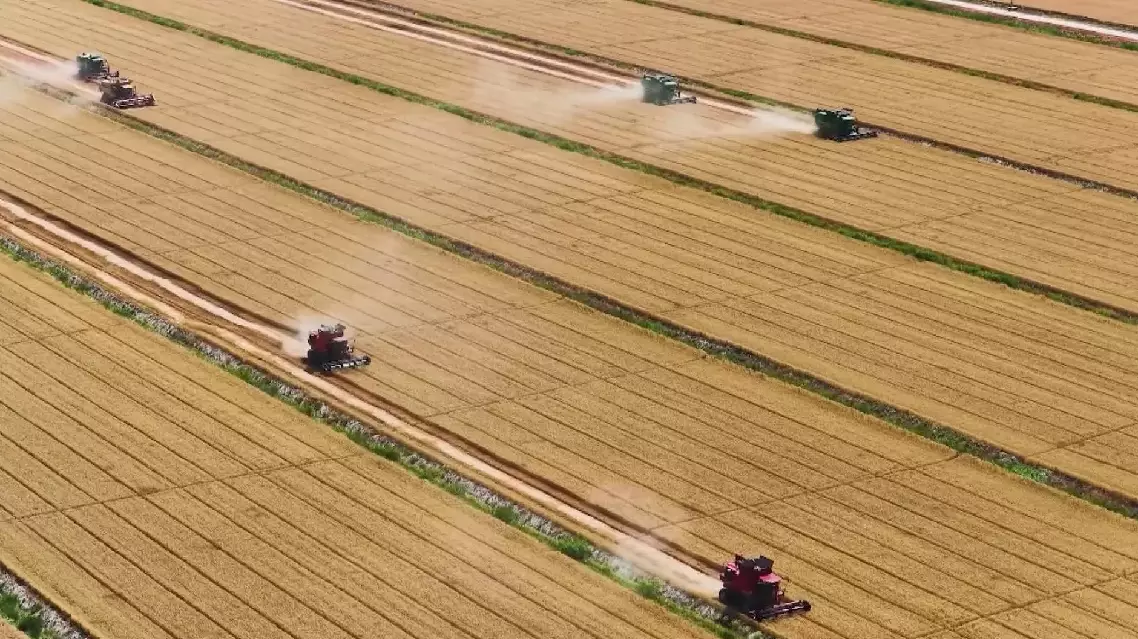
High tech propels bumper harvests in China's grain-producing provinces