Since the United States raised tariffs on imported steel and aluminum to 50 percent on June 4, Brazil's government and manufacturers have been pushing back, while small and mid-sized enterprises are already feeling the pressure.
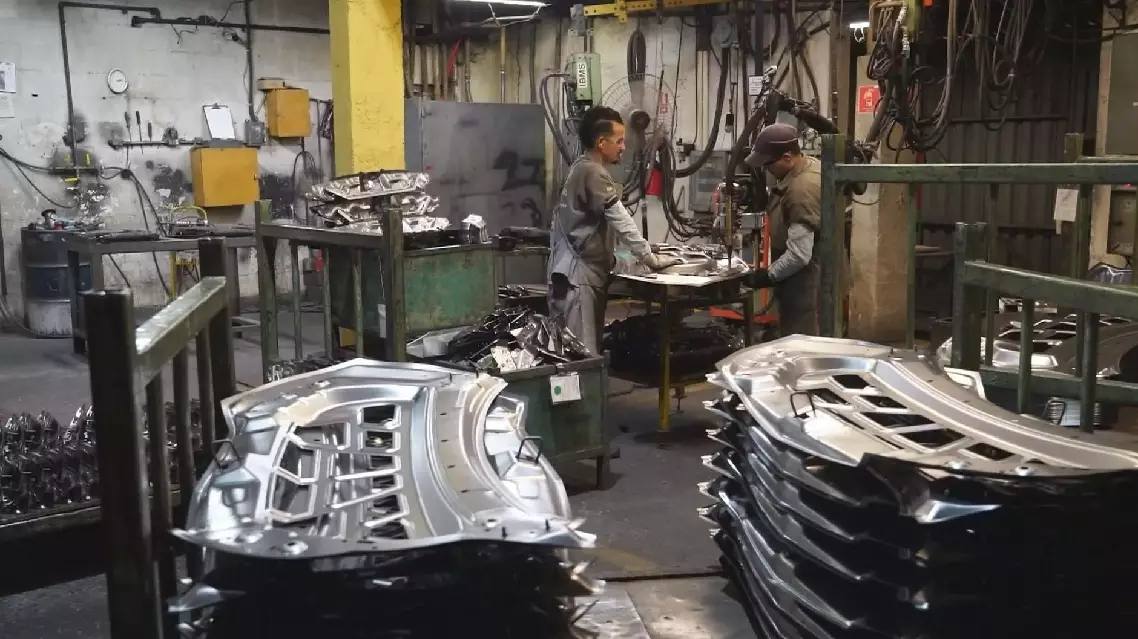
At a plant in the Brazilian state of Sao Paulo, 20,000 car hoods -- along with other parts -- are produced every month. Most are sold in the domestic market, but the company, Centauro, founded in 1970, also exports to 20 countries, mainly across Latin America.
The auto parts sector is a good example of an industry where steel and aluminum are essential materials.
Companies like Centauro have been keeping a close and increasingly concerned eye on the tariff war launched by the United States.
Brazil exports billions of dollars’ worth of steel and aluminum to the United States each year. The government says the U.S. tariffs are misguided and unjustified, and officials warn that the impact on companies -- both large and small -- is already being felt across the industrial sector.
Centauro's owner is also the president of Brazil's National Association of Car Parts Makers, Anfape. He says their biggest concern now is rising competition at home, as international steel products once destined for the U.S. are being redirected to other markets, including Brazil.
"We realize that there will be an oversupply of all types of globally produced inputs and products that were previously consumed by the U.S., and that various other countries will now be competing for those markets," said Renato Fonseca, president of Anfape.
According to the national development agency Sebrae, small and mid-sized companies account for nearly half of Brazil's industrial GDP.
The president of Brazil’s Union of Small and Medium Industries (Simpi) said the group’s members lack the leverage that global steel giants have to protect their interests.
"All of industry, directly or indirectly, depends on aluminum, steel, or both, as well as other raw materials. Whether it's equipment, facilities, or the product itself," said Josef Cury, the president of Simpi.
Brazil is still trying to negotiate with the United States for exemptions on at least part of its steel exports. But even if those talks succeed, the ripple effects of the tariff war are already moving through the country's supply chains and may be difficult to avoid.
Brazil pushes back as US tariff hike hits steel, aluminum exports
The Iranian government is focusing on public concerns and maintaining stable supplies of essential goods amid recent protests, Iranian President Masoud Pezeshkian said in a televised interview on Sunday.
In the city of Karaj, northwest of the capital Tehran, daily life has largely continued as normal. A video filmed by a local resident on Sunday shows food stores open and grocery shelves fully stocked.
"This is the block near my home, and there are some food stores here. Daily life continues here. Last night we did not see many protests in Karaj. Right now the city is very safe. This is a grocery store close to my home. All the food is available; nothing is in shortage. Here are noodles and different types of beans. Here are dairy products, cheese, and yogurt. I also checked other grocery stores and didn't see any shortages. Everything is available," said local resident Ali Reza.
Iranian officials have described recent disturbances as acts orchestrated by the "enemy," including some carried out by well-trained and armed "terrorists." The incidents have caused casualties among security personnel and civilians, as well as property damage.
The Secretary of Iran's Supreme National Security Council Ali Larijani has directed authorities to severely punish the "terrorists."
Meanwhile, Iran's police chief Ahmad-Reza Radan said on Sunday that the police had raised alert levels and arrested several leaders of the troublemakers during the operations on Saturday.
President Pezeshkian noted in the interview that the normal demands of the Iranian people are reasonable and justified, but they must realize that triggering riots and carrying out terrorist acts are the enemy's attempts to undermine the country. He urged the public to remain vigilant.
Also on Sunday, Iranian Parliament Speaker Mohammad Baqer Qalibaf warned that Tehran would regard U.S. and Israeli bases and facilities in the Middle East as "legitimate targets" if Washington takes military action against Iran. His remarks followed media reports saying U.S. President Donald Trump is "seriously considering authorizing a strike" against Iran.
Iranian state media reported that at least 109 members of Iran's security forces have been killed in clashes since the protests began 14 days ago. Meanwhile, human rights groups based outside the country said the number of protesters killed has exceeded 200, though the figure could not be independently verified.
The protests initially erupted over a sharp depreciation of the rial and sweeping subsidy reforms. Iranian authorities have blamed the unrest on foreign-linked agents and sanctions imposed by the United States.
Iranian president says government focusing on ensuring supplies amid protests