Skip to Content Facebook Feature Image

Republican senators to watch in the maneuvering over Trump's big bill

News

Republican senators to watch in the maneuvering over Trump's big bill
News

News

Republican senators to watch in the maneuvering over Trump's big bill

2025-06-10 02:31 Last Updated At:02:41

WASHINGTON (AP) — The Senate has set an ambitious timeline for passing President Donald Trump’s sweeping legislation to cut taxes and spending. But getting it on the Republican president's desk by July 4 will require some big decisions, and soon.

Republican senators are airing concerns about different parts of the legislation, including cuts to Medicaid, changes to food aid and the impact on the deficit. To push the bill to passage, Senate Majority Leader John Thune of South Dakota and other negotiators will need to find a compromise that satisfies both ends of their conference — and that can still satisfy the House, which passed the bill last month by only one vote.

A look at some of the groups and senators who leaders will have to convince as they work to push Trump’s “big, beautiful” bill toward a Senate vote:

Every Republican senator represents a state with a rural constituency — and some of their states are among the most rural in the country. Many in those less-populated areas rely heavily on Medicaid for health care, leading several of them to warn that the changes to the program in the bill could be devastating to communities that are already struggling.

Of particular concern is a freeze on a so-called provider tax that some states use to help pay for large portions of their Medicaid programs. The extra tax often leads to higher payments from the federal government, which critics say is a loophole that allows states to inflate their budgets. Sen. Josh Hawley of Missouri and several others have argued that freezing that tax revenue would hurt rural hospitals, in particular.

“Hospitals will close,” Hawley said last month. “It’s that simple. And that pattern will replicate in states across the country.”

Alabama Sen. Tommy Tuberville said Thursday that provider taxes in his state are “the money we use for Medicaid.”

“You start cutting that out, we’ve got big problems,” Tuberville said. Eliminating those taxes “might lose some folks.”

At the same time, Republican senators have little interest in a House-passed provision that spends more money by raising a cap on state and local tax deductions, known as SALT. The higher cap traditionally benefits more urban areas in states with high taxes, such as New York and California.

The House included the new cap after New York Republicans threatened to oppose the bill, but Senate Republicans uniformly dislike it. “I think there’s going to have to be some adjustment” on the SALT provision, Thune said Wednesday, noting that “senators are just in a very different place” from the House.

The House-passed bill would also shift some Medicaid and food stamp costs to states, a change that has the former governors in the Senate, in particular, worried.

West Virginia Sen. Jim Justice, who was governor of his state for eight years before his election to the Senate last year, said he favors many aspects of the bill. He supports the new work requirements for Medicaid and food stamp recipients, the restrictions on benefits for immigrants who are in the country illegally and the efforts to cut down on fraud. “There’s real savings there,” Justice said. “But then we ought to stop.”

“We’re on our way to cannibalizing ourselves,” Justice said. “We don’t want to hurt kids and hurt our families.”

The provisions stirring the most unease would require states to pay a higher share of the cost for food stamps — known as the Supplemental Nutrition Assistance Program, or SNAP. States would pay at least 5% of the cost of the benefits, with states that have high error rates in the program paying even more. The House bill would also shift additional administrative costs for the program to states.

North Dakota Sen. John Hoeven, also a former governor, said senators are working to get feedback from current governors and may propose some “incentive-oriented ideas” instead of a penalty for the high error rates.

“We don’t know if the states have really looked at the impacts of some of this yet,” Hoeven said.

Tuberville, who is running for governor of Alabama next year, said the program should be reformed instead of shifting costs.

“I know what our budget is and what we can afford, and we can’t start a federal program and then say, ‘Oh, let’s, let’s send it back to the states and let them take a big hunk of it,’” Tuberville said. “I mean, that’s not the way we do it.”

Thune needs to bring Republican moderates on board with the bill, including Maine Sen. Susan Collins and Alaska Sen. Lisa Murkowski. Both have reservations with the Medicaid cuts, among other things.

Collins said she wants to review how the SNAP changes will affect her state. Murkowski has questioned expiring subsidies for the Affordable Care Act and whether they might be needed if people are kicked off Medicaid.

Last month, Murkowski said she wants to make sure that people are not negatively impacted by the bill, “so we’re looking at it through that lens for both Medicaid and on energy.”

Murkowski and Sens. Thom Tillis of North Carolina, John Curtis of Utah and Jerry Moran of Kansas have also supported energy tax credits that would be phased out quickly under the House bill. The four senators argued that the quick repeal creates uncertainty for businesses and could raise prices for consumers.

Sens. Rand Paul of Kentucky, Ron Johnson of Wisconsin, Mike Lee of Utah and Rick Scott of Florida have argued the legislation does not save enough money and threatened to vote against it.

Paul is considered the least likely to support the measure. He says he won’t vote for it if it raises the debt ceiling — a key priority for GOP leaders in both the House and the Senate. The package would raise the nation’s debt limit by $4 trillion to allow more borrowing to pay the nation's bills, as the Treasury Department says the limit needs to be raised by the middle of July.

Johnson has been railing against the legislation since it was unveiled in the House, arguing that it does little to reduce government spending over time. He took those arguments to Trump last week at a meeting between the president and members of the Senate Finance Committee.

After the meeting, Johnson said he would continue to argue that the bill needs to do more to cut costs. But he said he came away with the recognition that he needed to be “more positive” as Trump exerts political pressure on Republicans to pass it.

“We’re a long ways from making the deficit curve bend down, but I recognize that’s going to take time,” Johnson said. “The truth is, there are a lot of good things in this bill that I absolutely support. I want it to succeed.”
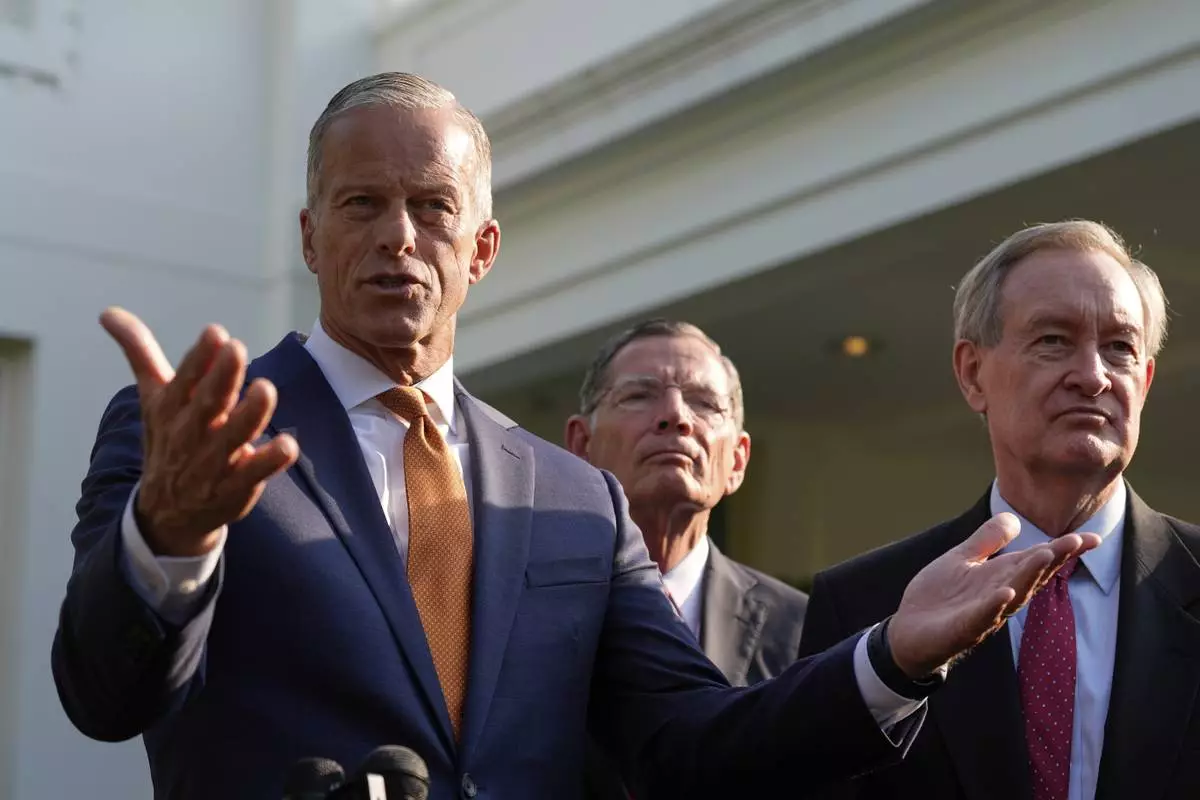
Senate Majority Leader John Thune, R-S.D., flanked by Sen. John Barrasso, R-Wyo., center, and Sen. Mike Crapo, R-Idaho, speak with reporters after meeting with President Donald Trump at the White House, Wednesday, June 4, 2025, in Washington. (AP Photo/Alex Brandon)
Senate Majority Leader John Thune, R-S.D., flanked by Sen. John Barrasso, R-Wyo., center, and Sen. Mike Crapo, R-Idaho, speak with reporters after meeting with President Donald Trump at the White House, Wednesday, June 4, 2025, in Washington. (AP Photo/Alex Brandon)


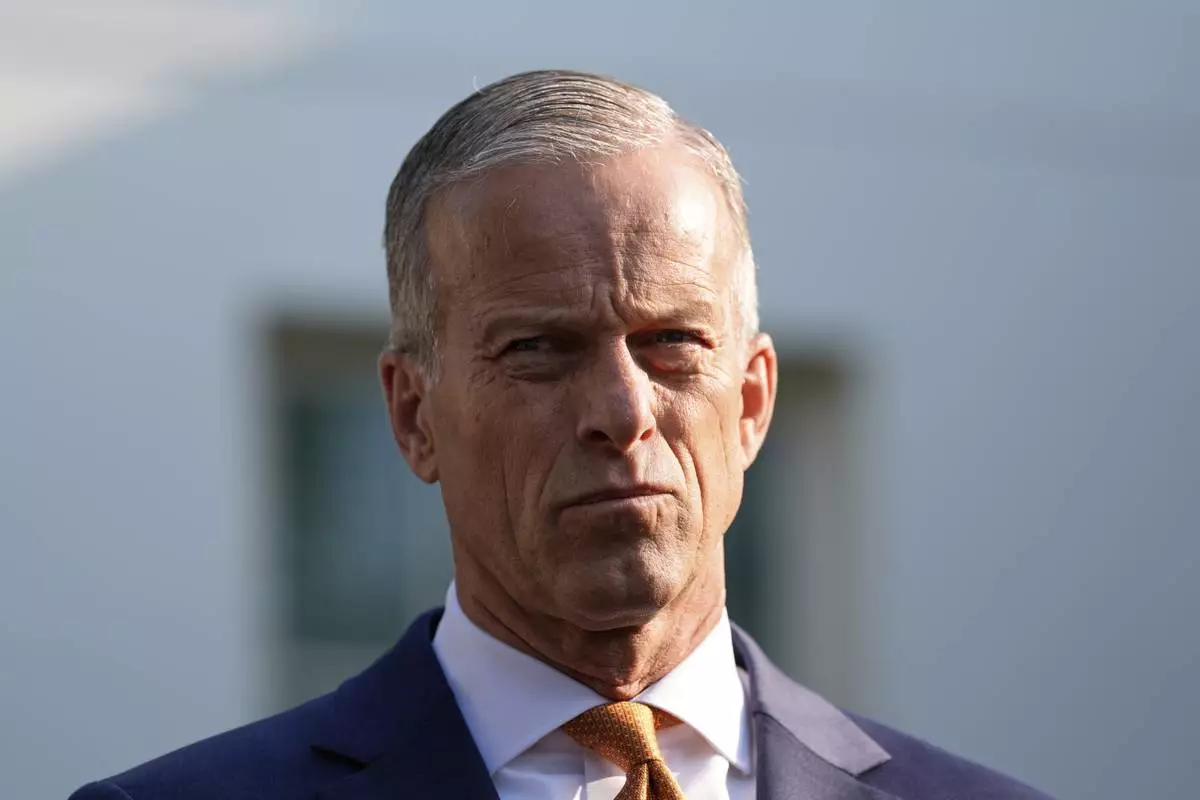
Senate Majority Leader John Thune, R-S.D., speaks with reporters after meeting with President Donald Trump at the White House, Wednesday, June 4, 2025, in Washington. (AP Photo/Alex Brandon)

Senate Majority Leader John Thune, R-S.D., speaks with reporters after meeting with President Donald Trump at the White House, Wednesday, June 4, 2025, in Washington. (AP Photo/Alex Brandon)

ST. LOUIS (AP) — World champions Ilia Malinin and the ice dance duo of Madison Chock and Evan Bates will anchor one of the strongest U.S. Figure Skating teams in history when they head to Italy for the Milan Cortina Olympics in less than a month.

Malinin, fresh off his fourth straight national title, will be the prohibitive favorite to follow in the footsteps of Nathan Chen by delivering another men's gold medal for the American squad when he steps on the ice at the Milano Ice Skating Arena.

Chock and Bates, who won their record-setting seventh U.S. title Saturday night, also will be among the Olympic favorites, as will world champion Alysa Liu and women's teammate Amber Glenn, fresh off her third consecutive national title.

U.S. Figure Skating announced its full squad of 16 athletes for the Winter Games during a made-for-TV celebration Sunday.

"I'm just so excited for the Olympic spirit, the Olympic environment," Malinin said. “Hopefully go for that Olympic gold.”

Malinin will be joined on the men's side by Andrew Torgashev, the all-or-nothing 24-year-old from Coral Springs, Florida, and Maxim Naumov, the 24-year-old from Simsbury, Connecticut, who fulfilled the hopes of his late parents by making the Olympic team.

Vadim Naumov and Evgenia Shishkova were returning from a talent camp in Kansas when their American Airlines flight collided with a military helicopter and crashed into the icy Potomac River in January 2025. One of the last conversations they had with their son was about what it would take for him to follow in their footsteps by becoming an Olympian.

“We absolutely did it,” Naumov said. “Every day, year after year, we talked about the Olympics. It means so much in our family. It's what I've been thinking about since I was 5 years old, before I even know what to think. I can't put this into words.”

Chock and Bates helped the Americans win team gold at the Beijing Games four years ago, but they finished fourth — one spot out of the medals — in the ice dance competition. They have hardly finished anywhere but first in the years since, winning three consecutive world championships and the gold medal at three straight Grand Prix Finals.

U.S. silver medalists Emilea Zingas and Vadym Kolesnik also made the dance team, as did the Canadian-born Christina Carreira, who became eligible for the Olympics in November when her American citizenship came through, and Anthony Ponomarenko.

Liu was picked for her second Olympic team after briefly retiring following the Beijing Games. She had been burned out by years of practice and competing, but stepping away seemed to rejuvenate the 20-year-old from Clovis, California, and she returned to win the first world title by an American since Kimmie Meissner stood atop the podium two decades ago.

Now, the avant-garde Liu will be trying to help the U.S. win its first women's medal since Sasha Cohen in Turin in 2006, and perhaps the first gold medal since Sarah Hughes triumphed four years earlier at the Salt Lake City Games.

Her biggest competition, besides a powerful Japanese contingent, could come from her own teammates: Glenn, a first-time Olympian, has been nearly unbeatable the past two years, while 18-year-old Isabeau Levito is a former world silver medalist.

"This was my goal and my dream and it just feels so special that it came true,” said Levito, whose mother is originally from Milan.

The two pairs spots went to Ellie Kam and Danny O'Shea, the U.S. silver medalists, and the team of Emily Chan and Spencer Howe.

The top American pairs team, two-time reigning U.S. champions Alisa Efimova and Misha Mitrofanov, were hoping that the Finnish-born Efimova would get her citizenship approved in time to compete in Italy. But despite efforts by the Skating Club of Boston, where they train, and the help of their U.S. senators, she did not receive her passport by the selection deadline.

“The importance and magnitude of selecting an Olympic team is one of the most important milestones in an athlete's life,” U.S. Figure Skating CEO Matt Farrell said, "and it has such an impact, and while there are sometimes rules, there is also a human element to this that we really have to take into account as we make decisions and what's best going forward from a selection process.

“Sometimes these aren't easy," Farrell said, “and this is not the fun part.”

The fun is just beginning, though, for the 16 athletes picked for the powerful American team.

AP Olympics: https://apnews.com/hub/milan-cortina-2026-winter-olympics

Amber Glenn competes during the women's free skating competition at the U.S. Figure Skating Championships, Friday, Jan. 9, 2026, in St. Louis. (AP Photo/Stephanie Scarbrough)

Amber Glenn competes during the women's free skating competition at the U.S. Figure Skating Championships, Friday, Jan. 9, 2026, in St. Louis. (AP Photo/Stephanie Scarbrough)

Alysa Liu skates during the "Making Team USA" performance at the U.S. Figure Skating Championships, Sunday, Jan. 11, 2026, in St. Louis. (AP Photo/Stephanie Scarbrough)

Alysa Liu skates during the "Making Team USA" performance at the U.S. Figure Skating Championships, Sunday, Jan. 11, 2026, in St. Louis. (AP Photo/Stephanie Scarbrough)

Maxim Naumov skates during the "Making Team USA" performance at the U.S. Figure Skating Championships, Sunday, Jan. 11, 2026, in St. Louis. (AP Photo/Stephanie Scarbrough)

Maxim Naumov skates during the "Making Team USA" performance at the U.S. Figure Skating Championships, Sunday, Jan. 11, 2026, in St. Louis. (AP Photo/Stephanie Scarbrough)

Madison Chock and Evan Bates skate during the "Making the Team" performance at the U.S. Figure Skating Championships, Sunday, Jan. 11, 2026, in St. Louis. (AP Photo/Stephanie Scarbrough)

Madison Chock and Evan Bates skate during the "Making the Team" performance at the U.S. Figure Skating Championships, Sunday, Jan. 11, 2026, in St. Louis. (AP Photo/Stephanie Scarbrough)

Gold medalist Ilia Malinin arrives for the metal ceremony after the men's free skate competition at the U.S. Figure Skating Championships, Saturday, Jan. 10, 2026, in St. Louis. (AP Photo/Jeff Roberson)

Gold medalist Ilia Malinin arrives for the metal ceremony after the men's free skate competition at the U.S. Figure Skating Championships, Saturday, Jan. 10, 2026, in St. Louis. (AP Photo/Jeff Roberson)

Recommended Articles