Beijing's Yunju Temple is harnessing cutting-edge digital technologies to safeguard its priceless collection of stone sutras, some of which date back over 1,400 years.
The stone sutras, known as Fangshan stone sutras, are listed among Chinese archival documentary heritage on Monday.
The carvings of the stone sutras began in the late Sui Dynasty (581-618) by monk Jingwan, founder of the Yunju Temple, and went through six dynasties, spanning 1,039 years before it was finished.
The temple now houses 14,278 stone slabs of sutras, featuring more than 35 million characters. To better protect this invaluable heritage, the temple has turned to cutting-edge digital preservation methods.
Using advanced techniques such as lighting matrix data acquisition and visual computing, preservation experts first conduct non-contact scanning to document the sutras' colors, carving lines, and surface depth.
They then use computer graphics and image synthesis algorithms to reveal details that have become invisible to the naked eye.
"This photo shows a stone sutra where many characters have worn away and some carvings have even flaked off. But the digital algorithms technology can help restore the original carving lines by analyzing their color differences. Our next step is to create 3D models for those sutras, aiming to bring these artifacts back to life and fully showcase their historical value," explained Zhang Zhutong, director of the temple's cultural relics management department.
Beyond their religious importance, the sutras also serve as a cultural treasure, reflecting the technological and artistic prowess of their time.
"These stone sutras demonstrate Beijing's advancements across multiple sectors at that time -- from economic and cultural development to craftsmanship, including techniques in iron smelting and gold-copper alloying," said Luo Zhao, director of the temple's cultural research center.
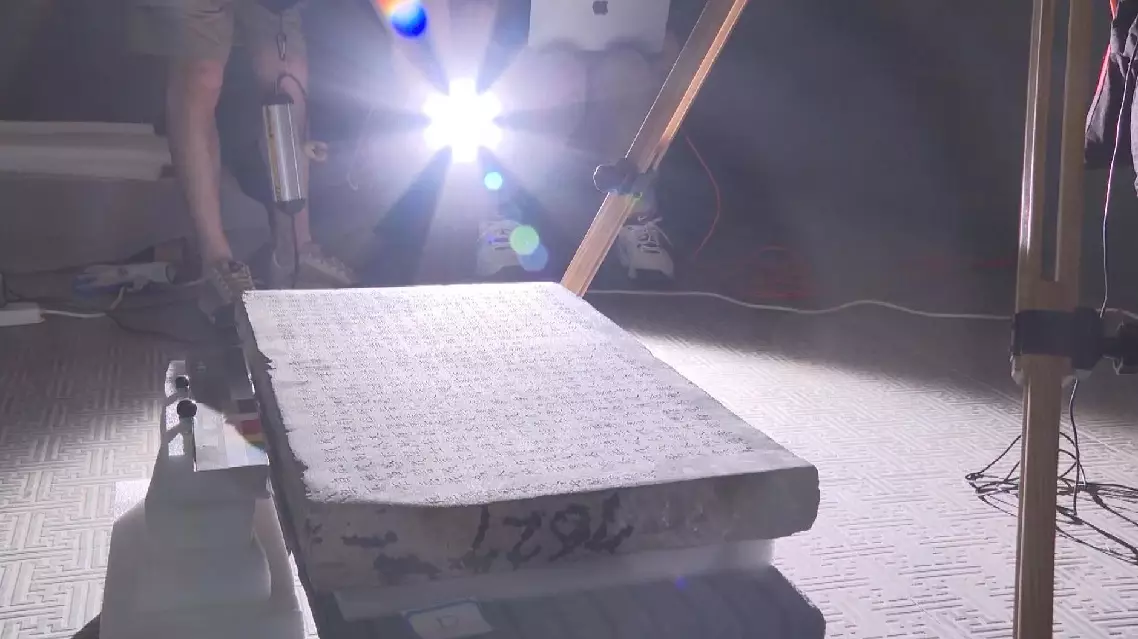
Yunju Temple harnesses digital technologies to preserve millennium-old stone scriptures
Russian helicopter manufacturers are looking to take their partnerships with Chinese firms to new heights at the 10th China-Russia Expo, which opened in Harbin of northeast China's Heilongjiang Province on Sunday.
The expo highlights future industries including intelligent equipment, digital security, green building materials, new energy storage and other key fields.
As the largest comprehensive exchange platform between the two countries, Russia's leading helicopter makers are seeing fresh opportunities to team up with Chinese machinery firms, seeking reciprocal partnerships that draw on the strengths of both sides.
Sergei Suchilin, Head of Life Cycle Support at Russian Helicopters, part of the state-owned high-tech conglomerate Rostec, joined the event to present their best products.
"The first one is [Mil] Mi-17, the most common, the most popular model all over the world. It has a lot of different modification and can be used in very many variants of exploitation. First of all, it's for transportation for personnel and cargoes, also it can be used on search and rescue operations," said Suchilin.
Beyond showcasing, Suchilin was particularly keen to connect with Chinese exhibitors and explore potential cooperation, hoping to tap into their manufacturing edge.
"Machines and equipment, I think, it is more interesting -- like a big producing plant for us, and China is famous for its machine and equipment. This field of economics is developing very well nowadays in China," said the Russian exhibitor.
Dozens of meters away from their booth, a variety of aero-engine models for passenger planes, cargo drones and helicopters were on display in the Chinese exhibition zone, covering a comprehensive industrial chain, which is especially appealing for Suchilin.
"It's our first visit and it is really interesting for us, because there are a lot of new developing industries in China and it is very interesting to have a look, and maybe we may have some cooperation in the future, to know the projects of local producers," he said.
The enthusiasm for collaboration is mutual. Zhang Yuliang of Xinghuo Machine Tool in Hebei Province expressed strong confidence in the Russian market, thanks to the high reliability and cost performance of his products.
"We have full confidence in the Russian market. Since 2022, the share of our products exported to Russia has risen from 10 percent to 50 percent. Chinese products boast high-cost performance and stable output. We will keep expanding production capacity to meet the needs of Russian clients," he said.
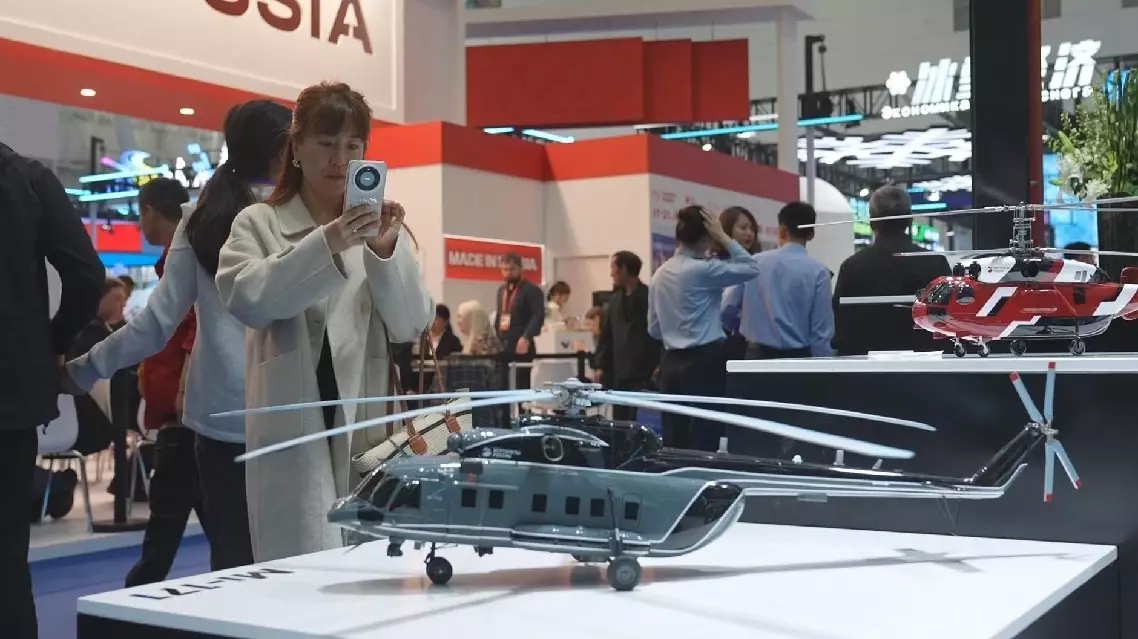
Russian helicopter makers eye collaboration with Chinese firms at China-Russia Expo