DAKAR, Senegal (AP) — Even as it pounds Ukraine, Russia is expanding its military footprint in Africa, delivering sophisticated weaponry to sub-Saharan conflict zones where a Kremlin-controlled armed force is on the rise. Skirting sanctions imposed by Western nations, Moscow is using cargo ships to send tanks, armored vehicles, artillery and other high-value equipment to West Africa, The Associated Press has found.
Relying on satellite imagery and radio signals, AP tracked a convoy of Russian-flagged cargo ships as they made a nearly one-month journey from the Baltic Sea. The ships carried howitzers, radio jamming equipment and other military hardware, according to military officials in Europe who closely monitored them. The deliveries could strengthen Russia’s fledgling Africa Corps as Moscow competes with the United States, Europe and China for greater influence across the continent.
The two-year-old Africa Corps, which has links to a covert branch of Russia’s army, is ascendant at a time when U.S. and European troops have been withdrawing from the region, forced out by sub-Saharan nations turning to Russia for security.
Mali, Burkina Faso and Niger have been battling fighters linked with al-Qaida and the Islamic State group for more than a decade.
At first, mercenary groups with an arms-length relationship to the Kremlin entered the fray in Africa. But increasingly, Russia is deploying its military might, and intelligence services, more directly.
”We intend to expand our cooperation with African countries in all spheres, with an emphasis on economic cooperation and investments,” Kremlin spokesman Dmitry Peskov said. “This cooperation includes sensitive areas linked to defense and security.”
Russia's 8,800-ton Baltic Leader and 5,800-ton Patria are among hundreds of ships that Western nations have sanctioned to choke off resources for Russia's war in Ukraine. The ships docked and unloaded in Conakry, Guinea, in late May, AP satellite images showed.
Other ships made deliveries to the same port in January. They delivered tanks, armored vehicles and other hardware that was then trucked overland to neighboring Mali, according to European military officials and a Malian blogger's video of the long convoy.
The military officials spoke to AP about Russian operations on condition of anonymity. The AP verified the blogger's video, geolocating it to the RN5 highway leading into Bamako, the Malian capital.
After the latest delivery in Conakry, trucks carrying Russian-made armored vehicles, howitzers and other equipment were again spotted on the overland route to Mali.
Malian broadcaster ORTM confirmed that the West African nation's army took delivery of new military equipment. AP analysis of its video and images filmed by the Malian blogger in the same spot as the January delivery identified a broad array of Russian-made hardware, including 152 mm artillery guns and other smaller canons.
AP also identified a wheeled, BTR-80 armored troop carrier with radio-jamming equipment, as well as Spartak armored vehicles and other armored carriers, some mounted with guns. The shipment also included at least two semi-inflatable small boats, one with a Russian flag painted on its hull, as well as tanker trucks, some marked “inflammable” in Russian on their sides.
The military officials who spoke to AP said they believe Russia has earmarked the most potent equipment — notably the artillery and jamming equipment — for its Africa Corps, not Malian armed forces. Africa Corps appears to have been given air power, too, with satellites spotting at least one Su-24 fighter-bomber at a Bamako air base in recent months.
For years, French forces supported counterinsurgency operations in Mali and neighboring Burkina Faso and Niger. But France pulled out its troops after coups in Mali in 2020 and 2021, in Burkina Faso in 2022 and Niger in 2023. Russian mercenaries stepped into the vacuum.
Wagner Group, the most notable, deployed to Sudan in 2017 and expanded to other African countries, often in exchange for mining concessions.
It earned a reputation for brutality, accused by Western countries and U.N. experts of human rights abuses, including in Central African Republic, Libya and Mali.
Of 33 African countries in which Russian military contractors were active, the majority were Wagner-controlled, according to U.S. government-sponsored research by RAND.
But after Wagner forces mutinied in Russia in 2023 and their leader, Yevgeny Prigozhin, was killed two months later in a suspicious plane crash, Moscow tightened its grip. Russian military operations in Africa were restructured, with the Kremlin taking greater control through Africa Corps.
It is overseen by the commander of Unit 29155, one of the most notorious branches of Russia’s shadowy GRU military intelligence service, according to the European Union. Unit 29155 has been accused of covertly attacking Western interests for years, including through sabotage and assassination attempts.
The EU in December targeted Unit 29155 Maj. Gen. Andrey Averyanov with sanctions, alleging that he is in charge of Africa Corps operations.
“In many African countries, Russian forces provide security to military juntas that have overthrown legitimate democratic governments, gravely worsening the stability, security and democracy of the countries,” the EU sanctions ruling said. These operations are financed by exploiting the continent's natural resources, the ruling added.
The Russian Ministry of Defense didn’t immediately respond to questions about Averyanov’s role in Africa Corps.
Researchers and military officials say the flow of weapons from Russia appears to be speeding Africa Corps’ ascendancy over Wagner, helping it win over mercenaries that have remained loyal to the group. Africa Corps is also is recruiting in Russia, offering payments of up to 2.1 million rubles ($26,500), and even plots of land, for signing a contract with the Ministry of Defense, plus more on deployment.
Within days of the latest equipment delivery, Wagner announced its withdrawal from Mali, declaring “mission accomplished" in a Telegram post.
Africa Corps said in a separate post that it would remain.
The changeover from Wagner to Africa Corps in Mali could be a forerunner for other similar transitions elsewhere on the continent, said Julia Stanyard, a researcher of Russian mercenary activity in Africa.
“Bringing in this sort of brand-new sophisticated weaponry, and new armored vehicles and that sort of thing, is quite a bit of a shift,” said Stanyard, of the Switzerland-based Global Initiative Against Transnational Organized Crime.
Armed groups in Mali have inflicted heavy losses on Malian troops and Russian mercenaries. The al-Qaida linked group JNIM killed dozens of soldiers in an attack this month on a military base. Insurgents also killed dozens of Wagner mercenaries in northern Mali last July.
Some of the latest hardware could have been shipped over specifically in response to such attacks, military officials said. They said the jamming equipment, for example, could help defend against booby traps detonated using phone signals.
The latest convoy attracted attention because a Russian Navy warship, the Boykiy, escorted the ships after they set off in April from Russia’s Kaliningrad region on the Baltic.
Last October, in what's considered a hostile act, the Boykiy's radar systems locked onto a French Navy maritime surveillance plane on patrol against suspected Russian efforts to sabotage underwater cables, according to military officials.
The convoy included a third sanctioned Russian cargo ship, the Siyanie Severa. It continued onward as Baltic Leader and Patria unloaded in Conakry, docking in Bata, Equatorial Guinea.
Satellite imagery from May 29 shows trucks lined up on the dock as the ship unloaded. The AP could not verify whether the cargo included weapons or the ultimate destination for the shipment, though Wagner has maintained a strong presence in the nearby Central African Republic.
Leicester reported from Paris and Biesecker from Washington. Beatrice Dupuy and Rachel Leathe in New York contributed.
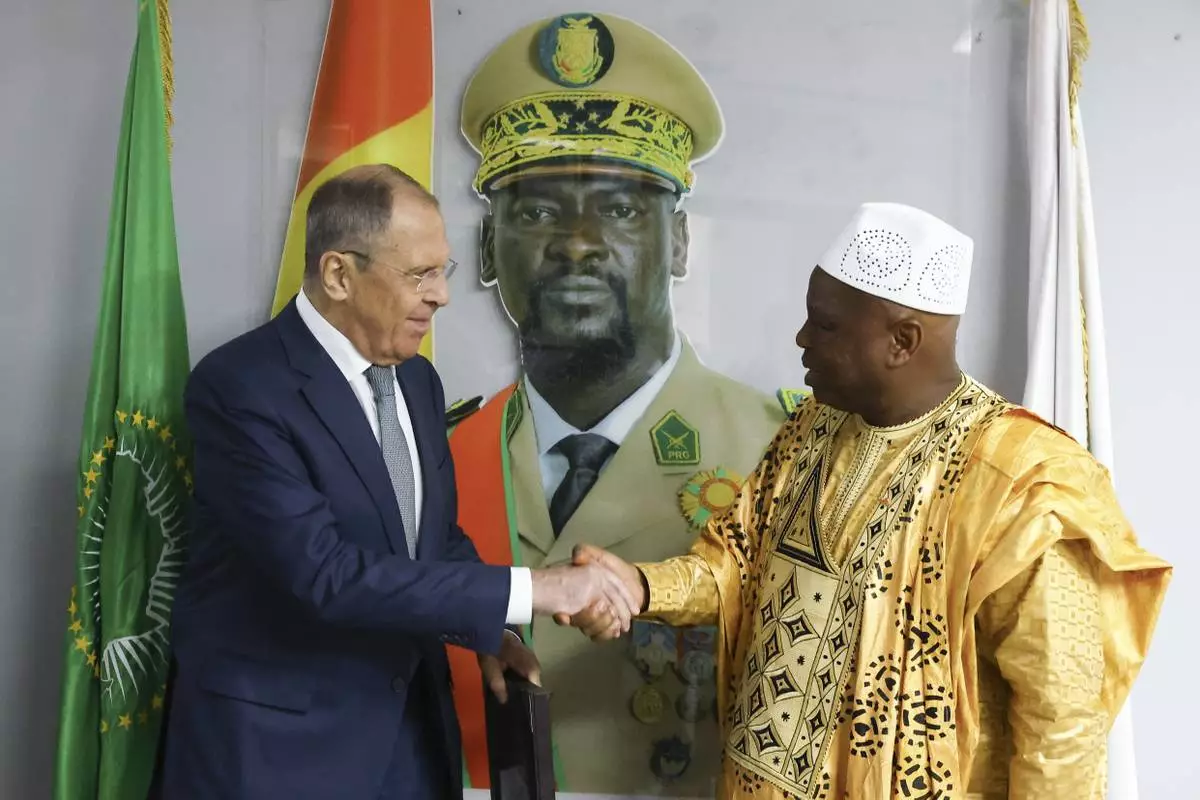
FILE - In this photo released by the Russian Foreign Ministry Press Service, Russian Foreign Minister Sergey Lavrov, left, and Guinea's Foreign Minister Morissanda Kouyate shake hands near a portrait of Guinea's President Mamadi Doumbouya in Conakry, Guinea, on June 3, 2024. (Russian Foreign Ministry Press Service via AP, File)
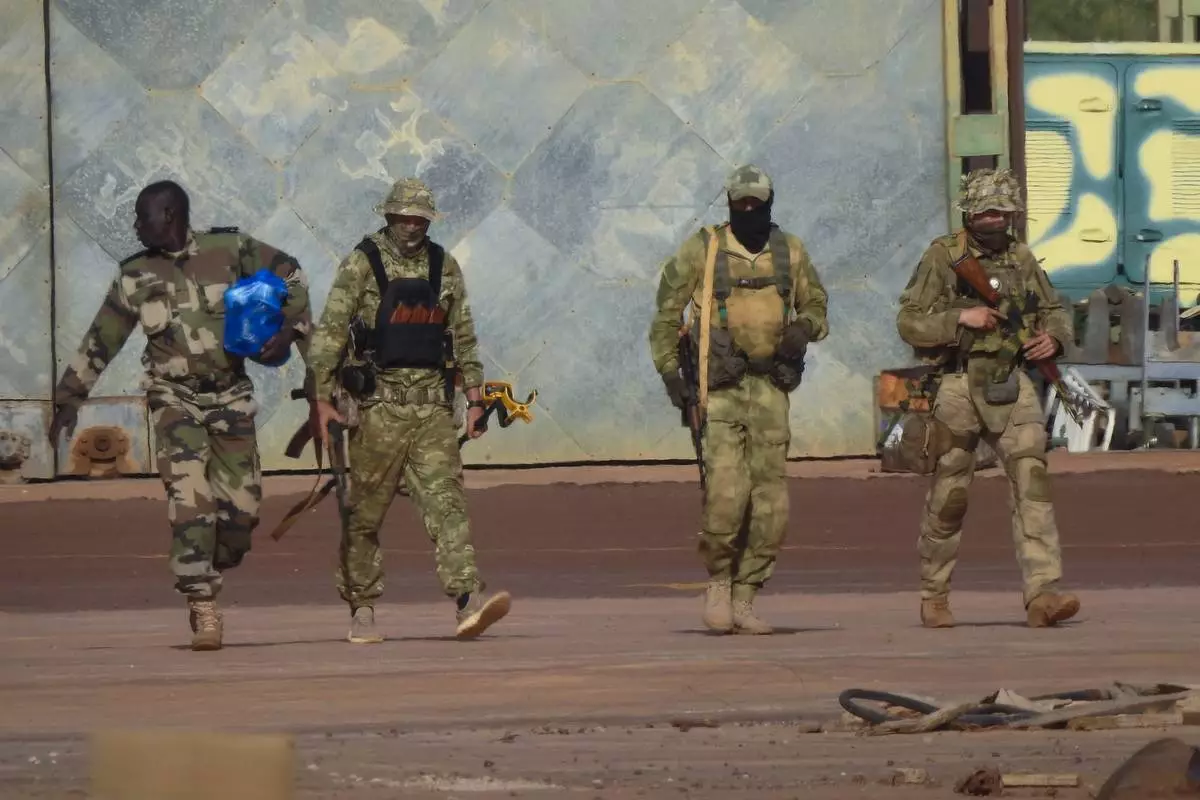
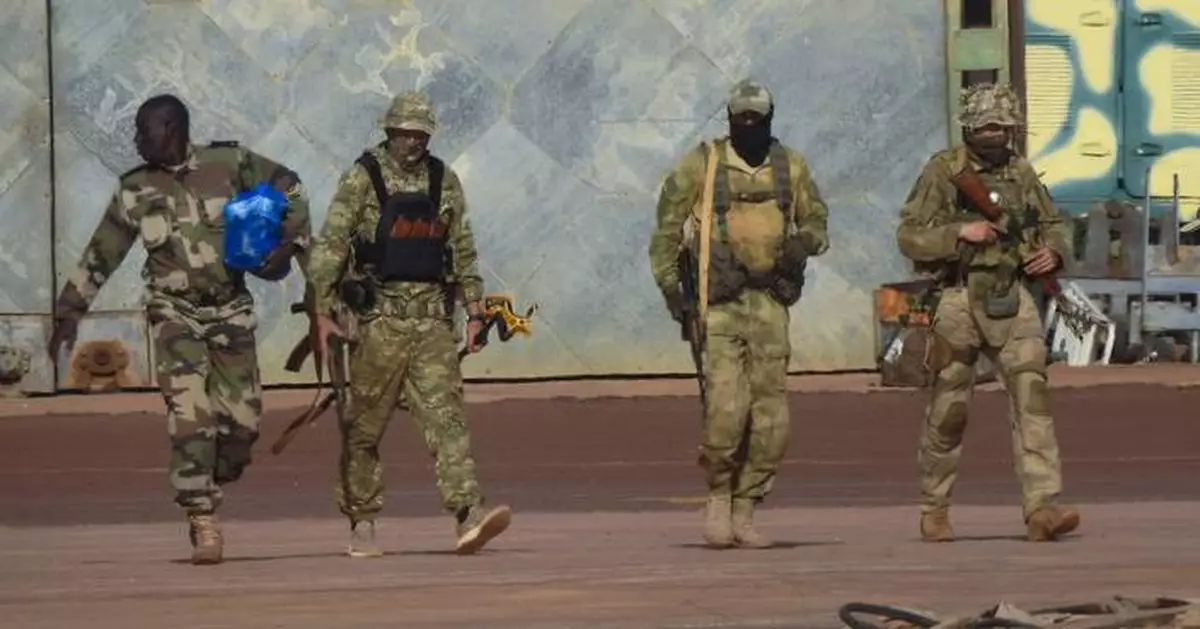
FILE - This undated photograph handed out by the French military shows three Russian mercenaries, right, in northern Mali. (French Army via AP)