Remarks by CE at media session before ExCo (with video)
Following are the remarks by the Chief Executive, Mr John Lee, at a media session before the Executive Council meeting today (June 10):
Reporter: Good morning Mr Lee. So you have chaired a senior meeting and instructed officials to follow up in response to the fresh water supply to housing estates in Fanling. What do you think the Government can learn from this incident, and are there any areas that should be improved on? And secondly, with Aristo Sham being the first Hong Kong-born pianist to win the Van Cliburn International Piano Competition, what does his win mean, in your opinion, and are there any plans to take this opportunity, perhaps, to review support to the industry? Thank you.
Chief Executive: In dealing with water matters, we have to ensure not just that it is safe to drink, but also that people drink it with their mind at ease. I'm highly concerned about the water matter in Queen's Hill Estate and Shan Lai Court, and that is why I held a meeting and gave four directives and 10 tasks for the relevant bureaux and departments to implement. I repeat the four directives: to trace the source; to set up an expert group to assist in the tracing; to immediately install and strengthen the filtration facilities in each and every building in Queen's Hill Estate and Shan Lai Court; and to speed up the work.
In regard to the 10 tasks, I don't want to repeat here, because they have been well announced. And I've also asked the Deputy Financial Secretary, Michael Wong, to oversee the implementation. I see the 10 specific tasks are being implemented fast and immediately. During the past weekend, colleagues deployed additional manpower on-site to speed up the work progress. The latest progress of key areas has received positive feedback from residents. For example, we have visited a lot of households that have previously made complaints about the water quality, and from them –and from the sample water we've collected – they've indicated that they no longer see any particles in the water. They find the water clean, and they feel at ease to drink the water.
We have also enhanced manpower at the district level to talk to people who may still have problems. This includes government officials, care teams, District Council members and the different representatives who are willing to join the government team to visit households and also talk to the different people to address their concerns. And I'm glad to hear that they have been receiving positive feedback that those who previously complained about the particles they have reported, they no longer see those particles. There may be one or two households that still reported that they had seen particles, but after flushing and some work to the taps and also cleaning the water meter, there is very clear improvement. We'll continue the work. Experience suggests that some particles or residue may remain in the pipes after entering into the building. In other words, in the same building, we're seeing a lot of households saying the water is clean – they don't see any particles anymore – but there may be one or two that still see some small particles. So these particles stay in internal pipes, probably within the households or probably within the taps or the water meter. Government colleagues are working hard to do all they can to continue to flush the pipes, flush the tap, flush the water meter. And I advise residents, they can do the same, but we'll do our best. And what is also very important is good dissemination of information, and we have been publishing the results every day on the website, and also posting the notice at the entrance of all buildings.
I think the experience that colleagues have learned from this incident is, response should be fast. We should understand the feelings of residents in water concerns to ensure that it's not just safe, but that when they drink the water, their mind is at ease. Colleagues, of course, focus on the technical side of ensuring the water is safe. I think everybody handling this matter knows that we should, at the same time, address residents' ease of mind when we deal with water problem. And I've also instructed the Water Supplies Department to replace the pipes which are the source of the particles. They're working hard on it. My thanks to the support and advice of the expert team which has been formed, they are more or less formulating the plan to replace the pipes which are the source of the problem as soon as possible, and the Water Supplies Department will submit the plan to the Development Bureau as soon as possible.
As regards the very good news of Aristo Sham having won the Van Cliburn International Piano Competition, which is one of the highest levels of piano competitions, and Mr Aristo Sham, being born in Hong Kong – we are so proud of him, and we are so glad that he has won the competition. I think every Hong Kong resident feels proud of this excellent result. And of course, if Aristo will find time to make a few performances in Hong Kong, it will really get us even more excited and we will see if that will happen, but we'll work hard to see whether we can make it happen.
I'm very glad that overall, the performances of a lot of artists from Hong Kong are doing well in different areas, and this is seen in a lot of good results they have achieved. The present mechanism for the Government to support performers in this field of art is through the Hong Kong Arts Development Council, and they will be looking closely at the needs to strengthen opportunities for different areas of art so as to develop talent, to develop the overall performances of those who are interested in different areas. There is an expert group, actually, in the Arts Development Council to look at the overall situation and the different areas, strengths and potentials, to examine assistance and support, including donations or subsidies in the area of developing different arts. So the mechanism is there and we will continue to make good use of the Arts Development Council to help artists in different areas to achieve their goals and realise their dreams. Thank you.
(Please also refer to the Chinese portion of the remarks.)
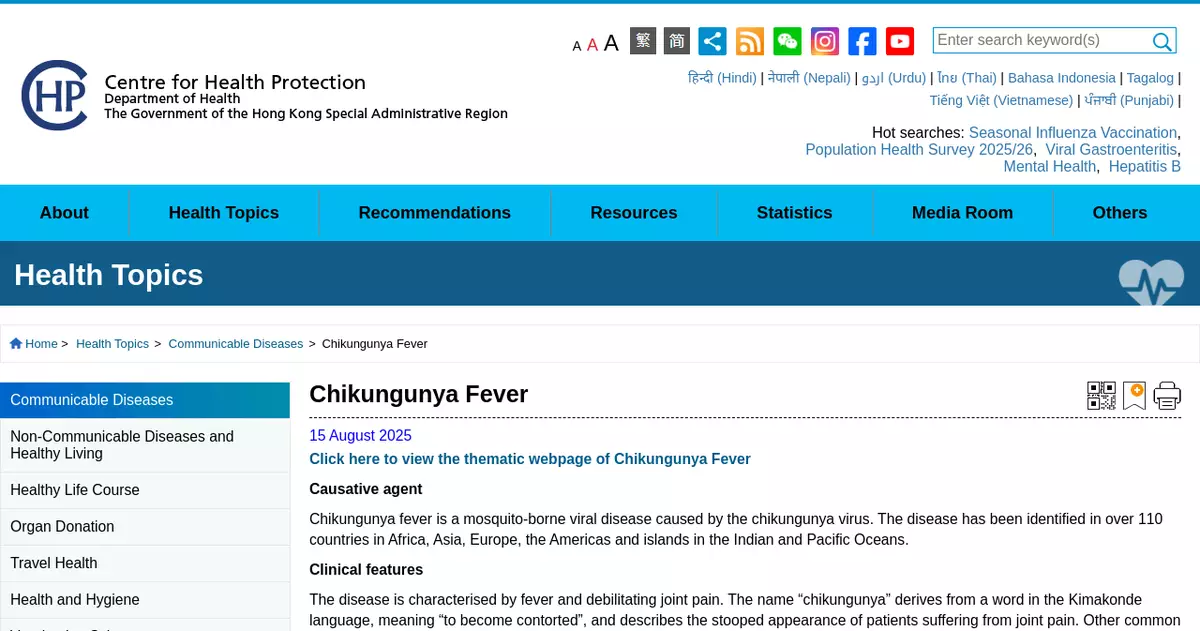
Update on chikungunya fever
The Centre for Health Protection (CHP) of the Department of Health announced that, as of 5pm today (January 11), no new cases of chikungunya fever (CF) had been recorded.
Latest surveillance data
------------------------------
Hong Kong has recorded a total of 82 confirmed CF cases last year. Among them, 11 were local cases, and the rest were imported cases.
Since the beginning of 2025, and as of December 10, 2025, a total of 502 264 CF cases and 186 CF-related deaths have been reported in over 40 countries/territories. Cases have been reported in the Americas, Africa, Asia, and Europe. Although the northern hemisphere has entered the winter season, temperatures in subtropical and some temperate regions remain elevated due to climate change, creating favourable conditions for mosquito breeding. In addition, CF outbreaks continue to occur in many countries worldwide. The risk of imported cases persists. Members of the public should check the situation of the destinations before travelling abroad, especially when travelling to Southeast Asian countries.
Government's comprehensive follow-up actions
-----------------------------------------------------
Given that some local cases of CF have visited the Tsing Yi Nature Trails or the surrounding area in November last year, the trails are currently closed until further notice. Relevant government departments continue to conduct large-scale mosquito control and prevention efforts along the trails, and the CHP appeals to the public not to enter the area in order to reduce the risk of contracting CF and to avoid exposure to chemicals or interfering with the mosquito control operations. Since the confirmation on December 10, 2025, of a case involving a person who had visited the Tsing Yi Nature Trails on November 30, 2025, no further local cases have been recorded to date. The CHP continues to urge individuals who have recently hiked along the Tsing Yi Nature Trails to seek medical attention as soon as possible if they develop relevant symptoms and to call the enquiry hotline (Tel: 2125 2373), which operates from 9am to 6pm.
The Food and Environmental Hygiene Department (FEHD) has been continuously conducting intensive fogging operations to eliminate adult mosquitoes along the Tsing Yi Nature Trails and the surrounding area. At suitable locations, large ultra-low volume foggers have been deployed, and a robot dog is being put on trial to enhance operational effectiveness. The FEHD has also set up new mosquito trapping devices, cleared discarded containers and garbage that could cause stagnant water, and applied larvicide oil or larvicides in areas with stagnant water that cannot be removed immediately. The FEHD has been collaborating with the Kwai Tsing District Office, the Lands Department and the Drainage Services Department to strengthen efforts in eliminating potential mosquito breeding sites along the Tsing Yi Nature Trails. Pamphlets have been distributed to hikers in the area, urging citizens to be vigilant against mosquito infestations and take personal protective measures. The FEHD has also held meetings of the interdepartmental task forces on anti-mosquito work across districts to discuss the latest developments regarding the situation and plan accordingly to co-ordinate relevant departments and stakeholders in strengthening mosquito prevention and control measures in areas under their purview.
Continuously strengthening prevention and control
---------------------------------------------------------
The FEHD and relevant departments have comprehensively enhanced the mosquito control operations in Hong Kong since July last year, and this has continued. Among these, the FEHD has conducted vector investigations and targeted mosquito control operations against the imported and local cases. In light of the local case, the FEHD has immediately conducted follow-up actions, including:
 carrying out intensive fogging in scrubby areas within a 250-metre radius of the relevant locations to kill adult mosquitoes;
carrying out inspections of the locations, removing stagnant water, applying insecticides and disposing of abandoned water containers every week with a view to preventing mosquito breeding; and
enhancing public education efforts through organising health talks, setting up mobile education stations, and distributing publicity leaflets.
carrying out intensive fogging in scrubby areas within a 250-metre radius of the relevant locations to kill adult mosquitoes;
carrying out inspections of the locations, removing stagnant water, applying insecticides and disposing of abandoned water containers every week with a view to preventing mosquito breeding; and
enhancing public education efforts through organising health talks, setting up mobile education stations, and distributing publicity leaflets.
The abovementioned measures will be continued. Furthermore, the Government will further enhance the mosquito control efforts in addition to the existing measures.
Preventive measures to be taken by the public
----------------------------------------------------
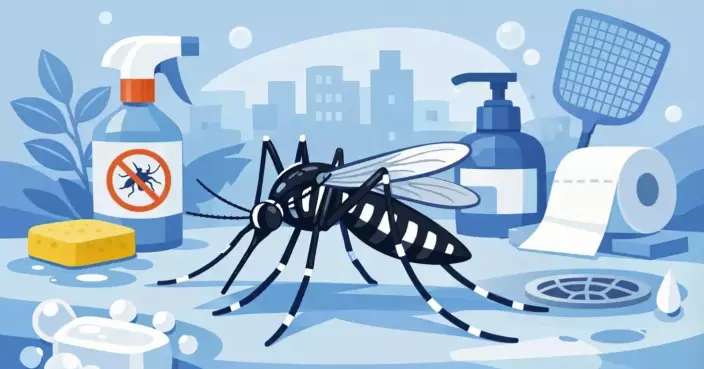
Members of the public should use DEET-containing insect repellents or other effective active ingredients properly to prevent mosquito bites, but the following precautions should be taken when using them:
read the label instructions carefully first;
apply right before entering an area with a risk of mosquito bites;
apply on exposed skin and clothing;
use DEET of up to 30 per cent for pregnant women and up to 10 per cent for children (for children who travel to countries or areas where mosquito-borne diseases are endemic or epidemic and where exposure is likely, those aged 2 months or above can use DEET-containing insect repellents with a DEET concentration of up to 30 per cent);
apply sunscreen first, then insect repellent;
reapply only when needed and follow the instructions; and
in addition to DEET, there are other insect repellents available on the market containing different active ingredients, such as IR3535 and picaridin. When using any insect repellent, the public should follow the usage instructions and precautions on the product label.
The FEHD also appeals to members of the public to continue to stay alert and work together to carry out mosquito prevention and control measures early, including inspecting their homes and surroundings to remove potential breeding grounds, changing water in vases and scrubbing their inner surfaces, removing water in saucers under potted plants at least once a week, and properly disposing of containers such as empty cans and lunch boxes. The FEHD also advises members of the public and property management agencies to keep drains free of blockage and level all defective ground surfaces to prevent the accumulation of water. They should also scrub all drains and surface sewers with an alkaline detergent at least once a week to remove any mosquito eggs.
The public should call 1823 in case of mosquito problems, and may visit the following pages for more information: the CF page of theCHPand theTravel Health Service, the latestTravel Health News,tips for using insect repellents, and the CHPFacebook Page,Instagram AccountandYouTube Channel, and also theMosquito Prevention and Control dedicated pageof the FEHD.
Source: AI-found images