China will increase central budget funding for social programs by over 30 percent this year compared to 2020 levels as part of a major push to improve public welfare, and the initiatives will be incorporated into the country's 15th Five-Year Plan (2026-2030), a senior official announced Tuesday.
Xiao Weiming, deputy secretary-general of the National Development and Reform Commission (NDRC), revealed the plan during a press conference in Beijing, following Monday's release of new guidelines on improving public well-being.
The guidelines on further safeguarding and improving public well-being, and resolutely addressing the most pressing concerns of the people, jointly issued by the Communist Party of China Central Committee and the State Council, outline 10 policy measures across four key areas designed to address pressing public concerns through more equitable, balanced and inclusive social services.
Key provisions include prioritizing equity in social welfare by expanding coverage and strengthening support for low-income populations, improving basic public service quality and accessibility, including residency-based service provision, enhancing educational resources and healthcare equity and expanding elderly and childcare services.
"[We] outline key strategic tasks, policy measures, and projects to enhance public services within the framework of the 15th Five-Year Plan. Central budget funding for public services this year will rise by over 30 percent from 2020 levels," said Xiao.
During the press conference, the official also underscored China's social safety net, noting that the country has built the world's largest social security system. Currently, 1.07 billion citizens are covered by basic pension insurance, while 1.32 billion are enrolled in basic medical insurance. Additionally, education accessibility now meets or exceeds the average standards of middle- and high-income nations.

China to integrate public service initiatives into 15th Five-Year Plan:official

China to integrate public service initiatives into 15th Five-Year Plan:official
The China-Cambodia-Thailand foreign ministers' meeting was held in Yuxi City, southwest China's Yunnan Province on Monday.
After the trilateral meeting, a press communique was issued, which made it clear from five aspects that Cambodia and Thailand will further enhance communication, deepen understanding, and gradually consolidate the ceasefire situation, restore mutual exchanges, rebuild political mutual trust, achieve a turnaround in relations, and maintain regional peace.
Wang Yi, Chinese Foreign Minister and a member of the Political Bureau of the Communist Party of China Central Committee, said that upholding the spirit of the Global Security Initiative proposed by President Xi Jinping, China has actively mediated between Cambodia and Thailand since the outbreak of their border conflict.
Chinese leaders have maintained friendly communication with Cambodian and Thai leaders, with multiple phone calls made among foreign ministers, and the Chinese special envoy has made four shuttle-diplomacy trips to Cambodia and Thailand, heeding views from both sides and learning about their respective legitimate concerns, and working to find a way to resolve differences through dialog and negotiation.
With the concerted efforts of all parties, the Cambodian and Thai armies reached a ceasefire agreement a few days ago, which is gratifying to China, Wang said.
Wang noted that it was just time to hold the trilateral meeting, which followed several bilateral meetings, especially the in-depth face-to-face exchanges between the foreign and defense ministries of Cambodia and Thailand, during which both sides demonstrated positive and open attitude, their commitment to de-escalating tensions, and their willingness to improve bilateral relations on the basis of a ceasefire.
The trilateral discussions were beneficial and constructive, with important consensus reached, Wang said.
The three sides have agreed that Cambodia and Thailand should look forward and move forward together and avoid the resumption of fighting; should maintain communication in implementing the ceasefire agreement, and remain confident and engage in equal dialog to gradually advance bilateral relations; and should rebuild mutual trust, Wang said.
Noting Cambodia and Thailand are eternal neighbors with a long history of friendly exchanges, Wang expressed hope that the trilateral meeting could heal the wounds caused by the conflict, remove the estrangement between the two countries, and truly achieve reconciliation, which meets the interests of the Cambodian and Thai people, as well as the common wish of all parties.
China will always be a promoter of the development of Cambodia-Thailand relations, Wang said, pledging all necessary assistance and support in ceasefire monitoring, humanitarian assistance, and demining cooperation.
China looks forward to and believes that Cambodia-Thailand relations will return to the right track at an early date, Wang said.
Cambodian and Thai foreign ministers thanked China for providing the dialog platform, expressing high appreciation for China's constructive role in resolving the conflict, easing tensions, and promoting dialog.
Both sides emphasized the preciousness of peace and expressed their willingness to actively implement the ceasefire agreement, make good use of dialog mechanisms at all levels, jointly manage and resolve disputes, and jointly safeguard peace and tranquility in the border areas between the two countries.
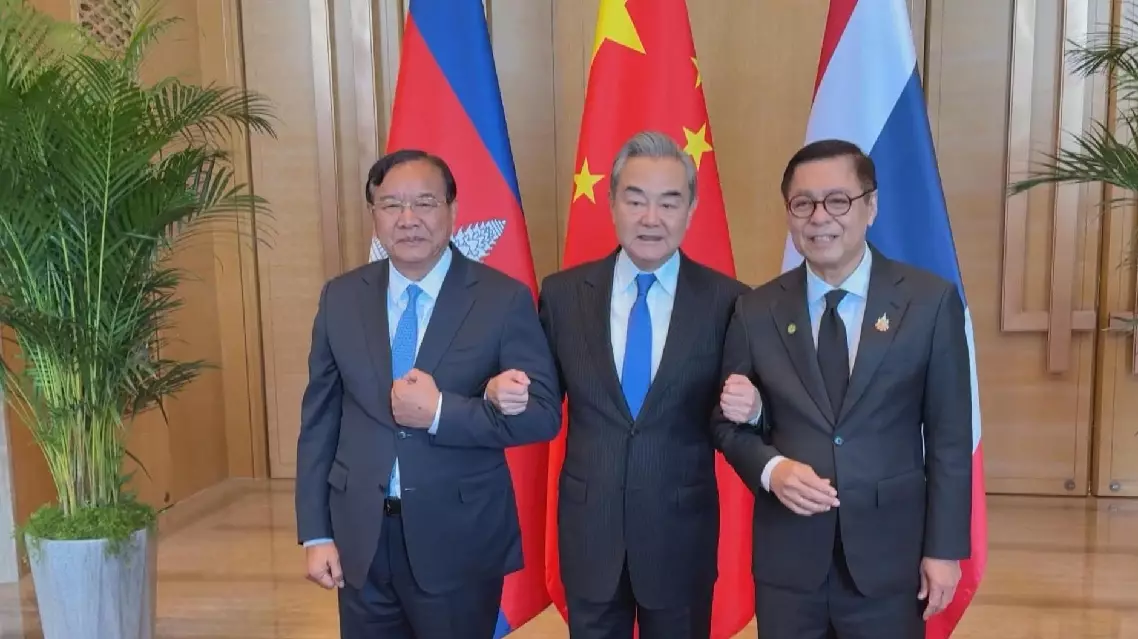
China-Cambodia-Thailand foreign ministers' meeting held in Yunnan