Malaysian researchers are teaming up with Chinese counterparts to test a modified-clay technology developed in China to combat red tide and other harmful blooms of algae.
Blooms of harmful algae, commonly called red tide, can have devastating impacts on human health and aquaculture, wiping out entire fish farms in a single night.
Excessive growth of harmful algae can make shellfish toxic for humans to consume or starve fish of oxygen, causing mass die-offs and painful economic losses to fish farmers.
Malaysian researchers have been gathering water samples on the country’s northeast coast to analyze them at a laboratory in Kelantan, which is a hub for research on the numerous species of harmful algae, some of which cause red tide.
Scientists believe climate change will lead to more frequent blooms of harmful algae or red tides, increasingly threatening human health and livelihoods, as well as food security.
"It's just like the analogy of this fire prevention system. The farm owner or the aquaculture operator need to equip themselves with the technology and know how to prepare for all this occurrence," said Lim Po Teen, a professor with the Institute of Ocean and Earth Sciences of the University of Malaya.
A "magic soil" made out of modified clays, developed by the Institute of Ocaenology of the Chinese Academy of Sciences (CAS), has proved effective in fighting red tide along China's coastal waters. And now the institute is working with Malaysian experts to use the technology in the Southeast Asian country.
"The harmful algal blooms are a kind of ecological disaster. We just introduced this kind of cutting-edge harmful algal bloom controlling technologies to several countries, including the United States, Peru, or Turkey and Malaysia, Singapore etc," said Yuan Yongquan, an associate professor with the CAS Institute of Oceanology.
The modified clays are sprayed onto the red tide algae, taking the majority of it down to the seabed through flocculation while inhibiting further growth of residual algae. The synthetic material was first applied in Xuanwu Lake in Nanjing, capital of east China's Jiangsu Province in 2005, to mitigate harmful algal blooms.
"There are so many approaches could be used to kill these organisms, but we wish to use some very green and environmentally-friendly technologies, so we just use the clay. And clay is from the natural soil, so the major ingredient is very green and environmentally-friendly. And after the treatment, the removal efficiency of the cyanobacteria organisms could reach over 90 percent within only 10 or 15 minutes,” said Yuan.
Malaysian scientists expect fruitful results from their collaboration with the Chinese institute to help improve algae removal efficiency and promote the development of local aquaculture.
"We would like to use it and test it with different algae species in our local settings and to see how efficient they are in the removal. And of course we hope that this technology will be helpful to the aquaculture industry. When occurrence of algal bloom happens, they can immediately use this to remove the algal bloom from the culture area. We are looking forward for this collaboration to be very fruitful and very useful to mitigate the harmful effect of the algal bloom,” said Lim.
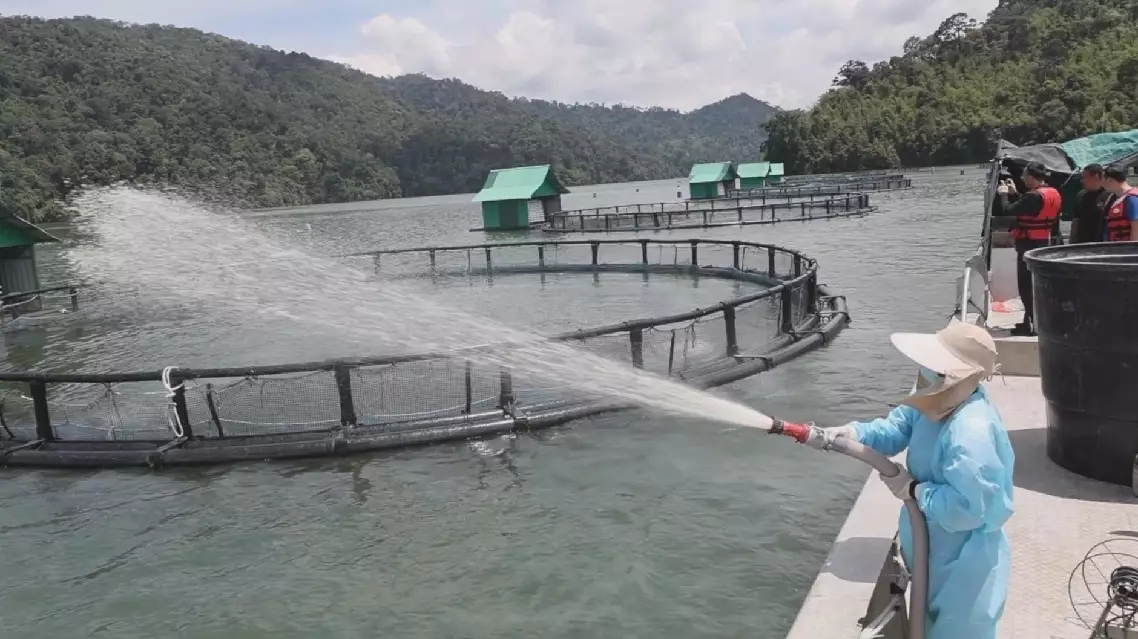
Malaysian researchers team up with Chinese marine scientists to combat ‘red tide’ algae