MADRID (AP) — In the heart of Spain's capital, Sobrino de Botín holds a coveted Guinness World Record as the world's oldest restaurant. Exactly three hundred years after it opened its doors, Botín welcomes droves of daily visitors hungry for Castilian fare with a side of history.
But on the outskirts of Madrid, far from the souvenir shops and tourist sites, a rustic tavern named Casa Pedro makes a bold claim. Its owners assert the establishment endured not just the Spanish Civil War in the 1930s and the Napoleonic invasion in the early 1800s, but even the War of Spanish Succession at the start of the 18th century — a lineage that would make Casa Pedro older than Botín and a strong contender for the title.
Click to Gallery

Several dishes from the restaurant's menu are photographed at Casa Pedro restaurant in Madrid, Spain, on May 16, 2025. (AP Photo/Manu Fernandez)

A chef cooks at Casa Pedro restaurant in Madrid, Spain, on May 16, 2025. (AP Photo/Manu Fernandez)
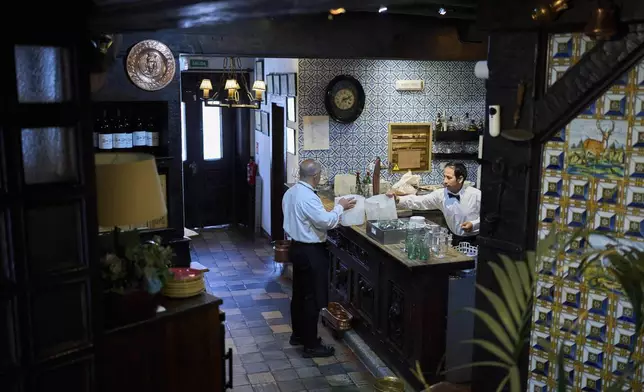
Waiters work at Casa Pedro restaurant in Madrid, Spain, on May 16, 2025. (AP Photo/Manu Fernandez)
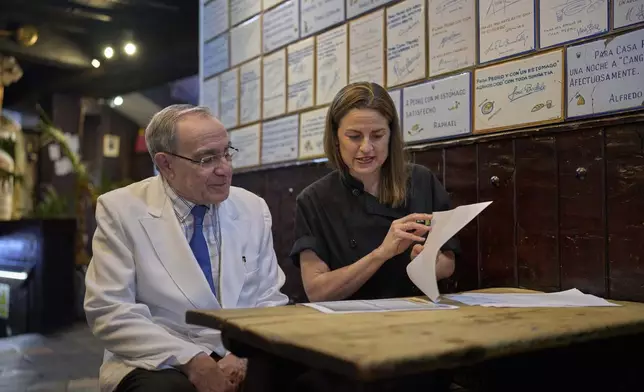
Irene Guinales, right, and Pedro Guinales del Valle, owners and managers of Casa Pedro restaurant, review documents regarding the restaurant's opening date in Madrid, Spain, on May 16, 2025. (AP Photo/Manu Fernandez)
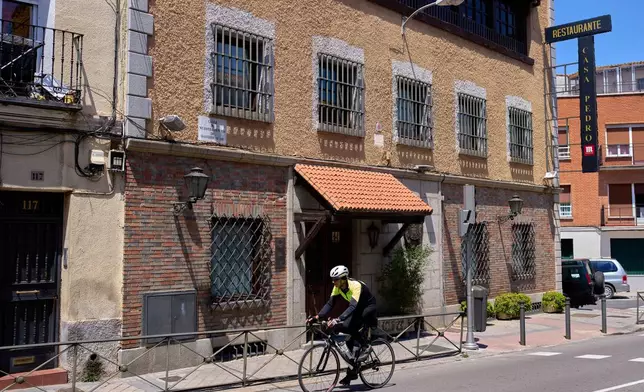
A view shows the exterior of the Casa Pedro restaurant in Madrid, Spain, on May 16, 2025. (AP Photo/Manu Fernandez)
“It’s really frustrating when you say, ‘Yes, we’ve been around since 1702,’ but ... you can’t prove it,” said manager and eighth-generation proprietor Irene Guiñales. “If you look at the restaurant’s logo, it says ‘Casa Pedro, since 1702,’ so we said, ‘Damn it, let’s try to prove it.’”
Guiñales, 51, remembers her grandfather swearing by Casa Pedro’s age, but she was aware that decades-old hearsay from a proud old-timer wouldn't be enough to prove it. Her family hired a historian and has so far turned up documents dating the restaurant's operations to at least 1750.
That puts them within striking distance of Botín’s record.
Both taverns are family-owned. Both offer Castilian classics like stewed tripe and roast suckling pig. They are decorated with charming Spanish tiles, feature ceilings with exposed wooden beams and underground wine cellars. And both enjoy a rich, star-studded history.
Botín's celebrated past includes a roster of literary patrons like Truman Capote, F. Scott Fitzgerald and Graham Greene. In his book “The Sun Also Rises,” Ernest Hemingway described it as “one of the best restaurants in the world." While Casa Pedro may not have boasted the same artistic pedigree, it boasts its own VIPs. Its walls are adorned with decades-old photographs of former Spanish King Juan Carlos I dining in one of its many rooms. The current Spanish monarch, King Felipe VI dines there, too, albeit more inconspicuously than his father.
But the similarities between the two hotspots end there.
Casa Pedro was once a stop on the only road heading north from the Spanish capital toward France. Its clientele is largely local regulars, like David González and Mayte Villena, who for years have spent every Friday lunching at the tavern.
“It wouldn't change a thing for us,” Villena said about the restaurant someday securing the Guinness title.
Botín, on the other hand, is a stone’s throw from Madrid’s famed Plaza Mayor, where any day of the week tour guides are herding groups around town — and often straight through the restaurant's front door.
Antonio González, a third-generation proprietor of Botín, concedes that the Guinness accolade awarded in 1987 has helped business, but said the restaurant had enough history to draw visitors even before.
“It has a certain magic,” he said.
The question then becomes: How can either restaurant definitively claim the title? Guinness provides its specific guidelines for the superlative only to applicants, according to spokesperson Kylie Galloway, noting that it entails “substantial evidence and documentation of the restaurant’s operation over the years."
González said that Guinness required Botín show that it has continuously operated in the same location with the same name.
The only time the restaurant closed was during the COVID-19 pandemic, as did Casa Pedro.
That criteria would mean that restaurants that are even older — Paris' Le Procope, which says it was founded in 1686, or Beijing’s Bianyifang, founded in 1416, or the 1673-established White Horse Tavern in Newport, Rhode Island — aren't eligible for the designation.
La Campana, in Rome’s historic center, claims over 500 years of operation, citing documents on its menu and in a self-published history. Its owners say they have compiled the requisite paperwork and plan to submit it to Guinness.
Guiñales and her husband couldn't consult archives from the former town of Fuencarral, now a Madrid neighborhood. Those papers went up in flames during the Spanish Civil War. Instead, they delved into Spanish national archives, where they found land registries of the area from the First Marquess of Ensenada (1743-1754) that showed the existence of a tavern, wine cellar and inn in the small town as of 1750.
In their spare time, the couple continues to hunt for records proving that Casa Pedro indeed dates back to 1702, as is proclaimed on its walls, takeout bags and sugar packets.
But even if they dig up the final documents and wrest the Guinness honor from Botín, Guiñales concedes that her restaurant's quiet location makes it unlikely to draw Botín’s clientele in central Madrid.
“To think that we could reach that public would be incredible,” Guiñales said. “It's a dream, but it's a dream.”

Several dishes from the restaurant's menu are photographed at Casa Pedro restaurant in Madrid, Spain, on May 16, 2025. (AP Photo/Manu Fernandez)
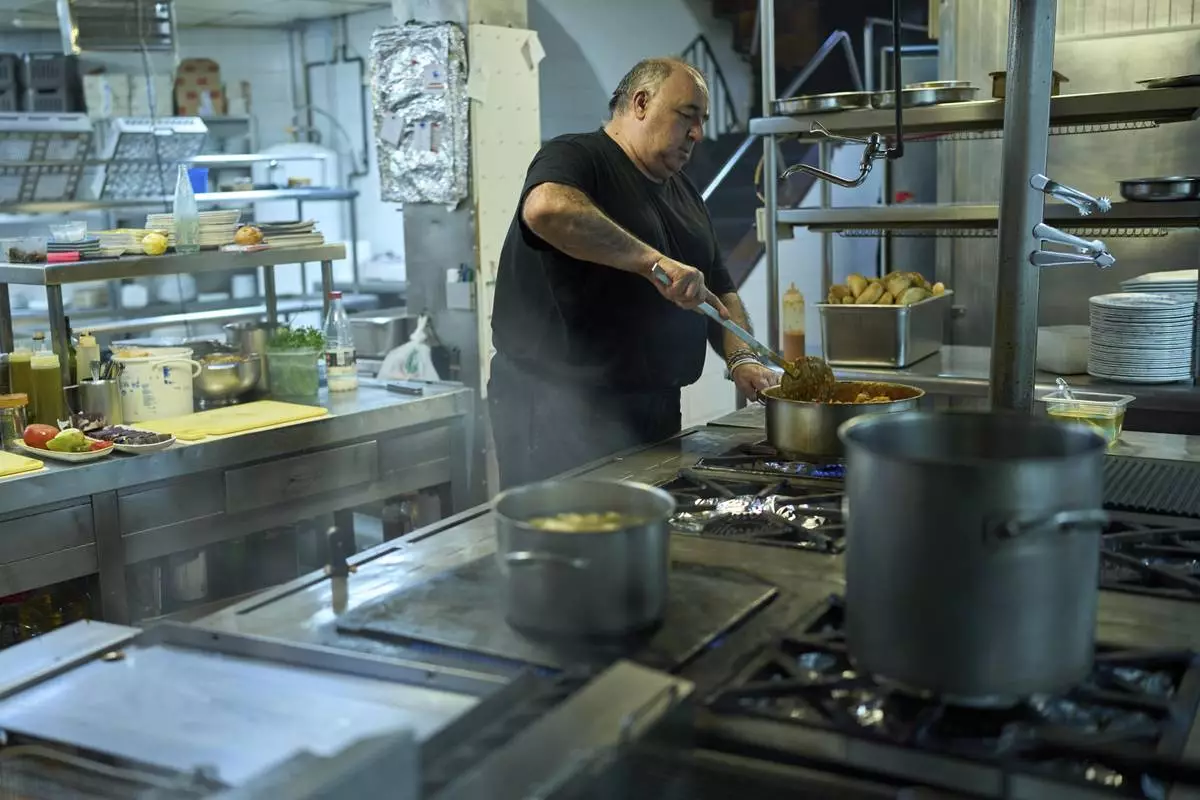
A chef cooks at Casa Pedro restaurant in Madrid, Spain, on May 16, 2025. (AP Photo/Manu Fernandez)
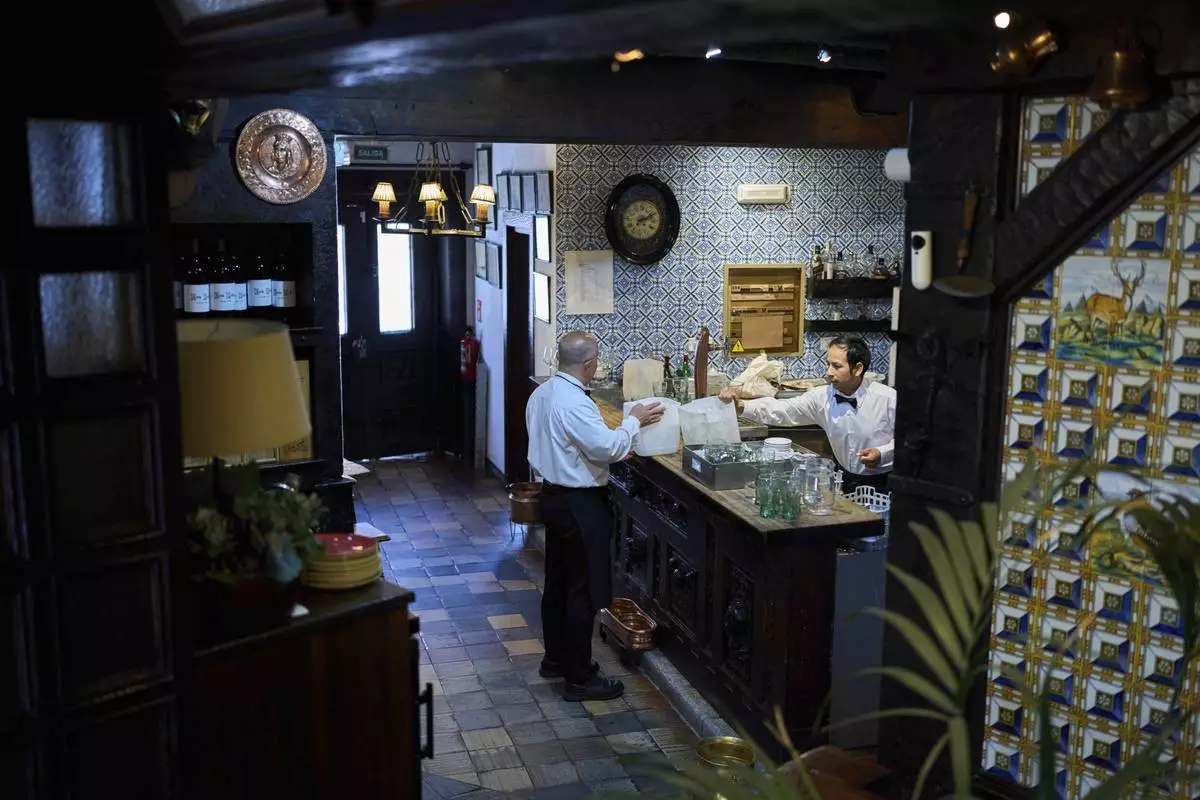
Waiters work at Casa Pedro restaurant in Madrid, Spain, on May 16, 2025. (AP Photo/Manu Fernandez)

Irene Guinales, right, and Pedro Guinales del Valle, owners and managers of Casa Pedro restaurant, review documents regarding the restaurant's opening date in Madrid, Spain, on May 16, 2025. (AP Photo/Manu Fernandez)

A view shows the exterior of the Casa Pedro restaurant in Madrid, Spain, on May 16, 2025. (AP Photo/Manu Fernandez)

WASHINGTON (AP) — Sluggish December hiring concluded a year of weak employment gains that have frustrated job seekers even though layoffs and unemployment have remained low.
Employers added just 50,000 jobs last month, nearly unchanged from a downwardly revised figure of 56,000 in November, the Labor Department said Friday. The unemployment rate slipped to 4.4%, its first decline since June, from 4.5% in November, a figure also revised lower.
The data suggests that businesses are reluctant to add workers even as economic growth has picked up. Many companies hired aggressively after the pandemic and no longer need to fill more jobs. Others have held back due to widespread uncertainty caused by President Donald Trump’s shifting tariff policies, elevated inflation, and the spread of artificial intelligence, which could alter or even replace some jobs.
Still, economists were encouraged by the drop in the unemployment rate, which had risen in the previous four straight reports. It had also alarmed officials at the Federal Reserve, prompting three cuts to the central bank's key interest rate last year. The decline lowered the odds of another rate reduction in January, economists said.
“The labor market looks to have stabilized, but at a slower pace of employment growth,” Blerina Uruci, chief economist at T. Rowe Price, said. There is no urgency for the Fed to cut rates further, for now."
Some Federal Reserve officials are concerned that inflation remains above their target of 2% annual growth, and hasn't improved since 2024. They support keeping rates where they are to combat inflation. Others, however, are more worried that hiring has nearly ground to a halt and have supported lowering borrowing costs to spur spending and growth.
November's job gain was revised slightly lower, from 64,000 to 56,000, while October's now shows a much steeper drop, with a loss of 173,000 positions, down from previous estimates of a 105,000 decline. The government revises the jobs figures as it receives more survey responses from businesses.
The economy has now lost an average of 22,000 jobs a month in the past three months, the government said. A year ago, in December 2024, it had gained 209,000 a month. Most of those losses reflect the purge of government workers by Elon Musk's Department of Government Efficiency.
Nearly all the jobs added in December were in the health care and restaurant and hotel industries. Health care added 38,500 jobs, while restaurants and hotels gained 47,000. Governments — mostly at the state and local level — added 13,000.
Manufacturing, construction and retail companies all shed jobs. Retailers cut 25,000 positions, a sign that holiday hiring has been weaker than previous years. Manufacturers have shed jobs every month since April, when Trump announced sweeping tariffs intended to boost manufacturing.
Wall Street and Washington are looking closely at Friday's report as it's the first clean reading on the labor market in three months. The government didn’t issue a report in October because of the six-week government shutdown, and November’s data was distorted by the closure, which lasted until Nov. 12.
The hiring slowdown reflects more than just a reluctance by companies to add jobs. With an aging population and a sharp drop in immigration, the economy doesn't need to create as many jobs as it has in the past to keep the unemployment rate steady. As a result, a gain of 50,000 jobs is not as clear a sign of weakness as it would have been in previous years.
And layoffs are still low, a sign firms aren't rapidly cutting jobs, as typically happens in a recession. The “low-hire, low-fire” job market does mean current workers have some job security, though those without jobs can have a tougher time.
Ernesto Castro, 44, has applied for hundreds of jobs since leaving his last in May. Yet the Los Angeles resident has gotten just three initial interviews, and only one follow-up, after which he heard nothing.
With nearly a decade of experience providing customer support for software companies, Castro expected to find a new job pretty quickly as he did in 2024.
“I should be in a good position,” Castro said. “It’s been awful.”
He worries that more companies are turning to artificial intelligence to help clients learn to use new software. He hears ads from tech companies that urge companies to slash workers that provide the kind of services he has in his previous jobs. His contacts in the industry say that employees are increasingly reluctant to switch jobs amid all the uncertainty, which leaves fewer open jobs for others.
He is now looking into starting his own software company, and is also exploring project management roles.
December’s report caps a year of sluggish hiring, particularly after April's “liberation day” tariff announcement by Trump. The economy generated an average of 111,000 jobs a month in the first three months of 2025. But that pace dropped to just 11,000 in the three months ended in August, before rebounding slightly to 22,000 in November.
Last year, the economy gained just 584,000 jobs, sharply lower than that more than 2 million added in 2024. It's the smallest annual gain since the COVID-19 pandemic decimated the job market in 2020.
Subdued hiring underscores a key conundrum surrounding the economy as it enters 2026: Growth has picked up to healthy levels, yet hiring has weakened noticeably and the unemployment rate has increased in the last four jobs reports.
Most economists expect hiring will accelerate this year as growth remains solid, and Trump's tax cut legislation is expected to produce large tax refunds this spring. Yet economists acknowledge there are other possibilities: Weak job gains could drag down future growth. Or the economy could keep expanding at a healthy clip, while automation and the spread of artificial intelligence reduces the need for more jobs.
Productivity, or output per hour worked, a measure of worker efficiency, has improved in the past three years and jumped nearly 5% in the July-September quarter. That means companies can produce more without adding jobs. Over time, it should also boost worker pay.
Even with such sluggish job gains, the economy has continued to expand, with growth reaching a 4.3% annual rate in last year's July-September quarter, the best in two years. Strong consumer spending helped drive the gain. The Federal Reserve Bank of Atlanta forecasts that growth could slow to a still-solid 2.7% in the final three months of last year.
FILE - A hiring sign is displayed at a grocery store in Northbrook, Ill., Tuesday, Jan. 21, 2025. (AP Photo/Nam Y. Huh)