BRUSSELS (AP) — The European Union and the U.K. announced Wednesday that they have reached an agreement to ease cross-border trade and travel in Gibraltar after years of post-Brexit wrangling over the contested territory at the tip of the Iberian peninsula.
In a post on social media, EU Trade Commissioner Maroš Šefčovič raised the deal as “a truly historic milestone: an EU-UK political agreement on the future relationship concerning Gibraltar. This benefits everyone and reinforces a new chapter in the relationship.”
Britain left the European Union in 2020 with the relationship between Gibraltar and the bloc unresolved. Talks on a deal to ensure people and goods can keep flowing over the Gibraltar-Spain border previously had made only halting progress.
Gibraltar was ceded to Britain in 1713, but Spain has maintained its sovereignty claim ever since. Relations concerning the Rock, as it is popularly referred to in English, have had their ups and downs over the centuries.
In Britain’s 2016 Brexit referendum, 96% of voters in Gibraltar supported remaining in the EU. The tiny territory on Spain’s southern tip depends greatly on access to the EU market for its 34,000 inhabitants.
The British government said the agreement “resolves the last major unresolved issue from Brexit,” while Spanish Foreign Minister José Albares said the deal was historic and marked “a new beginning” in the relationship between the U.K. and Spain.
He said that Spain “will guarantee free movement of people and goods,” adding that Gibraltar would now be linked to Europe’s free travel zone known as the Schengen Area with Spanish authorities controling entry and exit.
The deal, which must be ratified by parliaments in Spain and the U.K., will remove all physical barriers, checks and controls on people and goods moving between Spain and Gibraltar, the EU said in a statement.
In order to preserve The EU's free travel zone and borderless single market for goods, entry and exit checks will instead be conducted at Gibraltar's airport and port by both U.K. and Spanish border officials. The arrangement is similar to that in place at Eurostar train stations in London and Paris, where both British and French officials check passports.
The U.K. and Gibraltar had previously resisted Spain’s insistence that Spanish border officials be based at the airport, which is also home to a Royal Air Force base.
An agreement was also reached Wednesday for visas and travel permits.
The U.K. said that half Gibraltar’s population crosses the border each day and that without an agreement, new EU entry-exit rules mean every one would have to have their passports checked.
The British government hailed the deal as a win in Prime Minister Keir Starmer’s attempt to reset relations with the EU, five years after the U.K.’s acrimonious departure from the bloc.
The U.K. said the agreement “does not impact sovereignty” and ensures “full operational autonomy of the U.K.’s military facilities in Gibraltar.”
Spanish Prime Minister Pedro Sánchez noted that Spain maintains its claim of sovereignty over Gibraltar.
“After three centuries of no progress, the EU, the United Kingdom, and Spain have reached a comprehensive agreement that benefits citizens and our bilateral relationship with the United Kingdom. All this without renouncing Spanish claims to the isthmus and the return of Gibraltar,” he said on the social network X.
Gibraltar Chief Minister Fabian Picardo also hailed the agreement and said it “will bring legal certainty to the people of Gibraltar, its businesses and to those across the region who rely on stability at the frontier.”
—-
Lawless reported from London, Naishadham from Madrid.
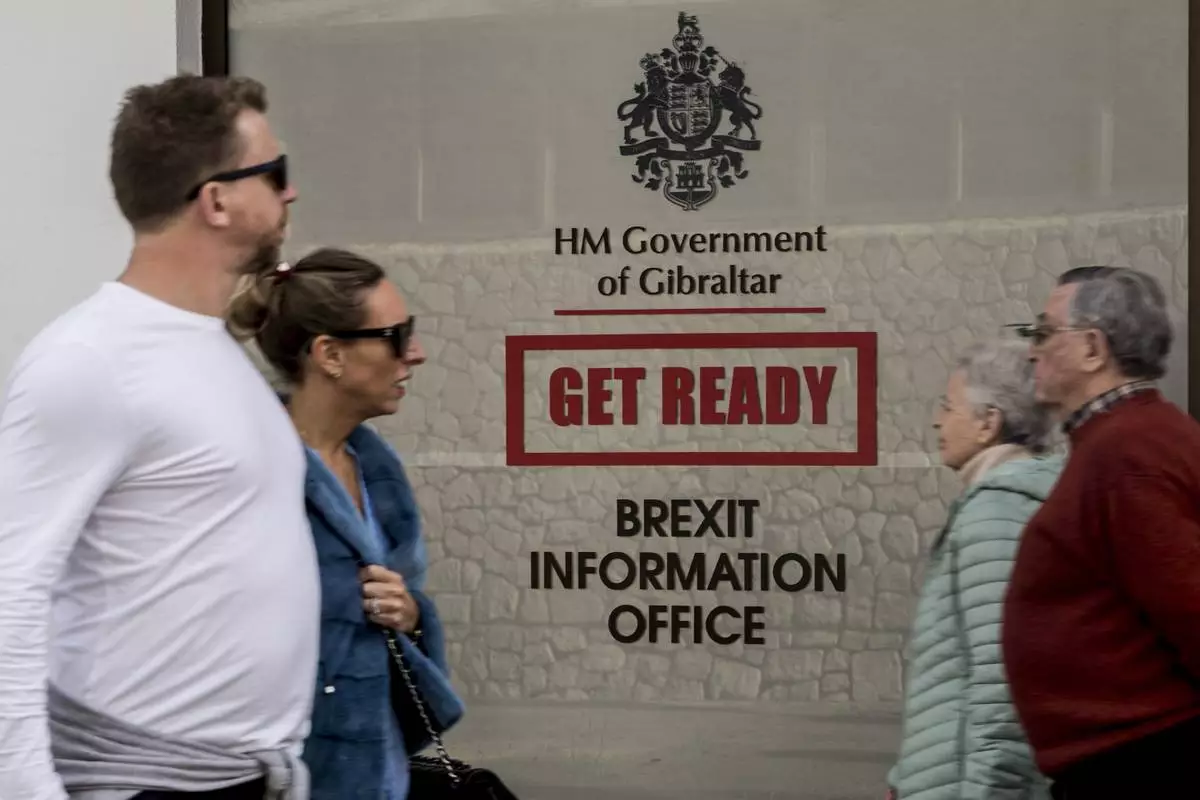
FILE - People walk past a Brexit information office at the British territory of Gibraltar, on Jan. 31, 2020. (AP Photo/Javier Fergo, File)
HELSINKI (AP) — Authorities are investigating damage to an undersea telecommunications cable in the Gulf of Finland early Wednesday that occurred between the capitals of Finland and Estonia.
Finnish authorities seized and inspected the vessel suspected to have caused the damage, the country's border guard said in a statement. Its anchor was lowered when it was discovered in Finland’s exclusive economic zone.
Helsinki police have opened an investigation into aggravated criminal damage, attempted aggravated criminal damage and aggravated interference with telecommunications.
The cable belongs to Finnish telecommunications service provider Elisa and is considered to be critical underwater infrastructure. The damage occurred in Estonia's exclusive economic zone, police said.
The ship's crew of 14 — hailing from Russia, Georgia, Azerbaijan and Kazakhstan — was detained by Finnish authorities, local media reported. The ship, named the Fitburg, was flagged in St. Vincent and the Grenadines. It had been traveling from Russia to Israel.
Finnish National Police Commissioner Ilkka Koskimäki told local media that investigators are not speculating on whether a state-level actor was behind the damage. Koskimäki also said the ship had been dragging its anchor for hours.
“Finland is prepared for security challenges of various kinds, and we respond to them as necessary,” Finnish President Alexander Stubb wrote on social platform X.
The undersea cables and pipelines that crisscross one of the busiest shipping lanes in Europe link Nordic, Baltic and central European countries. They promote trade and energy security and, in some cases, reduce dependence on Russian energy resources.
Earlier this year, Finnish authorities charged the captain and two senior officers of a Russia-linked vessel that damaged undersea cables between Finland and Estonia on Christmas Day in 2024.
The Finnish deputy prosecutor general said in a statement in August that charges of aggravated criminal mischief and aggravated interference with communications were filed against the captain and first and second officers of the Eagle S oil tanker. Their names were not made public. The statement said they denied the allegations.
The Kremlin previously denied involvement in damaging the infrastructure, which provides power and communication for thousands of Europeans.
The Eagle S was flagged in the Cook Islands but had been described by Finnish customs officials and the European Union’s executive commission as part of Russia’s shadow fleet of fuel tankers. Those are aging vessels with obscure ownership, acquired to evade Western sanctions amid the war in Ukraine and operating without Western-regulated insurance.
For the West, such incidents are believed to be part of widespread sabotage attacks in Europe allegedly linked to Moscow following its full-scale invasion of Ukraine in 2022.
Meanwhile, Estonian authorities are cooperating with the Finns to decide whether they should initiate a separate criminal case or move forward in a joint prosecution in the Elisa case. The telecom provider said its service was not affected by the damage.
Another undersea cable, owned by Swedish telecommunications service provider Arelion, was also damaged early Wednesday, according to Estonian officials. It was not immediately clear whether the Arelion cable's damage was linked to the Elisa's.
Martin Sjögren, an Arelion spokesperson, confirmed Wednesday's cable damage in the Gulf of Finland. He said another cable, this one between Sweden and Estonia in the Baltic Sea, was damaged on Tuesday.
“We are actively working with authorities in Sweden and other countries to investigate the cause of the cuts,” Sjögren said in an email. “We cannot disclose any details about exact times or locations at this point with regard to the ongoing investigation.”
Repair work is expected to begin as soon as poor weather conditions clear. He said the vast majority of the company's customers were unaffected by the damage.
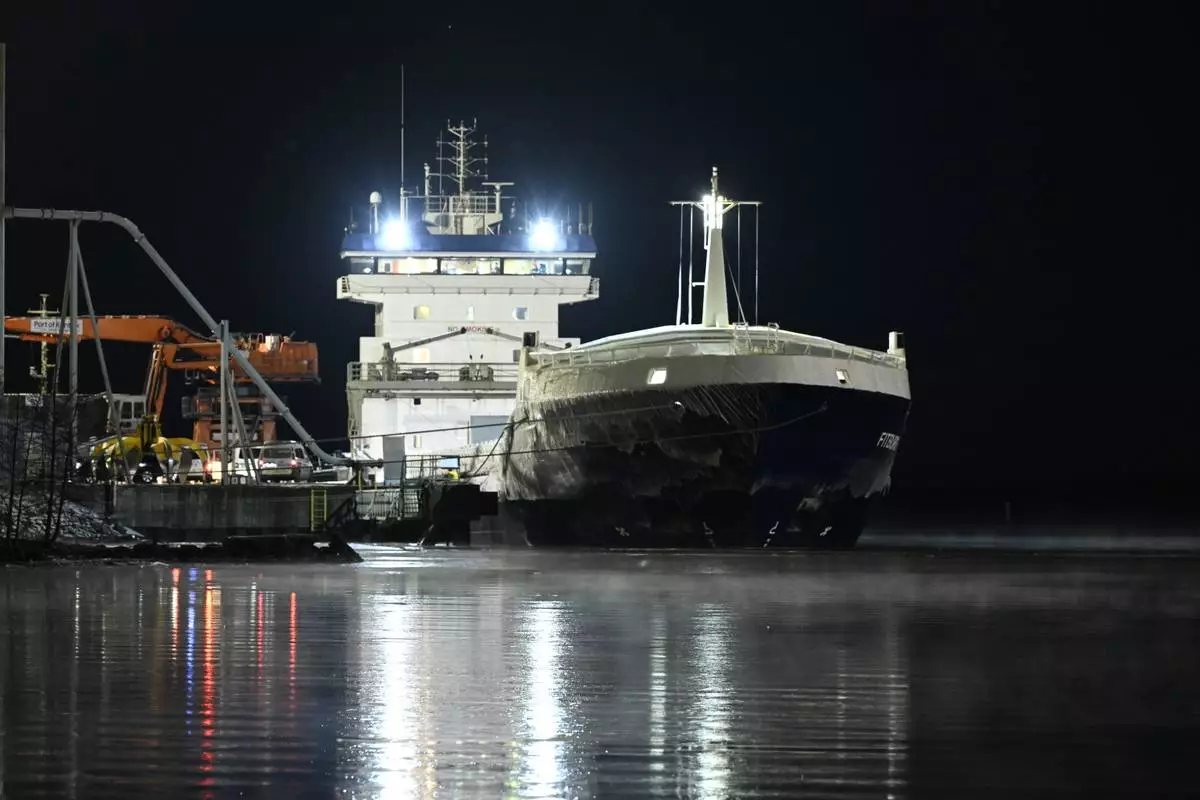
The seized vessel Fitburg rests in the harbour in Kirkkonummi, Finland, Wednesday, Dec. 31, 2025. (Roni Rekomaa/Lehtikuva via AP)
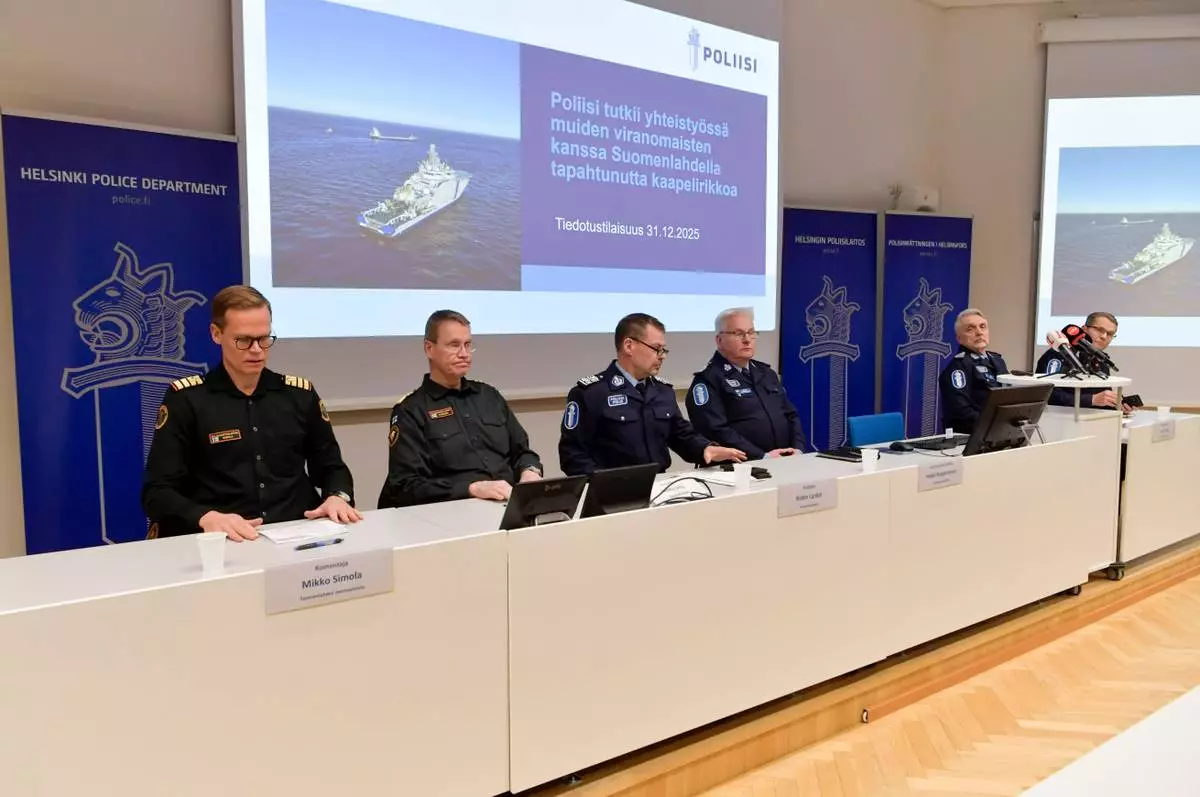
From left, Gulf of Finland Coast Guard District Commander Mikko Simola, Chief of the Border Guard Markku Hassinen, Director of the National Bureau of Investigation Robin Lardot, Helsinki Deputy Police Commissioner Heikki Kopperoinen, Helsinki Police Department chief Jari Liukku and National Police Comissioner Ilkka Koskimaeki, attend a press conferance in Helsinki, Finland, Wednesday, Dec. 31, 2025. (Kimmo Penttinen/Lehtikuva via AP)