Skip to Content Facebook Feature Image

Appeals court temporarily blocks judge's ruling to return control of National Guard to California

News

Appeals court temporarily blocks judge's ruling to return control of National Guard to California
News

News

Appeals court temporarily blocks judge's ruling to return control of National Guard to California

2025-06-14 01:56 Last Updated At:02:00

SAN FRANCISCO (AP) — The 9th U.S. Circuit Court of Appeals on Thursday temporarily blocked a federal judge’s order that directed President Donald Trump to return control of National Guard troops to California after he deployed them there following protests in Los Angeles over immigration raids.

The court said it would hold a hearing on the matter on Tuesday. The ruling came only hours after a federal judge’s order was to take effect at noon Friday.

Earlier Thursday, U.S. District Judge Charles Breyer ruled the Guard deployment was illegal and both violated the Tenth Amendment, which defines power between federal and state governments, and exceeded Trump’s statutory authority. The order applied only to the National Guard troops and not Marines who were also deployed to the LA protests. The judge said he would not rule on the Marines because they were not out on the streets yet.

A group of 200 Marines will begin protecting federal property and personnel in downtown Los Angeles at noon Friday, said Maj. Gen. Scott Sherman, commander of Task Force 51 who is overseeing the 4,700 troops deployed in Los Angeles.

The Marines will join some 2,000 National Guard troops that have been on the streets of the city since last week when immigration raids set off protests.

California Gov. Gavin Newsom, who had asked the judge for an emergency stop to troops helping carry out immigration raids, had praised the earlier ruling.

“Today was really about a test of democracy, and today we passed the test,” Newsom said in a news conference before the appeals court decision.

In a post on his Truth Social platform, Trump thanked the appeals court Friday morning.

“If I didn’t send the Military into Los Angeles, that city would be burning to the ground right now,” he said.

The White House had called Breyer's order “unprecedented” and said it “puts our brave federal officials in danger.”

“The district court has no authority to usurp the President’s authority as Commander in Chief,” White House spokesperson Anna Kelly said in a statement. “The President exercised his lawful authority to mobilize the National Guard to protect federal buildings and personnel in Gavin Newsom’s lawless Los Angeles. The Trump Administration will immediately appeal this abuse of power and looks forward to ultimate victory on the issue.”

About 700 Marines have been undergoing civil disturbance training at Naval Weapons Station Seal Beach in Orange County, California.

Typically the authority to call up the National Guard lies with governors, but there are limited circumstances under which the president can deploy those troops. Trump federalized members of the California National Guard under an authority known as Title 10.

Title 10 allows the president to call the National Guard into federal service when the country “is invaded,” when “there is a rebellion or danger of a rebellion against the authority of the Government,” or when the president is unable “to execute the laws of the United States.”

Breyer, who was appointed by former President Bill Clinton, said in his ruling that what is happening in Los Angeles does not meet the definition of a rebellion.

“The protests in Los Angeles fall far short of ‘rebellion,’” he wrote. “Individuals’ right to protest the government is one of the fundamental rights protected by the First Amendment, and just because some stray bad actors go too far does not wipe out that right for everyone.”

Newsom sued to block the Guard’s deployment against his wishes. California later filed an emergency motion asking the judge to block the Guard from assisting with immigration raids.

The governor argued that the troops were originally deployed to protect federal buildings and wanted the court to block the troops from helping protect immigration agents during the raids, saying that involving the Guard would escalate tensions and promote civil unrest.

Sherman said that as of Wednesday about 500 of the Guard troops had been trained to accompany agents on immigration operations. Photos of Guard soldiers providing security for the agents have already been circulated by immigration officials.

None of the Marines have been trained to go on immigration raids, and it is not yet clear if they eventually will, Sherman said.

In his broad ruling, the judge determined Trump had not properly called the Guard up in the first place.

The lawsuit argued that Title 10 also requires that the president go through governors when issuing orders to the National Guard, which the Trump administration didn't do.

Brett Shumate, an attorney for the federal government, said Trump complied with the statute by informing the general in charge of the troops of his decision and has the authority to call in the Guard even if he had not. Furthermore, the president's decisions are not subject to judicial review, Shumate argued.

“Our position is this is not subject to judicial review,” Shumate told the judge.

Breyer, who at one point waved a copy of the Constitution, said he disagreed.

“We’re talking about the president exercising his authority, and the president is, of course, limited in that authority. That’s the difference between a constitutional government and King George,” he said.

The protests over immigration raids in Los Angeles intensified after Trump called up the Guard and have since spread to other cities, including Boston, Chicago and Seattle.

Trump has described Los Angeles in dire terms that Mayor Karen Bass and Newsom say are nowhere close to the truth.

Most of the sprawling city has been spared as protests continue downtown, near City Hall and a federal detention center where some immigrants are being held.
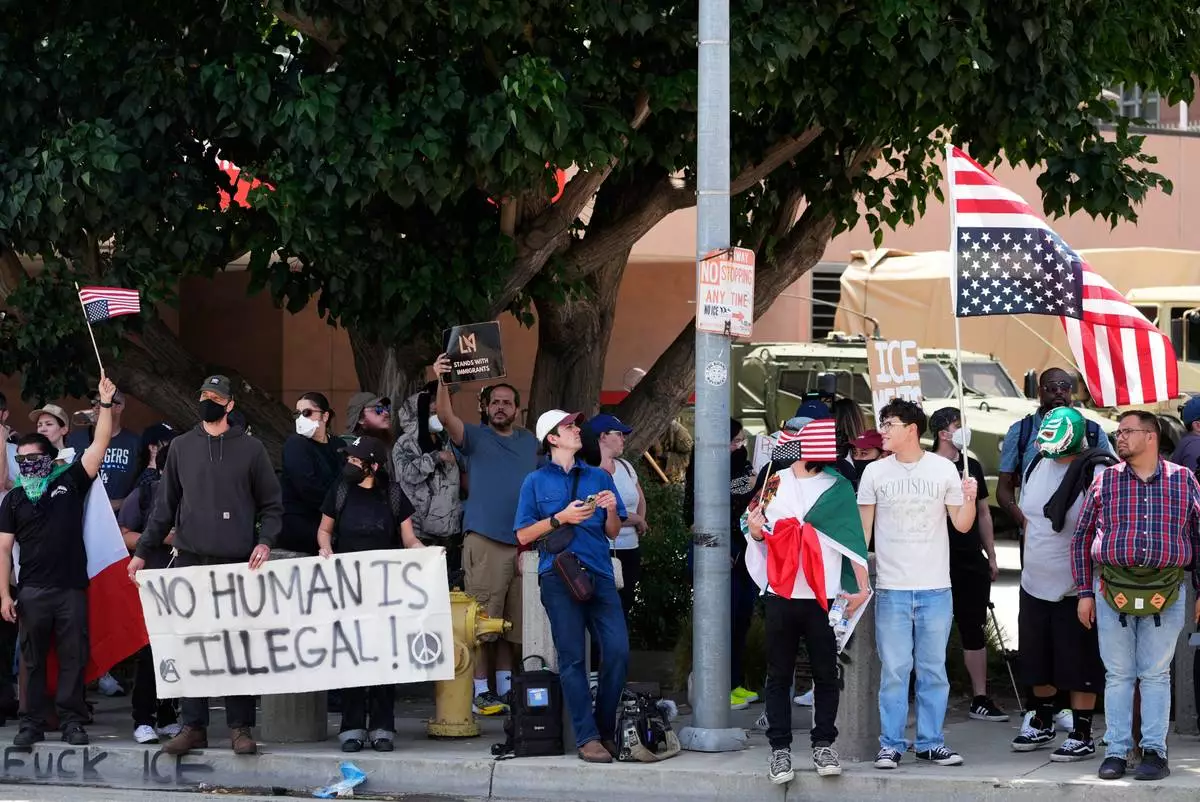
Protesters against federal immigration raids gather outside the Metropolitan Detention Center, Wednesday, June 11, 2025, in Los Angeles. (AP Photo/Damian Dovarganes)
Protesters against federal immigration raids gather outside the Metropolitan Detention Center, Wednesday, June 11, 2025, in Los Angeles. (AP Photo/Damian Dovarganes)
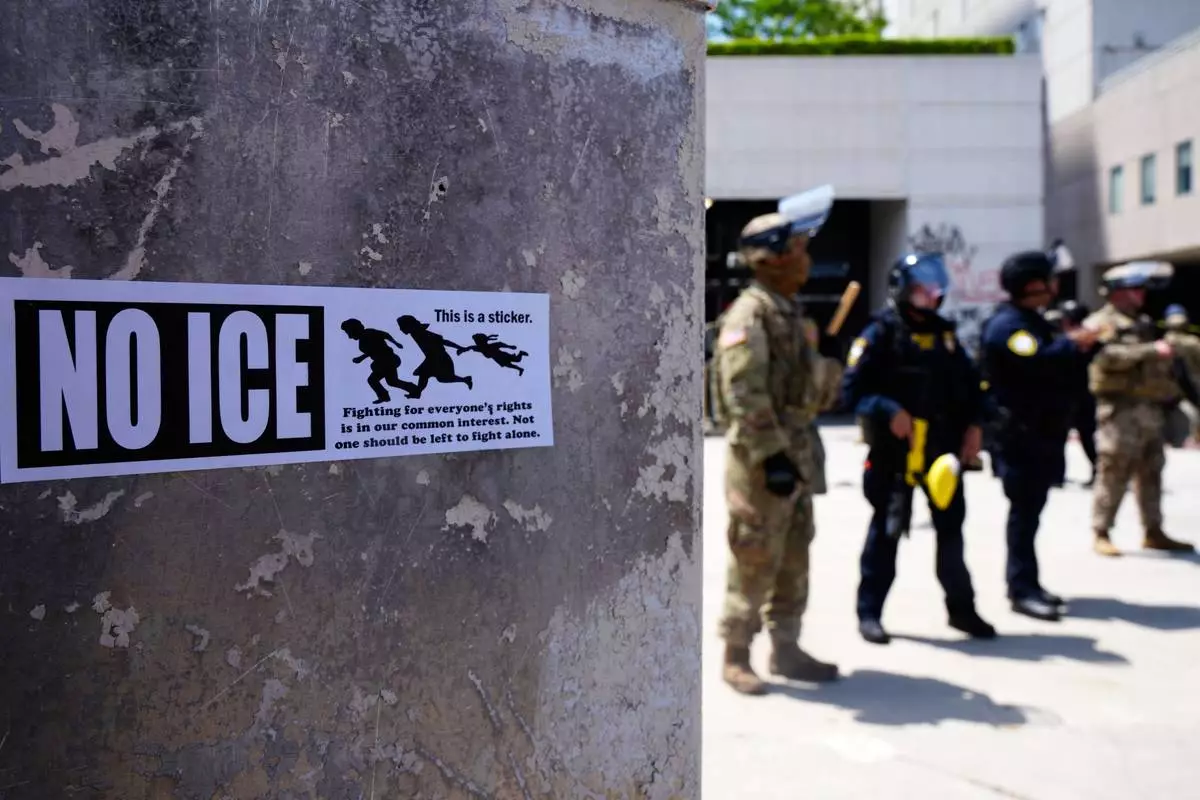
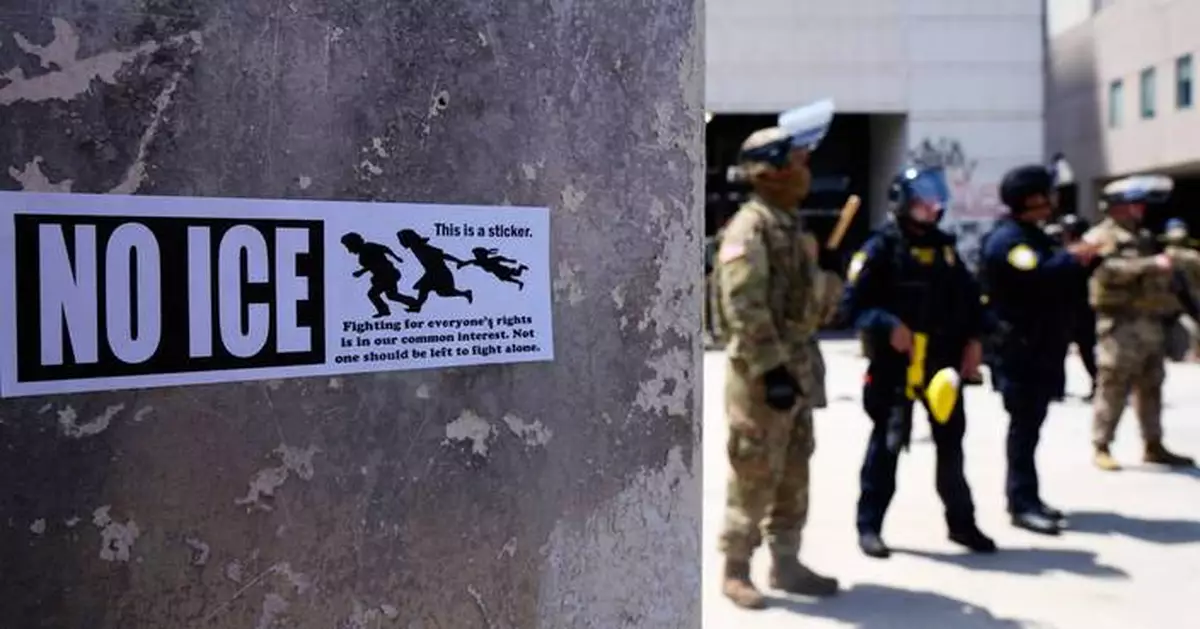
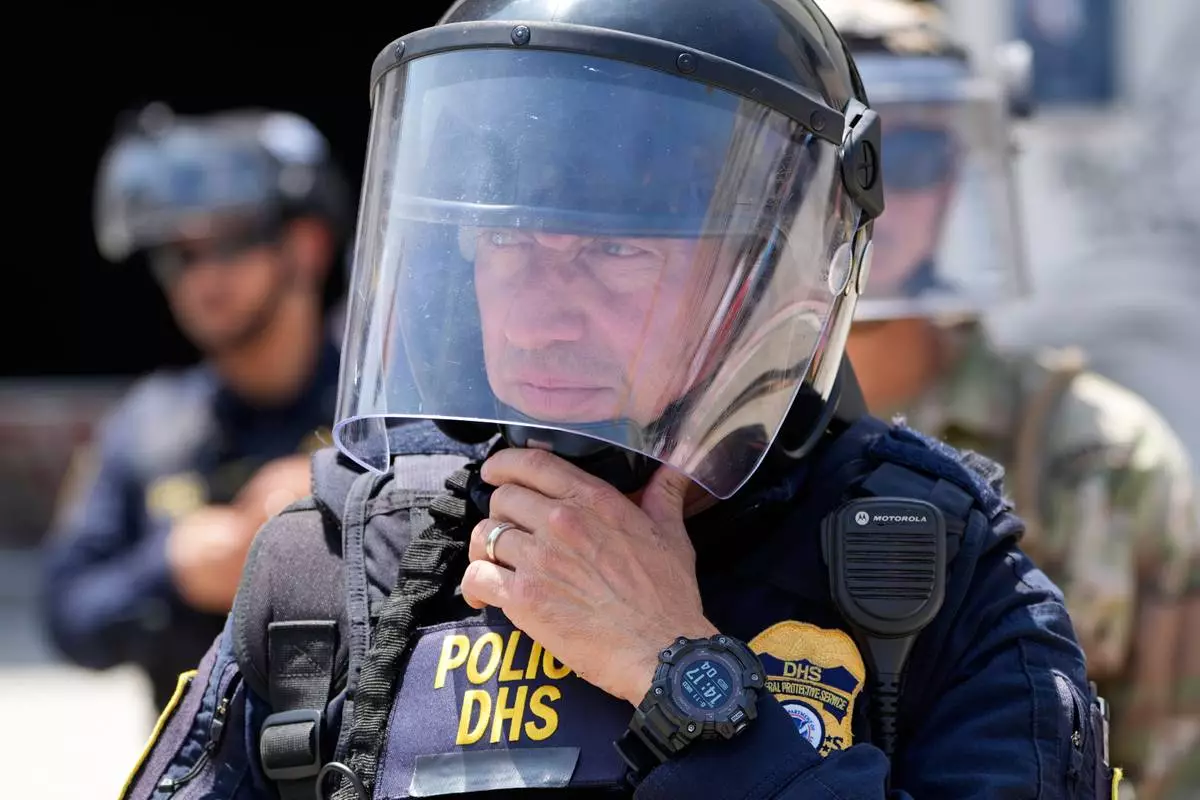
National Guard and DHS police stand guard outside the Metropolitan Detention Center, Wednesday, June 11, 2025, in Los Angeles. (AP Photo/Damian Dovarganes)
National Guard and DHS police stand guard outside the Metropolitan Detention Center, Wednesday, June 11, 2025, in Los Angeles. (AP Photo/Damian Dovarganes)
DHS police and National Guard protect the outside the Metropolitan Detention Center, Wednesday, June 11, 2025, in Los Angeles. (AP Photo/Damian Dovarganes)
DHS police and National Guard protect the outside the Metropolitan Detention Center, Wednesday, June 11, 2025, in Los Angeles. (AP Photo/Damian Dovarganes)
WASHINGTON (AP) — Secretary of State Marco Rubio suggested Sunday that the United States would not govern Venezuela day-to-day other than enforcing an existing “oil quarantine” on the country, a turnaround after President Donald Trump has insisted that the U.S. would be running Venezuela following its ouster of leader Nicolás Maduro.

Rubio's statements seemed designed to temper concerns that the assertive action to achieve regime change in Venezuela might lead the U.S. into another prolonged foreign intervention or failed attempt at nation-building.

They stood in contrast to Trump’s broad but vague claims that the U.S. would at least temporarily “run” the oil-rich nation, comments that suggested some sort of governing structure under which Caracas would be controlled by Washington.

Rubio offered a more nuanced take, saying the U.S. would continue to enforce an oil quarantine that was already in place on sanctioned tankers before Maduro was removed from power early Saturday and use that leverage as a means to press policy changes in Venezuela.

“And so that’s the sort of control the president is pointing to when he says that," Rubio said on CBS’ “Face the Nation.” "We continue with that quarantine, and we expect to see that there will be changes, not just in the way the oil industry is run for the benefit of the people, but also so that they stop the drug trafficking.”

The blockade on sanctioned oil tankers — some of which have been seized by the U.S. — “remains in place, and that’s a tremendous amount of leverage that will continue to be in place until we see changes that not just further the national interest of the United States, which is number one, but also that lead to a better future for the people of Venezuela,” he added.

Leaders in Venezuela have so far pushed back, calling on the Trump administration to release Maduro.

Even before the operation that nabbed Maduro, experts questioned the legality of aspects of the Trump administration’s pressure campaign on Maduro, including the deadly bombing of boats accused of trafficking drugs that some scholars said stretched the boundaries of international law.

Cuba on Sunday night announced that 32 Cuban security officers were killed in the U.S. operation in Venezuela, which Trump acknowledged: “You know, a lot of Cubans were killed yesterday.”

“There was a lot of death on the other side," Trump said aboard Air Force One as he flew back to Washington from his Mar-a-Lago estate in Florida. "No death on our side.”

The president's vow, repeated more than half a dozen times at a Florida news conference on Saturday, sparked concerns among some Democrats. It also drew unease from parts of his own Republican coalition, including an “America First” base that is opposed to foreign interventions, and from observers who recalled past nation-building efforts in Iraq and Afghanistan.

Rubio dismissed such criticism, saying Trump’s intent had been misunderstood.

“The whole foreign policy apparatus thinks everything is Libya, everything is Iraq, everything is Afghanistan,” Rubio said. "This is not the Middle East. And our mission here is very different. This is the Western Hemisphere.”

He also suggested the U.S. would give Maduro’s subordinates now in charge time to govern, saying, “We’re going to judge everything by what they do.” Though he did not rule out boots on the ground in Venezuela, Rubio said the U.S., which has built up its presence in the region, was already capable of stopping alleged drug boats and sanctioned tankers.

A day earlier, Trump had told reporters, “We’re going to run the country until such time as we can do a safe, proper and judicious transition.” He later pointed to his national security team with him, including Rubio and Defense Secretary Pete Hegseth, and said it would be done for a period of time by “the people that are standing right behind me. We’re gonna be running it, we’re gonna be bringing it back."

Despite Rubio's seeking to tamp down that notion, Trump reiterated Sunday that the U.S. would control Venezuela, saying, “We’re going to run everything."

“We’re going to run it, fix it,” he said Sunday. He added, "We’ll have elections at the right time” but didn't say when that might be.

A middle-of-the-night operation extracted Maduro and his wife, Cilia Flores, from their home in a military base in the capital city of Caracas — an act Maduro’s government called “imperialist.” The couple faces U.S. charges of participating in a narco-terrorism conspiracy.

The dramatic seizure capped an intensive Trump administration pressure campaign on Venezuela’s autocratic leader and months of secret planning, resulting in the most assertive American action to achieve regime change since the 2003 invasion of Iraq. Legal experts raised questions about the lawfulness of the operation, which was done without congressional approval.

Venezuela’s vice president, Delcy Rodríguez, has called Maduro the country’s rightful leader, even as her nation’s high court named her interim president. So did Defense Minister Vladimir Padrino López, who sai the country's armed forces “categorically reject the cowardly kidnapping" and will “maintain internal order and peace.”

Asked about Rodríguez comments in which she stands by Maduro, Trump said, “I don’t think it’s pushback" and suggested her calling what occurred a kidnapping of Maduro wasn't "a bad term.”

Maduro is due to make his first appearance Monday in Manhattan's federal court.

He and other Venezuelan officials were indicted in 2020 on narco-terrorism conspiracy charges, and the Justice Department released a new indictment Saturday of Maduro and his wife that painted his administration as a “corrupt, illegitimate government” fueled by a drug-trafficking operation that flooded the U.S with cocaine. The U.S. government does not recognize Maduro as the country’s leader.

Venezuela’s government kept operating as usual over the weekend as ministers remained in their posts.

The capital was unusually quiet Sunday with few vehicles moving around and convenience stores, gas stations and other businesses closed.

Maduro’s son, lawmaker Nicolás Ernesto Guerra, has not appeared in public since the attack. On Saturday, he posted on Instagram a government statement repudiating the capture of his father and stepmother.

The country’s incoming National Assembly is set to be sworn in at the legislative palace in Caracas. The unicameral assembly will remain under control of the ruling party.

Under Venezuelan law, Rodríguez would take over from Maduro. Rodriguez stressed during a Saturday appearance on state television that she did not plan to assume power, before Venezuela’s high court ordered that she assume the interim role.

Trump told The Atlantic in an interview Sunday that Rodríguez could “pay a very big price” if she doesn’t do what he thinks is right for Venezuela. Speaking to reporters later, Trump said Rodríguez is “cooperating” but reiterated the threat. He said he wanted her to provide “total access,” from major oil operations to basic infrastructure like roads, so all can be rebuilt.

His warning contrasted with his comments about Rodríguez on Saturday when he said Rubio had spoken with her and she was willing to do what the U.S. thinks is needed to improve the standard of living in Venezuela.

Garcia Cano reported from Caracas, Venezuela. Associated Press writers Darlene Superville aboard Air Force One and Jorge Rueda in Caracas, Venezuela, contributed to this report.

Protestors hold a banner stating "Trump Must Go Now" as they gather outside the UN Plaza during a demonstration against the U.S. bombing of Venezuela and seizure of Venezuelan President Nicolás Maduro, in San Francisco on Saturday, Jan. 3, 2026. (Yalonda M. James/San Francisco Chronicle via AP)

Protestors hold a banner stating "Trump Must Go Now" as they gather outside the UN Plaza during a demonstration against the U.S. bombing of Venezuela and seizure of Venezuelan President Nicolás Maduro, in San Francisco on Saturday, Jan. 3, 2026. (Yalonda M. James/San Francisco Chronicle via AP)

Government supporters burn a U.S. flag in Caracas, Venezuela, Saturday, Jan. 3, 2026, after U.S. President Donald Trump announced that U.S. forces had captured Venezuelan President Nicolás Maduro and his wife. (AP Photo/Ariana Cubillos)

Government supporters burn a U.S. flag in Caracas, Venezuela, Saturday, Jan. 3, 2026, after U.S. President Donald Trump announced that U.S. forces had captured Venezuelan President Nicolás Maduro and his wife. (AP Photo/Ariana Cubillos)

National Guard armored vehicles block an avenue leading to Miraflores presidential palace in Caracas, Venezuela, Saturday, Jan. 3, 2026. (AP Photo/Cristian Hernandez)

National Guard armored vehicles block an avenue leading to Miraflores presidential palace in Caracas, Venezuela, Saturday, Jan. 3, 2026. (AP Photo/Cristian Hernandez)

Destroyed containers lay at La Guaira port after explosions were heard in Venezuela, Saturday, Jan. 3, 2026. (AP Photo/Matias Delacroix)

Destroyed containers lay at La Guaira port after explosions were heard in Venezuela, Saturday, Jan. 3, 2026. (AP Photo/Matias Delacroix)

Smoke rises from Fort Tiuna, the main military garrison in Caracas, Venezuela, after multiple explosions were heard and aircraft swept through the area, Saturday, Jan. 3, 2026. (AP Photo/Matias Delacroix)

Smoke rises from Fort Tiuna, the main military garrison in Caracas, Venezuela, after multiple explosions were heard and aircraft swept through the area, Saturday, Jan. 3, 2026. (AP Photo/Matias Delacroix)

Men watch smoke rising from a dock after explosions were heard at La Guaira port, Venezuela, Saturday, Jan. 3, 2026. (AP Photo/Matias Delacroix)

Men watch smoke rising from a dock after explosions were heard at La Guaira port, Venezuela, Saturday, Jan. 3, 2026. (AP Photo/Matias Delacroix)

Supporters of Venezuelan President Nicolás Maduro embrace in downtown Caracas, Venezuela, Saturday, Jan. 3, 2026, after U.S. President Donald Trump announced that Maduro had been captured and flown out of the country. (AP Photo/Cristian Hernandez)

Supporters of Venezuelan President Nicolás Maduro embrace in downtown Caracas, Venezuela, Saturday, Jan. 3, 2026, after U.S. President Donald Trump announced that Maduro had been captured and flown out of the country. (AP Photo/Cristian Hernandez)

Recommended Articles