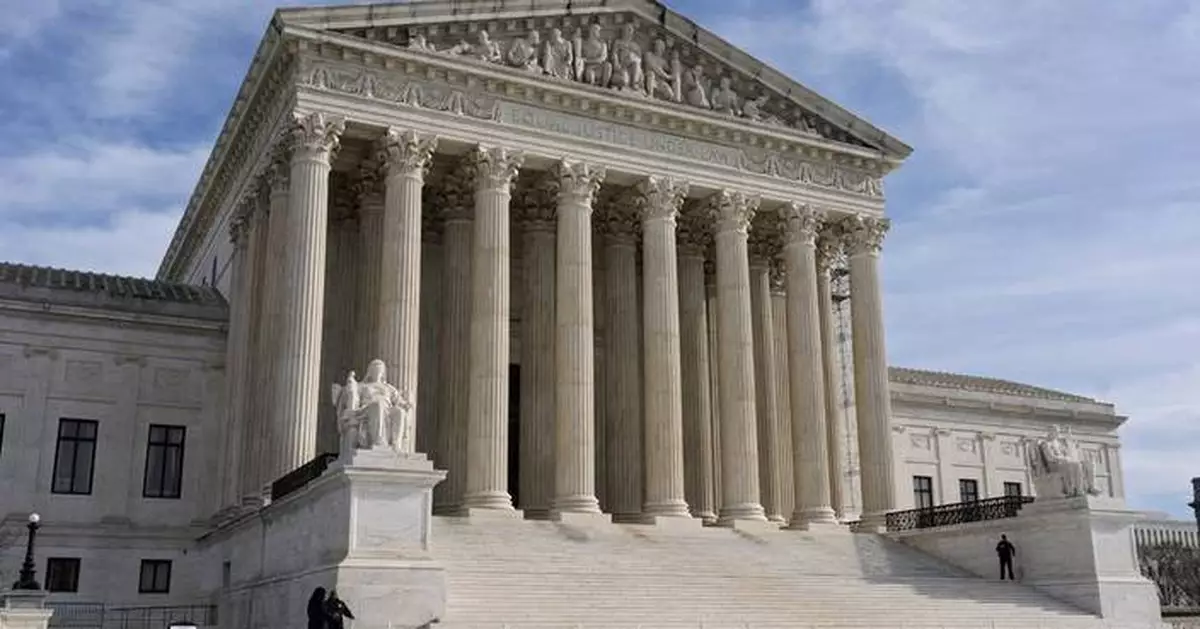
WASHINGTON (AP) — A teenage girl with a rare form of epilepsy won a unanimous Supreme Court ruling on Thursday that's expected to make it easier for families of children with disabilities to sue schools over access to education.
The girl's family says that her Minnesota school district didn’t do enough to make sure she has the disability accommodations she needs to learn, including failing to provide adequate instruction in the evening when her seizures are less frequent.
But lower courts ruled against the family's claim for damages, despite finding the school had fallen short. That’s because courts in that part of the country required plaintiffs to show schools used “bad faith or gross misjudgment,” a higher legal standard than most disability discrimination claims.
The district, Osseo Area Schools, said that lowering the legal standard could expose the country’s understaffed public schools to more lawsuits if their efforts fall short, even if officials are working in good faith.
The family appealed to the Supreme Court, which found that lawsuits against schools should have the same requirements as other disability discrimination claims.
Children with disabilities and their parents “face daunting challenges on a daily basis. We hold today that those challenges do not include having to satisfy a more stringent standard of proof than other plaintiffs,” Chief Justice John Roberts wrote for the court.
The court rebuffed the district's argument, made late in the appeals process, that all claims over accommodations for people with disabilities should be held to the same higher standard — a potentially major switch that would have been a “five-alarm fire” for the disability rights community, the girl's lawyers said.
Justice Clarence Thomas, joined by Justice Brett Kavanaugh, wrote separately to say he would be willing to consider those arguments at some point in the future, though he didn't say whether they would win.
But Justice Sonia Sotomayor, joined by Justice Ketanji Brown Jackson, saw it differently. Sotomayor wrote in another concurrence that adopting those higher standards more broadly would “eviscerate the core” of disability discrimination laws.
The girl's attorney Roman Martinez, of Latham & Watkins, called Thursday's ruling a win for the family and “children with disabilities facing discrimination in schools across the country." He added that "it will help protect the reasonable accommodations needed to ensure equal opportunity for all."
Follow the AP’s coverage of the U.S. Supreme Court at https://apnews.com/hub/us-supreme-court.
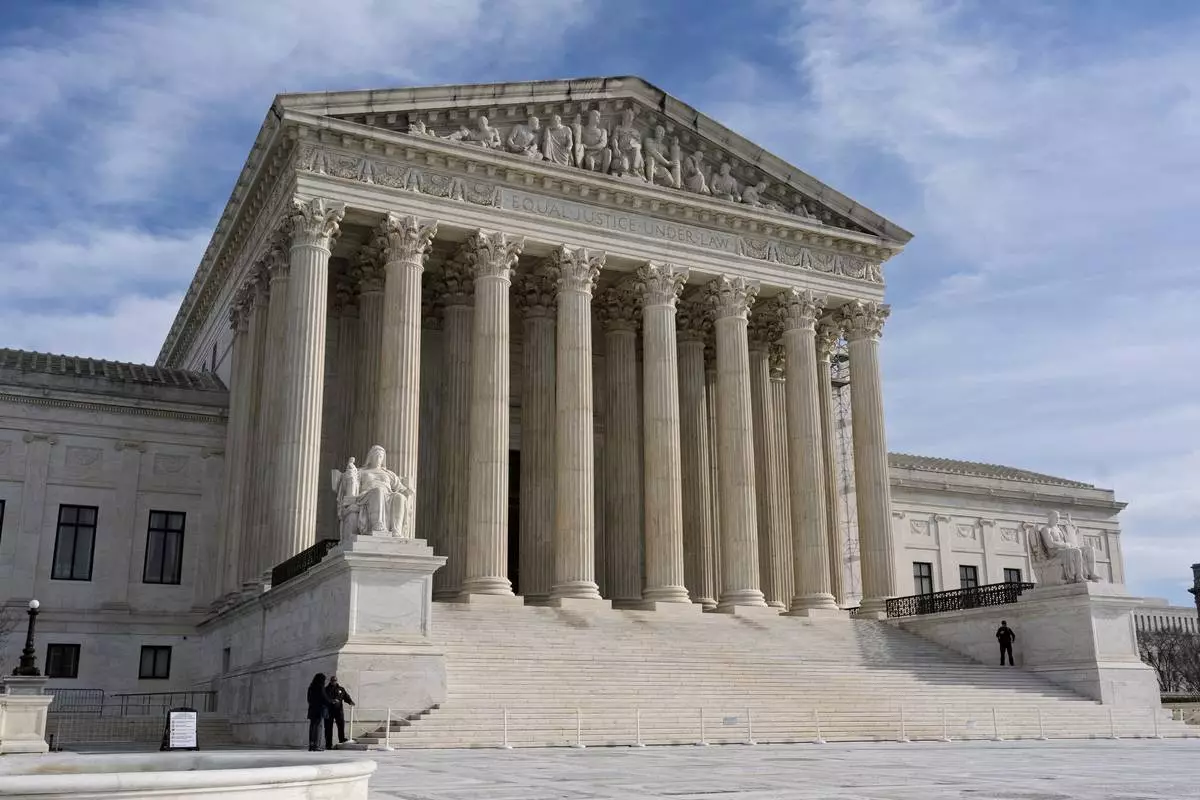
FILE - The Supreme Court is seen on Capitol Hill in Washington, Dec. 17, 2024. (AP Photo/J. Scott Applewhite, File)
NEW YORK (AP) — Thousands of nurses in three hospital systems in New York City went on strike Monday after negotiations through the weekend failed to yield breakthroughs in their contract disputes.
The strike was taking place at The Mount Sinai Hospital and two of its satellite campuses, with picket lines forming. The other affected hospitals are NewYork-Presbyterian and Montefiore Medical Center in the Bronx.
About 15,000 nurses are involved in the strike, according to New York State Nurses Association.
The strike, which comes during a severe flu season, could potentially force the hospitals to transfer patients, cancel procedures or divert ambulances. It could also put a strain on city hospitals not involved in the contract dispute, as patients avoid the medical centers hit by the strike.
The hospitals involved have been hiring temporary nurses to try and fill the labor gap during the walkout, and said in a statement during negotiations that they would “do whatever is necessary to minimize disruptions.” Montefiore posted a message assuring patients that appointments would be kept.
The work stoppage is occurring at multiple hospitals simultaneously, but each medical center is negotiating with the union independently. Several other hospitals across the city and in its suburbs reached deals in recent days to avert a possible strike.
The nurses’ demands vary by hospital, but the major issues include staffing levels and workplace safety. The union says hospitals have given nurses unmanageable workloads.
Nurses also want better security measures in the workplace, citing incidents like a an incident last week, when a man with a sharp object barricaded himself in a Brooklyn hospital room and was then killed by police.
The union also wants limitations on hospitals’ use of artificial intelligence.
The nonprofit hospitals involved in the negotiations say they’ve been working to improve staffing levels, but say the union’s demands overall are too costly.
Nurses voted to authorize the strike last month.
Both New York Gov. Kathy Hochul and Mayor Zohran Mamdani had expressed concern about the possibility of the strike. As the strike deadline neared, Mamdani urged both sides to keep negotiating and reach a deal that “both honors our nurses and keeps our hospitals open.”
“Our nurses kept this city alive through its hardest moments. Their value is not negotiable,” Mamdani said.
The last major nursing strike in the city was only three years ago, in 2023. That work stoppage, at Mount Sinai and Montefiore, was short, lasting three days. It resulted in a deal raising pay 19% over three years at those hospitals.
It also led to promised staffing improvements, though the union and hospitals now disagree about how much progress has been made, or whether the hospitals are retreating from staffing guarantees.
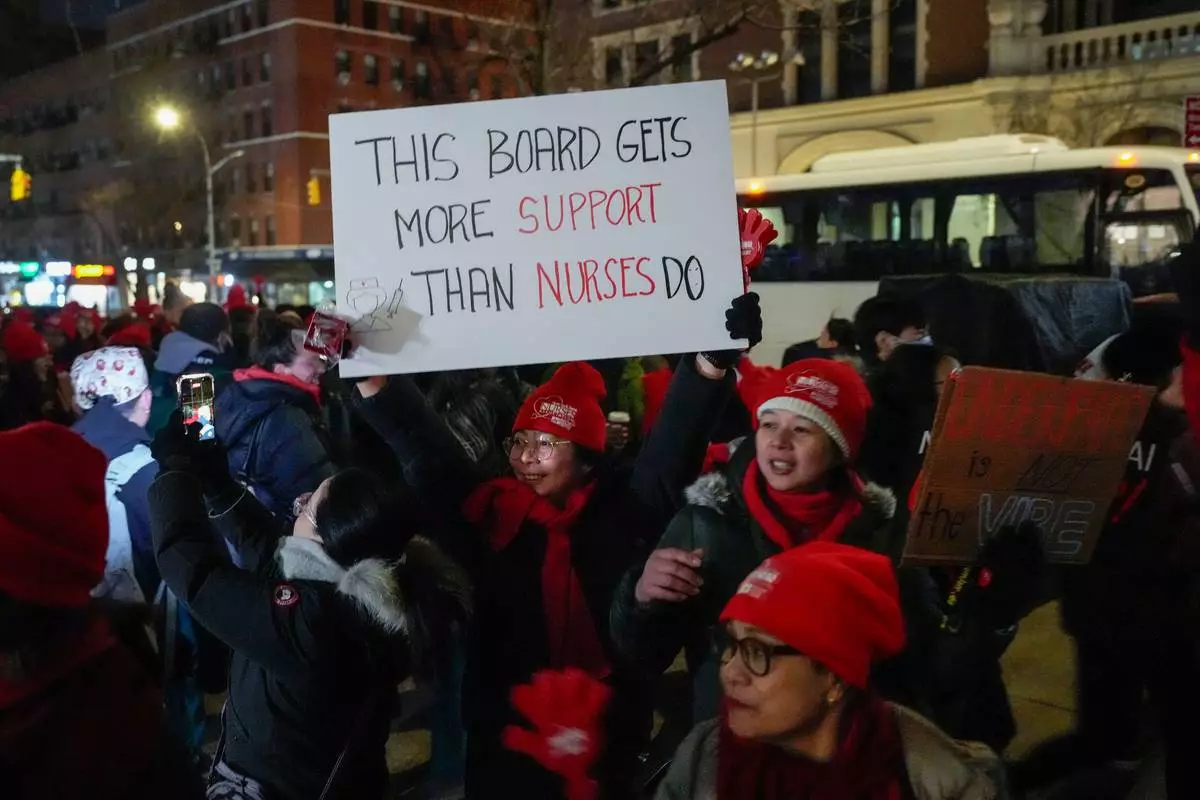
Nurses strike outside Mount Sinai West Hospital, Monday, Jan. 12, 2026, in New York. (AP Photo/Yuki Iwamura)
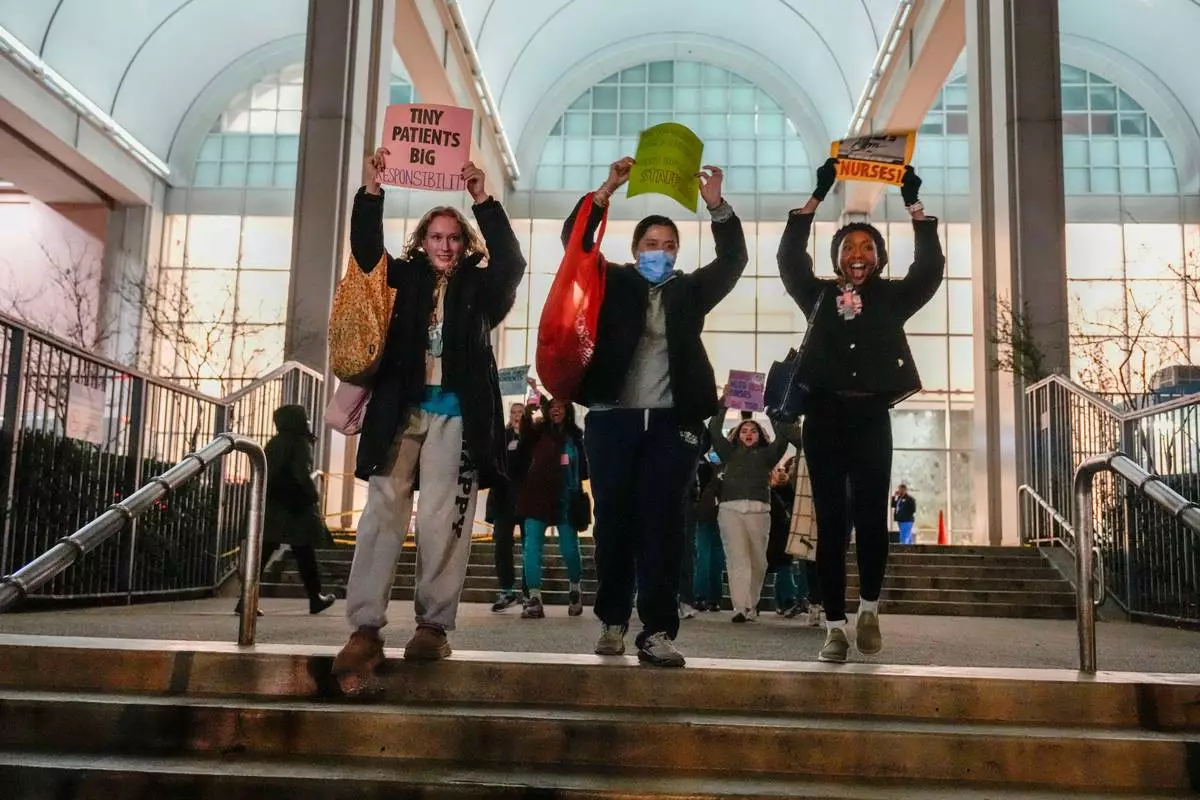
Nurses strike outside Mount Sinai West Hospital, Monday, Jan. 12, 2026, in New York. (AP Photo/Yuki Iwamura)
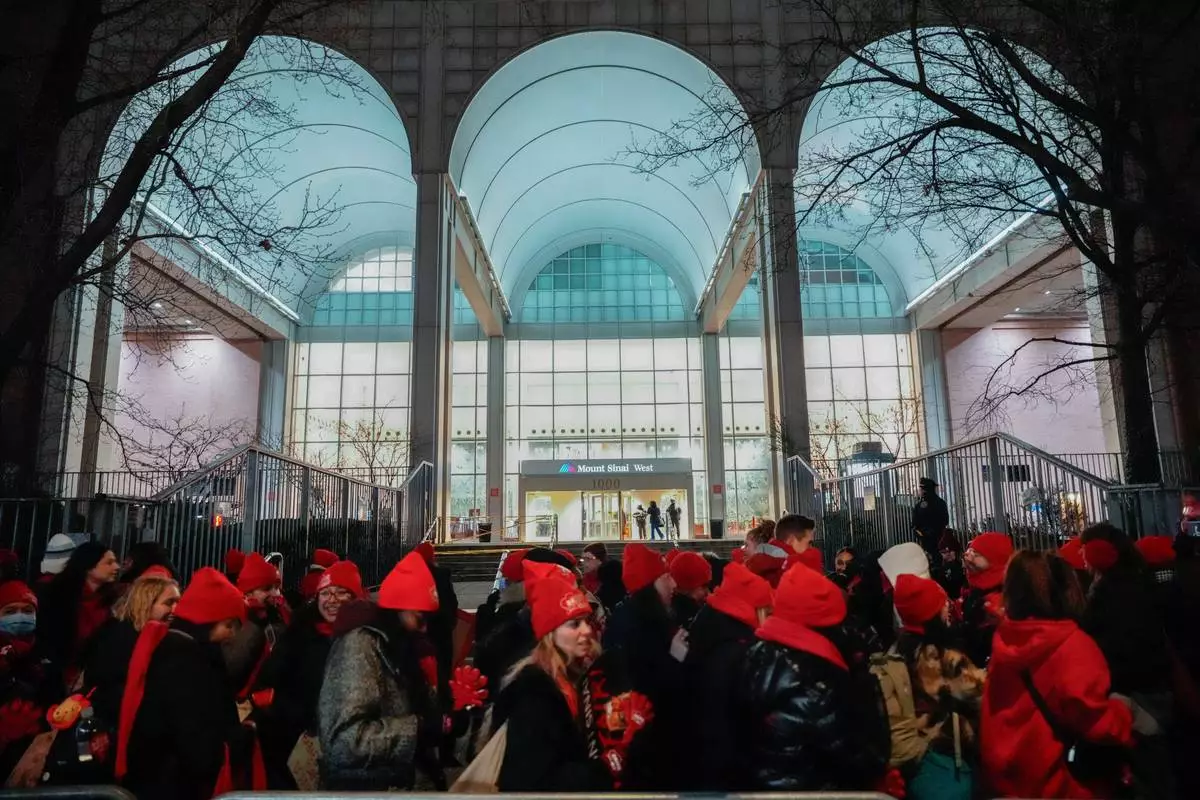
Nurses strike outside Mount Sinai West Hospital, Monday, Jan. 12, 2026, in New York. (AP Photo/Yuki Iwamura)
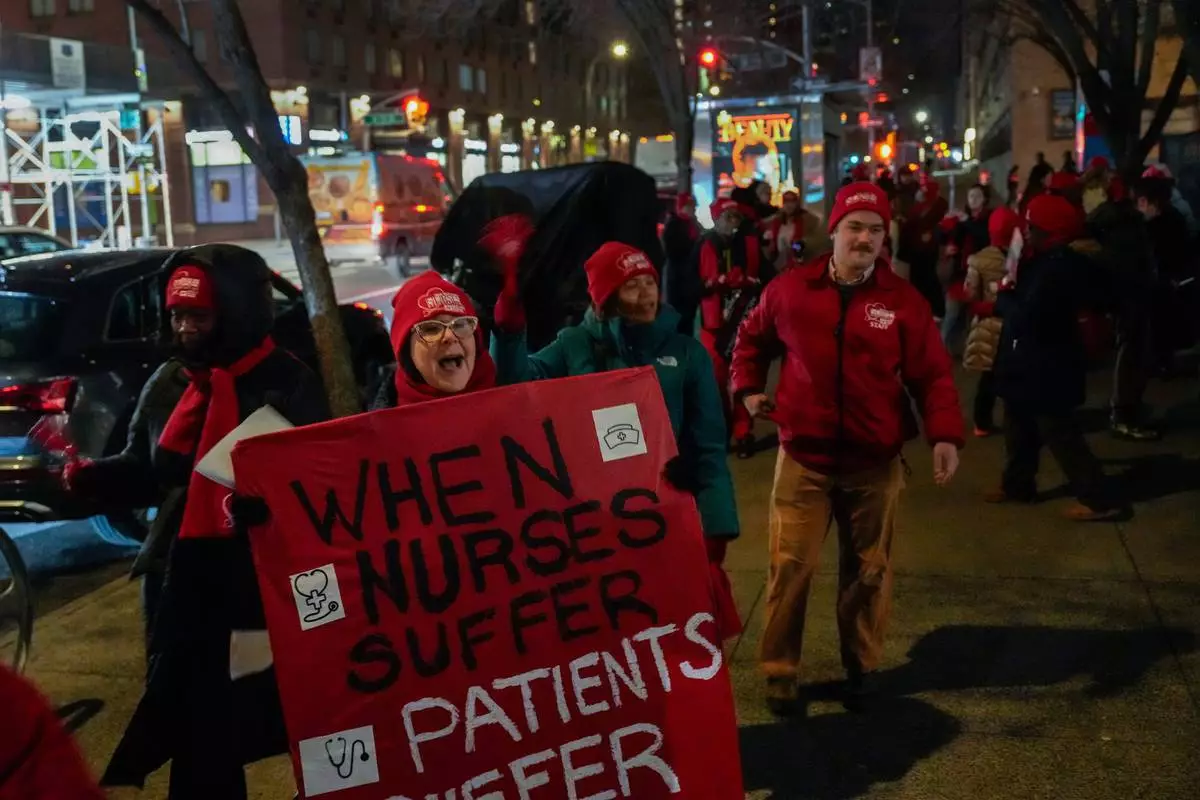
Nurses strike outside Mount Sinai West Hospital, Monday, Jan. 12, 2026, in New York. (AP Photo/Yuki Iwamura)

FILE - A medical worker transports a patient at Mount Sinai Hospital, April 1, 2020, in New York. (AP Photo/Mary Altaffer, File)