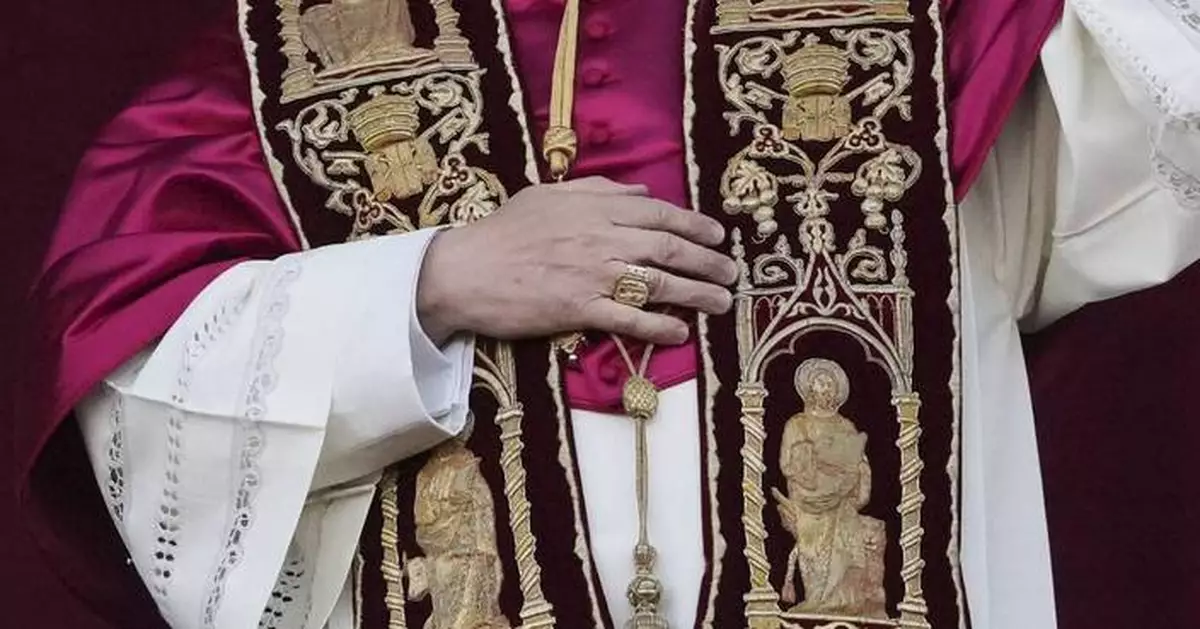
VATICAN CITY (AP) — When Pope Leo XIV stepped out on the central loggia of St. Peter’s Basilica to greet the crowd for the first time after his May 8 election, liturgical fashion aficionados around the globe took note: Gone was the simple white cassock and silver cross favored by Pope Francis. Back was the red satin mozzetta shoulder cape, the burgundy stola with gold embroidery and a gold cross held by a double-stranded silken gold cord.
Over Leo’s first few weeks, the excitement grew among liturgical fashion-conscious Catholics as they noticed new additions to the wardrobe, or rather a return to the old additions of the papal wardrobe: cufflinks, white pants, lace.
Click to Gallery
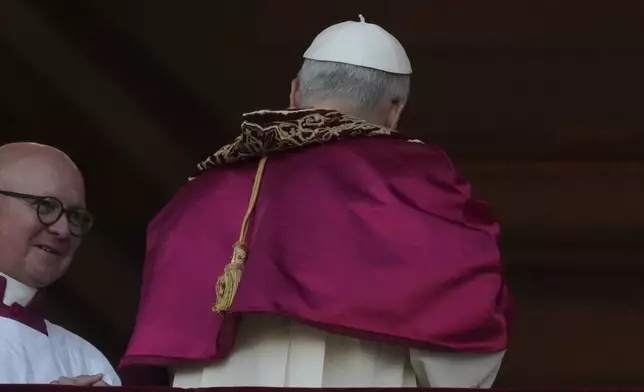
FILE - Newly elected Pope Leo XIV leaves after appearing on the balcony of St. Peter's Basilica at the Vatican, May 8, 2025. (AP Photo/Andrew Medichini, File)
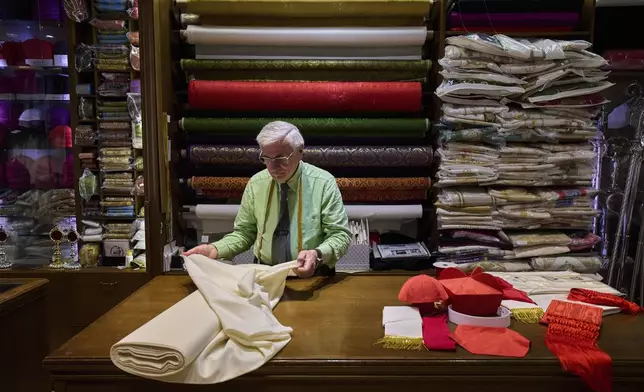
FILE - Italian tailor Raniero Mancinelli, 87, prepares the white fabric to create suits, in three different sizes, to be taken to the Vatican in the hope that it might be worn by the new pope, at his shop in Rome, April 24, 2025. (AP Photo/Bernat Armangue, File)
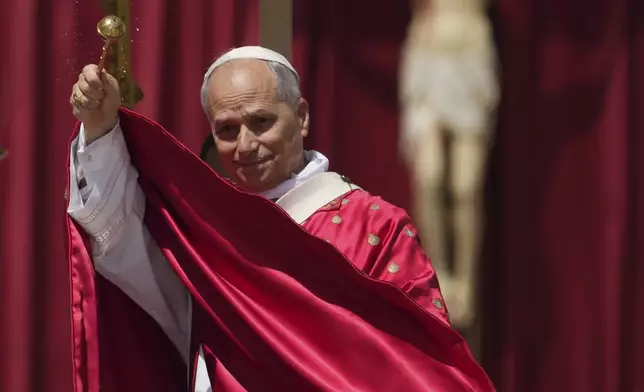
FILE - Pope Leo XIV spreads holy water as he celebrates a Mass for the Jubilee of New Religious Associations on Pentecost Day in St. Peter's Square at the Vatican, Sunday, June 8, 2025. (AP Photo/Andrew Medichini, File)
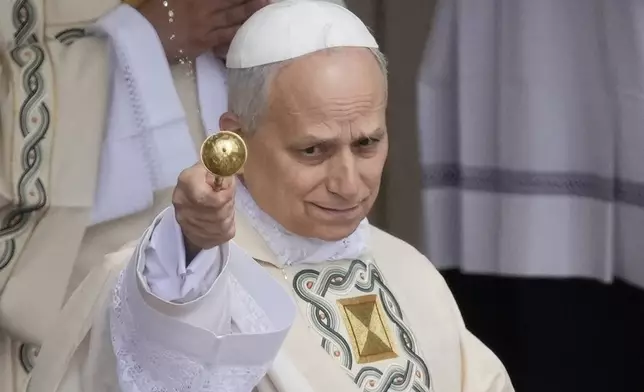
FILE - Pope Leo XIV celebrates a Mass for the formal inauguration of his pontificate, in St. Peter's Square attended by heads of state, royalty and ordinary faithful, May 18, 2025. (AP Photo/Gregorio Borgia, File)
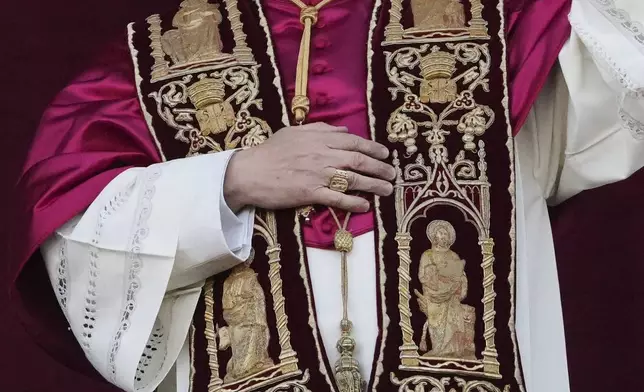
FILE - Newly elected Pope Leo XIV appears at the balcony of St. Peter's Basilica at the Vatican, May 8, 2025. (AP Photo/Alessandra Tarantino, File)
After Francis' revolutionary papacy, Vatican watchers are now wondering if Leo's return to the past sartorial look means a return to the past on other things too, including more substantial policy issues. But for tailors at the elite handful of liturgical tailoring shops in Rome, there is hope that Leo's return to the fancier garb of popes past will mean a boon to business if Leo's traditional look has a trickle-down effect from the pope to priests and all those in between.
According to the Rev. John Wauck, professor of church communication at the Pontifical Holy Cross University in Rome, Leo's clothing choices are a “return to form,” and his attire similar to that worn by Pope Benedict XVI, Pope John Paul II and other popes going back to the middle ages.
They show “a respect for tradition,” he said.
Such respect for the papal office is important for many conservative Catholics. Many conservatives and traditionalists soured on Francis' informal style and disdain for tradition, which reached its pinnacle with his his crackdown on the old Latin Mass. The old liturgy was celebrated before the modernizing reforms of the 1960s Second Vatican Council; Francis greatly restricted access to the old liturgy, saying it had become a source of division in parishes.
Leo has shown strong familiarity with Latin, and has taken to singing the Sunday noontime prayer in Latin. Some traditionalist Catholics are hoping Leo will take the pro-Latin path even further and reverse Francis to allow greater use of the traditional Latin Mass.
Massimo Faggioli, professor of theology at Villanova University, where Leo went to college, said it's too early to tell if Leo will reverse Francis' reform.
“It remains to be seen if Leo’s more traditional attire and liturgical style means that he will change Francis’ strong decisions limiting the so-called ‘Latin Mass,’" he said.
That said, Faggioli said U.S. conservatives seems particularly happy with Leo’s traditional attire, given Francis’ disdain for the fashion pomp of the papacy.
“In this sense, Francis might have been a parenthesis or an interlude, more than a changer of the tradition in ‘papal style,’” he said in an email.
At his inaugural Mass on May 18, 2025, Pope Leo XIV reached out his arm to sprinkle holy water and revealed a shirt with cufflinks, which Francis had largely avoided. He was also wearing an amitto, and an alb held in place by a cingulum. For the non-experts, the amitto is a lacy linen cloth that goes around the neck, the alb is the white tunic worn under the ceremonial vestment, and the cingulum is a braided rope with tassels that serves as a belt.
If it weren’t for photographers’ long lenses relentlessly trained on the pope’s every gesture, Leo’s switch from Francis’s standard black pants to more traditional white papal trousers would have gone completely unnoticed.
In addition to the clothing changes, Leo has returned to some other traditions of the Vatican that Francis eschewed.
He has shown himself willing to accept the traditional “baciamano” or kissing of his ring. Francis disliked having his ring kissed and often pulled his hand away if someone tried to kiss it.
“I think that what we see with Pope Leo is a willingness to embrace tradition, even if it risks seeming perhaps more formal than Pope Francis,” Wauck said. The idea is that “seeing that tradition as a treasure to be conserved and embraced as opposed to something that makes one feel perhaps a little bit standoffish.”
It remains to be seen whether Leo will move into the papal apartment in the Apostolic Palace, which stood empty during the 12-year Francis papacy. Francis shocked the world by choosing to live in a small room at the Santa Marta residence at the Vatican, eating his meals in the common dining room.
For the Rev. Castro Prudencio, this is all much ado about nothing. "For Pope Francis it was simplicity. Always. And Pope Leo has taken up what Pope Benedict had and many others. That is what the church is like,” he said.
Associated Press religion coverage receives support through the AP’s collaboration with The Conversation US, with funding from Lilly Endowment Inc. The AP is solely responsible for this content.
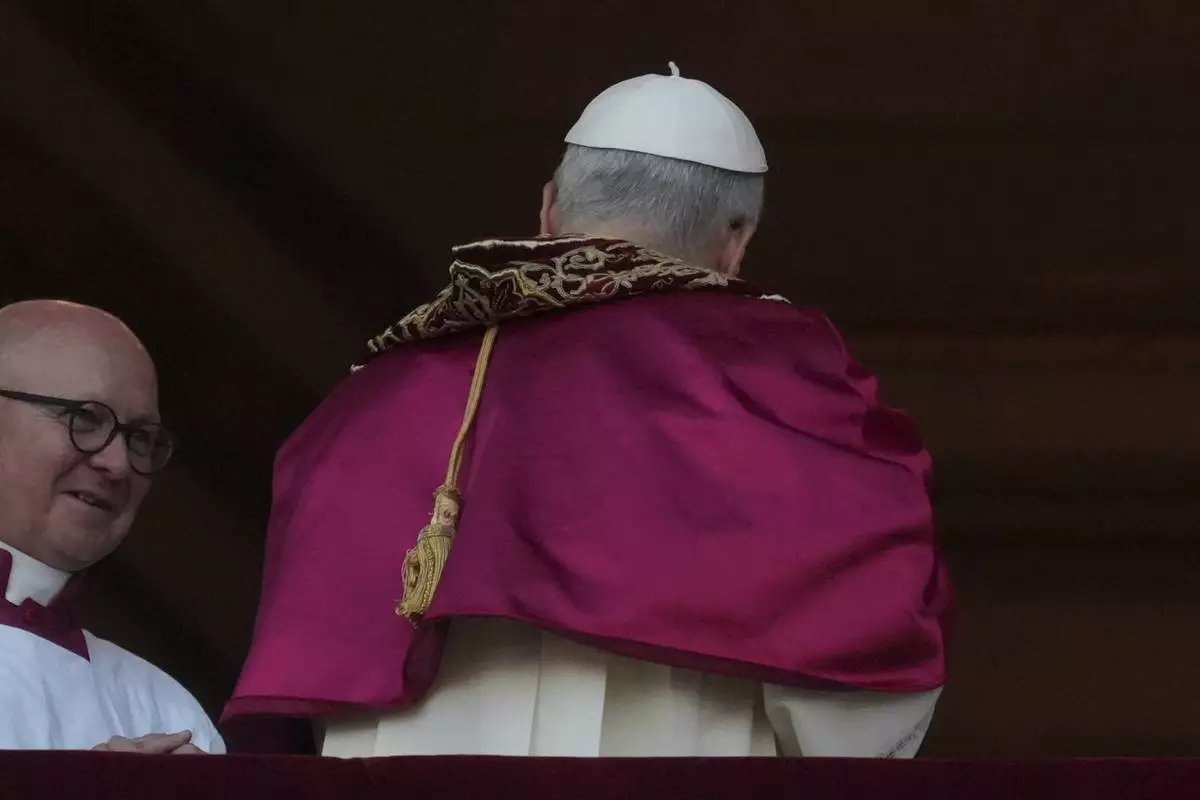
FILE - Newly elected Pope Leo XIV leaves after appearing on the balcony of St. Peter's Basilica at the Vatican, May 8, 2025. (AP Photo/Andrew Medichini, File)
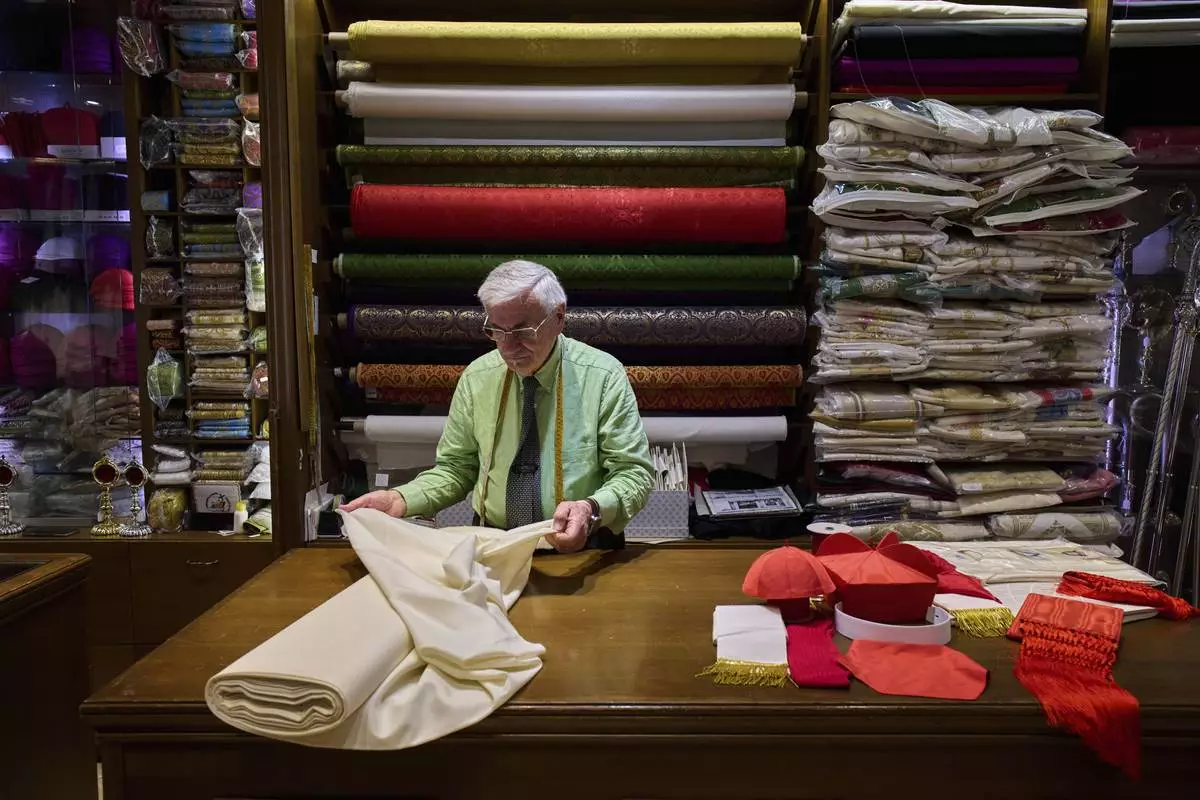
FILE - Italian tailor Raniero Mancinelli, 87, prepares the white fabric to create suits, in three different sizes, to be taken to the Vatican in the hope that it might be worn by the new pope, at his shop in Rome, April 24, 2025. (AP Photo/Bernat Armangue, File)
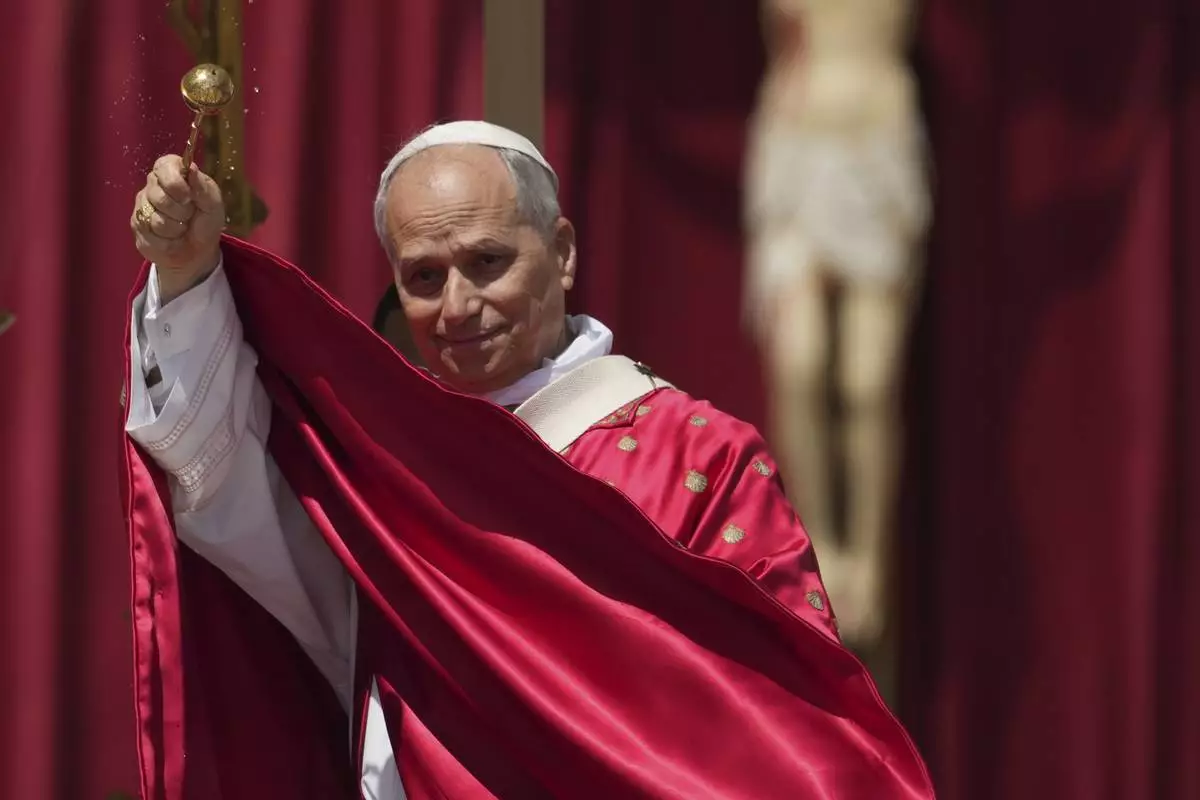
FILE - Pope Leo XIV spreads holy water as he celebrates a Mass for the Jubilee of New Religious Associations on Pentecost Day in St. Peter's Square at the Vatican, Sunday, June 8, 2025. (AP Photo/Andrew Medichini, File)
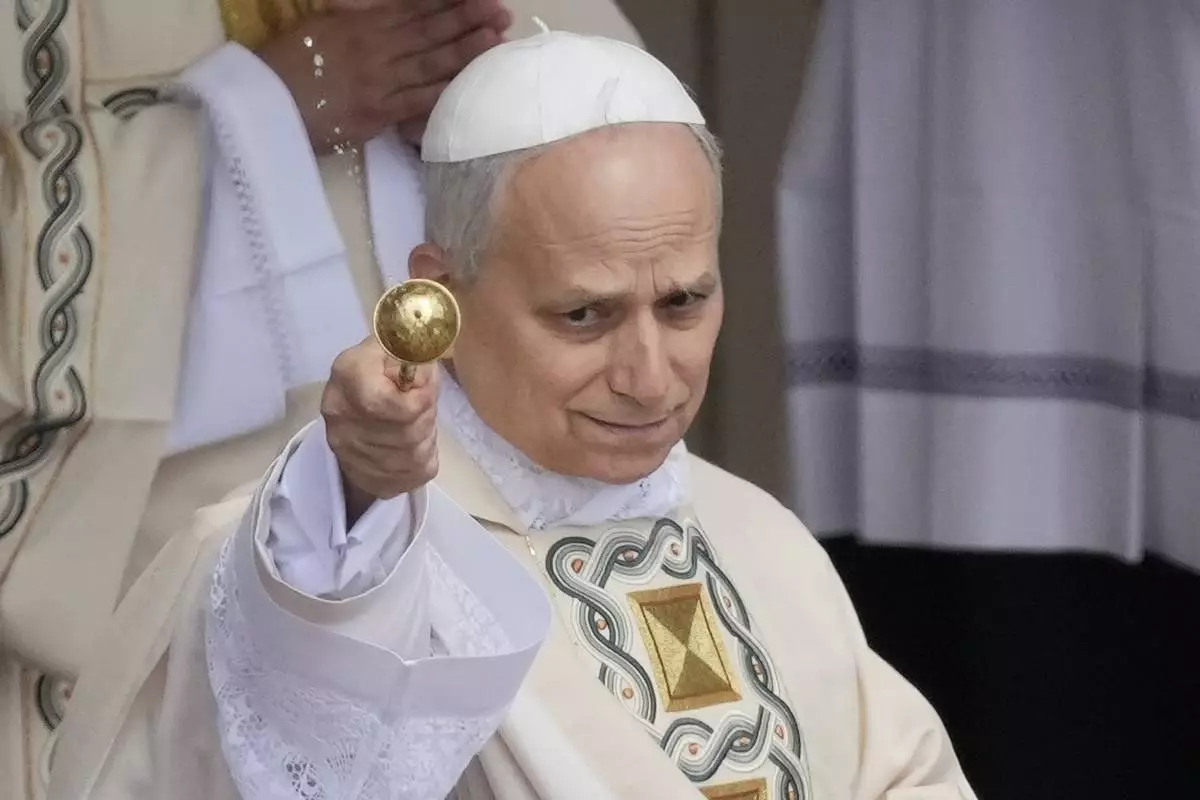
FILE - Pope Leo XIV celebrates a Mass for the formal inauguration of his pontificate, in St. Peter's Square attended by heads of state, royalty and ordinary faithful, May 18, 2025. (AP Photo/Gregorio Borgia, File)
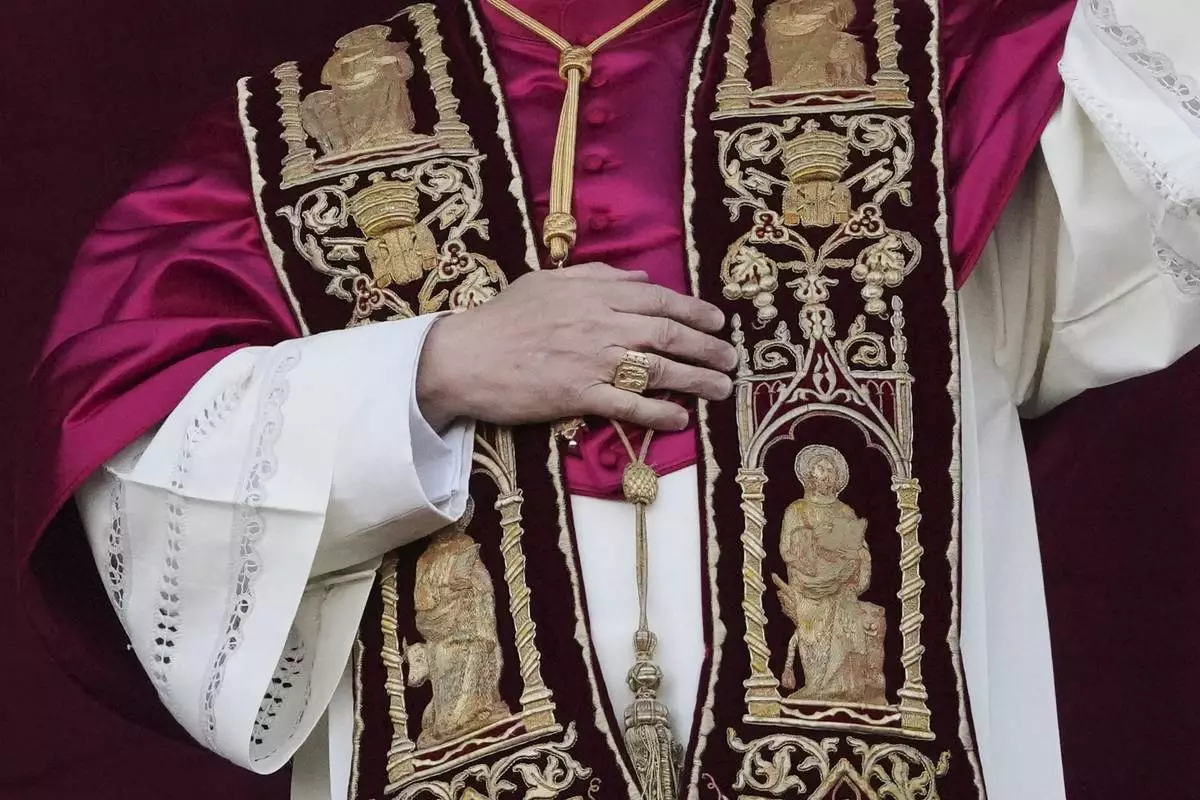
FILE - Newly elected Pope Leo XIV appears at the balcony of St. Peter's Basilica at the Vatican, May 8, 2025. (AP Photo/Alessandra Tarantino, File)
Secretary of State Marco Rubio suggested Sunday that the U.S. would not take a day-to-day role in governing Venezuela, a turnaround after President Donald Trump announced a day earlier that the U.S. would be running Venezuela following its ouster of leader Nicolás Maduro.
Rubio’s statements seemed designed to temper concerns about whether the assertive American action to achieve regime change might again produce a prolonged foreign intervention or failed attempt at nation-building. They stood in contrast to Trump’s broad but vague claims that the U.S. would at least temporarily “run” the oil-rich nation.
Venezuela’s defense minister demanded Maduro's release, maintaining that he is still the rightful leader of the South American country. The military, which has long acted as the arbiter of political disputes in Venezuela, has thrown its support behind Delcy Rodríguez, who served as vice president under Maduro.
Meanwhile, a tense calm hangs over Venezuela after the U.S. military operation that deposed Maduro, who was brought to New York to face criminal charges.
Maduro and his wife landed late Saturday afternoon at a small airport in New York. The couple face U.S. charges of participating in a narco-terrorism conspiracy.
Here's the latest:
On Saturday, Venezuela's high court ordered Vice President Delcy Rodriguez to assume the role of interim president.
Venezuela's constitution requires elections must be held within 30 days if a president becomes “permanently unavailable,” but the nation's loyalist Supreme Court declared Maduro's absence “temporary,” a scenario where there is no immediate election requirement.
Instead, the vice president, an unelected position, takes over for up to 90 days — a period that can be extended to six months with a vote of the National Assembly.
In handing temporary power to Rodriguez, the Supreme Court made no mention of the 180-day time limit, leading some to speculate she could try to remain in power even longer as she seeks to unite the disparate factions of the ruling socialist party while shielding it from what would certainly be a stiff electoral challenge.
Concern simmered in Cuba, one of Venezuela’s most important allies and trading partners, a day after the Trump administration warned it could turn its attention to the Caribbean nation.
“If I lived in Havana and I was in the government I’d be concerned, at least,” Secretary of State Marco Rubio said on Saturday.
Cuban authorities called a rally to support Venezuela’s government and railed against the U.S. military operation, writing in a statement: “All the nations of the region must remain alert, because the threat hangs over all of us.”
On Sunday, Cubans like 55-year-old biochemical laboratory worker Bárbara Rodríguez was among many following developments in Venezuela and worried about what she described as an “aggression against a sovereign state.”
“It can happen in any country, it can happen right here. We have always been in the crosshairs (of the United States),” she said.
Carriers including American, United, Delta and JetBlue say they have added extra flights on top of resuming their scheduled services in the eastern Caribbean after many flights in the region were canceled by the U.S. military action in Venezuela.
American Airlines says it is offering more than two dozen additional flights on Sunday and Monday, including round-trip flights to Antigua, Curacao and Puerto Rico. United Airlines has added at least 14 flights, while Delta Air Lines says it’s adding three additional flights Sunday.
Southwest Airlines announced Saturday that it added more round-trip Puerto Rico flights to its Sunday and Monday schedules, as well as round-trip flights to Aruba on Sunday.
Venezuela’s defense minister demanded the release of Maduro, maintaining that he is still the rightful leader of the South American country.
Venezuela’s armed forces “categorically reject the cowardly kidnapping” of Maduro, said General-in-Chief Vladimir Padrino López, flanked by the high military command during a nationwide radio and television broadcast.
Padrino López — without mentioning a death toll — said the capture occurred after “cold-bloodedly murdering a large part of his security team, soldiers, soldiers and innocent civilians.”
He maintained that Venezuela’s military was “united and cohesive in the face of the imperial aggression.”
Much of Maduro's government who helped keep him in power over years of unrest and crisis remains in place. That includes Venezuela’s new interim President Delcy Rodríguez, who previously served as vice president under Maduro.
The military, which has long acted as the arbiter of political disputes in Venezuela, has thrown its support behind Rodríguez.
The envoy to the U.S. made the statement after Katie Miller, wife of White House senior adviser Stephen Miller, posted on X a map of Greenland colored in stars and stripes and with the written note “SOON”.
“We do need Greenland, absolutely,” Trump himself told The Atlantic in an interview on Sunday.
“Just a friendly reminder about the US and the Kingdom of Denmark,” Ambassador Jesper Møller Sørensen wrote in his post on X responding to Miller. “We are close allies and should continue to work together as such. US security is also Greenland’s and Denmark’s security. Greenland is already part of NATO.”
Trump called repeatedly for U.S. jurisdiction over Greenland during his presidential transition and in the early months of his second term, causing anxiety in both Denmark and Greenland.
Greenland possesses natural resources that include oil, gas, and rare earth elements. Denmark is responsible for the autonomous territory’s foreign affairs and defense.
Last year, the Trump administration removed Temporary Protected Status for some 600,000 Venezuelan immigrants in the U.S. which had allowed them to work and stay in the country for a period.
When asked whether TPS would be reinstated for Venezuelans on Fox News Sunday, Homeland Security Secretary Kristi Noem defended the decision to revoke it.
Without TPS, those Venezuelans can be deported back to their home country, which is now reeling from the military operation and Maduro’s capture.
Noem said those who had TPS would be able to apply for refugee status.
Trump told The Atlantic on Sunday in a telephone interview that Delcy Rodríguez, Venezuela’s vice president, could “pay a very big price” if she doesn’t do what he thinks is right for the South American country.
That contrasted with the Republican president’s comments about Rodríguez on Saturday when he said Secretary of State Marco Rubio had spoken with her and that she was willing to do what the U.S. thinks is needed to improve the standard of living in Venezuela.
But Rodríguez has criticized Maduro’s removal from the country and has demanded that the U.S. return him.
Trump told the magazine that “if she doesn’t do what’s right, she is going to pay a very big price, probably bigger than Maduro.” The president told the New York Post in an interview Saturday that the U.S. wouldn’t need to station troops in Venezuela if she “does what we want.”
The governments of Spain, Brazil, Chile, Colombia, Mexico and Uruguay said in a statement that U.S. involvement in Venezuela is “an extremely dangerous precedent for peace and regional security and puts the civilian population at risk.”
In a statement released jointly by the governments, they expressed their “concern about any attempt at government control, administration, or external appropriation of natural or strategic resources.”
These actions are “incompatible with international law and threaten the political, economic, and social stability of the region,” they added.
Besides expressing their “deep concern and rejection” of the U.S. operation that ended with the capture of Venezuelan President Nicolás Maduro, they called for dialogue, negotiation, and respect for the will of the Venezuelan people to resolve the situation, “without external interference and in accordance with international law.”
Associated Press video on Sunday shows a banner now on display in Iran’s capital warning the United States and Israel that their soldiers could be killed if they take action in the country.
Trump’s recent comment that the U.S. “will come to their rescue” if Iran kills peaceful protesters has taken on a new meaning after the U.S. capture of Venezuelan President Nicolás Maduro, a longtime ally of Tehran.
Iran’s Foreign Ministry has condemned the “illegal U.S. attack against Venezuela.” U.S. Defense Secretary Pete Hegseth has said adversaries of the U.S. should note that “America can project our will anywhere, anytime.”
From California to Missouri and Texas, protesters are planning demonstrations Sunday and through the week against President Donald Trump’s military operation and capture of Maduro, which one protest description called “the illegal, unconstitutional invasion of Venezuela.”
Dozens appear to be organized by chapters of Indivisible, a left-leaning group, and many take umbrage with Trump’s plans to take control of Venezuela’s oil industry and ask American companies to revitalize it.
U.S. Sen. Chuck Grassley, a Republican from Iowa who serves as Senate president pro tempore, posted on X Saturday that Maduro is a narco-terrorist and his drug trafficking resulted in the deaths of too many Americans. He likened the Trump operation to then-President George Bush’s decision in 1989 to capture Panamanian dictator Manuel Noriega following his indictment for drug trafficking.
Illinois Gov. JB Pritzker, a Democrat and one of President Donald Trump’s most outspoken critics, posted that U.S. military action in Venezuela is unconstitutional and is putting troops in harm’s way with no long-term strategy. “The American people deserve a President focused on making their lives more affordable,” Pritzker wrote.
U.S. Sen. Tammy Baldwin, a Democrat from Wisconsin, posted a statement on X calling the strikes illegal and criticizing Trump for taking action without congressional approval. “The President does not have the unilateral authority to invade foreign countries, oust their governments, and seize their resources,” she wrote.
France’s foreign minister says the departure of President Nicolás Maduro “is good news for the Venezuelans” and called for a peaceful and democratic transition of power.
Jean-Noël Barrot said “Maduro was an unscrupulous dictator who confiscated Venezuelans’ freedom and stole their elections.”
“Then, yes, we pointed out that the method used infringes the principles of international law,” Barrot said about the U.S. military operation on France 2 national television.
Chuck Schumer, the Democratic Senate leader, called Maduro “a horrible, horrible person” but added, “You don’t treat lawlessness with other lawlessness. And that’s what’s happened.”
“We have learned through the years that, when America tries to regime change and nation-building in this way, the American people pay the price in both blood and results,” Schumer told ABC’s “This Week.”
Homeland Security Secretary Kristi Noem says President Donald Trump’s conversations with Venezuelan Vice President Delcy Rodriguez now are ”very matter-of-fact and very clear: You can lead or you can get out of the way, because we’re not going to allow you to continue to subvert American influence and our need to have a free country like Venezuela to work with rather than to have dictators in place who perpetuate crimes and drug trafficking.”
Noem tells “Fox News Sunday” that the United States wants a leader in Venezuela who will be “a partner that understands that we’re going to protect America” when it comes to stopping drug trafficking and “terrorists from coming into our country.”
She says that “we’re looking for a leader that will stand up beside us and embrace those freedoms and liberties for the Venezuelan people but also ensure that they’re not perpetuating crimes around the globe like they’ve had in the past.”
Secretary of State Marco Rubio appeared to back off Trump’s assertions that the U.S. was running Venezuela, insisting instead that Washington will use control of the South American country’s oil industry to force policy changes and, “We expect that it’s going to lead to results here.”
“We’re hopeful, hopeful, that it does positive results for the people for Venezuela,” Rubio told ABC’s “This Week.” “But, ultimately, most importantly, in the national interest of the United States.”
Asked about Trump suggesting that Rubio would be among the U.S. officials helping to run Venezuela, Rubio offered no details but said, “I’m obviously very intricately involved in the policy” going forward.
He said of Venezuela’s interim leader: “We don’t believe this regime in place is legitimate” because the country never held free and fair elections.
Venezuela’s capital Caracas was unusually quiet Sunday with few vehicles moving around. Convenience stores, gas stations and other businesses were mostly closed.
The presence of police and members of the military across the city was notable for its smaller size compared with an average day and even more so with the days when people protested against Maduro’s government in previous years.
Meanwhile, soldiers attempted to clear an area of an air base that had been on fire along with at least three passenger buses following Saturday’s U.S. attack.
The Brooklyn jail holding Nicolás Maduro is a facility so troubled that some judges have refused to send people there even as it has housed such famous inmates as music stars R. Kelly and Sean “Diddy” Combs.
Opened in the early 1990s, the Metropolitan Detention Center, or MDC Brooklyn, currently houses about 1,300 inmates.
It’s the routine landing spot for people awaiting trial in federal courts in Manhattan and Brooklyn, holding alleged gangsters and drug traffickers alongside some people accused of white collar crimes.
Maduro is not the first president of a country to be locked up there.
Juan Orlando Hernández, the former president of Honduras, was imprisoned at MDC Brooklyn while he was on trial for trafficking hundreds of tons of cocaine into the U.S. Hernández was pardoned and freed by President Donald Trump in December.
▶ Read more about MDC Brooklyn
Residents look at a damaged apartment complex that neighbors say was hit during U.S. strikes to capture Venezuelan President Nicolás Maduro, in Catia La Mar, Venezuela, Sunday, Jan. 4, 2026. (AP Photo/Matias Delacroix)
A soldier stands atop an armored vehicle driving toward Caracas, Venezuela, Sunday, Jan. 4, 2026. (AP Photo/Matias Delacroix)
Shoppers line up at a supermarket in Caracas, Venezuela, Sunday, Jan. 4, 2026. (AP Photo/Ariana Cubillos)