RICHMOND, Va. (AP) —
Two Virginia Democrats are battling Tuesday to be their party's nominee for attorney general. Yet, the name mentioned most in their campaigns is not that of their opponent, but rather a man who lives just over the Arlington Memorial Bridge: President Donald Trump.
The barrage of changes Trump has wrought to American culture in the first few months of his second White House residency has ignited the campaigns of Virginia Democrats Jay Jones and Shannon Taylor as they appeal unrelentingly to the most devout swaths of their base ahead of down-ballot primary elections. The primary will also determine the party’s nominations this year for lieutenant governor and some contested seats in the House of Delegates.
In one of only two states electing governors in November — the other is New Jersey — the caustic anti-Trump rhetoric could be a hint of what voters nationwide will hear from Democrats in next year's midterm elections, when the stakes will be higher.
Virginia's nominees for governor have been settled by default. Democrat Abigail Spanberger became her party's nominee after running unopposed, and Republican Winsome Earle-Sears was the only contender who gathered enough signatures to be on the ballot. The other statewide races are for attorney general and lieutenant governor, and Democrats in both contests seem to be vying to top each other with anti-Trump rhetoric and caustic ads.
Republicans are not hosting statewide primaries this year, so only Democrats will pick a nominee for lieutenant governor. It's a part-time position that pays about $36,000 a year but is often a stepping stone to higher office. Six Democrats want the job, and most of them have pushed ad after ad on the airwaves and online about their commitment to taking on Trump if elected to the mostly ceremonial role.
In the contest for attorney general, Jones and Taylor are competing in much the same way. Turnout is likely to be sluggish, which means firing up base voters is widely seen as the way to go. The last time a left-wing candidate for governor ran unopposed, roughly 142,000 Democrats voted for an attorney general nominee compared with more than 485,000 this past election cycle.
Still, the AG's race has been spicy, more so when the candidates' criticism isn't directed at each other. Jones and Taylor have lambasted the White House and argued that the administration’s actions should be litigated in court. When they are not lamenting Trump, their attacks are directed toward incumbent Republican Attorney General Jason Miyares, who is seeking reelection.
In their respective campaigns, the Democrats argue that Miyares submits to the president by not suing him. They say that sets him apart from more progressive attorneys general across the United States, who are going to court over such things as birthright citizenship and elections. Their main message: A Democrat will take the White House to trial when Miyares won’t — and saving democracy starts there.
“The job is to protect Virginians, to fight for them, to work for them, to keep us safe,” Jones said while campaigning in June in Falls Church, Virginia, adding, “I don’t understand why he is not going after them.”
Last month, Taylor told a room full of Democratic voters that Miyares would enable Trump’s overreaches in Virginia, and potentially double down on institutions that don’t comply with the president.
Either way, “the result is the same for Virginians: getting hurt,” she said.
In a wide-ranging interview in May, Miyares said he identifies as a balls-and-strikes Republican. The former Virginia Beach state delegate, elected top prosecutor in 2021, worked to reduce violent crime. He sought settlements from Big Pharma. When he felt President Joe Biden’s administration overstepped, he went to court.
But as Trump was ushered into office for a second term, Miyares entered new political terrain. Unlike most other states, Virginians will elect their attorney general this November, nearly a year after the country voted for the president and his consequential agenda.
Miyares has waded into the political arena. He often spars on social media with progressive prosecutors throughout Virginia for being too lenient in prosecuting criminal cases.
Still, Miyares rebuffed the notion that suing Trump is his top concern. He said the Democrats looking to replace him fail to understand the nature of his position.
The attorney general touted meaningful work his office has shouldered: holding listening sessions for crime victims, designating resources to support law enforcement and beefing up his office’s prosecutions of child support cases.
He flashed his law enforcement badge, tucked within a leather wallet, and described the emblem as a guidepost for being an effective people’s prosecutor.
“They seem very obsessed with Donald Trump, whereas I’m obsessed with how am I going to keep Virginians safe?” Miyares said.
Olivia Diaz is a corps member for The Associated Press/Report for America Statehouse News Initiative. Report for America is a nonprofit national service program that places journalists in local newsrooms to report on undercovered issues.

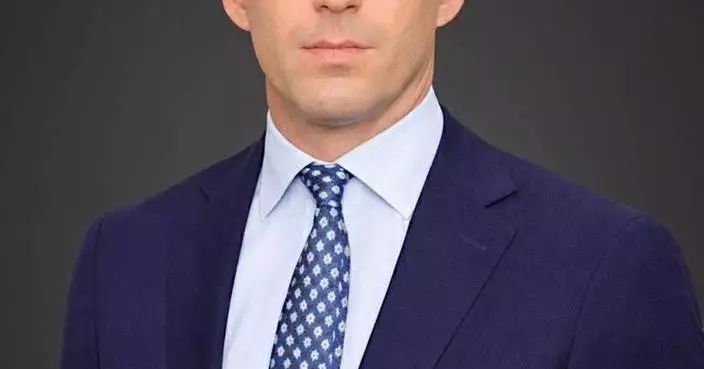
FILE - In this photo combo, from left, Del. Jay Jones, D-Norfolk, gives remarks during the Virginia Democratic Attorney General debate, May 15, 2021 in Richmond, Va., Virginia Attorney General Jason Miyares speaks during an interview at the Office of the Attorney General in Richmond, Va., May 9, 2023 and Henrico Commonwealth's Attorney Shannon Taylor arrives at the Albemarle County Circuit Court in Charlottesville, Va., June 4, 2024. (Shaban Athuman, Ryan M. Kelly/Richmond Times-Dispatch/AP)
RHO, Italy (AP) — No ice is colder and harder than speedskating ice. The precision it takes has meant that Olympic speedskaters have never competed for gold on a temporary indoor rink – until the 2026 Milan Cortina Winter Games.
In the pursuit of maximum glide and minimum friction, Olympic officials brought on ice master Mark Messer, a veteran of six previous Olympic speedskating tracks and the ice technician in charge of the Olympic Oval in Calgary, Canada — one of the fastest tracks in the world with over 300 records.
Messer has been putting that experience to work one thin layer of ice at a time since the end of October at the new Speed Skating Stadium, built inside adjacent trade fair halls in the city of Rho just north of Milan.
“It’s one of the biggest challenges I’ve had in icemaking,’’ Messer said during an interview less than two weeks into the process.
If Goldilocks were a speedskater, hockey ice would be medium hard, for fast puck movement and sharp turns. Figure skating ice would be softer, allowing push off for jumps and so the ice doesn’t shatter on landing. Curling ice is the softest and warmest of all, for controlled sliding.
For speedskating ice to be just right, it must be hard, cold and clean. And very, very smooth.
“The blades are so sharp, that if there is some dirt, the blade will lose the edge,’’ Messer said, and the skater will lose speed.
Speedskater Enrico Fabris, who won two Olympic golds in Turin in 2006, has traded in his skates to be deputy sports manager at the speedskating venue in Rho. For him, perfect ice means the conditions are the same for all skaters — and then if it's fast ice, so much the better.
"It's more of a pleasure to skate on this ice,'' he said.
Messer’s first Olympics were in Calgary in 1988 — the first time speedskating was held indoors. “That gave us some advantages because we didn’t have to worry about the weather, wind blowing or rain,’’ he said. Now he is upping the challenge by becoming the first ice master to build a temporary rink for the Olympics.
Before Messer arrived in Italy, workers spent weeks setting up insulation to level the floor and then a network of pipes and rubber tubes that carry glycol — an antifreeze — that is brought down to minus 7 or minus 8 degrees Celsius (17.6 to 19.4 degrees Fahrenheit) to make the ice.
Water is run through a purification system — but it can’t be too pure, or the ice that forms will be too brittle. Just the right amount of impurities “holds the ice together,’’ Messer said.
The first layers of water are applied slowly, with a spray nozzle; after the ice reaches a few centimeters it is painted white — a full day’s work — and the stripes are added to make lanes.
“The first one takes about 45 minutes. And then as soon as it freezes, we go back and do it again, and again and again. So we do it hundreds of times,’’ Messer said.
As the ice gets thicker, and is more stable, workers apply subsequent layers of water with hoses. Messer attaches his hose to hockey sticks for easier spreading.
What must absolutely be avoided is dirt, dust or frost — all of which can cause friction for the skaters, slowing them down. The goal is that when the skaters push “they can go as far as possible with the least amount of effort,’’ Messer said.
The Zamboni ice resurfacing machine plays a key role in keeping the track clean, cutting off a layer and spraying water to make a new surface.
One challenge is gauging how quickly the water from the resurfacing machine freezes in the temporary rink.
Another is getting the ice to the right thickness so that the Zamboni, weighing in at six tons, doesn’t shift the insulation, rubber tubing or ice itself.
“When you drive that out, if there’s anything moving it will move. We don’t want that,’’ Messer said.
The rink got its first big test on Nov. 29-30 during a Junior World Cup event. In a permanent rink, test events are usually held a year before the Olympics, leaving more time for adjustments. “We have a very small window to learn,’’ Messer acknowledged.
Dutch speedskater Kayo Vos, who won the men’s neo-senior 1,000 meters, said the ice was a little soft — but Messer didn’t seem too concerned.
“We went very modest to start, now we can start to change the temperatures and try to make it faster and still maintain it as a safe ice,’’ he said.
Fine-tuning the air temperature and humidity and ice temperature must be done methodically — taking into account that there will be 6,000 spectators in the venue for each event. The next real test will be on Jan. 31, when the Olympians take to the ice for their first training session.
“Eighty percent of the work is done but the hardest part is the last 20 percent, where we have to try to find the values and the way of running the equipment so all the skaters get the same conditions and all the skaters get the best conditions,’’ Messer said.
AP Winter Olympics: https://apnews.com/hub/milan-cortina-2026-winter-olympics

Serpentines are set on the ice of the stadium where speed skating discipline of the Milan Cortina 2026 Winter Olympics will take place, in Rho, outskirt of Milan, Tuesday, Nov. 11, 2025. (AP Photo/Luca Bruno)

Ice Master Mark Messer poses in the stadium where speed skating discipline of the Milan Cortina 2026 Winter Olympics will take place, in Rho, outskirt of Milan, Tuesday, Nov. 11, 2025. (AP Photo/Luca Bruno)
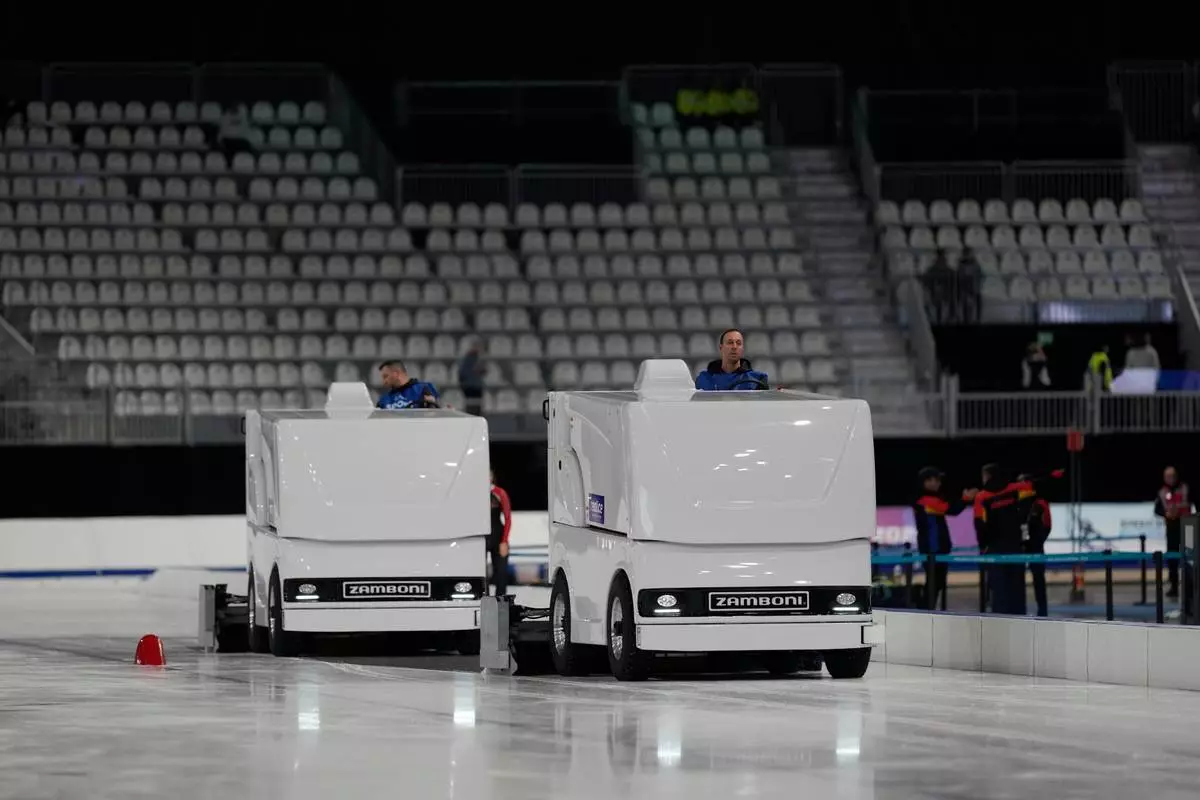
Workers clean the ice surface during a peed skating Junior World Cup and Olympic test event, in Rho, near Milan, Italy, Saturday, Nov. 29, 2025. (AP Photo/Luca Bruno)

Ice Master Mark Messer poses in the stadium where speed skating discipline of the Milan Cortina 2026 Winter Olympics will take place, in Rho, outskirt of Milan, Tuesday, Nov. 11, 2025. (AP Photo/Luca Bruno)

Ice Master Mark Messer poses in the stadium where speed skating discipline of the Milan Cortina 2026 Winter Olympics will take place, in Rho, outskirt of Milan, Tuesday, Nov. 11, 2025. (AP Photo/Luca Bruno)