The Longmen Grottoes, a UNESCO World Heritage Site with over 1,500 years of history, has embraced digital technologies to revolutionize cultural relic preservation and restoration -- an advancement aligns with Chinese President Xi Jinping's longstanding commitment to protecting cultural heritage, which he considers essential to the nation's identity.
Located in Luoyang City, central China's Henan Province, the Longmen Grottoes are one of China's four largest Buddhist cave complexes, along with the Mogao Caves and Maijishan Grottoes in Gansu Province, and the Yungang Grottoes in Shanxi Province.
Inscribed on the UNESCO World Heritage List in November 2000, the site once faced significant preservation challenges due to natural erosion and human damage.
"The Longmen Grottoes, carved into limestone cliffs, are relatively vulnerable to water damage. Water infiltration accelerates microbial growth, causing severe deterioration. Initially, we relied on some primitive ways like manual restoration techniques, which proved inadequate for the challenges we faced," said Ma Chaolong, deputy director of the department on grottoes conservation and research and heritage monitoring of Longmen Grottoes Academy.
Gao Junping, an associate research fellow at the cultural relic preservation and exhibition, and documentation center of Longmen Grottoes Academy, noted the complexities of preserving such a large and intricate heritage site.
"As a large-scale, outdoor and immovable heritage complex, the Longmen Grottoes is home to intricately superimposed cultural relics. Therefore, using traditional conservation methods would present enormous challenges in terms of workload, technical difficulty, and quality assurance," said Gao.
The Longmen Grottoes are just one of the nearly 6,000 cave temples across China. Those grottoes not only demonstrate Chinese civilization but also have important historical and cultural value.
The conservation and restoration of those grottoes have always been a significant concern of Xi, also general secretary of the Communist Party of China Central Committee and chairman of the Central Military Commission. He has paid visits to all of China's four major grotto sites.
"He has also inspected the Mogao Grottoes, the Yungang Grottoes, and the Maijishan Grottoes. Under the guidance of the Central Committee of the Communist Party of China and the general secretary's personal care, conservation efforts at the Longmen Grottoes have undergone transformative improvements. Notably, we have achieved significant breakthroughs in both preservation philosophy and methods," said Yu Jie, a research fellow at Longmen Grottoes Academy.
Harnessing advanced digital technologies such as virtual restoration, augmented reality, and 3D printing, the conservation team at the Longmen Grottoes has developed innovative methods to virtually restore damaged cultural relics and virtually reconstruct the scattered relics.
"Integrating digital technology with enhanced craftsmanship, we have achieved better outcomes through advanced materials and improved methods in cultural relic preservation," said Ma.
On May 19, Xi visited the Longmen Grottoes and learned about the unique characteristics of local stone and the art of stone carving.
"During the inspection tour, the general secretary learned in detail about the status quo of cultural heritage conservation at the Longmen Grottoes. He also talked with travelers, encouraging young children to develop cultural confidence from an early age," said Yu.
"At the Guyang Cave, the general secretary asked about our conservation work. We briefed him on the distinctiveness of Longmen's rock formations and told him that many inscriptions have been preserved well, including the 20 famous inscriptions of the Longmen Grottoes, 19 of which are in the Guyang Cave. He showed strong interests and mentioned China's four major grottoes, noting that he had visited all the four after seeing the Longmen Grottoes," said Ma.
At the three Binyang caves, Xi saw some Buddhist niche inscriptions, which reminded him of another stone, from another time.
In the 1980s, when he was a young official in Zhengding, a historical county in Hebei Province, Xi exhibited rare foresight on cultural preservation. He made field visits to centuries-old temples chronicled in county annals, and took concrete steps to protect them.
During one such visit to Longxing Temple, Xi came upon a timeworn stone slab from the Sui Dynasty (581-618). The bold, elegant calligraphy carved into its surface was slowly fading, at risk of being lost to the elements.
Recognizing its value, Xi ordered immediate measures to shield the monument from further damage. It was later hailed as an important artifact in the field of Chinese calligraphy.
"When we arrived at the three Binyang Caves, he paid special attention to several Buddhist niche inscriptions, recalling his experience in preserving a Sui-era slab at the Longxing Temple during his time in Zhengding," said Yu.
And it wasn't just this Sui-era slab that Xi was concerned about.
Since taking the helm of the Party in 2012, Xi has kept cultural preservation high on the national agenda. He has issued a steady stream of directives on the protection of relics, archaeology and intangible heritage, and made frequent visits to historical and cultural sites across the country.
"The general secretary has underlined the importance of preserving, inheriting and promoting these treasures of Chinese culture. His words inspired and encouraged us greatly. Digital technology is now integrated throughout the entire process of conserving, preserving and promoting the Longmen Grottoes, serving as a major innovative technological approach to make this heritage better known to the outside world," said Gao.
Growing cultural pride has fueled a boom in archaeological tourism in China, with an increasing number of young travelers visiting cultural heritage sites, museums, and memorial halls.
"One principle that must be followed is to carry out utilization of cultural heritages on the premise of protection. In recent years, the number of visits to the Longmen Grottoes has surged significantly, reaching 7.7 million in 2024," said Yu.
The growing popularity of archaeological tourism also reflects Xi's vision of bringing cultural heritages to life and ensuring their inheritance.
"We need to bring to life all collections in our museums, all heritage structures across our lands and all records in our classics. In this way, the Chinese civilization, together with the rich and colorful civilizations created by the people of other countries, will provide mankind with the right cultural guidance and strong motivation," said Xi while delivering a speech at the headquarters of UNESCO in March 2014.
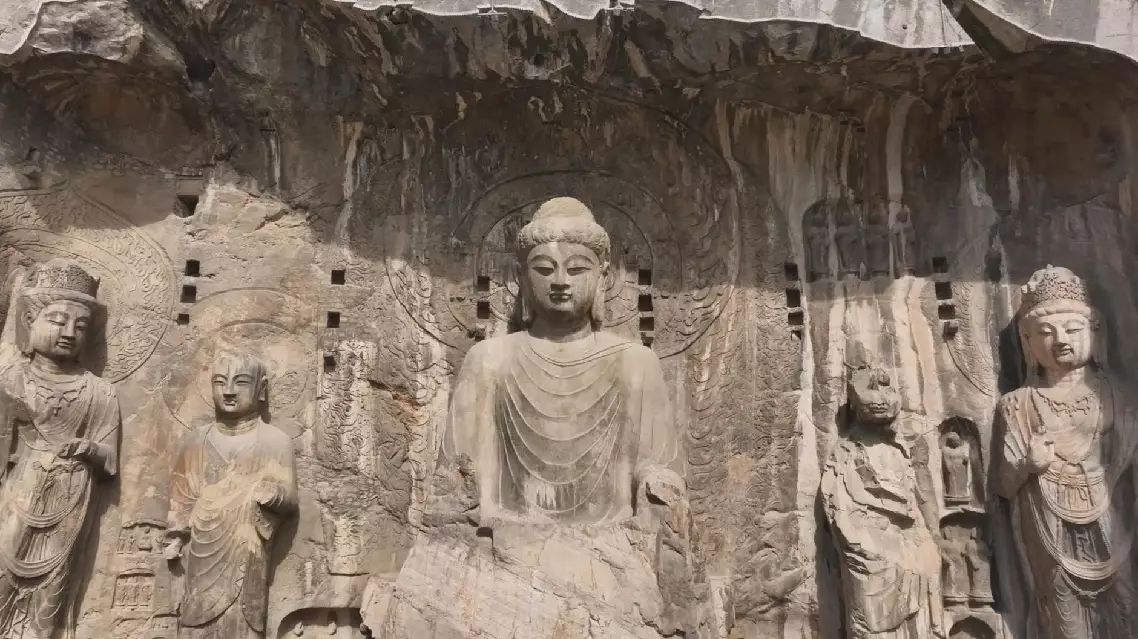
Ancient grottoes embrace digital technology for preservation, echoing Xi's vision for heritage protection