Skip to Content Facebook Feature Image

China’s water infrastructure expertise can help tackle Botswana’s scarcity: minister

China

China

China

China’s water infrastructure expertise can help tackle Botswana’s scarcity: minister

2025-06-14 22:15 Last Updated At:06-15 04:37

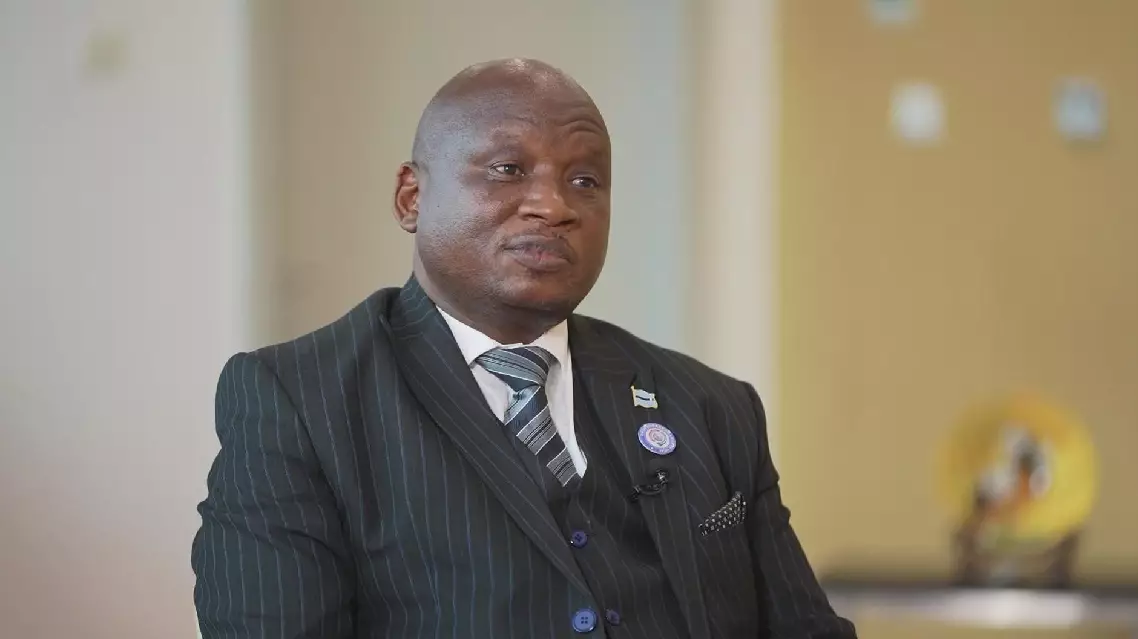
⁠⁠⁠⁠⁠⁠⁠China's expertise in water infrastructure can help address Botswana's water scarcity challenges, according to Onneetse Ramogapi, Botswana’s Minister of Water and Human Settlement.    At the fourth China-Africa Economic and Trade Expo, which opened on Thursday in the central Chinese city of Changsha, China and Botswana are building partnerships to drive development. Their cooperation covers mega-infrastructure projects, drought-resistant agriculture, and advanced wastewater management systems.   In an interview with China Global Television Network (CGTN), Ramogapi said that China's technology can help Botswana recycle wastewater.   "China can help us in water reclaim mission, known as wastewater reclamation, whereby we recycle used water and then we reuse it again. China has got that technology. Currently, we have a so-called Glen Valley and all other areas that need the recycling of water. That is another area that is really needed. China can help us with that technology," he said.   Ramogapi said he was looking forward to exploring water projects with China focused on supply enhancement and wastewater treatment at the Expo.   "Number one, like I said, through water reclamation, wastewater reclamation, where we will be recycling wastewater. Secondly, we have a Chobe-Zambezi project, whereby we want to take water from the Chobe-Zambezi, which is a very, very big river in the southern part of the country. So China can also assist us in terms of that, and that is very, very important. On the other hand, there is also a board of boreholes, and China can assist in that. They treat the water, and then we can have enough water," the minister said.   Speaking about future cooperation, Ramogapi outlined a project aimed at combining renewable energy with water conservation.   “You know, there are so many projects. The other project that we are envisaging is whereby we will be coming up with floating solar panels; then we put them on dams so that they will reduce the evaporation of water. And if we put those solar (panels) on dams, it will also assist in providing power energy. By so doing, we will be saving a lot of power. So, the power that we need through coal, instead, we will generate it through a green technology by using solar panels. So these are the areas that we need,” he said.
China’s water infrastructure expertise can help tackle Botswana’s scarcity: minister
China’s water infrastructure expertise can help tackle Botswana’s scarcity: minister
The U.S. military strike against Venezuela and capture of its president, Nicolas Maduro, has shocked the international community, triggering a steady stream of condemnation and serious concerns worldwide.

Brazil, Chile, Colombia, Mexico, Uruguay and Spain issued a joint statement on Sunday, expressing serious concern about and firm opposition to the U.S. unilateral military operations in Venezuela.

The U.S. actions contravene fundamental principles of international law, particularly the prohibition on the use or threat of force, and respect for the sovereignty and territorial integrity of States, as enshrined in the UN Charter, constituting an extremely dangerous precedent against peace and regional security, according to the statement.

In expressing profound concern and firm rejection, the six countries stressed in the statement that the situation in Venezuela must be resolved exclusively by peaceful means, and through dialogue, negotiation and respect for the will of the Venezuelan people in all its expressions, without external interference and in accordance with international law.

Only an inclusive political process, led by Venezuelans, can lead to a democratic, sustainable solution that respects human dignity, according to the statement.

Spanish Prime Minister Pedro Sanchez condemned the U.S. raid in Venezuela as a violation of international law, adding that the Spanish government always advocates and defends international law and peaceful resolution of conflicts.

Addressing a meeting of the Community of Latin American and Caribbean States (CELAC), Cuban Foreign Minister Bruno Rodriguez demanded the unconditional and immediate release of Maduro and his wife.

Noting that Latin America and the Caribbean are a zone of peace, he expressed his firm opposition to the use of force, which is an unshakable principle.

Any aggression against Venezuela shall be regarded as an attack against all CELAC member states, and nations must collectively oppose it, he stressed.

The South African government denounced the U.S. attack on Venezuela as a violation of international law, according to a statement released on Sunday.

History has repeatedly demonstrated that military invasions against sovereign states yield only instability and deepening crisis, the statement said.

South Africa calls on the UN Security Council to urgently convene a session to address this situation, according to the statement.

Serbian President Aleksandar Vucic said what happened in Venezuela demonstrates that international law and the UN Charter are losing their practical effectiveness.

U.S. military action against Venezuela marks a dangerous precedent, as similar actions could be taken against any other nations, he said.

In addition, the foreign ministries of Namibia, Singapore, Oman and Pakistan also issued statements on the same day, expressing grave concern over U.S. interference in Venezuela's internal affairs.

They emphasized the need to uphold international law and the principles of the UN Charter while respecting Venezuela's sovereignty.

They also called on all parties to exercise restraint and resolve the crisis through peaceful dialogue.

U.S. move against Venezuela sparks condemnation, concerns worldwide

U.S. move against Venezuela sparks condemnation, concerns worldwide

Recommended Articles