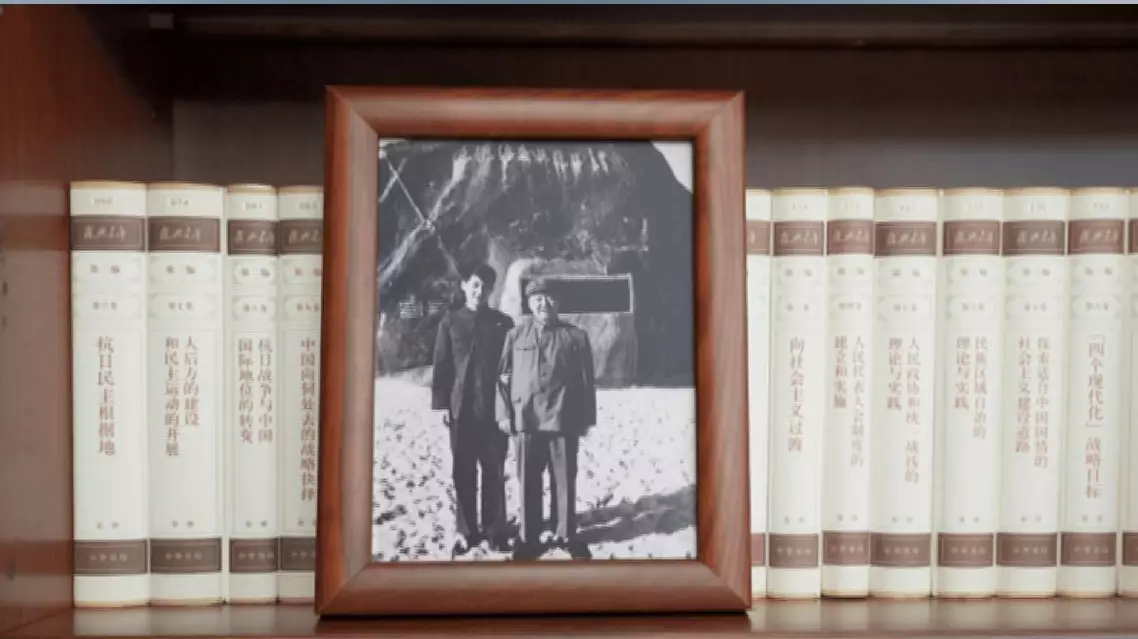
The noble qualities that Chinese President Xi Jinping has learned from his father Xi Zhongxun (1913-2002) have played a crucial role in shaping the values of himself, fueling his unwavering commitment to serving the people.
"There are many noble characters I wish to inherit from father," Xi Jinping, then governor of east China's Fujian Province, said in a letter to his father Xi Zhongxun, a proletarian revolutionary with profound love for the people, more than two decades ago.
His father's words and deeds deeply influenced Xi Jinping's character, strengthening his resolve to devote himself to communism and serving the country.
In January 1969, just shy of turning 16, Xi Jinping arrived at Liangjiahe, a rugged village on the arid Loess Plateau in northwest China, to work the fields alongside the farmers who called the rural community home.
"As a public servant of the people, I have my roots deep in the northern Shaanxi plateau because it cultivated my unchanging mission: to do practical things for the people!" Xi wrote years later in an autobiographical work. "Wherever I go, I will always be a son of the loess lands," he wrote.
In the exhibition hall of the premises of the former prefectural Party committee of Suide of northwest China's Shaanxi Province, one line of words is particularly striking: "sit upright on the side of the people," which was said by Xi Zhongxun who was once also the Party chief of Suide County.
Under such influence, Xi Jinping has always devoted himself to the people.
Over the decades from Liangjiahe to Zhengding, from Fujian to Zhejiang, from Shanghai to Beijing - he has always championed the Party's principle of serving the people wholeheartedly.
In November 2012, shortly after being elected general secretary of the Communist Party of China (CPC) Central Committee, he stood before the press at the Great Hall of the People and said: "The Chinese people's aspiration for a better life is what we are striving for."
In November 2013, during an inspection tour of the central province of Hunan, when visiting Shibadong, an ethnic Miao village labeled "poor" at the time, Xi Jinping introduced himself as a servant of the people.
When he was on an inspection tour of the Guangxi Zhuang Autonomous Region in April 2021, Xi Jinping told farmers in Maozhushan Village that "people's well-being is what is of vital importance to the nation".
In his 2024 New Year message to the nation, Xi Jinping said: " Our goal is both inspiring and simple. Ultimately, it is about delivering a better life for the people."
He has kept the people's welfare at heart, responding to their expectations while staying committed to serving the people.
Like his father, Xi Jinping has consistently emphasized the importance of using investigation and research to understand realities, identify root causes and solve problems.
In August 1978, Xi Jinping, who was studying at Tsinghua University, participated in a summer social practice, accompanying his father, then Party chief of Guangdong Province, on rural inspections.
His father sought solutions through research and studies, gathering wisdom from the people. This taught Xi Jinping a lasting principle: to resolve contradictions and problems, one must stay engaged with the people and their communities.
Inheriting his father's down-to-earth approach, Xi Jinping, while in Zhengding, Hebei Province, visited all villages administered by the county. Then in Ningde, Fujian Province, he visited nine counties within the first three months as secretary of the CPC Ningde Prefectural Committee, and traveled to most townships later on. After he was transferred to Zhejiang Province, he visited all 90 counties in just over a year.
In 2020, Xi Jinping led the drafting group for proposals for formulating the 14th five-year plan (2021-2025) and long-range objectives through 2035. He presided over seven symposiums within three months to seek suggestions from representatives from all walks of life, and made several inspection tours to find keys to challenges.
In an instruction on the work concerning the compilation of the 15th Five-Year Plan (2026-2030) in May this year, Xi Jinping emphasized the importance of integrating top-level design with seeking advice from the public, enhancing research and discussions, and building broad consensus.
Family virtues and traditions had exerted a profound influence on Xi Jinping.
"Father leads an extremely frugal life. Your strict parenting is well-known. Under father's education and influence, we have developed a habit of industry and thrift since childhood," He wrote in a 2001 letter for his father's 88th birthday celebration.
It is under his father's influence that Xi Jinping has developed habits of frugality.
"Even now, in my home, not a single grain of rice in a bowl can be wasted," Xi Jinping said while attending a deliberation with the delegation from east China's Shandong Province during the annual session of the National People's Congress in 2018.
"The habit of diligence and thrift should be preserved," he said.
In December 2016, when meeting with attendees at a Beijing conference to honor model families across the nation, he noted: "Family education covers many aspects, but above all, it's about virtue - teaching children how to be a good person."
Xi Jinping has required officials at all levels to prioritize family values, urging leading officials, especially senior ones, to strictly discipline not only themselves, but also their family members and people around them.
Xi Zhongxun once said: "What greater happiness and pride can a CPC member have than to work more for the Party!"
His father's words and deeds have taught Xi Jinping how to be a man of value to the people, driving him to dedicate his life to the cause of serving the people.
Virtues learned from father fuel Xi's devotion to serving people