Skip to Content Facebook Feature Image

A hillside of white crosses fuels a misleading story about South Africa's farm killings

News

A hillside of white crosses fuels a misleading story about South Africa's farm killings
News

News

A hillside of white crosses fuels a misleading story about South Africa's farm killings

2025-06-16 12:08 Last Updated At:12:42

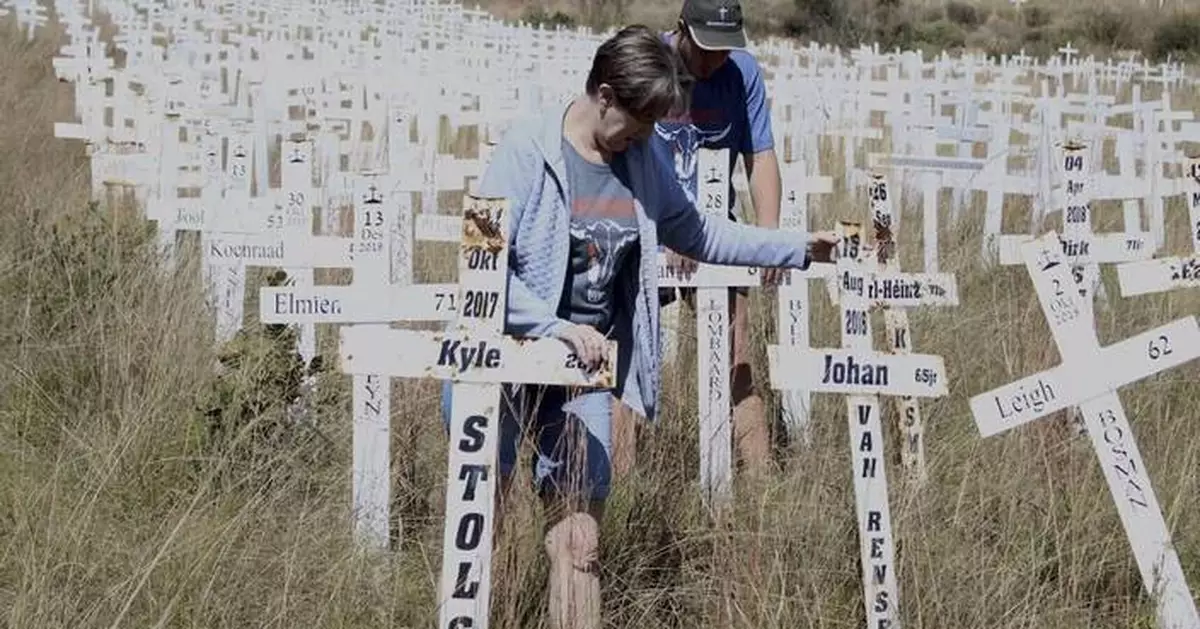
MOKOPANE, South Africa (AP) — The white crosses are staked in the ground on an otherwise barren hillside on the edge of a farm, each one standing as a reminder of a terrible story of a person being killed.

But the crosses, nearly 3,000 of them, do not tell the full story of South Africa's farm killings.

More Images
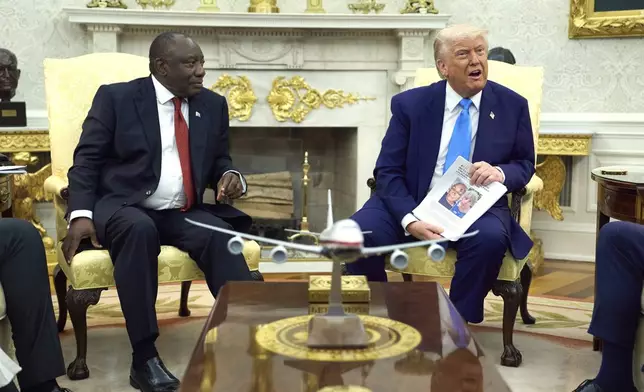
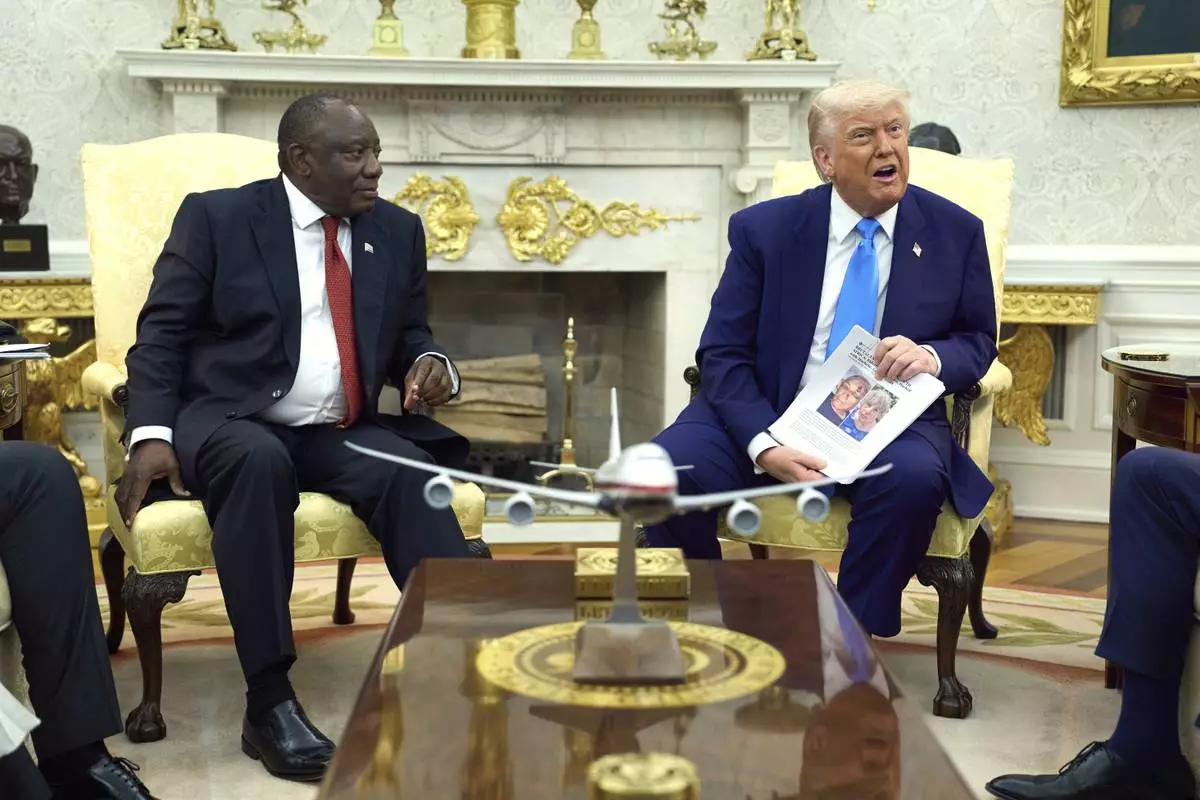
FILE - President Donald Trump meets with South Africa's President Cyril Ramaphosa in the Oval Office of the White House, in Washington, May 21, 2025. (AP Photo/Evan Vucci, File)
FILE - President Donald Trump meets with South Africa's President Cyril Ramaphosa in the Oval Office of the White House, in Washington, May 21, 2025. (AP Photo/Evan Vucci, File)

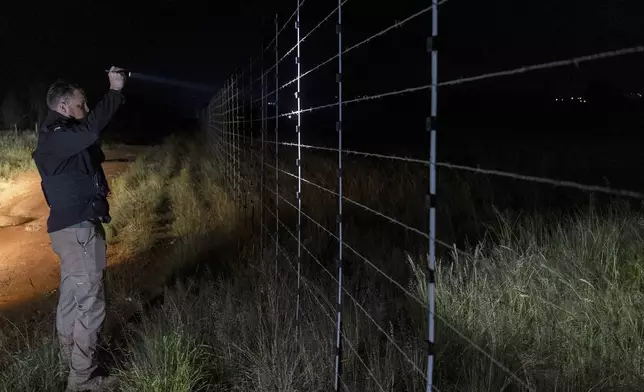
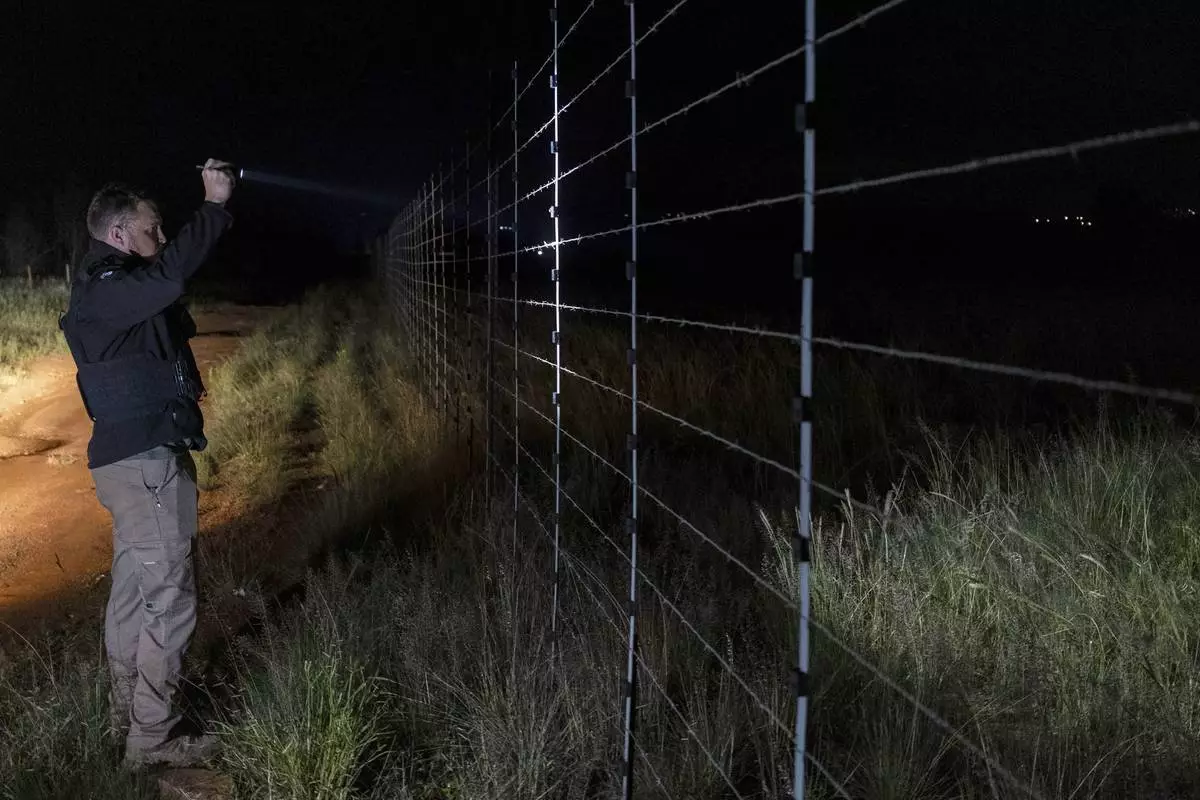
Dewet Ungerer, an AfriForum coordinator, patrols a road during a neighborhood and farm security watch operation in Bashewa area, near Pretoria, South Africa, March 27, 2025. (AP Photo/Alet Pretorius)
Dewet Ungerer, an AfriForum coordinator, patrols a road during a neighborhood and farm security watch operation in Bashewa area, near Pretoria, South Africa, March 27, 2025. (AP Photo/Alet Pretorius)

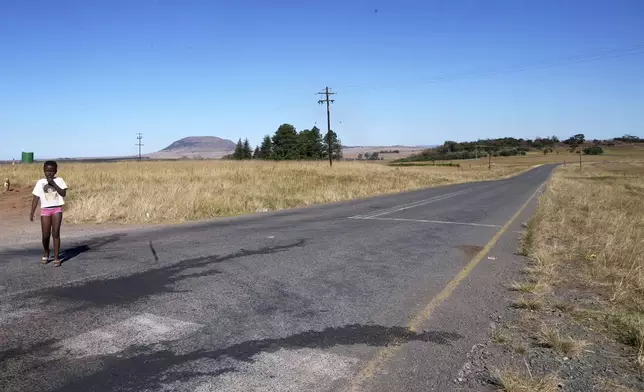
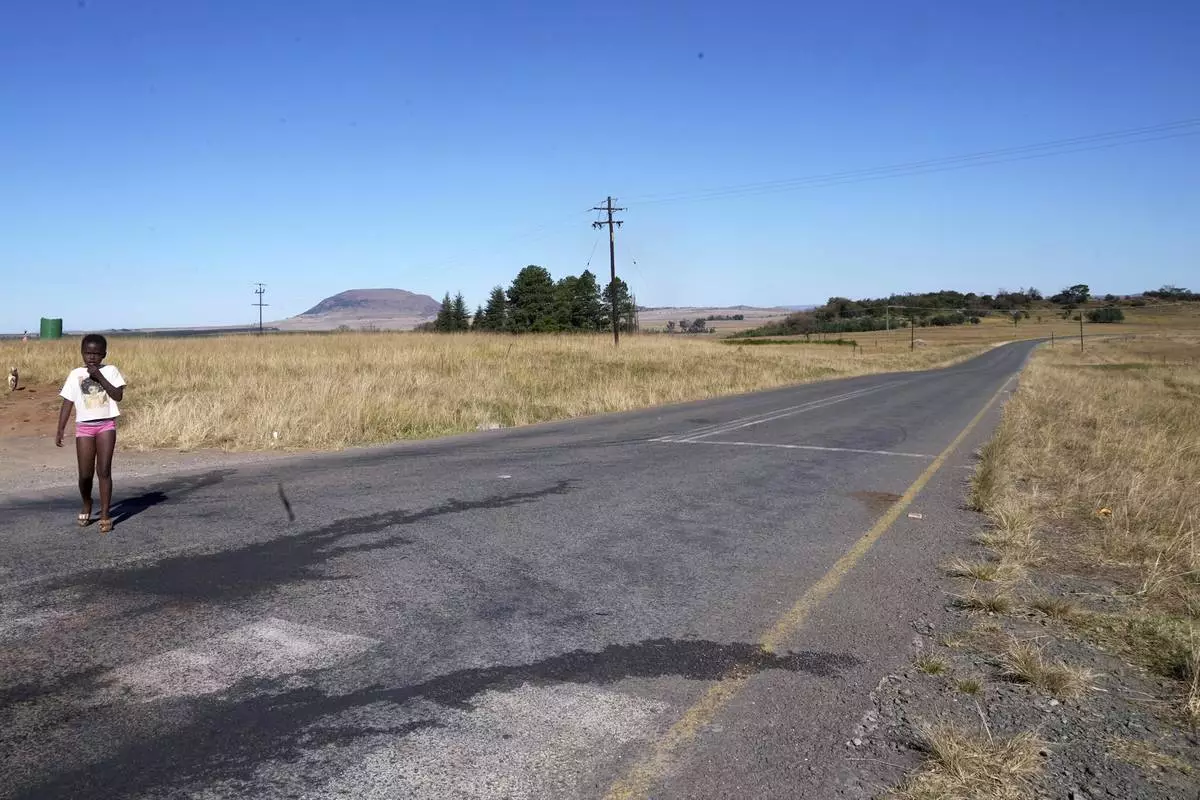
A young girl walks in Normandien, a rural area in KwaZulu-Natal province, South Africa, May 23, 2025. (AP Photo/Alfonso Nqunjana)
A young girl walks in Normandien, a rural area in KwaZulu-Natal province, South Africa, May 23, 2025. (AP Photo/Alfonso Nqunjana)

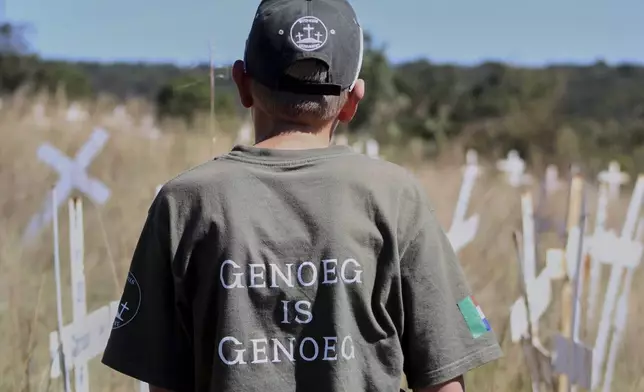
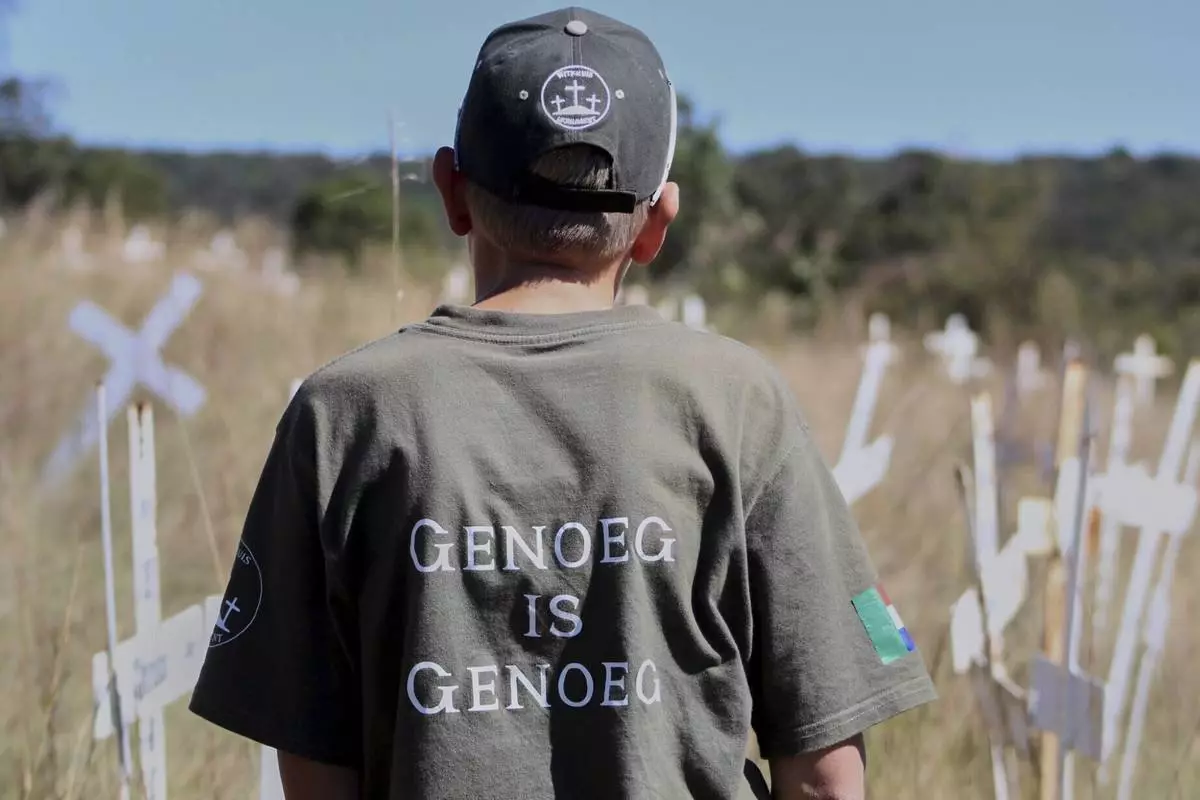
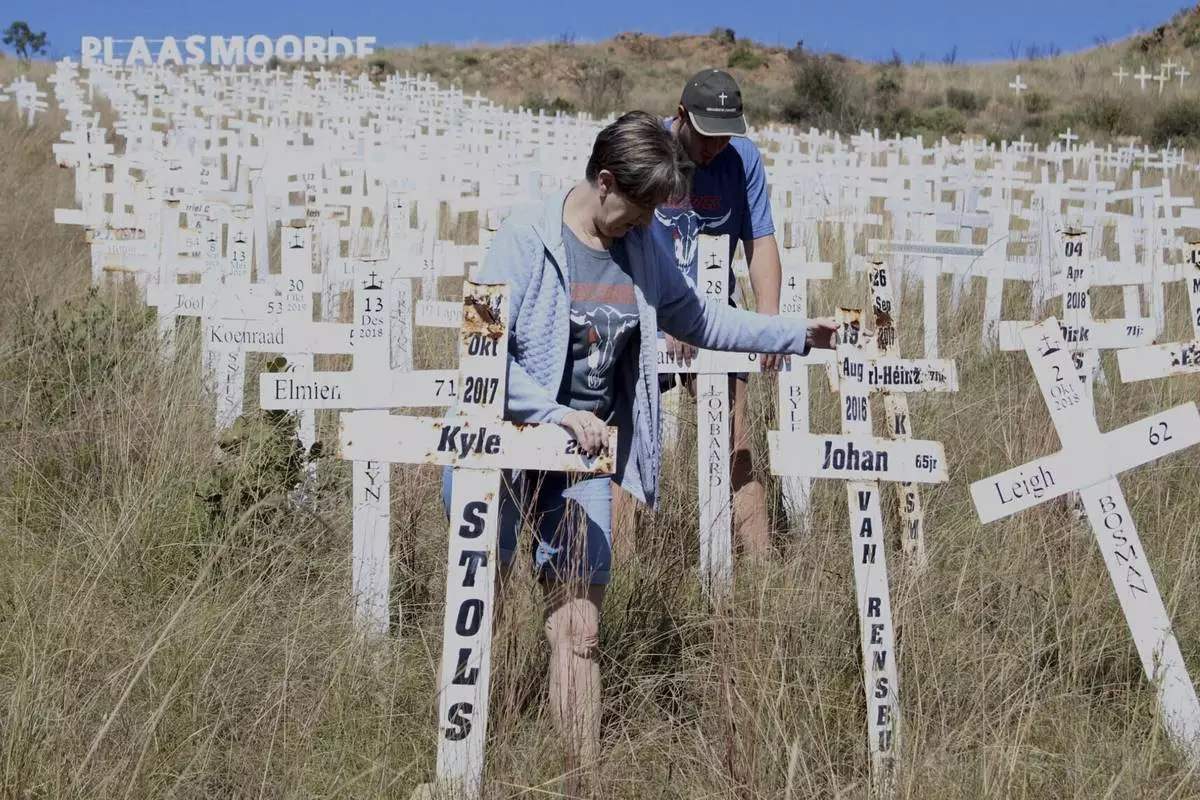
Jano de Lange, wearing a shirt that reads, "Enough is enough," observes white crosses at the Witkruis Monument, near Polokwane, South Africa, May 24, 2025. (AP Photo/Mogomotsi Magome)
Jano de Lange, wearing a shirt that reads, "Enough is enough," observes white crosses at the Witkruis Monument, near Polokwane, South Africa, May 24, 2025. (AP Photo/Mogomotsi Magome)

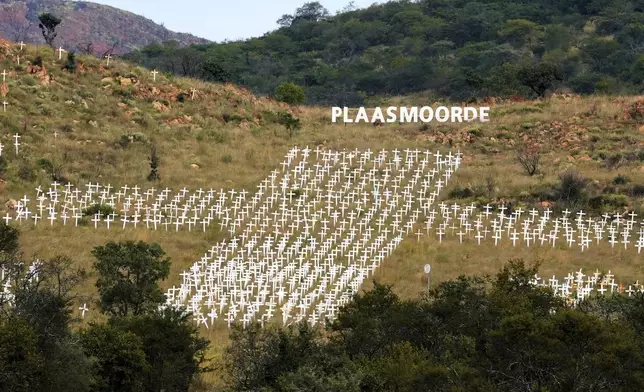
FILE - Crosses, memorializing white farmers who were killed, are seen at Witkruis Monument near Polokwane, South Africa, May 15, 2025. (AP Photo/Themba Hadebe, File)
FILE - Crosses, memorializing white farmers who were killed, are seen at Witkruis Monument near Polokwane, South Africa, May 15, 2025. (AP Photo/Themba Hadebe, File)

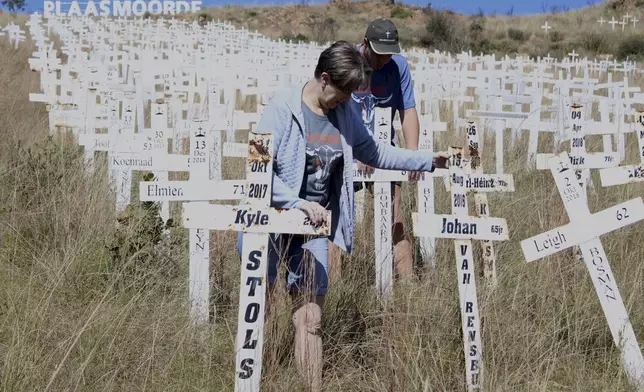
Anita de Lange, left, and her son, Hansie de Lange, tidy up at the Witkruis Monument, near Polokwane, South Africa, May 24, 2025. (AP Photo/Mogomotsi Magome)

Anita de Lange, left, and her son, Hansie de Lange, tidy up at the Witkruis Monument, near Polokwane, South Africa, May 24, 2025. (AP Photo/Mogomotsi Magome)

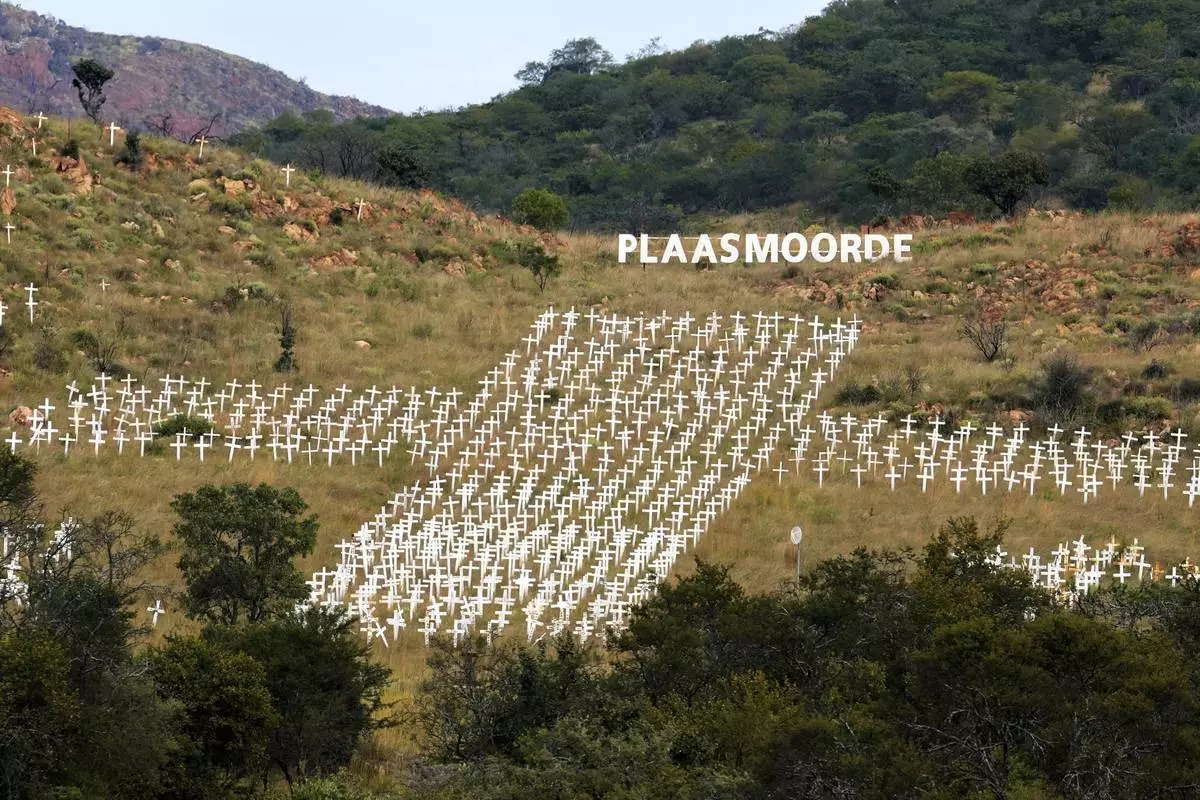
The Witkruis Monument — which means White Cross Monument in the language spoken by South Africa's white Afrikaner minority — is a memorial only to white people who were killed on farms over the last three decades. It's a visceral snapshot seized on by some South Africans to drive a discredited narrative that white farmers in the majority Black country are being targeted in a widespread, race-based system of persecution.

The false narrative has also been spread by conservative commentators in the United States and elsewhere — and amplified by South African-born Elon Musk and U.S. President Donald Trump. Last month, Trump escalated the rhetoric, using the term “genocide” to describe violence against white farmers.

The South African government and experts who have studied farm killings have publicly denounced the misinformation spread by Trump and others. Even the caretaker of Witkruis says the monument — which makes no reference to the hundreds of Black South African farmers and farmworkers who have been killed — does not tell the complete story.

The killings of farmers and farmworkers, regardless of race, are a tiny percentage of the country's high level of crime, and they typically occur during armed robberies, according to available statistics and two studies carried out over the last 25 years.

Yet because wealthier white people own 72% of South Africa's privately owned farms, according to census data, they are disproportionately affected by these often brutal crimes. Black people own just 4% of the country’s privately owned farmland, and the rest is owned by people who are mixed race or of Indian heritage.

Misinformation about farm killings has been fueled by right-wing political groups in South Africa and others outside the country, said Gareth Newman, a crime expert at the Institute for Security Studies think tank in Pretoria.

Some of the fringe South African groups, which hold no official power, boycotted the country’s first democratic elections in 1994, when South Africa's apartheid system of white minority rule officially ended. They have espoused a debunked theory of persecution — in a country where whites make up about 7% of the population — ever since.

“They held on to these beliefs as a way of maintaining social cohesion in their groups, making sure that they can obtain funding and support," Newman said. "And they were getting support from right-wing groups abroad because it fit their narrative."

The Witkruis Monument was started in 2004 but recognizes victims going back to 1994.

Each year, more crosses are planted to memorialize white farmers and their family members who were killed, organizers say. Recently, they've planted around 50 crosses a year.

Kobus de Lange, a local Afrikaner farmer, has taken on the role of caretaker of Witkruis. He gave The Associated Press access to see the memorial, bringing along his wife and children to help tidy up the monument in the country's north, near the town of Mokopane.

De Lange expressed the fear and frustration of a white farming community that feels authorities have not done enough to protect them. One of his sons wore a T-shirt with the slogan “enough is enough” — written in their Afrikaans language — in reference to the killings.

But de Lange acknowledged that the memorial does not capture the full scope of farm killings.

“It’s across the board, there are Black farmers who are also attacked,” de Lange said. He said in some farm attacks, Black farmworkers are tortured by criminals for information on how to break into the main farmhouse.

The Witkruis Monument would be willing to put up crosses to Black farmers and farmworkers who have been killed, but their relatives haven't requested it, he said.

The monument includes memorabilia bearing the flags of conservative Afrikaner movements, symbols that are generally frowned upon because Afrikaners were at the heart of the apartheid government.

From April 2023 through March 2024, there were 49 farm killings recorded by AfriForum, a white Afrikaner lobby group. That's about 0.2% of overall murders tallied by the government over the same period. The group recorded 296 farm robberies in that timeframe, or about 0.7% of all robberies.

AfriForum's numbers don't include killings of Black farmers and workers, and the country’s official crime statistics are not broken down by race.

Black people make up more than 80% of South Africa’s population of 62 million, and most victims of violent crime across South Africa are Black. But there is no public relations campaign to raise awareness about the killing of Black farmers.

Across racial lines, most public outcry about crime in South Africa is over the high rates of rape and murder of women and children, which mostly takes place in cities and townships.

To tamp down misinformation, South African police last month took the unprecedented step of providing a racial breakdown of farm killings during the first three months of the year. Between January and March, there were six murders on farms, down from 12 during the same period last year. One of the victims was white, the rest were Black.

“What Donald Trump is saying about whites being targeted does not exist," said MmaNtuli Buthelezi, who lives on a farm in Normandien, a rural area in KwaZulu-Natal province.

Black farmworkers also feel vulnerable, Buthelezi said. "We don’t even have small firearms. Our weapons are just a spear and a shield, and sticks we get from the woods.”

Nomandien is an area where the farming community planted white crosses to raise awareness about farm killings in 2020. During a White House visit last month by South African President Cyril Ramaphosa, Trump showed a video in which he incorrectly referred to the location as a “burial site” of slain white farmers.

Also, and without evidence, Trump has accused South Africa's Black-led government of “fueling” what he said was racially motivated violence against whites. In February, Trump issued an executive order punishing the country by banning all U.S. aid and assistance to South Africa.

The Trump administration has cited a chant used by a minority Black-led political party in South Africa that has the lyrics “shoot the farmer” as contributing to what it claims is the racially motivated killings of white farmers. Violent crimes against farmers were a problem for years before the apartheid-era chant was revived.

The South African government investigated farm killings in 2003. It interviewed dozens of police detectives and other experts and concluded that robbery was the most common motive for violent crimes, including murders, that occurred on farms. A study by the South African Human Rights Commission in 2015 reached a similar conclusion.

“It is criminal individuals and groups that are targeting them because they are considered vulnerable,” said Newham, who has researched the subject for more than 15 years. “They have things like cars, guns and laptops.”

In some cases, perpetrators are former laborers who return to attack, kill and rob farm owners to settle disputes over money. In others, disgruntled former employees had returned simply for revenge, according to historical records of the National Prosecuting Authority.

Nqunjana reported from Normandien, South Africa.
FILE - President Donald Trump meets with South Africa's President Cyril Ramaphosa in the Oval Office of the White House, in Washington, May 21, 2025. (AP Photo/Evan Vucci, File)
FILE - President Donald Trump meets with South Africa's President Cyril Ramaphosa in the Oval Office of the White House, in Washington, May 21, 2025. (AP Photo/Evan Vucci, File)

Dewet Ungerer, an AfriForum coordinator, patrols a road during a neighborhood and farm security watch operation in Bashewa area, near Pretoria, South Africa, March 27, 2025. (AP Photo/Alet Pretorius)
Dewet Ungerer, an AfriForum coordinator, patrols a road during a neighborhood and farm security watch operation in Bashewa area, near Pretoria, South Africa, March 27, 2025. (AP Photo/Alet Pretorius)

A young girl walks in Normandien, a rural area in KwaZulu-Natal province, South Africa, May 23, 2025. (AP Photo/Alfonso Nqunjana)
A young girl walks in Normandien, a rural area in KwaZulu-Natal province, South Africa, May 23, 2025. (AP Photo/Alfonso Nqunjana)

Jano de Lange, wearing a shirt that reads, "Enough is enough," observes white crosses at the Witkruis Monument, near Polokwane, South Africa, May 24, 2025. (AP Photo/Mogomotsi Magome)
Jano de Lange, wearing a shirt that reads, "Enough is enough," observes white crosses at the Witkruis Monument, near Polokwane, South Africa, May 24, 2025. (AP Photo/Mogomotsi Magome)

FILE - Crosses, memorializing white farmers who were killed, are seen at Witkruis Monument near Polokwane, South Africa, May 15, 2025. (AP Photo/Themba Hadebe, File)
FILE - Crosses, memorializing white farmers who were killed, are seen at Witkruis Monument near Polokwane, South Africa, May 15, 2025. (AP Photo/Themba Hadebe, File)

Anita de Lange, left, and her son, Hansie de Lange, tidy up at the Witkruis Monument, near Polokwane, South Africa, May 24, 2025. (AP Photo/Mogomotsi Magome)
Anita de Lange, left, and her son, Hansie de Lange, tidy up at the Witkruis Monument, near Polokwane, South Africa, May 24, 2025. (AP Photo/Mogomotsi Magome)
WASHINGTON (AP) — President Donald Trump's photo portrait display at the Smithsonian's National Portrait Gallery has had references to his two impeachments removed, the latest apparent change at the collection of museums he has accused of bias as he asserts his influence over how official presentations document U.S. history.

The wall text, which summarized Trump's first presidency and noted his 2024 comeback victory, was part of the museum's “American Presidents” exhibition. The description had been placed alongside a photograph of Trump taken during his first term. Now, a different photo appears without any accompanying text block, though the text was available online. Trump was the only president whose display in the gallery, as seen Sunday, did not include any extended text.

The White House did not say whether it sought any changes. Nor did a Smithsonian statement in response to Associated Press questions. But Trump ordered in August that Smithsonian officials review all exhibits before the nation celebrates the 250th anniversary of the Declaration of Independence on July 4. The Republican administration said the effort would “ensure alignment with the president’s directive to celebrate American exceptionalism, remove divisive or partisan narratives, and restore confidence in our shared cultural institutions.”

Trump's original “portrait label," as the Smithsonian calls it, notes Trump's Supreme Court nominations and his administration's development of COVID-19 vaccines. That section concludes: “Impeached twice, on charges of abuse of power and incitement of insurrection after supporters attacked the U.S. Capitol on January 6, 2021, he was acquitted by the Senate in both trials.”

Then the text continues: “After losing to Joe Biden in 2020, Trump mounted a historic comeback in the 2024 election. He is the only president aside from Grover Cleveland (1837– 1908) to have won a nonconsecutive second term.”

Asked about the display, White House spokesman Davis Ingle celebrated the new photograph, which shows Trump, brow furrowed, leaning over his Oval Office desk. Ingle said it ensures Trump's “unmatched aura ... will be felt throughout the halls of the National Portrait Gallery.”

The portrait was taken by White House photographer Daniel Torok, who is credited in the display that includes medallions noting Trump is the 45th and 47th president. Similar numerical medallions appear alongside other presidents' painted portraits that also include the more extended biographical summaries such as what had been part of Trump's display.

Sitting presidents are represented by photographs until their official paintings are commissioned and completed.

Ingle did not answer questions about whether Trump or a White House aide, on his behalf, asked for anything related to the portrait label.

The gallery said in a statement that it had previously rotated two photographs of Trump from its collection before putting up Torok's work.

“The museum is beginning its planned update of the America’s Presidents gallery which will undergo a larger refresh this Spring,” the gallery statement said. “For some new exhibitions and displays, the museum has been exploring quotes or tombstone labels, which provide only general information, such as the artist’s name.”

For now, references to Presidents Andrew Johnson and Bill Clinton being impeached in 1868 and 1998, respectively, remain as part of their portrait labels, as does President Richard Nixon's 1974 resignation as a result of the Watergate scandal.

And, the gallery statement noted, “The history of Presidential impeachments continues to be represented in our museums, including the National Museum of American History.”

Trump has made clear his intentions to shape how the federal government documents U.S. history and culture. He has offered an especially harsh assessment of how the Smithsonian and other museums have featured chattel slavery as a seminal variable in the nation's development but also taken steps to reshape how he and his contemporary rivals are depicted.

In the months before his order for a Smithsonian review, he fired the head archivist of the National Archives and said he was firing the National Portrait Gallery's director, Kim Sajet, as part of his overhaul. Sajet maintained the backing of the Smithsonian's governing board, but she ultimately resigned.

At the White House, Trump has designed a notably partisan and subjective “Presidential Walk of Fame” featuring gilded photographs of himself and his predecessors — with the exception of Biden, who is represented by an autopen — along with plaques describing their presidencies.

The White House said at the time that Trump himself was a primary author of the plaques. Notably, Trump's two plaques praise the 45th and 47th president as a historically successful figure while those under Biden's autopen stand-in describe the 46th executive as “by far, the worst President in American History” who “brought our Nation to the brink of destruction.”

Barrow reported from Atlanta.

A reflection of the portrait of former President Barack Obama is seen in a photograph of President Donald Trump on display at the Smithsonian's National Portrait Gallery's "American Presidents" exhibit on Sunday, Jan. 11, 2026 in Washington. (AP Photo/Rod Lamkey, Jr.)

A reflection of the portrait of former President Barack Obama is seen in a photograph of President Donald Trump on display at the Smithsonian's National Portrait Gallery's "American Presidents" exhibit on Sunday, Jan. 11, 2026 in Washington. (AP Photo/Rod Lamkey, Jr.)

A reflection of the portrait of former President Barack Obama is seen in a photograph of President Donald Trump on display at the Smithsonian's National Portrait Gallery's "American Presidents" exhibit on Sunday, Jan. 11, 2026 in Washington. (AP Photo/Rod Lamkey, Jr.)

A reflection of the portrait of former President Barack Obama is seen in a photograph of President Donald Trump on display at the Smithsonian's National Portrait Gallery's "American Presidents" exhibit on Sunday, Jan. 11, 2026 in Washington. (AP Photo/Rod Lamkey, Jr.)

A visitor stops to look at a photograph of President Donald Trump and a short plaque next to it are on display at the Smithsonian's National Portrait Gallery's "American Presidents" exhibit on Sunday, Jan. 11, 2026 in Washington. (AP Photo/Rod Lamkey, Jr.)

A visitor stops to look at a photograph of President Donald Trump and a short plaque next to it are on display at the Smithsonian's National Portrait Gallery's "American Presidents" exhibit on Sunday, Jan. 11, 2026 in Washington. (AP Photo/Rod Lamkey, Jr.)

People react to a photograph of President Donald Trump on display at the Smithsonian's National Portrait Gallery's "American Presidents" exhibit on Sunday, Jan. 11, 2026 in Washington. (AP Photo/Rod Lamkey, Jr.)

People react to a photograph of President Donald Trump on display at the Smithsonian's National Portrait Gallery's "American Presidents" exhibit on Sunday, Jan. 11, 2026 in Washington. (AP Photo/Rod Lamkey, Jr.)

Visitors to the National Portrait Gallery walk past the portrait of President Donald Trump, Sunday, Jan. 11, 2026, in Washington. (AP Photo/Rod Lamkey, Jr.)

Visitors to the National Portrait Gallery walk past the portrait of President Donald Trump, Sunday, Jan. 11, 2026, in Washington. (AP Photo/Rod Lamkey, Jr.)

Visitors stop to look at a photograph of President Donald Trump and a short plaque next to it are on display at the Smithsonian's National Portrait Gallery's "American Presidents" exhibit on Sunday, Jan. 11, 2026 in Washington. (AP Photo/Rod Lamkey, Jr.)

Visitors stop to look at a photograph of President Donald Trump and a short plaque next to it are on display at the Smithsonian's National Portrait Gallery's "American Presidents" exhibit on Sunday, Jan. 11, 2026 in Washington. (AP Photo/Rod Lamkey, Jr.)

A photograph of President Donald Trump and a short plaque next to it are on display at the Smithsonian's National Portrait Gallery's "American Presidents" exhibit on Sunday, Jan. 11, 2026 in Washington. (AP Photo/Anna Johnson)

A photograph of President Donald Trump and a short plaque next to it are on display at the Smithsonian's National Portrait Gallery's "American Presidents" exhibit on Sunday, Jan. 11, 2026 in Washington. (AP Photo/Anna Johnson)

President Donald Trump speaks during a meeting with oil executives in the East Room of the White House, Friday, Jan. 9, 2026, in Washington. (AP Photo/Evan Vucci)

President Donald Trump speaks during a meeting with oil executives in the East Room of the White House, Friday, Jan. 9, 2026, in Washington. (AP Photo/Evan Vucci)

Recommended Articles