Skip to Content Facebook Feature Image

North Carolina redistricting trial begins, with racial gerrymandering allegations the focus

News

North Carolina redistricting trial begins, with racial gerrymandering allegations the focus
News

News

North Carolina redistricting trial begins, with racial gerrymandering allegations the focus

2025-06-17 01:54 Last Updated At:02:00

WINSTON-SALEM, N.C. (AP) — North Carolina congressional and legislative districts drawn by Republicans that helped them retain majorities in Raleigh and Washington are in court, as federal lawsuits accuse mapmakers of illegally eroding Black voting power in the process.

A three-judge panel convened Monday in Winston-Salem for a trial over allegations that GOP legislative leaders violated federal law and the U.S. Constitution when they enacted new electoral maps in the ninth-largest state in October 2023. Republican leaders counter that lawfully partisan — and not racial — considerations helped inform their decision-making.

The lines were used in the 2024 elections, after which Republicans kept General Assembly majorities and flipped three U.S. House seats held by Democratic incumbents who didn’t seek reelection because they decided the recast district made winning impossible. Those seat flips, which turned a 7-7 delegation into one with a 10-4 Republican advantage, helped the GOP keep narrow control of the House, which has helped advance President Donald Trump's agenda.

Favorable rulings for the plaintiffs could force Republicans to redraw maps for the 2026 elections, making it harder to retain their partisan advantage. Otherwise, the districts could be used through the 2030 elections.

The trial involves two lawsuits filed in late 2023.

In one lawsuit, the North Carolina NAACP, Common Cause and several Black residents originally sued over redrawn state House and Senate maps and U.S. House districts. The other lawsuit filed by nearly 20 Black and Latino voters focused on the new congressional districts, four of which they argue are illegal racial gerrymanders.

Pretrial rulings this spring and amended litigation dismissed challenges to the state House map and narrowed state Senate arguments to a handful of districts.

Still, both lawsuits claim that lines are so skewed for GOP candidates that many Black voters cannot elect their preferred candidates, violating the Voting Rights Act. They allege the mapmakers at times submerged or spread out Black voting blocs, which historically have favored Democrats, into surrounding districts with white majorities — benefiting Republicans.

They point to the Piedmont Triad region where the cities of Greensboro, High Point and Winston-Salem are located. They said Republicans split the region’s concentrated Black voting population within multiple U.S. House districts. Then-Rep. Kathy Manning, a Greensboro Democrat, decided not to run again because her district shifted to the right.

“This was an effort to spread those voters across districts,” said Jonathan Rodden, a Stanford University redistricting expert who testified Monday for some plaintiffs about congressional boundaries. Rodden said the results were less-compact districts that make it harder for voters within them to act collectively toward a common policy goal.

The plaintiffs also allege GOP lawmakers unlawfully packed Black voting-age residents into a Charlotte-area congressional district.

The trial's lawyers agreed not to give opening statements Monday. But in a pretrial brief, lawyers for Republican leaders said the lawmakers used mapmaking rules that prohibited using data identifying the race of voters, in keeping with rulings on previous North Carolina redistricting maps in which judges chided them for emphasizing race.

Instead, Republicans were able to lawfully use partisan data — like statewide election results — in drawing the new maps, the lawyers said. They cite a 2019 U.S. Supreme Court decision and an April 2023 state Supreme Court decision that neutered legal claims of illegal partisan gerrymandering.

“The General Assembly has striven to end racial politics through race-blind redistricting,” wrote Katherine McKnight and Phil Strach, two lawyers for the GOP legislators, adding that a Voting Rights Act violation “would only return the State to the race-based redistricting it has sought to end.”

Rodden testified Monday the “racial sorting” of voters within challenged congressional districts that he examined can’t be attributed fully to politics alone. On cross-examination, Rodden acknowledged that he didn't know all of the partisan factors that GOP lawmakers considered in 2023.

The three judges were all nominated to the bench by Republican presidents: 4th U.S. Circuit Court of Appeals Judge Allison Rushing (Donald Trump) and District Judges Thomas Schroeder (George W. Bush) and Richard Myers (Trump).

The panel has set aside several days for a trial that won't end until July 9. Other likely witnesses include individual plaintiffs, state legislators, historians and more mapping experts. No immediate decision is expected — the legal sides have until early August to file additional briefs.

The court's ruling can be appealed. With candidate filing for the 2026 election starting Dec. 1, any required remapping would have to be completed by late fall to avoid election disruptions.

North Carolina has a long history of redistricting litigation in federal courts.

The U.S. Supreme Court ruled in landmark cases in the 1980s, 1990s and 2000s involving racial bias and the extent to which racial considerations could be used in forming districts that favored the election of Black candidates. The court's 2019 decision on partisan gerrymandering stemmed from a North Carolina case.

The current maps were drawn after the state Supreme Court, with a Republican seat majority, essentially struck down rulings the court made in 2022 when it had a Democratic majority.

Two other lawsuits challenging the 2023 district boundaries are pending.

Statewide races in North Carolina are close, and Democrats have held the governor’s mansion for most of the past 30 years. But Republicans have controlled the General Assembly — and thus redistricting — since 2011. Redistricting maps can’t be blocked by a governor’s veto.
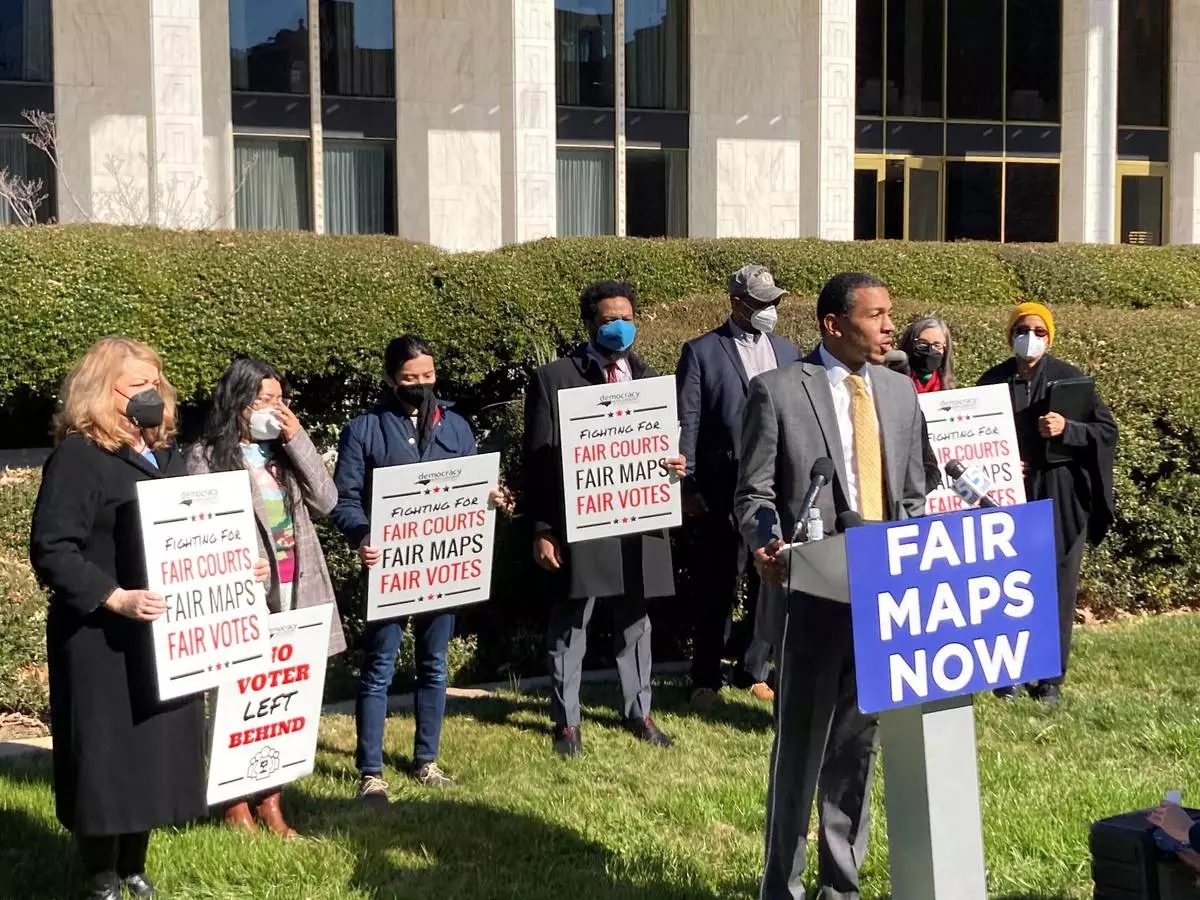
FILE - Reggie Weaver, at podium, speaks outside the Legislative Building in Raleigh, N.C, on Tuesday, Feb. 15, 2022, about a recent partisan gerrymandering ruling by the North Carolina Supreme Court.(AP Photo/Gary D. Robertson, File)
FILE - Reggie Weaver, at podium, speaks outside the Legislative Building in Raleigh, N.C, on Tuesday, Feb. 15, 2022, about a recent partisan gerrymandering ruling by the North Carolina Supreme Court.(AP Photo/Gary D. Robertson, File)

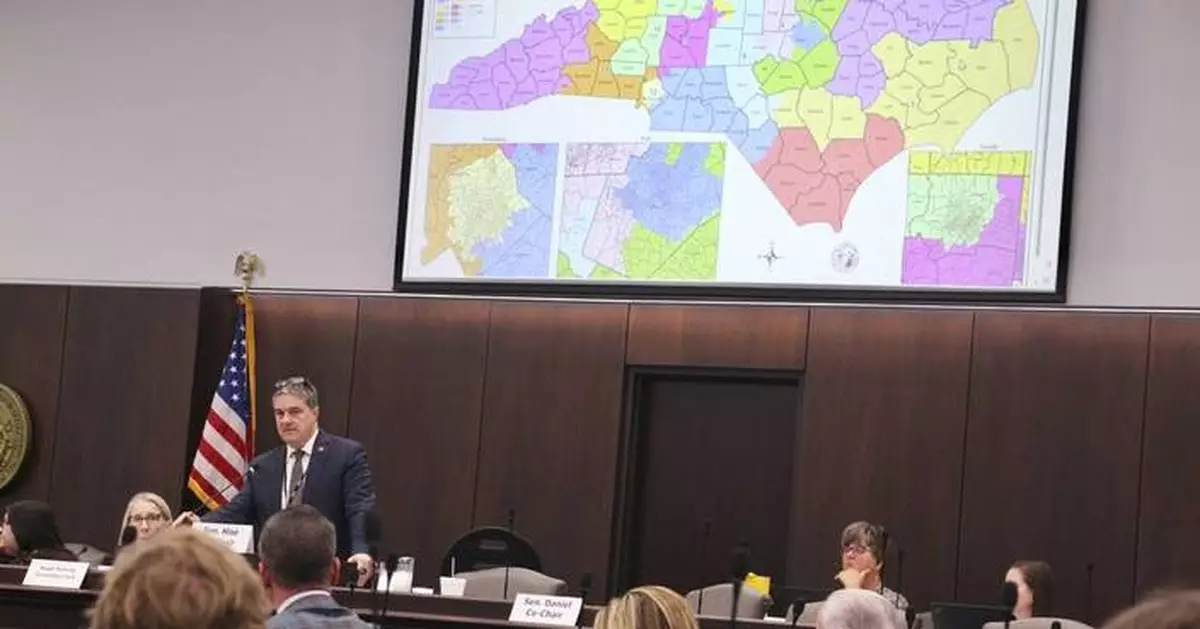
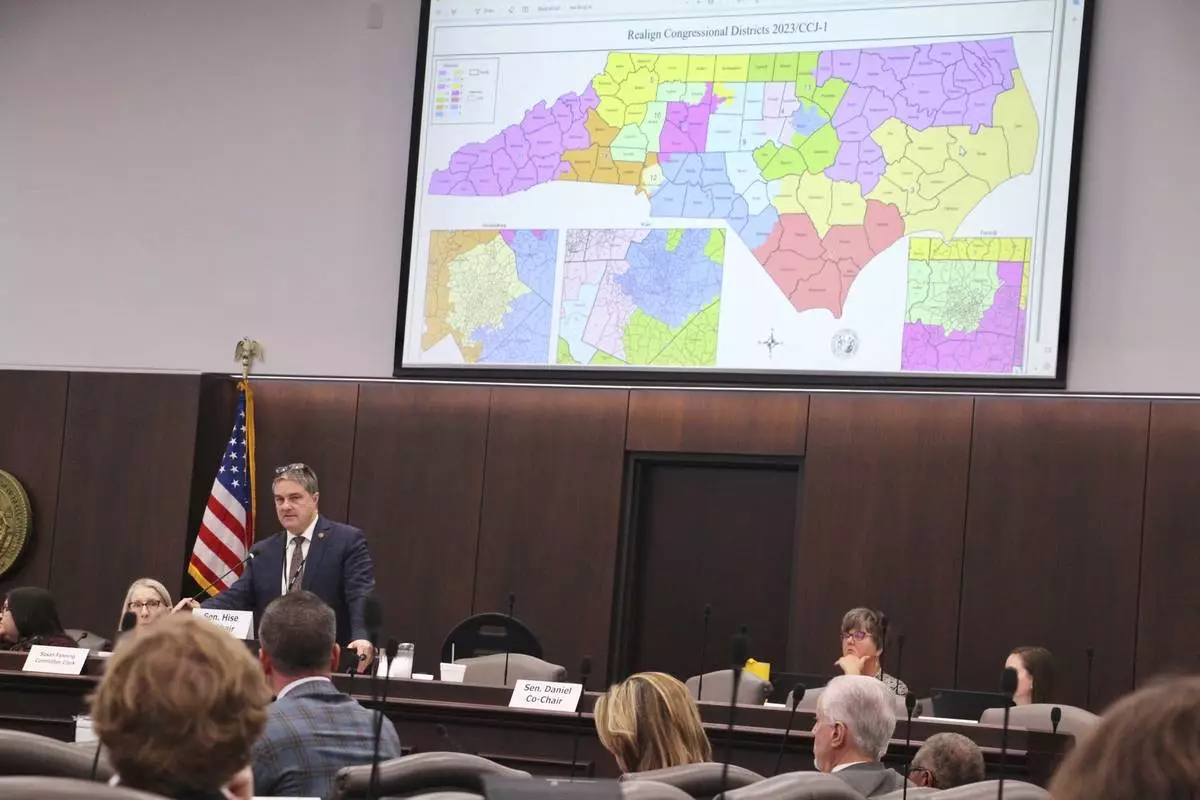
FILE - The North Carolina Senate reviews copies of a map proposal for the state's congressional districts starting in 2024 during a committee hearing at the Legislative Office Building, Oct. 19, 2023, in Raleigh, N.C. (AP Photo/Hannah Schoenbaum, File)

FILE - The North Carolina Senate reviews copies of a map proposal for the state's congressional districts starting in 2024 during a committee hearing at the Legislative Office Building, Oct. 19, 2023, in Raleigh, N.C. (AP Photo/Hannah Schoenbaum, File)
RHO, Italy (AP) — No ice is colder and harder than speedskating ice. The precision it takes has meant that Olympic speedskaters have never competed for gold on a temporary indoor rink – until the 2026 Milan Cortina Winter Games.

In the pursuit of maximum glide and minimum friction, Olympic officials brought on ice master Mark Messer, a veteran of six previous Olympic speedskating tracks and the ice technician in charge of the Olympic Oval in Calgary, Canada — one of the fastest tracks in the world with over 300 records.

Messer has been putting that experience to work one thin layer of ice at a time since the end of October at the new Speed Skating Stadium, built inside adjacent trade fair halls in the city of Rho just north of Milan.

“It’s one of the biggest challenges I’ve had in icemaking,’’ Messer said during an interview less than two weeks into the process.

If Goldilocks were a speedskater, hockey ice would be medium hard, for fast puck movement and sharp turns. Figure skating ice would be softer, allowing push off for jumps and so the ice doesn’t shatter on landing. Curling ice is the softest and warmest of all, for controlled sliding.

For speedskating ice to be just right, it must be hard, cold and clean. And very, very smooth.

“The blades are so sharp, that if there is some dirt, the blade will lose the edge,’’ Messer said, and the skater will lose speed.

Speedskater Enrico Fabris, who won two Olympic golds in Turin in 2006, has traded in his skates to be deputy sports manager at the speedskating venue in Rho. For him, perfect ice means the conditions are the same for all skaters — and then if it's fast ice, so much the better.

"It's more of a pleasure to skate on this ice,'' he said.

Messer’s first Olympics were in Calgary in 1988 — the first time speedskating was held indoors. “That gave us some advantages because we didn’t have to worry about the weather, wind blowing or rain,’’ he said. Now he is upping the challenge by becoming the first ice master to build a temporary rink for the Olympics.

Before Messer arrived in Italy, workers spent weeks setting up insulation to level the floor and then a network of pipes and rubber tubes that carry glycol — an antifreeze — that is brought down to minus 7 or minus 8 degrees Celsius (17.6 to 19.4 degrees Fahrenheit) to make the ice.

Water is run through a purification system — but it can’t be too pure, or the ice that forms will be too brittle. Just the right amount of impurities “holds the ice together,’’ Messer said.

The first layers of water are applied slowly, with a spray nozzle; after the ice reaches a few centimeters it is painted white — a full day’s work — and the stripes are added to make lanes.

“The first one takes about 45 minutes. And then as soon as it freezes, we go back and do it again, and again and again. So we do it hundreds of times,’’ Messer said.

As the ice gets thicker, and is more stable, workers apply subsequent layers of water with hoses. Messer attaches his hose to hockey sticks for easier spreading.

What must absolutely be avoided is dirt, dust or frost — all of which can cause friction for the skaters, slowing them down. The goal is that when the skaters push “they can go as far as possible with the least amount of effort,’’ Messer said.

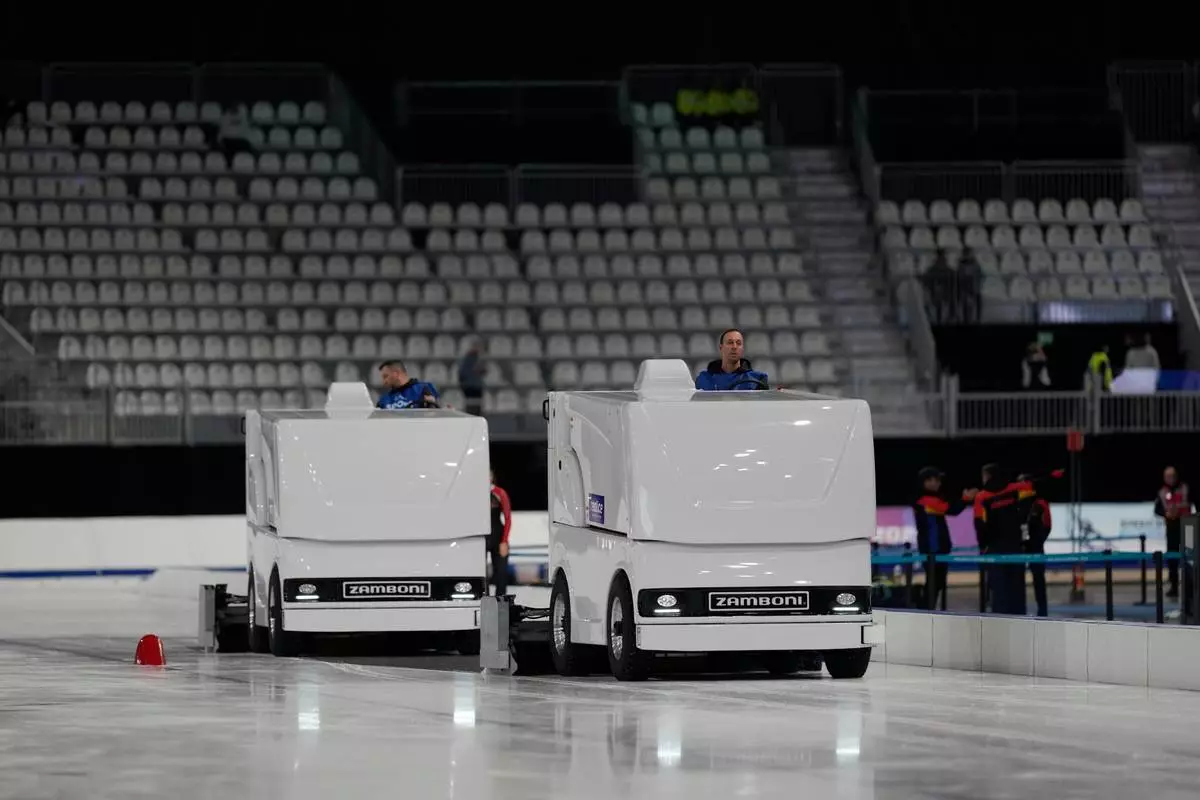
The Zamboni ice resurfacing machine plays a key role in keeping the track clean, cutting off a layer and spraying water to make a new surface.

One challenge is gauging how quickly the water from the resurfacing machine freezes in the temporary rink.

Another is getting the ice to the right thickness so that the Zamboni, weighing in at six tons, doesn’t shift the insulation, rubber tubing or ice itself.

“When you drive that out, if there’s anything moving it will move. We don’t want that,’’ Messer said.

The rink got its first big test on Nov. 29-30 during a Junior World Cup event. In a permanent rink, test events are usually held a year before the Olympics, leaving more time for adjustments. “We have a very small window to learn,’’ Messer acknowledged.

Dutch speedskater Kayo Vos, who won the men’s neo-senior 1,000 meters, said the ice was a little soft — but Messer didn’t seem too concerned.

“We went very modest to start, now we can start to change the temperatures and try to make it faster and still maintain it as a safe ice,’’ he said.

Fine-tuning the air temperature and humidity and ice temperature must be done methodically — taking into account that there will be 6,000 spectators in the venue for each event. The next real test will be on Jan. 31, when the Olympians take to the ice for their first training session.

“Eighty percent of the work is done but the hardest part is the last 20 percent, where we have to try to find the values and the way of running the equipment so all the skaters get the same conditions and all the skaters get the best conditions,’’ Messer said.

AP Winter Olympics: https://apnews.com/hub/milan-cortina-2026-winter-olympics

Serpentines are set on the ice of the stadium where speed skating discipline of the Milan Cortina 2026 Winter Olympics will take place, in Rho, outskirt of Milan, Tuesday, Nov. 11, 2025. (AP Photo/Luca Bruno)

Serpentines are set on the ice of the stadium where speed skating discipline of the Milan Cortina 2026 Winter Olympics will take place, in Rho, outskirt of Milan, Tuesday, Nov. 11, 2025. (AP Photo/Luca Bruno)

Ice Master Mark Messer poses in the stadium where speed skating discipline of the Milan Cortina 2026 Winter Olympics will take place, in Rho, outskirt of Milan, Tuesday, Nov. 11, 2025. (AP Photo/Luca Bruno)

Ice Master Mark Messer poses in the stadium where speed skating discipline of the Milan Cortina 2026 Winter Olympics will take place, in Rho, outskirt of Milan, Tuesday, Nov. 11, 2025. (AP Photo/Luca Bruno)

Workers clean the ice surface during a peed skating Junior World Cup and Olympic test event, in Rho, near Milan, Italy, Saturday, Nov. 29, 2025. (AP Photo/Luca Bruno)

Workers clean the ice surface during a peed skating Junior World Cup and Olympic test event, in Rho, near Milan, Italy, Saturday, Nov. 29, 2025. (AP Photo/Luca Bruno)

Ice Master Mark Messer poses in the stadium where speed skating discipline of the Milan Cortina 2026 Winter Olympics will take place, in Rho, outskirt of Milan, Tuesday, Nov. 11, 2025. (AP Photo/Luca Bruno)

Ice Master Mark Messer poses in the stadium where speed skating discipline of the Milan Cortina 2026 Winter Olympics will take place, in Rho, outskirt of Milan, Tuesday, Nov. 11, 2025. (AP Photo/Luca Bruno)

Ice Master Mark Messer poses in the stadium where speed skating discipline of the Milan Cortina 2026 Winter Olympics will take place, in Rho, outskirt of Milan, Tuesday, Nov. 11, 2025. (AP Photo/Luca Bruno)

Ice Master Mark Messer poses in the stadium where speed skating discipline of the Milan Cortina 2026 Winter Olympics will take place, in Rho, outskirt of Milan, Tuesday, Nov. 11, 2025. (AP Photo/Luca Bruno)

Recommended Articles