PHNOM PENH, Cambodia, June 16, 2025 /PRNewswire/ -- Cambodia's financial sector is undergoing a quiet yet powerful transformation—one that centers on sustainability, responsibility, and community empowerment. From commercial banks to microfinance institutions (MFIs), Cambodian financial service providers are increasingly embracing ethical lending practices, environmental, social, and governance (ESG)-aligned financing, and inclusive economic development that benefits both people and the planet.
Cambodia's financial institutions are embracing Environmental, Social, and Governance (ESG) principles to promote sustainable and inclusive finance

Cambodia's financial institutions are embracing Environmental, Social, and Governance (ESG) principles to promote sustainable and inclusive finance
Cambodia's financial institutions are embracing Environmental, Social, and Governance (ESG) principles to promote sustainable and inclusive finance
The momentum began in 2019 when the Association of Banks in Cambodia (ABC), with support from the National Bank of Cambodia (NBC) and the Ministry of Environment, introduced the Cambodian Sustainable Finance Principles (CSFP). These voluntary guidelines help financial institutions incorporate environmental, social, and governance considerations into their lending practices. The ESG factors are no longer mere buzzwords. A key milestone was the creation of the Sustainable Finance Principles, which encouraged banks to consider environmental and social factors in business decisions, including lending. The number of adopters increased from 48 to 74 members in 2024, including 57 commercial banks, 8 specialized banks, 6 representative offices, the Cambodia Microfinance Association (CMA), the Cambodian Association of Finance and Technology (CAFT), one Microfinance Deposit-Taking Institution (MDI) and a Credit Guarantee Corporation of Cambodia (CGCC). They are committing to more rigorous risk assessments concerning climate, governance, and social impacts.
"As responsible providers, we are committed to ensuring financial access while contributing positively to the well-being of the population, always upholding the principles of transparency, fairness, and social responsibility," said ABC Chairman Mr. Rath Sophoan.
Commercial banks have demonstrated their leadership in various areas of responsible finance. ACLEDA Bank has incorporated ESG risk factors into its credit assessments and publishes annual sustainability reports focused on financial inclusion, environmental protection, and customer protection. Canadia Bank, has prioritized digital transformation while promoting community-oriented banking practices. Maybank Cambodia, through its Cashville Kidz program, continues to enhance financial literacy among young people in partnership with local schools and NGOs, while advancing the sustainability agenda. Meanwhile, ABA Bank has launched targeted campaigns to improve financial education in rural communities, helping Cambodians build long-term financial security.
In parallel, MFIs under the CMA have shown equal dedication to advancing responsible finance. AMK Microfinance, for instance, serves approximately 300,000 loan clients—96% of whom are in rural areas and 79% of whom are women. LOLC Cambodia, one of the country's largest MFIs, recently earned the Stakeholder-Verified Orange Seal award for its commitment to gender equality and environmental sustainability, and is preparing to issue a USD 50 million sustainability bond to fund green and social initiatives. Amret Microfinance Institutions stands at the forefront of Cambodia's microfinance sector, contributing to the development of the Cambodian economy through supporting micro and small farmers and businesses, especially in rural areas, with tailored and responsible financial services.
To improve access to capital and support small businesses, CMA recently entered a three-year partnership with CGCC This agreement enables MFIs to extend more credit to Micro, Small and Medium Enterprises (MSMEs), particularly women entrepreneurs and those in rural areas, by offering credit guarantees and financial literacy training. Complementing this, commercial banks such as Prince Bank, which was awarded "Best Bank for SMEs in Cambodia 2024" by Euromoney, and Cambodia Post Bank, have developed SME-specific lending products and business guidance tools tailored to Cambodia's growing entrepreneurial base.
At the national level, under high level Multi-Stakeholder Consultation co-chaired by NBC and United Nations on Microfinance in Cambodia, has identified a number of key issues along with the proposed solutions & initiatives to uplift client protection and to strengthen responsible lending practices in Cambodia's banking and financial services sector. Significant progress has been made in enhancing responsible lending standards. This includes enforcing the implementation of the Code of Conduct and adopting the consumer protection harmonization assessment tools, with a select number of banking and financial institutions (BFIs) to undergo the assessment by the 3rd party assessor.
At the community level, both banks and MFIs have launched major financial education campaigns. Since 2020, ABC and CMA members have been actively driving monthly digital financial literacy campaigns—supercharging their impact with a dynamic weekly rollout starting in 2023. ABC and CMA's "Safe Finance" program, supported by NBC and various financial institutions, is distributing educational materials across communes and villages to raise awareness of borrower rights and financial safety.
"Digital payments and inclusive finance are transforming lives in Cambodia, especially in underserved areas. By promoting access and accountability, we are building a more inclusive economy that empowers individuals and protects communities," said Ms. Dith Nita, Chairwoman of the Cambodia Microfinance Association.
The National Financial Inclusion Strategy 2019–2025 provides the broader framework for this transformation, aiming to integrate more Cambodians—especially women, farmers, and rural families—into the formal financial system. Complementing this is the Sustainable Finance Roadmap, which helps financial institutions align with national climate goals and global development targets.
Additionally, the Financial Consumer Center—co-led by ABC and CMA—now provides a dedicated avenue for resolving borrower disputes and improving trust in the financial system. This mechanism supports the enforcement of Cambodia's Lending Guidelines and the sector-wide Code of Conduct, which prohibit unethical lending practices and promote client welfare.
Together, Cambodia's banks and MFIs are not only financing growth but doing so responsibly. Whether it's investing in ESG-aligned infrastructure, providing affordable credit to rural entrepreneurs, or ensuring every borrower understands their rights, the sector is proving that responsible finance is not just possible in emerging economies—it's essential.
As global investors increasingly prioritize transparency, sustainability, and long-term impact, Cambodia's financial sector is steadily emerging as a model for Southeast Asia.
For further details please contact:
ABC Secretariat
Mr. Sok Chan, Head of Financial Inclusion and Public Relations
Email: abc_fi@abc.org.kh
Phone: +855 92 683 330
CMA Secretariat
Mr. Tongngy Kaing, Head of Communications
Email: hcd@cma-network.org
Phone: +855 95 262 111
About ABC
The Association of Banks in Cambodia was formed in 1994 and is recognized by the Royal Government as the official organization to represent the country's private banking sector. Our purpose is to promote constructive dialogue amongst member banks, and to serve as an industry voice to the public and the Government.
About CMA
The Cambodia Microfinance Association is an NGO and professional association that aims to ensure the prosperity and sustainability of the microfinance sector in Cambodia. CMA plays a vital role in creating local and international networks as well as seeking equity and loan funds, new technologies and overseeing conflict resolution between microfinance operators. All of these activities have led each member microfinance institution to become stronger and more successful and thereby attract support from the international market to enable industry expansion.
** The press release content is from PR Newswire. Bastille Post is not involved in its creation. **

Cambodia's Financial Institutions Lead the Way in Responsible and Inclusive Finance
|
The fund will invest in startups in SMU's flagship Urban SustaInnovator accelerator programme, which began incubating them from February 2026.
SINGAPORE, May 22, 2026 /PRNewswire/ -- Singapore Management University (SMU) today announced the launch of the Urban SustaInnovator (USI) Fund, a US$10 million (S$12.69 million) investment programme designed to support startups emerging from USI, SMU's flagship accelerator for urban solutions and sustainability (USS) ventures for expansion in Singapore and across Asia. The fund will invest in USI's globally sourced and competition-vetted pipeline of early stage deep-tech startups from the Lee Kuan Yew Global Business Plan Competition (LKYGBPC).
USI was launched at the 12th edition of LKYGBPC held in September 2025 at SMU by Minister for National Development, Mr Chee Hong Tat, and was designed to incubate high-potential startups in the USS sector. The accelerator began incubating its first batch of startups in February 2026.
The USI Fund, believed to be South-east Asia's first university-anchored co-investment fund dedicated to urban solutions and sustainability, is integrated with the purpose-built accelerator that supports early-stage ventures addressing critical urban challenges – including decarbonisation, energy transition, the built environment, mobility, and circularity – as they move from validation to real-world deployment across Asian cities.
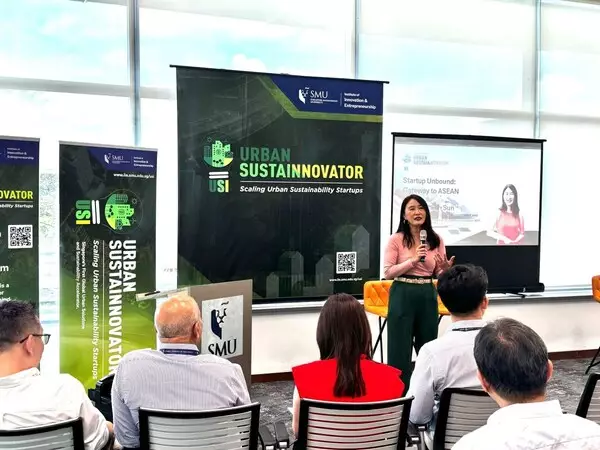
Professor Sun Sun Lim, SMU's Vice President (Partnerships & Engagement), said, "Urban sustainability innovation often fails not for lack of ideas, but for lack of capital that understands early–stage risk and long deployment cycles. The USI Fund addresses this pain point by co–investing with leading venture capital partners and backing deep-tech startups from SMU's robust global pipeline, providing targeted early–stage capital to help founders scale proven solutions into Asian urban markets."
Professor Lim, who is also the Chair of the USI Programme Management Committee, said that the Fund will co–invest alongside established venture capital partners under prevailing market terms, providing catalytic capital while benefiting from the commercial rigour and sector expertise of lead investors. The Fund is expected to make its first investments from the inaugural USI accelerator cohort, with deployments expected to commence by Q4 2026.
Built-in Pipeline from the Lee Kuan Yew Global Business Plan Competition
The competition attracted over 1,500 applications from more than 90 countries, creating a strong pipeline from which seven high-potential startups were selected for incubation under the USI accelerator programme. This gives the USI Fund privileged access to quality startups with demonstrated traction and strong alignment with priority urban sustainability themes.
The USI programme brings together public, private, and philanthropic partners to support these high–potential startups to anchor in Singapore and scale across Asia. The 12–month, hybrid, non–residential, zero–fee and equity–free programme provides founders with regional market access through SMU's growing network of overseas centres in the region, fundraising and pilot support, as well as mentorship and ecosystem connectivity.
The programme is supported by a 'Singapore Inc' Advisory Board comprising venture capitalists, scientists, corporates, and regulators, providing founders with multi-sectoral and multidisciplinary guidance from early validation through to regional expansion.
Inaugural Cohort Demonstrates Early Traction
The seven startups in the inaugural USI accelerator cohort are showing significant progress across capital raise, deployment and international validation.
Qarbotech, a Malaysia–based nanotechnology company developing photosynthesis–enhancing materials for agriculture, has gained global visibility after winning the Grand Prix at SusHi Tech 2026 and securing a pilot project with Tokyu Fudosan Group. MacroCycle, a US–based startup specialising in chemical upcycling of PET plastics, has attracted institutional backing from Volta Circle, the investment platform of the Lohia family which owns Indorama Corporation, while also being recognised as a finalist at Temasek Foundation's The Liveability Challenge 2026.
Commercial progress is also evident among ventures that have moved beyond proof–of–concept.
Inviscid AI, a Singapore company focused on real–time thermodynamic simulation using physics–informed neural networks, has reported eightfold revenue growth since joining the USI programme. Sesame Sustainability, an AI–driven industrial decarbonisation software platform founded by alumni of the Massachusetts Institute of Technology, has secured paid pilot engagements with Swedish multinational ABB and received strong interest from a strategic investor. Smart Tire Company, a US–based venture commercialising airless tyres derived from shape–memory alloy technology, is advancing pilot projects linked to NASA–affiliated programmes. Mimicrete, a UK based company working on self–healing concrete solutions, has commenced a pilot in Singapore with The GEAR by Kajima. Pronoe, a French company focused on carbon capture through modular ocean alkalinity systems, is working on a carbon removal pre–purchase agreement project with Frontier, backed by Meta and Google.
Both Qarbotech and Mimicrete are also in the process of establishing or expanding their presence in Singapore, underscoring the city's role as a regional launchpad for deep tech commercialisation and scale–up.
Advancing the 'Teaching Accelerator' Model
In line with SMU's emphasis on experiential and practice–oriented learning, another important benefit of the USI Fund is that it enables SMU students to learn directly from live ventures and real investment decisions through interactions with the founders and mentors on the USI programme, said Prof Lim.
She said, "Selected SMU students are embedded across stages of the USI platform – from startup evaluation and market analysis to diligence and portfolio support – allowing them to develop venture literacy, climate and sustainability insight, commercialisation know-how and applied decision–making skills beyond the classroom."
"By integrating capital deployment with deep experiential learning, the USI Fund reinforces SMU's mission as a global city university, where education, innovation, and real–world impact are closely intertwined," she added.
For more information, please visit https://iie.smu.edu.sg/usi
About SMU IIE
The Singapore Management University's Institute of Innovation and Entrepreneurship (IIE) empowers aspiring entrepreneurs and innovators to create positive change. It offers tailored training programmes, an equity-free incubator, and a vibrant community that connects innovators through events and networking opportunities, including the renowned Lee Kuan Yew Global Business Plan Competition (LKYGBPC). For more information: https://iie.smu.edu.sg
About SMU
Established in 2000, Singapore Management University (SMU) is recognised for its disciplinary and multi-disciplinary research that addresses issues of global relevance, impacting business, government, and society. Its distinctive education, incorporating innovative experiential learning, aims to nurture global citizens, entrepreneurs and change agents. With more than 13,000 students, SMU offers a wide range of bachelors, masters and PhD degree programmes in the disciplinary areas associated with six of its eight schools - Accountancy, Business, Computing, Economics, Law and Social Sciences. Its seventh school, the SMU College of Integrative Studies, offers degree programmes in deep, integrative interdisciplinary education. The College of Graduate Research Studies, SMU's eighth school, enhances integration and interdisciplinarity across the various SMU postgraduate research programmes that will enable students to gain a holistic learning experience and well-grounded approach to their research. SMU also offers a growing number of executive development and continuing education programmes. Through its city campus, SMU focuses on making meaningful impact on Singapore and beyond through its partnerships with industry, policymakers and academic institutions. https://www.smu.edu.sg/
The fund will invest in startups in SMU's flagship Urban SustaInnovator accelerator programme, which began incubating them from February 2026.
SINGAPORE, May 22, 2026 /PRNewswire/ -- Singapore Management University (SMU) today announced the launch of the Urban SustaInnovator (USI) Fund, a US$10 million (S$12.69 million) investment programme designed to support startups emerging from USI, SMU's flagship accelerator for urban solutions and sustainability (USS) ventures for expansion in Singapore and across Asia. The fund will invest in USI's globally sourced and competition-vetted pipeline of early stage deep-tech startups from the Lee Kuan Yew Global Business Plan Competition (LKYGBPC).
USI was launched at the 12th edition of LKYGBPC held in September 2025 at SMU by Minister for National Development, Mr Chee Hong Tat, and was designed to incubate high-potential startups in the USS sector. The accelerator began incubating its first batch of startups in February 2026.
The USI Fund, believed to be South-east Asia's first university-anchored co-investment fund dedicated to urban solutions and sustainability, is integrated with the purpose-built accelerator that supports early-stage ventures addressing critical urban challenges – including decarbonisation, energy transition, the built environment, mobility, and circularity – as they move from validation to real-world deployment across Asian cities.
Professor Sun Sun Lim, SMU's Vice President (Partnerships & Engagement), said, "Urban sustainability innovation often fails not for lack of ideas, but for lack of capital that understands early–stage risk and long deployment cycles. The USI Fund addresses this pain point by co–investing with leading venture capital partners and backing deep-tech startups from SMU's robust global pipeline, providing targeted early–stage capital to help founders scale proven solutions into Asian urban markets."
Professor Lim, who is also the Chair of the USI Programme Management Committee, said that the Fund will co–invest alongside established venture capital partners under prevailing market terms, providing catalytic capital while benefiting from the commercial rigour and sector expertise of lead investors. The Fund is expected to make its first investments from the inaugural USI accelerator cohort, with deployments expected to commence by Q4 2026.
Built-in Pipeline from the Lee Kuan Yew Global Business Plan Competition
The competition attracted over 1,500 applications from more than 90 countries, creating a strong pipeline from which seven high-potential startups were selected for incubation under the USI accelerator programme. This gives the USI Fund privileged access to quality startups with demonstrated traction and strong alignment with priority urban sustainability themes.
The USI programme brings together public, private, and philanthropic partners to support these high–potential startups to anchor in Singapore and scale across Asia. The 12–month, hybrid, non–residential, zero–fee and equity–free programme provides founders with regional market access through SMU's growing network of overseas centres in the region, fundraising and pilot support, as well as mentorship and ecosystem connectivity.
The programme is supported by a 'Singapore Inc' Advisory Board comprising venture capitalists, scientists, corporates, and regulators, providing founders with multi-sectoral and multidisciplinary guidance from early validation through to regional expansion.
Inaugural Cohort Demonstrates Early Traction
The seven startups in the inaugural USI accelerator cohort are showing significant progress across capital raise, deployment and international validation.
Qarbotech, a Malaysia–based nanotechnology company developing photosynthesis–enhancing materials for agriculture, has gained global visibility after winning the Grand Prix at SusHi Tech 2026 and securing a pilot project with Tokyu Fudosan Group. MacroCycle, a US–based startup specialising in chemical upcycling of PET plastics, has attracted institutional backing from Volta Circle, the investment platform of the Lohia family which owns Indorama Corporation, while also being recognised as a finalist at Temasek Foundation's The Liveability Challenge 2026.
Commercial progress is also evident among ventures that have moved beyond proof–of–concept.
Inviscid AI, a Singapore company focused on real–time thermodynamic simulation using physics–informed neural networks, has reported eightfold revenue growth since joining the USI programme. Sesame Sustainability, an AI–driven industrial decarbonisation software platform founded by alumni of the Massachusetts Institute of Technology, has secured paid pilot engagements with Swedish multinational ABB and received strong interest from a strategic investor. Smart Tire Company, a US–based venture commercialising airless tyres derived from shape–memory alloy technology, is advancing pilot projects linked to NASA–affiliated programmes. Mimicrete, a UK based company working on self–healing concrete solutions, has commenced a pilot in Singapore with The GEAR by Kajima. Pronoe, a French company focused on carbon capture through modular ocean alkalinity systems, is working on a carbon removal pre–purchase agreement project with Frontier, backed by Meta and Google.
Both Qarbotech and Mimicrete are also in the process of establishing or expanding their presence in Singapore, underscoring the city's role as a regional launchpad for deep tech commercialisation and scale–up.
Advancing the 'Teaching Accelerator' Model
In line with SMU's emphasis on experiential and practice–oriented learning, another important benefit of the USI Fund is that it enables SMU students to learn directly from live ventures and real investment decisions through interactions with the founders and mentors on the USI programme, said Prof Lim.
She said, "Selected SMU students are embedded across stages of the USI platform – from startup evaluation and market analysis to diligence and portfolio support – allowing them to develop venture literacy, climate and sustainability insight, commercialisation know-how and applied decision–making skills beyond the classroom."
"By integrating capital deployment with deep experiential learning, the USI Fund reinforces SMU's mission as a global city university, where education, innovation, and real–world impact are closely intertwined," she added.
For more information, please visit https://iie.smu.edu.sg/usi
About SMU IIE
The Singapore Management University's Institute of Innovation and Entrepreneurship (IIE) empowers aspiring entrepreneurs and innovators to create positive change. It offers tailored training programmes, an equity-free incubator, and a vibrant community that connects innovators through events and networking opportunities, including the renowned Lee Kuan Yew Global Business Plan Competition (LKYGBPC). For more information: https://iie.smu.edu.sg
About SMU
Established in 2000, Singapore Management University (SMU) is recognised for its disciplinary and multi-disciplinary research that addresses issues of global relevance, impacting business, government, and society. Its distinctive education, incorporating innovative experiential learning, aims to nurture global citizens, entrepreneurs and change agents. With more than 13,000 students, SMU offers a wide range of bachelors, masters and PhD degree programmes in the disciplinary areas associated with six of its eight schools - Accountancy, Business, Computing, Economics, Law and Social Sciences. Its seventh school, the SMU College of Integrative Studies, offers degree programmes in deep, integrative interdisciplinary education. The College of Graduate Research Studies, SMU's eighth school, enhances integration and interdisciplinarity across the various SMU postgraduate research programmes that will enable students to gain a holistic learning experience and well-grounded approach to their research. SMU also offers a growing number of executive development and continuing education programmes. Through its city campus, SMU focuses on making meaningful impact on Singapore and beyond through its partnerships with industry, policymakers and academic institutions. https://www.smu.edu.sg/
** This press release is distributed by PR Newswire through automated distribution system, for which the client assumes full responsibility. **
Singapore Management University Launches South-east Asia's First University-Anchored Fund Dedicated to Urban Solutions & Sustainability