
Skip to Content Facebook Feature Image

Americans want Medicaid and food stamps funding maintained or increased, AP-NORC poll shows

News

Americans want Medicaid and food stamps funding maintained or increased, AP-NORC poll shows
News

News

Americans want Medicaid and food stamps funding maintained or increased, AP-NORC poll shows

2025-06-17 03:53 Last Updated At:04:00

WASHINGTON (AP) — As Republican senators consider President Donald Trump’s big bill that could slash federal spending and extend tax cuts, a new survey shows most U.S. adults don’t think the government is overspending on the programs the GOP has focused on cutting, like Medicaid and food stamps.

Americans broadly support increasing or maintaining existing levels of funding for popular safety net programs, including Social Security and Medicare, according to the poll from The Associated Press-NORC Center for Public Affairs Research. They're more divided on spending around the military and border security, and most think the government is spending too much on foreign aid.

The poll points to a disconnect between Republicans’ policy agenda and public sentiment around the domestic programs that are up for debate in the coming weeks.

Here’s the latest polling data on how Americans view federal funding:

Many Americans see Medicaid and food assistance programs as underfunded — even as Congress proposes significant cuts to Medicaid and food and nutrition assistance programs — and few say “too much” money is going to these programs.

About half of U.S. adults say “too little” funding goes to Medicaid, which is a government health care coverage program for low-income people and people with certain disabilities. Nearly half, 45%, say food and nutrition assistance programs like food stamps, SNAP or EBT cards are underfunded, according to the poll. About 3 in 10 U.S. adults in each case say those programs are receiving “about the right amount” of funding, indicating that most Americans likely do not want to see significant cuts to the two programs.

About 2 in 10 say Medicaid is overfunded, while about one-quarter say that about food assistance programs.

Republicans are especially likely to say “too much” is spent on food and nutrition assistance programs when compared with Democrats and independents — 46% of Republicans say this, compared with about 1 in 10 Democrats and independents.

When it comes to Medicaid, fewer Republicans, about one-third, say the government is spending “too much.”

About 6 in 10 Americans say there is not enough government money going toward Social Security, Medicare or education broadly. But Democrats overwhelmingly think “too little” money is allocated to these areas, while Republicans are happier with the status quo.

Very few think Medicare, Social Security and education are getting “too much” funding. Only about 1 in 10 Republicans say this about either Medicare or Social Security. Roughly one-quarter of Republicans say too much is spent on education.

When it comes to Social Security, about half of Republicans say “too little” is spent, compared with about 7 in 10 Democrats.

Americans are more divided on whether the government is devoting too much money to the military or border security.

About 3 in 10 say the government is spending “too much” on the military, while a similar share say the government is spending “too little.” Close to 4 in 10 say the government is spending “about the right amount.”

Republicans are much less likely to say “too little” is being spent on border security than they were before Trump took office again in January. Now, 45% of Republicans say “too little” is being spent, down from 79% in a January AP-NORC poll.

On the other hand, Democrats are more likely to say that “too much” is being spent on border security. About half of Democrats now say this, compared with about 3 in 10 in January.

The Trump administration has asked Congress for deep reductions to foreign aid programs, including cuts to global health programs and refugee resettlement initiatives.

Foreign aid is one area with more general agreement that there is “too much” federal spending. Most U.S. adults, 56%, say the U.S. government is spending too much on assistance to other countries, which is down from 69% in an AP-NORC poll from March 2023.

There is a deep partisan divide on the issue, though. About 8 in 10 Republicans say the country is overspending on foreign aid, compared with about one-third of Democrats.

The AP-NORC poll of 1,158 adults was conducted June 5-9, using a sample drawn from NORC’s probability-based AmeriSpeak Panel, which is designed to be representative of the U.S. population. The margin of sampling error for adults overall is plus or minus 4 percentage points.
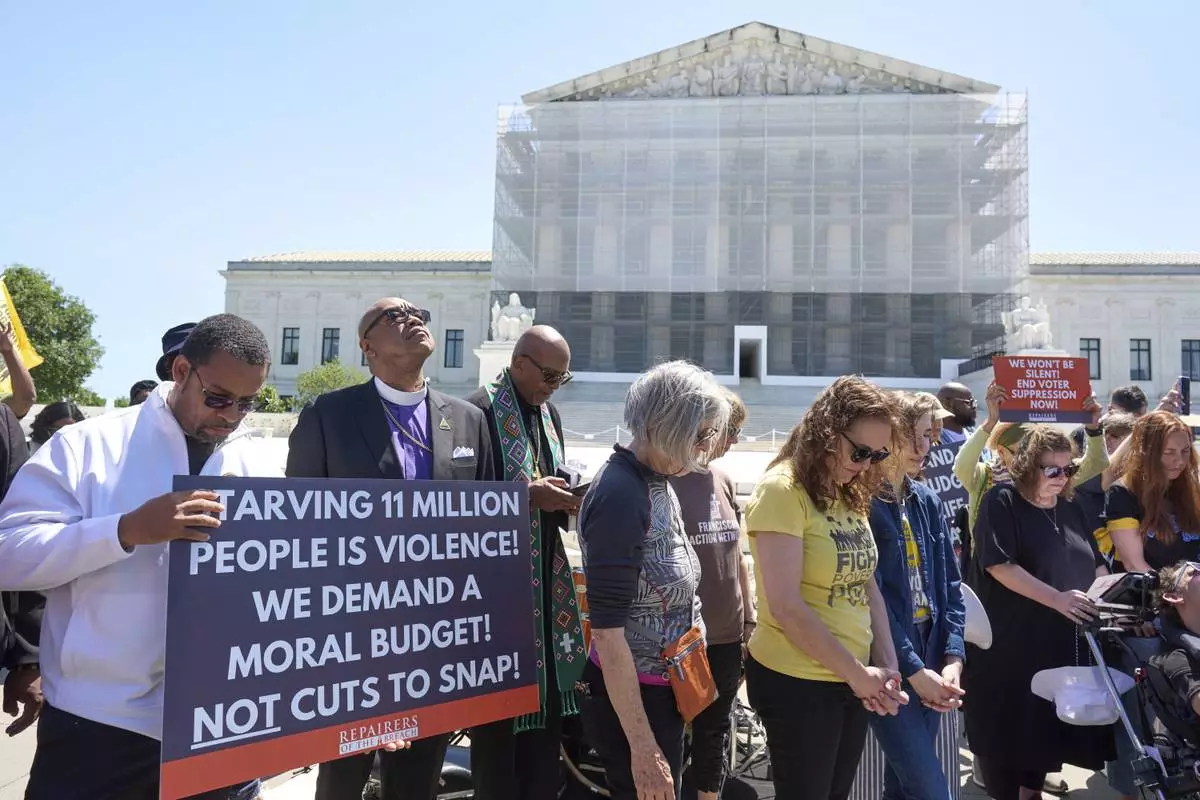
Activists with the Poor People's Campaign protest against spending reductions across Medicaid, food stamps and federal aid in President Donald Trump's spending and tax bill being worked on by Senate Republicans this week, outside the Supreme Court in Washington, Monday, June 2, 2025. (AP Photo/J. Scott Applewhite)
Activists with the Poor People's Campaign protest against spending reductions across Medicaid, food stamps and federal aid in President Donald Trump's spending and tax bill being worked on by Senate Republicans this week, outside the Supreme Court in Washington, Monday, June 2, 2025. (AP Photo/J. Scott Applewhite)

NEW YORK (AP) — Thousands of nurses in three hospital systems in New York City went on strike Monday after negotiations through the weekend failed to yield breakthroughs in their contract disputes.

The strike was taking place at The Mount Sinai Hospital and two of its satellite campuses, with picket lines forming. The other affected hospitals are NewYork-Presbyterian and Montefiore Medical Center in the Bronx.

About 15,000 nurses are involved in the strike, according to New York State Nurses Association.

The strike, which comes during a severe flu season, could potentially force the hospitals to transfer patients, cancel procedures or divert ambulances. It could also put a strain on city hospitals not involved in the contract dispute, as patients avoid the medical centers hit by the strike.

The hospitals involved have been hiring temporary nurses to try and fill the labor gap during the walkout, and said in a statement during negotiations that they would “do whatever is necessary to minimize disruptions.” Montefiore posted a message assuring patients that appointments would be kept.

The work stoppage is occurring at multiple hospitals simultaneously, but each medical center is negotiating with the union independently. Several other hospitals across the city and in its suburbs reached deals in recent days to avert a possible strike.

The nurses’ demands vary by hospital, but the major issues include staffing levels and workplace safety. The union says hospitals have given nurses unmanageable workloads.

Nurses also want better security measures in the workplace, citing incidents like a an incident last week, when a man with a sharp object barricaded himself in a Brooklyn hospital room and was then killed by police.

The union also wants limitations on hospitals’ use of artificial intelligence.

The nonprofit hospitals involved in the negotiations say they’ve been working to improve staffing levels, but say the union’s demands overall are too costly.

Nurses voted to authorize the strike last month.

Both New York Gov. Kathy Hochul and Mayor Zohran Mamdani had expressed concern about the possibility of the strike. As the strike deadline neared, Mamdani urged both sides to keep negotiating and reach a deal that “both honors our nurses and keeps our hospitals open.”

“Our nurses kept this city alive through its hardest moments. Their value is not negotiable,” Mamdani said.

The last major nursing strike in the city was only three years ago, in 2023. That work stoppage, at Mount Sinai and Montefiore, was short, lasting three days. It resulted in a deal raising pay 19% over three years at those hospitals.

It also led to promised staffing improvements, though the union and hospitals now disagree about how much progress has been made, or whether the hospitals are retreating from staffing guarantees.

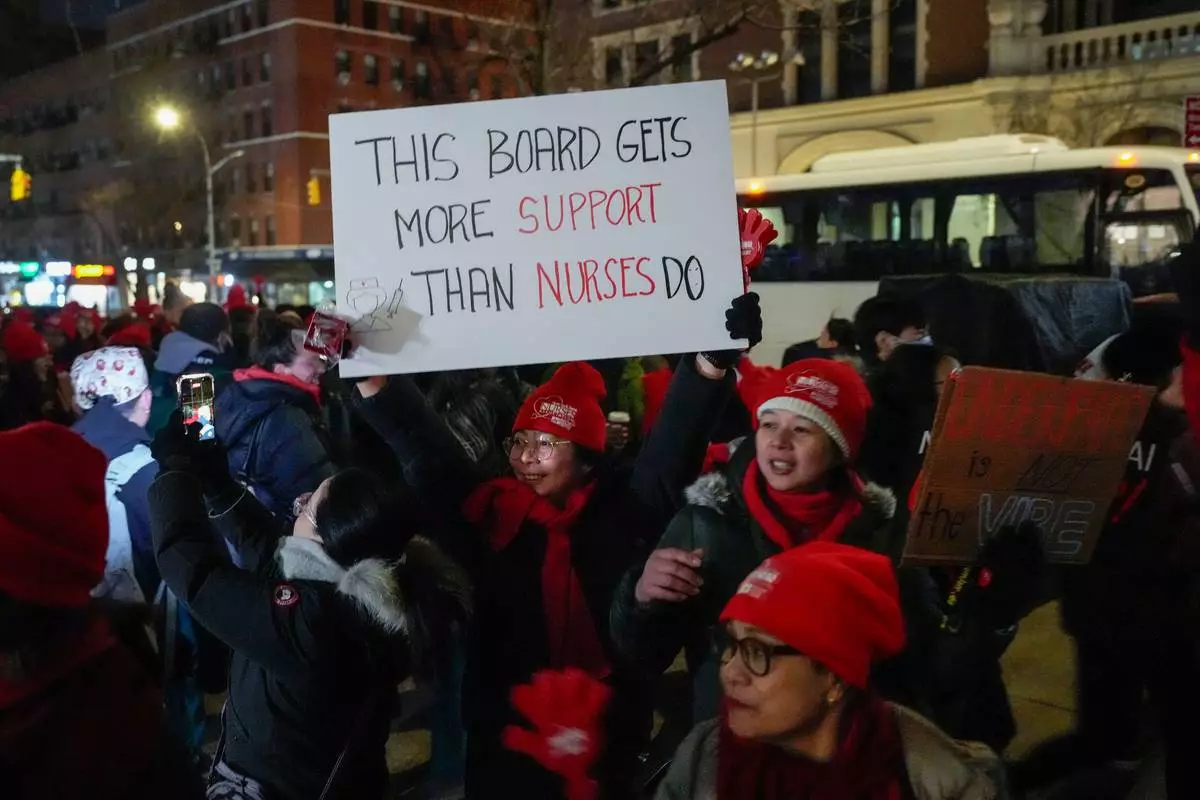
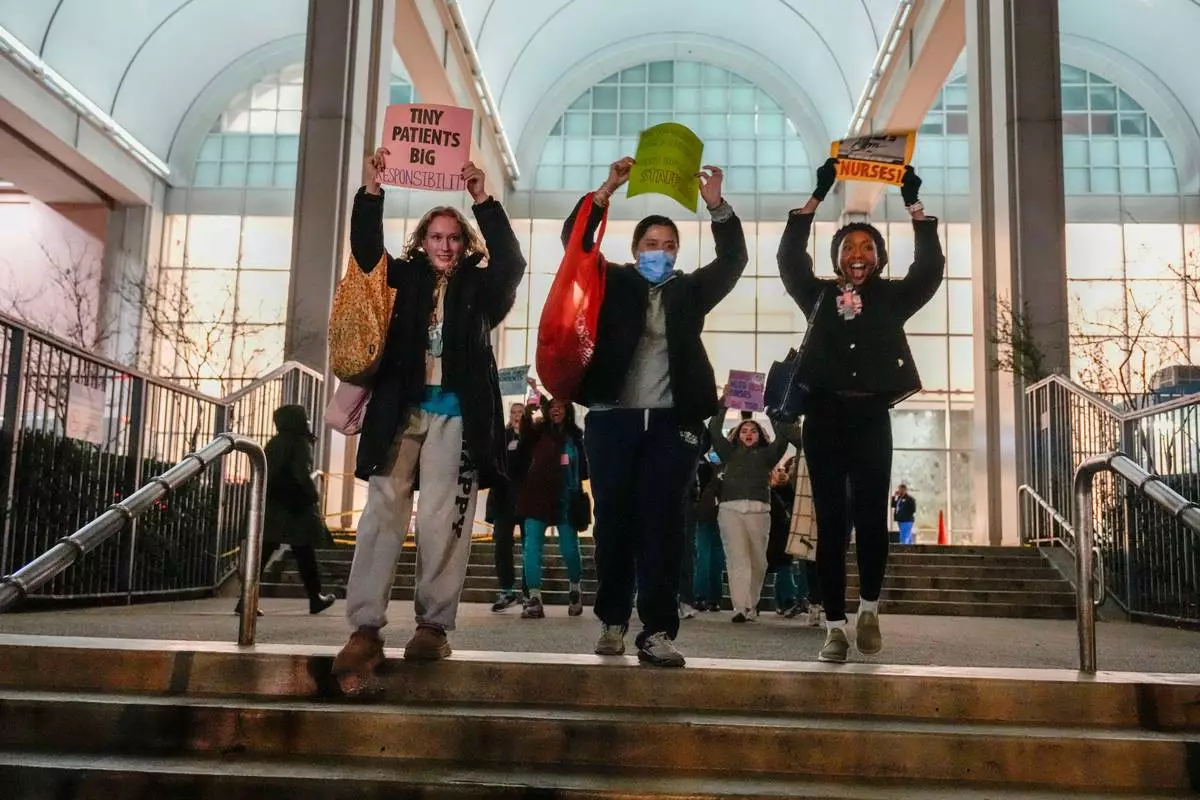
Nurses strike outside Mount Sinai West Hospital, Monday, Jan. 12, 2026, in New York. (AP Photo/Yuki Iwamura)

Nurses strike outside Mount Sinai West Hospital, Monday, Jan. 12, 2026, in New York. (AP Photo/Yuki Iwamura)

Nurses strike outside Mount Sinai West Hospital, Monday, Jan. 12, 2026, in New York. (AP Photo/Yuki Iwamura)

Nurses strike outside Mount Sinai West Hospital, Monday, Jan. 12, 2026, in New York. (AP Photo/Yuki Iwamura)

Nurses strike outside Mount Sinai West Hospital, Monday, Jan. 12, 2026, in New York. (AP Photo/Yuki Iwamura)

Nurses strike outside Mount Sinai West Hospital, Monday, Jan. 12, 2026, in New York. (AP Photo/Yuki Iwamura)

Nurses strike outside Mount Sinai West Hospital, Monday, Jan. 12, 2026, in New York. (AP Photo/Yuki Iwamura)

Nurses strike outside Mount Sinai West Hospital, Monday, Jan. 12, 2026, in New York. (AP Photo/Yuki Iwamura)

FILE - A medical worker transports a patient at Mount Sinai Hospital, April 1, 2020, in New York. (AP Photo/Mary Altaffer, File)

FILE - A medical worker transports a patient at Mount Sinai Hospital, April 1, 2020, in New York. (AP Photo/Mary Altaffer, File)

Recommended Articles