China's latest economic data highlights resilient growth, industrial upgrades, and strong domestic demand in a complex and challenging external environment with many uncertainties, a China Media Group commentary in Chinese said on Friday.
A translation of the commentary follows:
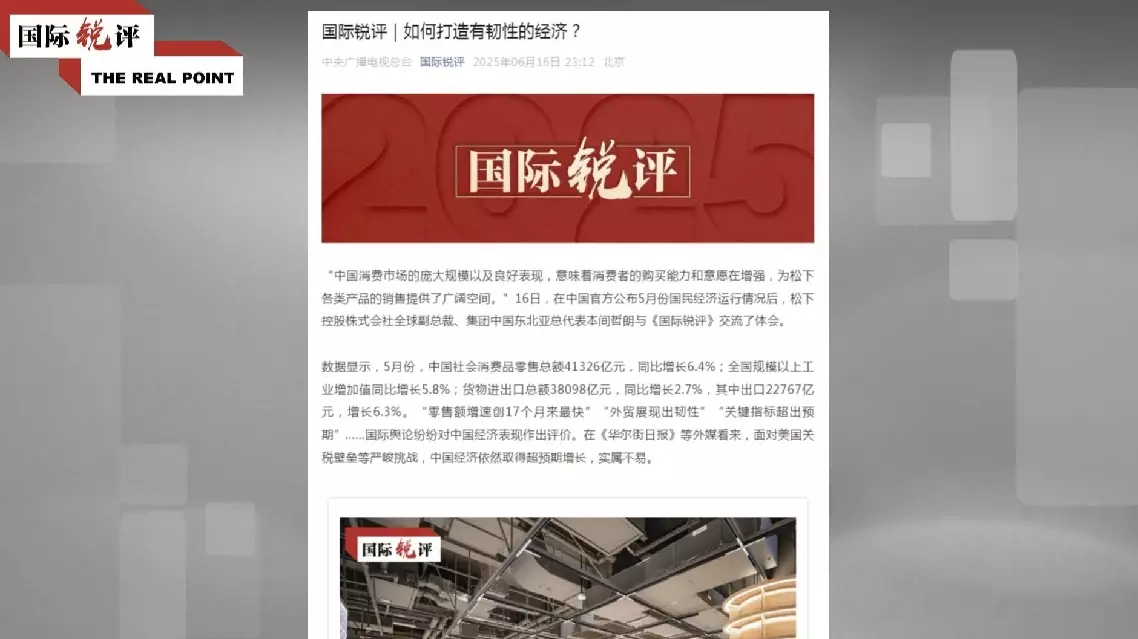
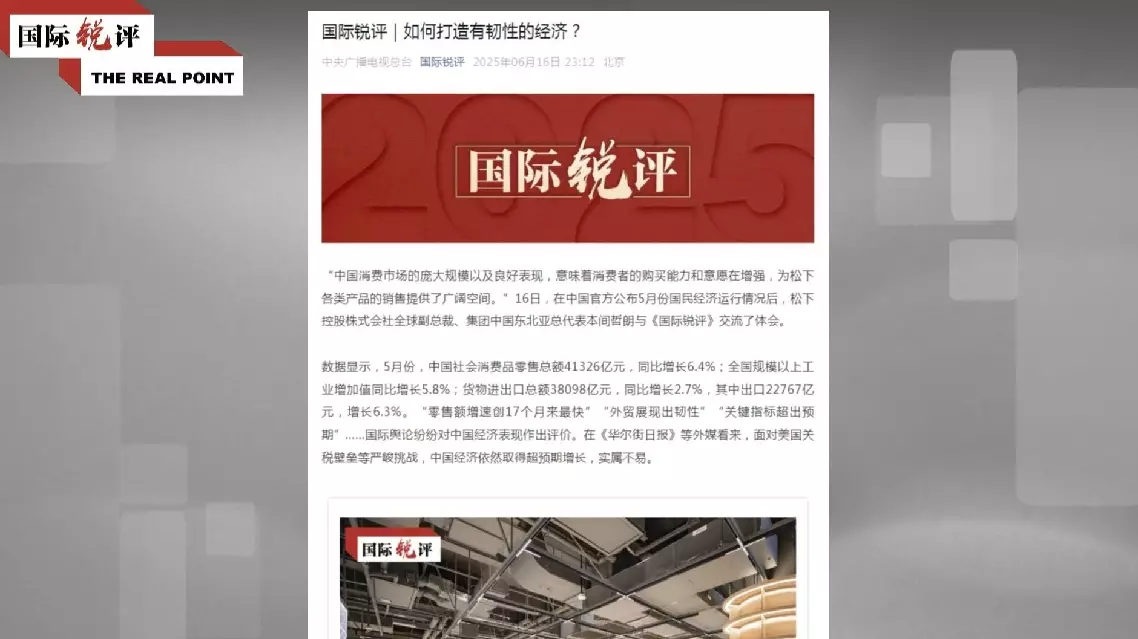
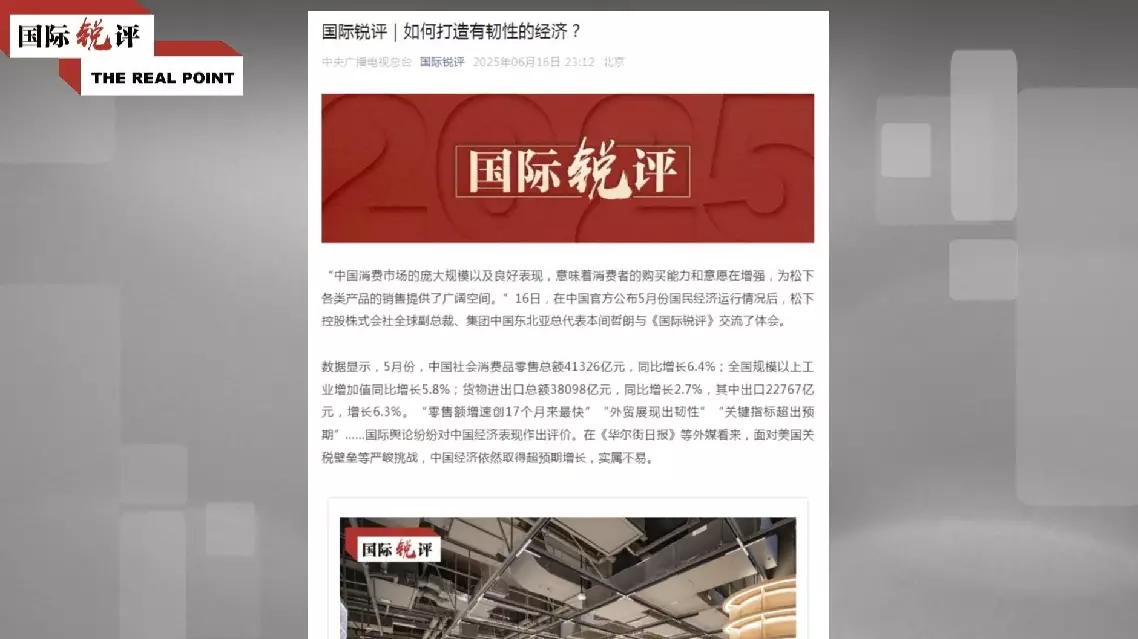
On Monday, following the release of China's national economic performance data for May, Tetsuro Homma, global executive vice president of Panasonic Holdings Corporation and regional head for China and Northeast Asia, said that the large scale and strong performance of China's consumer market suggested an increase in both purchasing power and willingness among consumers, which in turn had created broad opportunities for the sales of Panasonic's various products.
According to the data, in May, China's total retail sales of consumer goods reached 4.1326 trillion yuan (580 billion U.S. dollars), a year-on-year increase of 6.4 percent. The value-added of industrial enterprises above the designated size grew by 5.8 percent year on year. Total imports and exports of goods reached 3.8098 trillion yuan, up 2.7 percent, of which exports amounted to 2.2767 trillion yuan, representing a 6.3 percent increase.
Headlines such as "Retail Growth Hits 17-Month High," "Foreign Trade Shows Resilience," and "Key Indicators Exceed Expectations" have prompted wide recognition from international media. Outlets like The Wall Street Journal noted the significance of China's better-than-expected economic growth amid severe external challenges such as U.S. tariff barriers.
A closer look at this "report card" reveals several highlights in China's economic performance.
First and foremost is "stability." The stability of a national economy is gauged not only by changes in production and demand indicators but also by employment and pricing levels. From the key indicators, China's Index of Services Production and total retail sales of consumer goods grew by 5.9 percent and 5 percent year on year, respectively, from January to May, both showing an acceleration compared to the first quarter. Meanwhile, the value-added of industrial enterprises above the designated size achieved a relatively rapid growth of 6.3 percent.
In May, the nationwide surveyed urban unemployment rate was 5 percent, down from the previous month. The core Consumer Price Index (CPI) also rose, indicating a generally stable supply-demand relationship in the market. These elements collectively reflect the overall stable operation of China's economy.
Meanwhile, innovation plays a key role, and characteristics of high-quality development are increasingly evident. In May, the value-added of equipment manufacturing above the designated size increased by 9 percent and contributed 54.3 percent to overall industrial growth. Production of new energy vehicles and solar cells rose by 31.7 percent and 27.8 percent, respectively, continuing their momentum of rapid growth. The expansion of sectors such as high-end manufacturing, the digital economy, and renewable energy is injecting new vitality into the country's industrial restructuring and upgrading.
Notably, in May, China's foreign trade withstood pressure and continued to grow, once again demonstrating the resilience of its economy. In terms of trade partners, although trade with the U.S. declined somewhat, trade with ASEAN countries and Belt and Road partner nations maintained growth. As for exports, from January to May, electromechanical products with higher technical content emerged as a major driver, growing by 9.3 percent, with integrated circuit exports up by 18.9 percent. Imports of tech-intensive products also increased, with electromechanical products rising by 6 percent and imports of automatic data processing equipment and integrated circuits growing by 69 percent and 7.3 percent, respectively. These trends reflect the domestic demand prompted by China’s economic transformation and upgrading, and confirm that the vast Chinese market remains a significant opportunity for the world.
Viewed against the backdrop of the current international landscape, China's economic stability has not come easily. Amid rising unilateralism and protectionism, major economic organizations have downgraded forecasts for global growth in 2025. Yet China has achieved notable economic results. Why?
Wang Xiaosong, a professor at Renmin University of China, said that, externally, the China-U.S. economic and trade talks in Geneva in May made substantive progress and reached key consensus points, improving bilateral trade relations and benefiting the global economy. Internally, China's economic fundamentals are sound, featuring a vast market and huge potential. When external demand contracts, domestic consumption can be tapped through measures like shifting from exports to the domestic market. In addition, as China's technological capabilities continue to strengthen, and various industries accelerate transformation and upgrading, its comprehensive competitiveness is continuously improving, supporting the high-quality development of China's economy.
Policy factors have also played an important role. Since September 2024, the Chinese government has implemented a series of macroeconomic policies aimed at stabilizing growth. This year's initiatives, such as boosting consumption, accelerating the implementation of major national strategies and building up security capacity in key areas, as well as promoting a new round of large-scale equipment upgrades and consumer goods trade-in programs, have effectively expanded domestic demand, increased production, and released economic vitality. These actions underpin China's confidence and strength in overcoming risks and challenges.
China's stable economic performance amid pressure is a positive development for the global community. He Jun, executive vice president of KSB Group for North Asia, a leading global manufacturer of industrial valves and pumps, said that China's push to develop new quality productive forces, especially in green technology innovation, has provided new opportunities for cooperation. In 2023, KSB Shanghai was designated as a regional headquarters, and from January to May this year, the company's sales volume and orders increased by 7 percent and 8 percent year on year, respectively, he said.
Likewise, Tetsuro noted that Panasonic has launched 19 new investment and construction projects in China since 2020. In July, Panasonic will open a new electronic materials factory in Shanghai’s Fengxian District and, at the same time, engage in investments related to clean energy, mobility technology, and innovative consumption in cooperation with Chinese fund firms. A representative from Nestle shared that the company has invested over six billion yuan in China since 2020. Over 90 percent of products sold in the country are produced locally.
The recent progress made during the inaugural meeting of the China-U.S. trade consultation mechanism has injected greater stability and certainty into the global economy. However, one must also acknowledge that China still faces a complex and challenging external environment with many uncertainties. In the face of such difficulties, China will unswervingly manage its own affairs, relying on the certainties provided by high-quality development to navigate a world full of uncertainties, offering more opportunities and dividends to the world through "China’s contribution."
China’s economy shows resilience amid global challenges: commentary
China’s economy shows resilience amid global challenges: commentary
China’s economy shows resilience amid global challenges: commentary