Skip to Content Facebook Feature Image

2026 Nissan LEAF: How designers turned the iconic EV into a sleek, air-cheating crossover

News

2026 Nissan LEAF: How designers turned the iconic EV into a sleek, air-cheating crossover
News

News

2026 Nissan LEAF: How designers turned the iconic EV into a sleek, air-cheating crossover

2025-06-18 00:59 Last Updated At:01:11

NASHVILLE, Tenn.--(BUSINESS WIRE)--Jun 17, 2025--

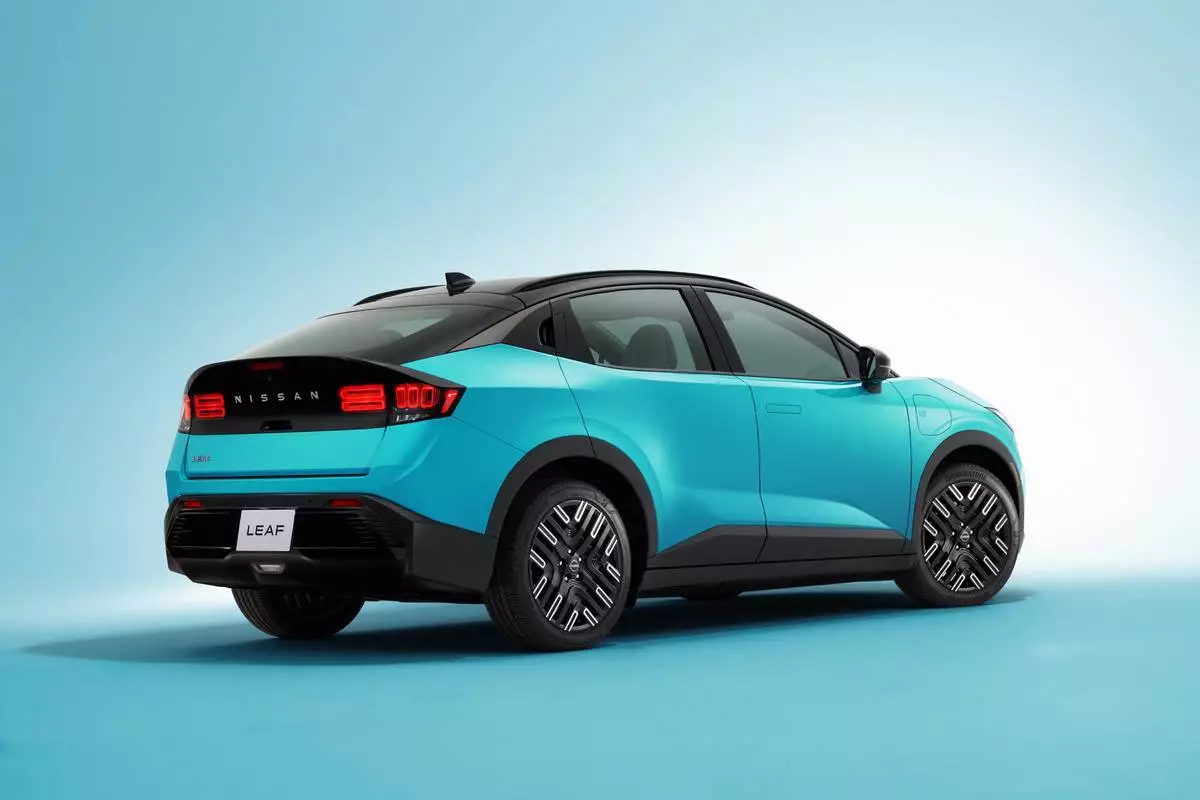
The all-new 2026 Nissan LEAF 1 is the boldest iteration yet of the brand’s pioneering electric vehicle (EV). Designers transformed the hatchback into a crossover featuring a bold new face, muscular fenders and wheels pushed toward the corners of the chassis. And thanks to precise adjustments and attention to detail, the third-generation LEAF has a remarkably low drag coefficient of just 0.26.

This press release features multimedia. View the full release here: https://www.businesswire.com/news/home/20250617958565/en/

Giovanny Arroba, vice president of Nissan Design Europe, led the project. From the beginning, he encouraged the design team to lean into their creativity and embrace Nissan’s Japanese heritage.

“We wanted the team to truly explore and rev their imagination,” he said.

An electrifying legacy

LEAF was the first mass-market, fully electric vehicle when it debuted in 2009. In the 16 years since, more than half a million have been sold globally 2.

“LEAF is quite special,” Arroba said. “The design philosophy for the new LEAF really is keeping a spirit of timeless Japanese futurism and bringing impactful, striking design as we reimagine it as a crossover for the next generation.”

The most noticeable change is LEAF’s crossover proportions. Designers pushed the wheels closer to the corners, raised its stance and shortened the front overhang. Combined, they present a message of sportiness and capability.

“It has a much more agile presence on the road,” Arroba said.

Sleek, striking and seamless

Since EVs do not require a traditional grille, Nissan designers incorporated more of the body color into the front fascia, creating a cohesive look. LED headlights are connected by a thin, continuous light across the front of the vehicle, helping emphasize LEAF’s width.

“The V-motion-like mask integrates all our lighting elements from corner to corner with a rectangle motif that’s echoed in our taillights,” Arroba said.

The new rear is upright and features a high lip spoiler to diffuse air, further aiding aerodynamics.

“When you walk up to the back of the car, you really notice its new proportions, reflecting sleek efficiency while maintaining its functionality as a crossover,” Arroba said.

Designers added subtle details for drivers to discover. Throughout the vehicle, there is a motif of two vertical bars next to three horizontal bars. This alludes to ni and san – Japanese for two and three, respectively – a nod to the brand’s name. The most obvious placement of this motif is the taillights, which feature a 3D, holographic design.

“When you turn on the car, it comes to life in a digitalized, playful, charming manner,” Arroba said.

Throughout the vehicle, designers and engineers maintained a mantra of precision. They ensured panel gaps between doors, windows, the hood and other components were flush and small – creating a more cohesive, high-quality appearance.

This attention to seamless quality contributed to LEAF’s excellent aerodynamics, alongside flush retractable door handles, hidden rear door handles and plenty of time in the wind tunnel.

“The silhouette is shaped by science. That’s what gives us the low drag coefficient, especially for a crossover,” Arroba said.

New modern, airy interior

Stepping inside the 2026 LEAF, passengers will be greeted by an immediate sense of airiness and space.

“Being an electrified platform with a flat floor, we’re able to carve out a lot more space than a traditional car, and we want to really show it off,” Arroba said.

Enhancing this feeling is an available dimming panoramic roof – Nissan's first – that can become opaque in an instant. The driver can make several adjustments to make the glass opaque over the front seats, rear seats, both or neither. The LEAF nameplate is included in the opaque design.

“When the sunshine comes through that panoramic roof, it'll create the shadow of the nameplate in the interior of the car,” Arroba explained.

Much like the 2025 Murano, horizontal lines provide a modern, spacious impression. Materials don’t just look premium – they feel upscale as well, with soft-touch surfaces in key touchpoints.

“We wanted less hard plastics and more soft wrapping, but with a sense of vibrancy. Even the darker interior has a little bit of flake in it, bringing a little bit of shine and color – especially when the sun hits it,” Arroba said. “The surfaces are alive.”

The LEAF embraces the latest technology without overwhelming its occupants. Available dual 14.3-inch screens are smoothly integrated into the dashboard and feature new graphics that can gradually change with the time of day.

“You step in and you feel the morning environment through the color and the background,” Arroba said. “As it goes through midday, evening and night, those colors change.”

Nissan designers took a deliberate, thoughtful approach in creating the latest LEAF. While its new look is a departure from the outgoing model, it embodies the spirit of the original LEAF – and maintains its status as an EV icon.

“What makes LEAF special is its pioneering spirit,” Arroba said. “That lives on in this new design. We’re very proud of it, and I can’t wait to see it on the road.”

About Nissan USA Stories

The Nissan USA Stories page explores the best of Nissan’s people, products, technology and more. New to the page? Subscribe here to receive alerts when a new story is published.

1 2026 LEAF not yet available for purchase. Expected availability fall 2025. Pre-production model shown. Actual production model may vary.

2 Based on Global Nissan LEAF sales numbers since 2010.
The all-new 2026 Nissan LEAF is the boldest iteration yet of the brand’s pioneering electric vehicle (EV). Designers transformed the hatchback into a crossover featuring a bold new face, muscular fenders and wheels pushed toward the corners of the chassis. And thanks to precise adjustments and attention to detail, the third-generation LEAF has a remarkably low drag coefficient of just 0.26. Giovanny Arroba, vice president of Nissan Design Europe, led the project. From the beginning, he encouraged the design team to lean into their creativity and embrace Nissan’s Japanese heritage.

The all-new 2026 Nissan LEAF is the boldest iteration yet of the brand’s pioneering electric vehicle (EV). Designers transformed the hatchback into a crossover featuring a bold new face, muscular fenders and wheels pushed toward the corners of the chassis. And thanks to precise adjustments and attention to detail, the third-generation LEAF has a remarkably low drag coefficient of just 0.26. Giovanny Arroba, vice president of Nissan Design Europe, led the project. From the beginning, he encouraged the design team to lean into their creativity and embrace Nissan’s Japanese heritage.
RHO, Italy (AP) — No ice is colder and harder than speedskating ice. The precision it takes has meant that Olympic speedskaters have never competed for gold on a temporary indoor rink – until the 2026 Milan Cortina Winter Games.

In the pursuit of maximum glide and minimum friction, Olympic officials brought on ice master Mark Messer, a veteran of six previous Olympic speedskating tracks and the ice technician in charge of the Olympic Oval in Calgary, Canada — one of the fastest tracks in the world with over 300 records.

Messer has been putting that experience to work one thin layer of ice at a time since the end of October at the new Speed Skating Stadium, built inside adjacent trade fair halls in the city of Rho just north of Milan.

“It’s one of the biggest challenges I’ve had in icemaking,’’ Messer said during an interview less than two weeks into the process.

If Goldilocks were a speedskater, hockey ice would be medium hard, for fast puck movement and sharp turns. Figure skating ice would be softer, allowing push off for jumps and so the ice doesn’t shatter on landing. Curling ice is the softest and warmest of all, for controlled sliding.

For speedskating ice to be just right, it must be hard, cold and clean. And very, very smooth.

“The blades are so sharp, that if there is some dirt, the blade will lose the edge,’’ Messer said, and the skater will lose speed.

Speedskater Enrico Fabris, who won two Olympic golds in Turin in 2006, has traded in his skates to be deputy sports manager at the speedskating venue in Rho. For him, perfect ice means the conditions are the same for all skaters — and then if it's fast ice, so much the better.

"It's more of a pleasure to skate on this ice,'' he said.

Messer’s first Olympics were in Calgary in 1988 — the first time speedskating was held indoors. “That gave us some advantages because we didn’t have to worry about the weather, wind blowing or rain,’’ he said. Now he is upping the challenge by becoming the first ice master to build a temporary rink for the Olympics.

Before Messer arrived in Italy, workers spent weeks setting up insulation to level the floor and then a network of pipes and rubber tubes that carry glycol — an antifreeze — that is brought down to minus 7 or minus 8 degrees Celsius (17.6 to 19.4 degrees Fahrenheit) to make the ice.

Water is run through a purification system — but it can’t be too pure, or the ice that forms will be too brittle. Just the right amount of impurities “holds the ice together,’’ Messer said.

The first layers of water are applied slowly, with a spray nozzle; after the ice reaches a few centimeters it is painted white — a full day’s work — and the stripes are added to make lanes.

“The first one takes about 45 minutes. And then as soon as it freezes, we go back and do it again, and again and again. So we do it hundreds of times,’’ Messer said.

As the ice gets thicker, and is more stable, workers apply subsequent layers of water with hoses. Messer attaches his hose to hockey sticks for easier spreading.

What must absolutely be avoided is dirt, dust or frost — all of which can cause friction for the skaters, slowing them down. The goal is that when the skaters push “they can go as far as possible with the least amount of effort,’’ Messer said.

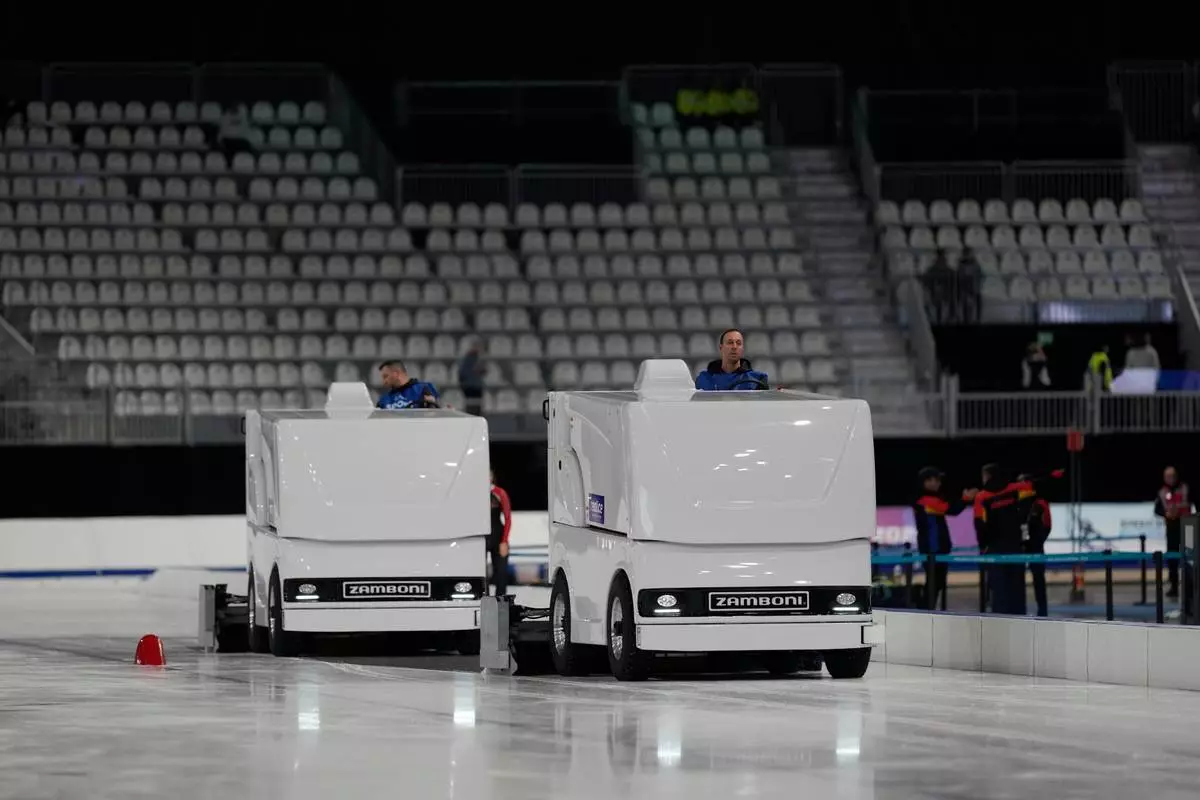
The Zamboni ice resurfacing machine plays a key role in keeping the track clean, cutting off a layer and spraying water to make a new surface.

One challenge is gauging how quickly the water from the resurfacing machine freezes in the temporary rink.

Another is getting the ice to the right thickness so that the Zamboni, weighing in at six tons, doesn’t shift the insulation, rubber tubing or ice itself.

“When you drive that out, if there’s anything moving it will move. We don’t want that,’’ Messer said.

The rink got its first big test on Nov. 29-30 during a Junior World Cup event. In a permanent rink, test events are usually held a year before the Olympics, leaving more time for adjustments. “We have a very small window to learn,’’ Messer acknowledged.

Dutch speedskater Kayo Vos, who won the men’s neo-senior 1,000 meters, said the ice was a little soft — but Messer didn’t seem too concerned.

“We went very modest to start, now we can start to change the temperatures and try to make it faster and still maintain it as a safe ice,’’ he said.

Fine-tuning the air temperature and humidity and ice temperature must be done methodically — taking into account that there will be 6,000 spectators in the venue for each event. The next real test will be on Jan. 31, when the Olympians take to the ice for their first training session.

“Eighty percent of the work is done but the hardest part is the last 20 percent, where we have to try to find the values and the way of running the equipment so all the skaters get the same conditions and all the skaters get the best conditions,’’ Messer said.

AP Winter Olympics: https://apnews.com/hub/milan-cortina-2026-winter-olympics

Serpentines are set on the ice of the stadium where speed skating discipline of the Milan Cortina 2026 Winter Olympics will take place, in Rho, outskirt of Milan, Tuesday, Nov. 11, 2025. (AP Photo/Luca Bruno)

Serpentines are set on the ice of the stadium where speed skating discipline of the Milan Cortina 2026 Winter Olympics will take place, in Rho, outskirt of Milan, Tuesday, Nov. 11, 2025. (AP Photo/Luca Bruno)

Ice Master Mark Messer poses in the stadium where speed skating discipline of the Milan Cortina 2026 Winter Olympics will take place, in Rho, outskirt of Milan, Tuesday, Nov. 11, 2025. (AP Photo/Luca Bruno)

Ice Master Mark Messer poses in the stadium where speed skating discipline of the Milan Cortina 2026 Winter Olympics will take place, in Rho, outskirt of Milan, Tuesday, Nov. 11, 2025. (AP Photo/Luca Bruno)

Workers clean the ice surface during a peed skating Junior World Cup and Olympic test event, in Rho, near Milan, Italy, Saturday, Nov. 29, 2025. (AP Photo/Luca Bruno)

Workers clean the ice surface during a peed skating Junior World Cup and Olympic test event, in Rho, near Milan, Italy, Saturday, Nov. 29, 2025. (AP Photo/Luca Bruno)

Ice Master Mark Messer poses in the stadium where speed skating discipline of the Milan Cortina 2026 Winter Olympics will take place, in Rho, outskirt of Milan, Tuesday, Nov. 11, 2025. (AP Photo/Luca Bruno)

Ice Master Mark Messer poses in the stadium where speed skating discipline of the Milan Cortina 2026 Winter Olympics will take place, in Rho, outskirt of Milan, Tuesday, Nov. 11, 2025. (AP Photo/Luca Bruno)

Ice Master Mark Messer poses in the stadium where speed skating discipline of the Milan Cortina 2026 Winter Olympics will take place, in Rho, outskirt of Milan, Tuesday, Nov. 11, 2025. (AP Photo/Luca Bruno)

Ice Master Mark Messer poses in the stadium where speed skating discipline of the Milan Cortina 2026 Winter Olympics will take place, in Rho, outskirt of Milan, Tuesday, Nov. 11, 2025. (AP Photo/Luca Bruno)

Recommended Articles