ATLANTA (AP) — A former Fulton County jail guard has been indicted on federal civil rights charges after prosecutors said she used her Taser abusively against three inmates and then lied to cover it up.
Khadijah Solomon, a 47-year-old Fairburn resident, pleaded not guilty to the six-count indictment in federal court in Atlanta on Tuesday and was released on bail. The troubled jail where Solomon worked has been under a federal civil rights investigation for the past two years and was also the site where Donald Trump surrendered on election interference charges in 2023.
Solomon's lawyer, Devin Rafus, said his client will fight the allegations.
“The Fulton County Sheriff’s Office is under a lot of political pressure with the Department of Justice investigating the jail,” Rafus said via email. “My client is collateral damage of that pressure.”
The June 11 indictment said Solomon used her Taser “without legal justification" against separate inmates at the Atlanta jail on Jan. 16, Jan. 25 and Jan. 27. The indictment alleges that Solomon then wrote reports falsely justifying what she did.
In reality, sheriff's office investigators said body-worn camera video showed the pretrial detainees were compliant and not resisting.
In the Jan. 16 incident, sheriff's office investigators said Solomon approached an inmate who was kicking his cell door and said she was about to “pop” him before opening the cell and using the Taser on the inmate. Investigators said Solomon then stunned the inmate twice more. She later claimed in her report that the inmate “was getting ready to throw” a tray at her.
The sheriff's office in February announced that it had fired Solomon and two other jail officers — Chantrece Buggs and LaQuondria Pierce — arrested them, and charged them with state crimes including aggravated assault and violating their oath of office. Solomon, a jail sergeant, was also charged with cruelty to inmates and false statements or writings.
At the time, investigators said Pierce used her Taser without justification on an inmate Feb. 13 and Buggs encouraged Solomon's violence. No federal charges against the other two were announced, and neither has yet been indicted in a state court.
Rafus, who is also the lawyer representing Pierce, did not immediately respond to an email seeking comment on her state charges.
Natalie Ammons, a spokesperson for Fulton County Sheriff Pat Labat, said the sheriff's office had worked with the FBI in the Solomon case.
“On three occasions, Khadijah Solomon allegedly tased Fulton County Jail detainees without a legitimate purpose, causing each of them pain and injury," U.S. Attorney Theodore S. Hertzberg said in a statement. "Abuses of power of this kind are unconstitutional, erode our community’s trust, and will be prosecuted.”
The U.S. Justice Department in July 2023 opened a civil rights investigation into jail conditions in Fulton County, citing violence, filthy living quarters and the in-custody death of a man whose body was found covered in insects. That investigation found that jail officers didn't receive adequate training and guidance on the use of force and were found to engage in “a pattern or practice of using excessive force” against people in county custody.
The Justice Department and Fulton County officials announced in January that they had entered into a court-enforceable consent decree. An independent monitor was appointed in February to oversee that agreement.
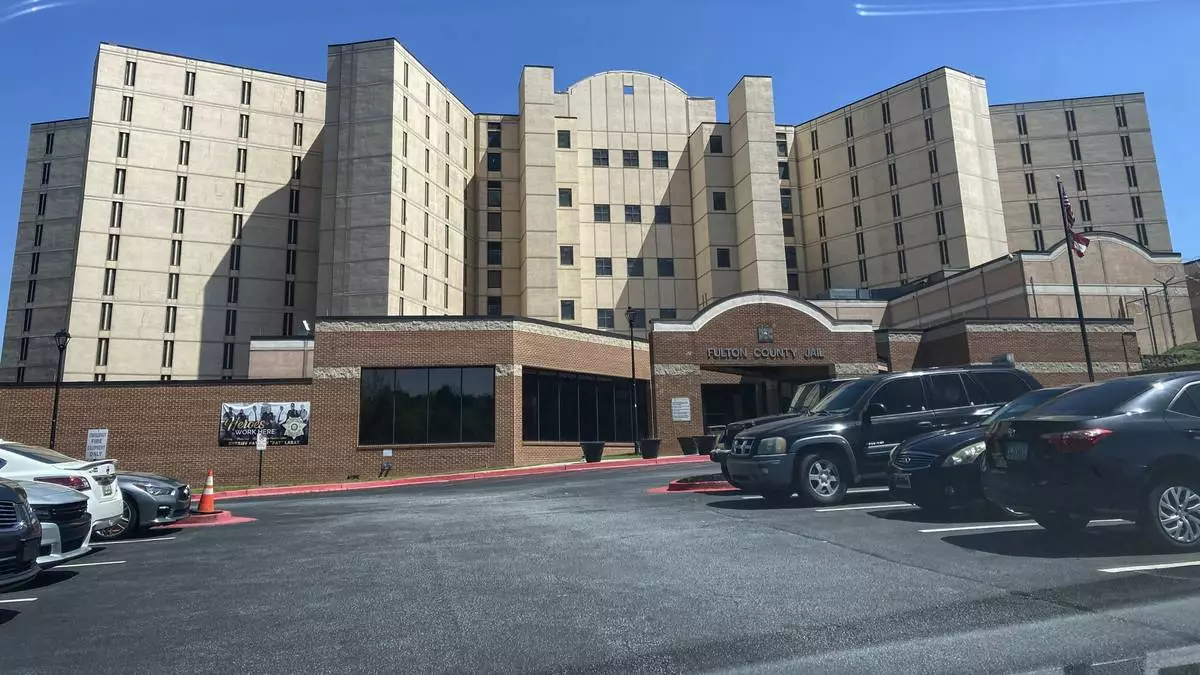
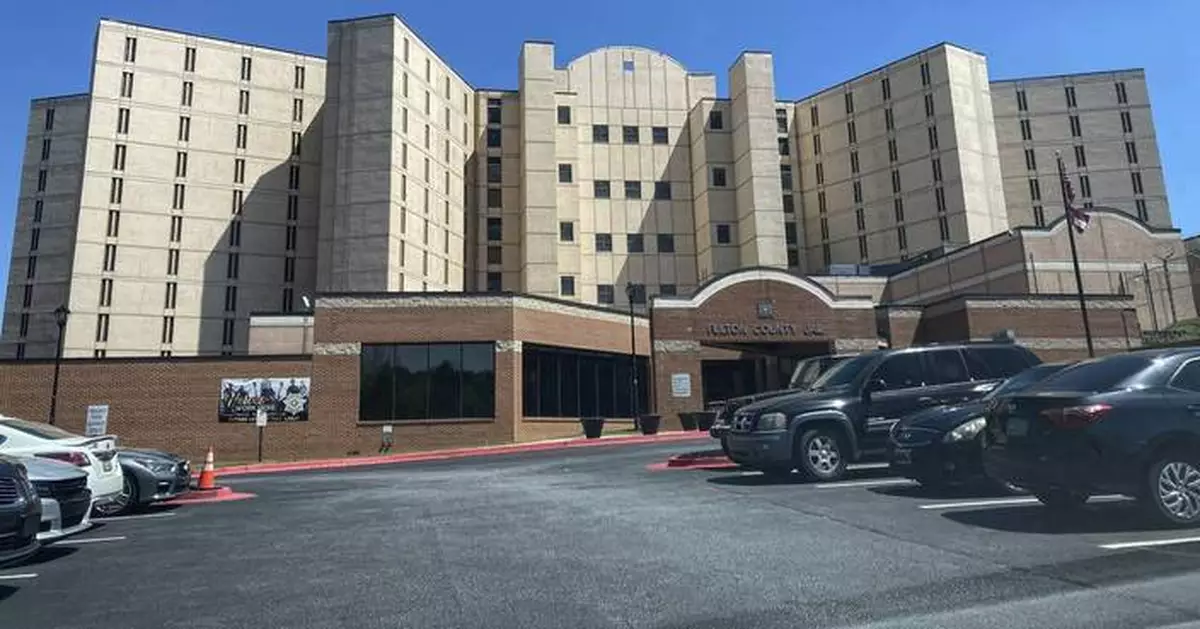
FILE - Vehicles are parked outside the Fulton County Jail, April 11, 2023, in Atlanta. (AP Photo/Kate Brumback, File)
RHO, Italy (AP) — No ice is colder and harder than speedskating ice. The precision it takes has meant that Olympic speedskaters have never competed for gold on a temporary indoor rink – until the 2026 Milan Cortina Winter Games.
In the pursuit of maximum glide and minimum friction, Olympic officials brought on ice master Mark Messer, a veteran of six previous Olympic speedskating tracks and the ice technician in charge of the Olympic Oval in Calgary, Canada — one of the fastest tracks in the world with over 300 records.
Messer has been putting that experience to work one thin layer of ice at a time since the end of October at the new Speed Skating Stadium, built inside adjacent trade fair halls in the city of Rho just north of Milan.
“It’s one of the biggest challenges I’ve had in icemaking,’’ Messer said during an interview less than two weeks into the process.
If Goldilocks were a speedskater, hockey ice would be medium hard, for fast puck movement and sharp turns. Figure skating ice would be softer, allowing push off for jumps and so the ice doesn’t shatter on landing. Curling ice is the softest and warmest of all, for controlled sliding.
For speedskating ice to be just right, it must be hard, cold and clean. And very, very smooth.
“The blades are so sharp, that if there is some dirt, the blade will lose the edge,’’ Messer said, and the skater will lose speed.
Speedskater Enrico Fabris, who won two Olympic golds in Turin in 2006, has traded in his skates to be deputy sports manager at the speedskating venue in Rho. For him, perfect ice means the conditions are the same for all skaters — and then if it's fast ice, so much the better.
"It's more of a pleasure to skate on this ice,'' he said.
Messer’s first Olympics were in Calgary in 1988 — the first time speedskating was held indoors. “That gave us some advantages because we didn’t have to worry about the weather, wind blowing or rain,’’ he said. Now he is upping the challenge by becoming the first ice master to build a temporary rink for the Olympics.
Before Messer arrived in Italy, workers spent weeks setting up insulation to level the floor and then a network of pipes and rubber tubes that carry glycol — an antifreeze — that is brought down to minus 7 or minus 8 degrees Celsius (17.6 to 19.4 degrees Fahrenheit) to make the ice.
Water is run through a purification system — but it can’t be too pure, or the ice that forms will be too brittle. Just the right amount of impurities “holds the ice together,’’ Messer said.
The first layers of water are applied slowly, with a spray nozzle; after the ice reaches a few centimeters it is painted white — a full day’s work — and the stripes are added to make lanes.
“The first one takes about 45 minutes. And then as soon as it freezes, we go back and do it again, and again and again. So we do it hundreds of times,’’ Messer said.
As the ice gets thicker, and is more stable, workers apply subsequent layers of water with hoses. Messer attaches his hose to hockey sticks for easier spreading.
What must absolutely be avoided is dirt, dust or frost — all of which can cause friction for the skaters, slowing them down. The goal is that when the skaters push “they can go as far as possible with the least amount of effort,’’ Messer said.
The Zamboni ice resurfacing machine plays a key role in keeping the track clean, cutting off a layer and spraying water to make a new surface.
One challenge is gauging how quickly the water from the resurfacing machine freezes in the temporary rink.
Another is getting the ice to the right thickness so that the Zamboni, weighing in at six tons, doesn’t shift the insulation, rubber tubing or ice itself.
“When you drive that out, if there’s anything moving it will move. We don’t want that,’’ Messer said.
The rink got its first big test on Nov. 29-30 during a Junior World Cup event. In a permanent rink, test events are usually held a year before the Olympics, leaving more time for adjustments. “We have a very small window to learn,’’ Messer acknowledged.
Dutch speedskater Kayo Vos, who won the men’s neo-senior 1,000 meters, said the ice was a little soft — but Messer didn’t seem too concerned.
“We went very modest to start, now we can start to change the temperatures and try to make it faster and still maintain it as a safe ice,’’ he said.
Fine-tuning the air temperature and humidity and ice temperature must be done methodically — taking into account that there will be 6,000 spectators in the venue for each event. The next real test will be on Jan. 31, when the Olympians take to the ice for their first training session.
“Eighty percent of the work is done but the hardest part is the last 20 percent, where we have to try to find the values and the way of running the equipment so all the skaters get the same conditions and all the skaters get the best conditions,’’ Messer said.
AP Winter Olympics: https://apnews.com/hub/milan-cortina-2026-winter-olympics

Serpentines are set on the ice of the stadium where speed skating discipline of the Milan Cortina 2026 Winter Olympics will take place, in Rho, outskirt of Milan, Tuesday, Nov. 11, 2025. (AP Photo/Luca Bruno)

Ice Master Mark Messer poses in the stadium where speed skating discipline of the Milan Cortina 2026 Winter Olympics will take place, in Rho, outskirt of Milan, Tuesday, Nov. 11, 2025. (AP Photo/Luca Bruno)
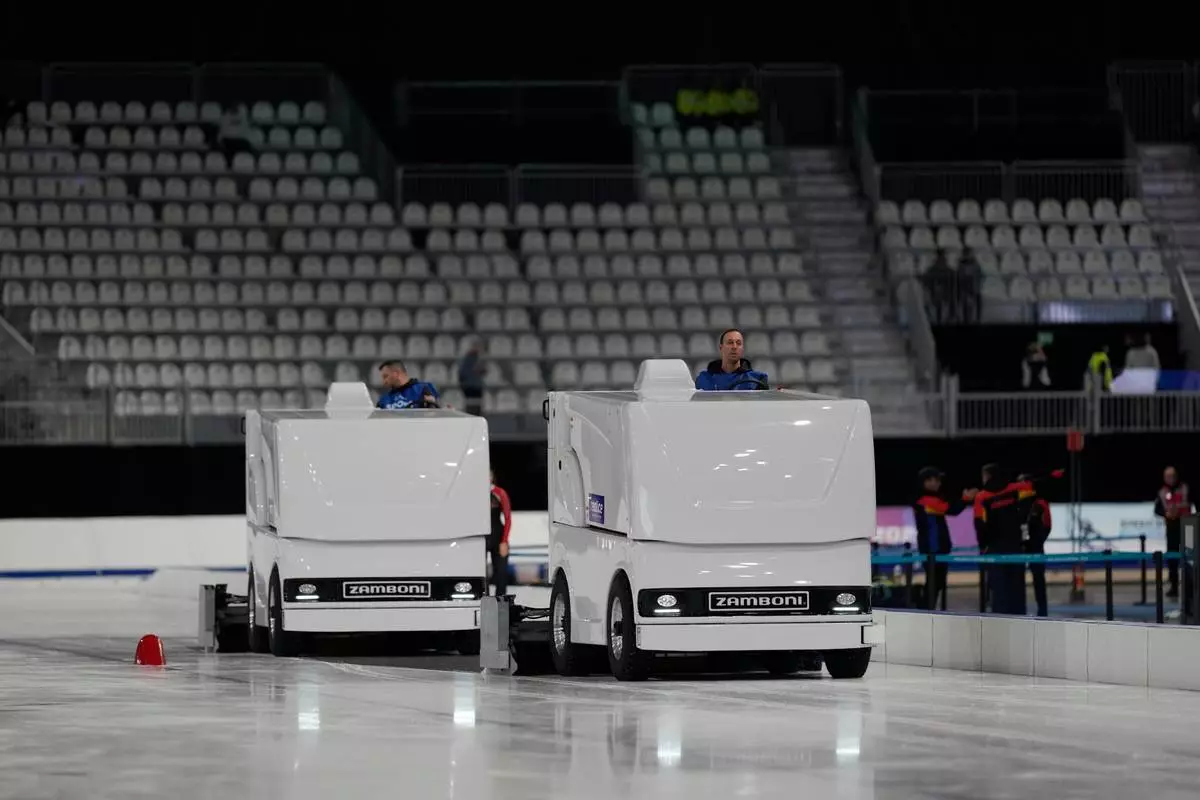
Workers clean the ice surface during a peed skating Junior World Cup and Olympic test event, in Rho, near Milan, Italy, Saturday, Nov. 29, 2025. (AP Photo/Luca Bruno)

Ice Master Mark Messer poses in the stadium where speed skating discipline of the Milan Cortina 2026 Winter Olympics will take place, in Rho, outskirt of Milan, Tuesday, Nov. 11, 2025. (AP Photo/Luca Bruno)

Ice Master Mark Messer poses in the stadium where speed skating discipline of the Milan Cortina 2026 Winter Olympics will take place, in Rho, outskirt of Milan, Tuesday, Nov. 11, 2025. (AP Photo/Luca Bruno)