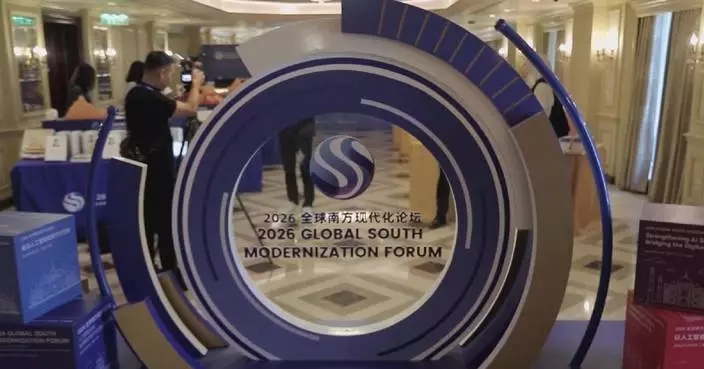
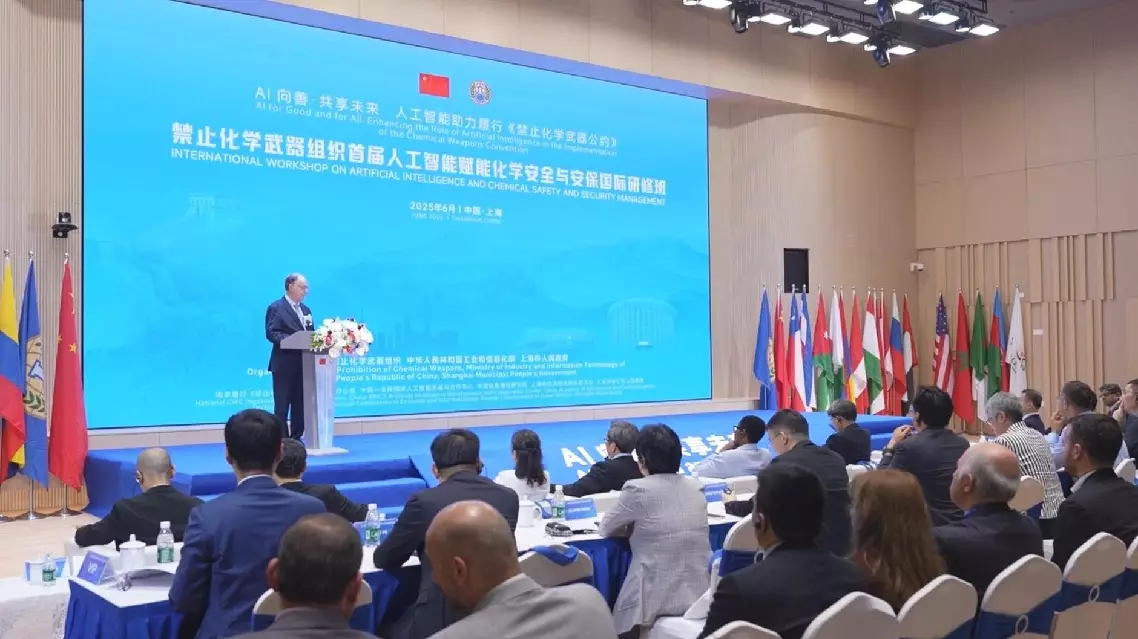
China, in partnership with the Organisation for the Prohibition of Chemical Weapons (OPCW), has launched a workshop in Shanghai to address the dual role of artificial intelligence (AI) in enhancing chemical safety while mitigating its associated risks.
At the First AI and Chemical Safety and Security Management workshop, which began on Tuesday, representatives from OPCW's member states shared insights on the challenges AI poses, both as a tool to strengthen and as a potential threat to global chemical weapons controls.
"The world has become a much more difficult place. There is a lack of understanding between very important countries, and at the same time, chemical weapons nowadays can be generated and used in a more efficient way, in a cheaper way than before. We need this organization more than before to face a task, to work altogethe0r, the 193 states parties, to face the new risks, the new threats that are perfectly defined," said Fernando Arias, director-general of the OPCW.
"We have more than 200 applicants, more than 40 came to Shanghai for this workshop and 80 percent of those participants are from the developing countries. So this active participation is a testament that China's position or policy on AI have been extensive or widely appreciated and supported by the international community," said Tan Jian, Chinese Ambassador to the Netherlands.
A Chinese scholar emphasized at the event that China is actively fostering international collaboration and global governance in AI, supported by a series of tailored policies and regulations.
"We all know that AI has a dual use in the field of the prohibition of chemical weapons. On one hand, it will promote the technology development, but on the other hand it still causes some very serious risks," said Jia Kai, associate professor at School of International and Public Affairs of Shanghai Jiao Tong University.
Fatema Alnaqbi, an IT specialist at the Abu Dhabi Hazardous Materials Center, highlighted the critical role of AI in enhancing detection capabilities.
"Well as you know, the hazardous items are [being] transferred from other countries, so we need to use the AI to detect it in a professional way and a secure way," she said.
During the 4-day workshop, participants will explore the Shanghai Chemical Industry Park and Shanghai University, gaining insights into China's advancements in smart, green chemical industries and the integration of AI in scientific research.
China launches workshop to explore AI's dual role in chemical safety